Archive for the ‘gangs’ Category
Tuesday, June 14th, 2011
“Criminal Insurgency” is becoming a preferred term of art to describe entities like the Narco-cartels of Mexico that have evolved from transnational criminal organizations into groups with paramilitary and intelligence capabilities or Colombia’s FARC which formerly was a model Marxist insurgency but devolved downward into a drug trafficking army. The term is used partly to placate doctrinaire purists among defense intellectuals who see insurgency definitively as armed political movements following Mao’s three stages or bust. After all, they have only had since the late 80’s and early 90’s, when Bill Lind and Martin van Creveld warned them this was coming, to get used to the idea.
Colonel Robert Killebrew, a smart fellow at CNAS, has an article in NDU‘s PRISM that puts the problem of criminal insurgency into a hemispheric context:
Criminal Insurgency in the Americas and Beyond
….Essentially, the United States faces external and internal challenges in reorienting to more effectively fight the cartels and their allies. Refocusing U.S. policy from a “war on drugs” to a more comprehensive fight against the cartels and gangs is essential if the United States and its allies are to prevail. Since the basis of the cartels’ survival lies in the control of regions where governmental control is nonexistent and populations may be impoverished and alienated, successful counter-cartel strategies are fundamentally counterinsurgency strategies developed by the concerned states themselves and supported by the United States. Counter-cartel strategies must first be political strategies, integrating military and police activity into a broader political approach that emphasizes the rule of law as an alternative to the rule of force. Four aspects of a Western Hemisphere counter-cartel strategy follow.
First, step up the direct attacks on the cartels. Over the past decades, U.S. law enforcement professionals have developed successful operational techniques that cartel leaders fear: partnerships with effective local police (often with U.S. training), expertise with judicially approved wiretaps and electronic surveillance, rewards programs that make criminal bosses vulnerable to betrayal, and, above all, when local laws permit, extradition to U.S. courts and prisons. The United States and its allies should increase the capability for multiagency field operations in all these dimensions, as well as the professionalization of host country military forces for operations requiring holding ground while the rule of law is reinstituted by other national agencies. DEA already operates throughout the region and has solid relationships with counterpart agencies; additionally, the agency has worked closely with U.S. combatant commands, notably U.S. Southern Command, where its powerful extraterritorial jurisdiction authority supplemented the military’s own programs to help U.S. allies in the region. DEA should continue to advise and assist host country police and counternarcotics forces, but the size of the agency must be greatly increased. With 5,500 agents spread over the hemisphere-including the United States-the agency that plays such a key role in the ongoing war with the cartels is spread too thin.
Second, the U.S. and its allies must continue to attack the cartels’ financial networks and money-laundering capabilities-a key strategy that requires more resourcing at Treasury. Cartel leaders fear U.S. indictments and extradition to American courts; extradition, exposure, and seizure of “dirty” money from criminal operations are all effective strategies that identify kingpins and threaten them with trials in U.S. courts and long terms in U.S. prisons. The United States has learned to use financial analysis and indictments as weapons against the cartels, even when they are beyond the immediate reach of U.S. law. Their use should be expanded.
Third, help our neighbors build more functional state institutions, particularly courts, and stimulate economic growth. In terms of the U.S. role and our assistance to allies, our understanding of security assistance must be broadened to include effective assistance to police and courts. For example, as part of Plan Colombia-a Colombian-developed counter-cartel strategy-the United States provided the Colombian National Police (CNP) with telecommunications-intercept equipment and, working through the Department of Justice, helped the CNP build a judicial process to support wiretap investigations. The result was a powerful tool that assisted indictments against cartel leadership and extraditions to the United States for prosecution. Likewise, assisting host nations to build strong, noncorrupt judicial systems is critical to assisting or restoring stable governments in areas threatened by cartel or other insurgent violence; courts, appellate courts, and efficient prisons are key pieces. Other U.S. agencies and contractors can provide other materiel assistance, training, partnership, and, when authorized, direct help in specified areas such as the collection of certain kinds of strategic intelligence. The U.S. Department of Defense can provide advisors and trainers on the Colombia model to supplement local military and law enforcement efforts, and occasionally direct aid in the form of helicopter transportation and naval support.61
Posted in 21st century, 3 gen gangs, 4GW, academia, America, analytic, black globalization, CNAS, COIN, conspiracy, counterinsurgency, criminals, dystopia, extremists, Failed State, foreign policy, gangs, government, ideas, insurgency, intellectuals, Latin America, Mexico, military, national security, networks, non-state actors, organizations, politics, social networks, social science, state failure, strategist, strategy, Strategy and War, Tactics, transnational criminal organization | 3 Comments »
Monday, May 23rd, 2011
[ by Charles Cameron — the talk & the walk, vehicles as weapons, Islamist and “narco” terror ]
.
.
Compare and contrast:
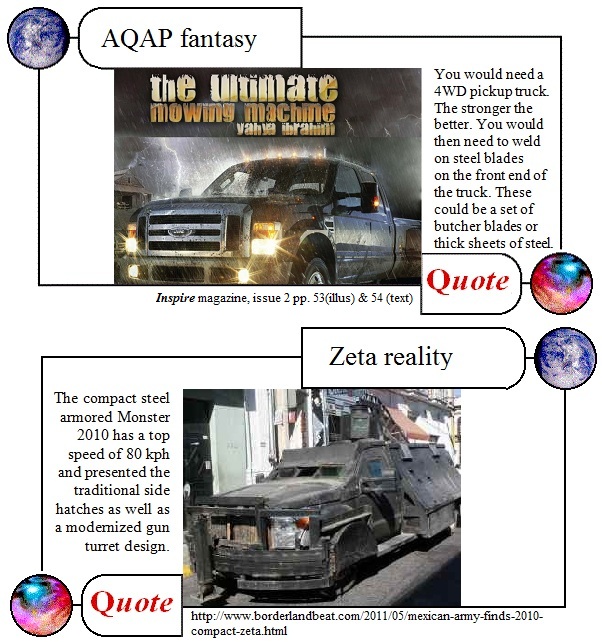
Hell, a Colombian cartel was fielding narco-subs a while back, as I recall..
Posted in 21st century, al qaida, analogy, Charles Cameron, criminals, gangs, periodicals, propaganda, psychology | Comments Off on Trucking: AQAP and the Zetas
Tuesday, April 5th, 2011
 Narcos Over the Border: Gangs, Cartels and Mercenaries
 by Dr. Robert J. Bunker (Ed.)I just finished my review copy of Narcos Over the Border. It is one of the more disturbing academic works recently published in the national security field, not excluding even those monographs dealing with Islamist terrorism and Pakistan. If the authors of this granular examination of Mexico’s immense problems with warring narco-cartels, mercenary assassins, systemic corruption, 3rd generation gangs and emerging “Narcocultas”of Santa Muerte are correct – and I suspect they are – Mexico’s creeping path toward state failure reprsents a threat to American national security of the first order.
The 237 page, heavily footnoted, book is organized into three sections: Organization and Technology Use by the narcos networks, Silver or Lead on their carrot and stick infiltration/intimidation of civil society and the state apparatus, and Response Strategies for the opponents of the cartels. Bunker’s co-authors Matt Begert, Pamela Bunker, Lisa Campbell, Paul Kan, Alberto Melis, Luz Nagle, John Sullivan, Graham Turbiville, Jr., Phil Wiliams and Sarah Womer bring an array of critical perspectives to the table from academia, law enforcement, intelligence, defense and security fields as researchers and practitioners. The effort to blend disciplinary approaches in Narcos Over the Border is both an intentional and commendable effort to break down academic and policy silos and bureaucratic “turf” perspectives that prevent analyzing Mexico’s security dilemmas as an interrelated threat increasingly resembling a full-fledged insurgency (albeit not on the classic Maoist Model).Some impressions I gained from reading Narcos Over the Border include:
- The Narco-Cartels and the Zetas, which fight each other as well as Mexico’s military ( Mexican police generally are infiltrated, intimidated, outgunned and seriously outclassed by the Cartel gunmen, Zetas and Guatemalan Kaibiles) are better armed and better trained than are the Taliban. The deadly and efficient Zetas and Kaibiles are superior to regular Mexican military forces and have established safe haven training camps in Central America.
- Narco-cartels are properly speaking, no longer narco-cartels but transnational criminal syndicates involved in a wider array of revenue generating activities, but with professional intelligence and military capabilities, and increasingly, political, social and religious agendas that are functionally reminiscient of Hezbollah and HAMAS.
- The Mexican state is severely hampered in it’s response to the threat presented by the cartels by it’s own strategic use of corruption as a cost saving measure and a tool for sustaining elite control of Mexican politics, as well as a method of personal enrichment by members of Mexico’s ruling class.
- The eschewing of the extreme violence by the cartels North of the border appears to be more of a sign of a strategic policy by cartel and Zeta bosses than a lack of capacity or evidence of a lack of infiltration into American society. To the contrary, Mexican cartel links to acutely dangerous American prison and street gangs such as the Mexican Mafia and MS-13 are significant and well documented.
- The cartels are global, not regional or local operators.
- The culture of the Narco-cartels, which draws on some romantic Mexican social and religious underground traditions, particularly the hybrid cartel La Familia , is morphing into a very dangerous “Narcocultas”, a neo-pagan, folk religion featuring ritualistic violence, beheadings and torture-murders carried out for reasons other than economic competition.
- Mexico has departed the realm of having a serious law enforcement problem and has graduated to a significant counterinsurgency war against the cartels in which the Mexican state is treading water or making progress against some cartels (possibly displacing their activities to weaker states in Central America).
The authors do not assume the worst case scenario, state collapse, for Mexico but rather an insidious “hollowing out” of the state by the cartels and a mutation of Mexico’s native culture to host a 4GW nightmare. As Robert Bunker writes:
What is proposed here is that Mexico is not on it’s way to becoming a “rotting corpse” but potentially something far worse – akin to a body infected by a malicious virus. Already, wide swaths of Mexico have been lost to the corrupting forces and violence generated by local gangs, cartels and mercenaries. Such narco-corruption faced few bariers given the fertile ground already existing in Mexico derived from endemic governmental corruption at all levels of society and in some ways, it even further aided the ‘virus’ spreading through Mexican society from this new infection. Among it’s other symptoms, it spreads values at variance with traditional society, including those:
….conceivably derived from norms based on slaveholding, illicit drug use, sexual activity with minors and their exploitation in prostitution, torture and beheadings, the farming of humans for body parts, the killing of innocents for political gain and personal gratification and the desecration of the dead.
While meticulous, Narcos Over the Border is not all-encompassing in scope. A fundamentally Mexico-centric collection of scholarly articles, it does not deal extensively with American policy makers involved in Mexico’s narco-insurgency, the intricacies of cartel financial operations or undertake case studies of narco activities in Mexican-American communities, though the authors do track narco-cartel and gang presence in cyberspace. Narcos Over the Borders represents a starting point for deeper investigation of narco-insurgency and for a national security comunity that has thus far treated Mexico as a third tier problem, a policy call to arms.Strongly recommended.
Posted in 21st century, 3 gen gangs, 4GW, academia, America, analytic, authors, black globalization, book, connectivity, conspiracy, counterinsurgency, criminals, cultural intelligence, dystopia, Failed State, gangs, government, ideas, illegal combatants, insurgency, intellectuals, john p. sullivan, Latin America, Mexico, military, national security, non-state actors, OSINT, politics, primary loyalties, robert j. bunker, security, social networks, social science, state failure, terrorism, theory, transnational criminal organization, Viral, war | 9 Comments »
Friday, January 21st, 2011
Narcos Over the Border: Gangs, Cartels and Mercenaries by Dr. Robert J. Bunker (Ed.)
Just received a review copy courtesy of Dr. Bunker and James Driscoll of Taylor & Francis – could not have arrived at a better time given several research projects in which I am engaged.
The 237 page, heavily footnoted, book is organized into three sections: Organization and Technology Use by the narcos networks, Silver or Lead on their carrot and stick infiltration/intimidation of civil society and the state apparatus, and Response Strategies for the opponents of the cartels. Bunker’s co-authors Matt Begert, Pamela Bunker, Lisa Campbell, Paul Kan, Alberto Melis, Luz Nagle, John Sullivan, Graham Turbiville, Jr., Phil Wiliams and Sarah Womer bring an array of critical perspectives to the table from academia, law enforcement, intelligence, defense and security fields as researchers and practitioners.
Looks good – will get a full review here at a later date, but a work that will definitely of interest to those readers focusing on national security, COIN, 4GW, irregular or Hybrid war, terrorism, transnational organized crime and black globalization.
Posted in 21st century, 3 gen gangs, 4GW, academia, America, analytic, authors, black globalization, book, COIN, conspiracy, counterinsurgency, criminals, cultural intelligence, dystopia, Failed State, gangs, government, ideas, insurgency, intellectuals, mercenary, Mexico, military, national security, non-state actors, organizations, OSINT, primary loyalties, robert j. bunker, security, social networks, social science, state failure, Tactics, terrorism, theory, transnational criminal organization, war | 3 Comments »
Tuesday, November 16th, 2010
After an extended hiatus, Summer Series 2010: Reviewing the Books! re-starts……

Blood and Rage: A Cultural History of Terrorism by Michael Burleigh
British historian Michael Burleigh brings the same kind of unsparingly brutal prose to the history of terrorism that he previously delivered on National Socialism in his acclaimed, The Third Reich: A New History . There is a wealth of detail about terrorists, their casual atrocities and the warped morality that terrorists habitually employ to rationalize their crimes; a nihilistic mentalite shared with their intellectual groupies in universities and political law firms that will shock and inform the reader. The scattered nature of the case studies that comprise modern terrorism though, makes Blood and Rage more of a kaleidescope than microscope.
Burleigh set out to chronicle a comprehensive examination of the evolution of terrorism in the last two centuries. There are Feinians and radicalized Russian Narodniks, murderous FLN Algerians and their pied noir OAS blood enemies, Irgun gunmen and Black September, ETA, IRA and Baader-Meinhoff gangsters consorting with Palestinian radicals and Herbert Marcuse. Burleigh dissects the psychopathology of ultraviolent degenerates like Hugh “Lenny” Murphy, Abu Musab al-Zarqawi and Andreas Baader. Terrorists, statistically speaking, are generally not madmen in a clinical sense, but Burleigh records a noteworthy exception regarding Germany’s Baader-Meinhoff Gang:
….With their numbers by now reduced to about a dozen people, the group was desperate for new recruits. Salvation came from an unlikely quarter. The mad. A radical psychiatrist at Heidelberg University, influenced by the anti-psychiatry of R.D. Laing and the anti-institutionalisation theories of Franco Basaglia, had formed a socialist collective among the mainly student clientele he was treating for various mental disturbances common to that age cohort including depression, paranoia and mild schizophrenia. In early 1971 Baader and Ensslin visited Heidelberg where they met some of the radicalized patients. In the following years, about twelve of the latter, including Gerhard Muller, Siegfried Hausner, Sieglinde Hofmann, Lutz Taufner and others became the second generation of RAF terrorists, initially under the slogan “Crazies to Arms”.
Blood and Rage makes for a grim read, with the recurring pattern of terrorism and counterterrorist response erupting to demoralize societies until the terrorists in question are either dead, imprisoned or mellowed by paunchy middle-age and political irrelevance as the  times pass their maniacal political passions by. Only in a few instances, notably South Africa and Northern Ireland are political settlements a more feasible option than methodical police and intelligence work followed by tough-minded prosecution and a steely societal rejection of grandiose moral claims of terrorists and their fellow-travelling left-wing lawyer-advocates. Burleigh also makes clear his disdain for militarized CT and multiculturalist enablement alike.
The weakness of Blood and Rage, unlike some of Burleigh’s other works, is a lack of a strong analytical theme, focus or grand theory to explain and unite the relentless and gory march of geographically diverse case studies in terrorism, though an intelligent reader should be able to discern patterns present well enough for themselves. Given Burleigh’s stature as a scholar, one can envision him having taken the ball further down field for a deeper level of analysis of terrorism as a societal phenomena. Burleigh would probably reply that such is not the proper job of a historian, which while true enough, still leaves me wishing he had.
As a popular history, Blood and Rage makes a page turner out of rancorous destruction.
Posted in 19th century, 20th century, 21st century, 4GW, academia, analytic, authors, book, criminals, extremists, gangs, historians, history, ideas, intellectuals, military intelligence, national security, politics, psychology, reading, social science, Summer Series, Tactics, terrorism | 2 Comments »


