zenpundit.com » tribes

Archive for the ‘tribes’ Category

The al-Masri Dialogue

Tuesday, February 9th, 2010

Charles Cameron, in his latest guest post here, penned a beautiful essay regarding the ongoing exchanges between Australian counter-terrorism scholar Leah Farrall and Abu Walid al-Masri, an adviser to the Taliban and an experienced strategist of Islamist insurgency. Farrall has translated and posted this dialogue on her blog, All Things Counter Terrorism, which has received much attention, commentary and criticism in the blogosphere and on private listservs and quasi-official bulletin boards.

Generally, I leave this sort of subject to Charles, since he has the academic expertise to drill down to a granular level of Islamic theology and Islamist ideology, but al-Masri is an intriguing figure and his public conversation with Farrall is a novelty worth investigating. It would be hard to imagine during the Cold War, an open media debate between a Western CI official and a Soviet spymaster still engaged in espionage in the field ( Kim Philby hurled public jermiads it is true, but that was in retirement in Moscow and only after his long-suffering KGB handlers had managed to get his severe alcoholism under control). In that spirit, I want to offer a few observations.

While there is artifice present, as al-Masri is consciously speaking to a multiplicity of audiences in his remarks, the idea that we should therefore dismiss the dialogue with Farrall, as some suggest, is an error. There is also posturing in purely intra-Islamist-debates on which we eavesdrop and, frankly, within our own arguments inside government and out. We learn from what people do and do not do, from what they say and what is left unsaid. Being able to speak to multiple audiences is a constraint, as well as an advantage, as it shapes the parameters of the premises to be employed and the extent to which the underlying logic can be permissably extrapolated. To quote a Zen saying, if you wish to fence in a bull, give him a large meadow. 

The constraints, if correctly discerned, are illuminating and are analytically useful in constructing our own tactical responses and message strategy (assuming someone can convince the State Department bureaucracy that IO and public diplomacy are important and persuade Congressional leaders to fund such activities with more than pocket change). They are also useful in helping to understand the worldview and governing paradigms of our opponents in more complex and nuanced manner than reflexively saying “they hate our freedoms”. Well, many jihadi types do in fact, viscerally hate our freedoms or deny that democracy is a legitimate form of government in an abstract sense, much the same way they casually disparage Hindus as “cow worshippers” or Thais as “crazy Buddhists”; however those loose attitudes and spasms of hostility are not akin to operational principles or strategic doctrines.

For that, we have to dig deeper into the politico-religious motivations of violent Islamists and listen closely to what our enemies are saying – particularly when they are making an effort to speak to us directly, as al-Masri is doing, his determination to score propaganda points in his little elicitation dance with Farrall notwithstanding. Americans are not very good at listening and our elites are deeply uncomfortable with the entire subject of religion, tending to view pious expressions of Christianity with contempt and Islam as a completely taboo subject. There is a strong preference in government and academia for analytical models of terrorism or insurgency that dwell on DIME spectrum variables because these fit in the personal comfort zones and the educational, social and professional experiences of the American elite. This would be a perfect approach if al Qaida’s leadership were composed of Ivy League alumni and Fortune 500 CEOs.

Economics and military force are always factors in geopolitical conflict, the war of terror included, but until Islamist extremists oblige us by becoming secular Marxist revolutionaries waving little red books, it would behoove us to look with greater scrutiny at the curiously reified religious ideology with which they justify or eschew courses of action to themselves. Our own strategies might be more focused and effective if the operators across our intelligence, military, diplomatic and law enforcement agencies had something approaching a shared understanding of violent Islamism and if they could communicate this understanding along with the benefit of their experience and current intelligence to help political leaders shape American policy.

Guest Post: Cameron on “A Response to a Most Remarkable Conversation”

Saturday, February 6th, 2010

Charles Cameron, my regular guest blogger, is the former Senior Analyst with The Arlington Institute and Principal Researcher with the Center for Millennial Studies at Boston University. He specializes in forensic theology, with a deep interest in millennial, eschatological and apocalyptic religious sects of all stripes.

Response to a most remarkable conversation

by Charles Cameron

i

Some time back, I posted here about the conversation between Leah Farrall, until recently a senior analyst with the Australian Federal Police and their subject specialist for al-Qaida, and Abu Walid al-Masri, long time mujahid, writer and strategist, friend and frequent critic of bin Laden, and the first foreigner to give bayat to Mullah Omar. Leah is presently writer her doctoral dissertation on al-Qaida, Abu Walid is under house arrest in Iran. Their online conversation continues, as Leah has described in an article for The Australian, and I believe this in itself is a significant even in online discourse, as I suggest in a post on Howard Rheingold’s SmartMobs blog.

Leah has been posting Abu Walid’s responses to her questions on her blog, first in Arabic and then as time permits in English, for some time now. Most recently, she posted her own detailed responses alongside Abu Walid’s questions to her — and the topic of their conversation accordingly shifted from issues of the structure and history of Al-Qaida and the Taliban (Leah’s academic interests) to issues of the morality of warfare, and of the jihad and war on terror in particular (Abu Walid’s concerns).

Leah has graciously invited me to respond to this new phase of the discussion, which cuts very close to my own heart.

ii

Abu Walid’s questions, as Adam Serwer has noted at The American Prospect, are largely focused on issues of due process:

Al Masri asks why the U.S. imprisons people based on secret evidence, why all detainees don’t get fair trials, and why the U.S. has tortured detainees. He brings up secret prisons and bounty hunters. He also alludes to America allowing “security departments in the underdeveloped world to do their dirty work, such as severe torture,” which I assume refers to extraordinary rendition.

Leah, who knows a great deal about these things, has responded to each of these points in detail. And Abu Walid and Leah are not alone in reproving such things — they have many critics, not least in the United States, some of whom have tracked these issues with a far closer eye than I have. Scott Horton, writing in Harper’s and elsewhere, knows far more about these practices, their justifications under recent Presidents, and their relation to US and international law than I do, and one of the reasons I find the western democratic tradition powerfully appealing is the fact that he can openly criticize his Presidents in the public media on such topics.

The topic of our behavior in time of war concerns me deeply, because it is fundamentally a topic about the gift of human life, how we should use it and how we should respect it. Islam, and before it Judaism, both declare that to take one human life is to extinguish a world, and that somewhat poetic statement is a brilliant summary of why the means of peace should be preferred to those of war.

This view, that every human life is of extraordinary worth, applies not only to the killing of humans, in war or elsewhere, but also to their mistreatment — what the New York Times has described as “dark-of-night snatch-and-grabs, hidden prisons and interrogation tactics that critics condemned as torture”.

So let me say directly that I too am opposed to torture, to beheadings, to attacks that cause civilian casualties, to the capture or killing of humanitarian aid workers, to extraordinary renditions.

My own hope is that the United States will not allow the tragic consequences of terror attacks to diminish the kind of freedom that allows people like Scott Horton to do the research, and to publish their findings freely. I find myself agreeing here with Benjamin Franklin, who wrote, “Those who would give up Essential Liberty to purchase a little Temporary Safety, deserve neither Liberty nor Safety.”

My prayers are for an end to war, and until that time, for moderation in its practice.

iii

This post, then, is more a response to the fact of an emerging dialog between Abu Walid and Leah Farrall than it is to the specifics of their discussion. After reading Leah’s responses to Abu Walid, I find I have very little to add to what she has said.

What touches me most deeply, in fact, is neither the issue of the structure of Al-Qaida nor the rights and wrongs of the conflict, but the simple fact of dialog between these two persons. It is not a facing off between opposing sides, in which so often each side demonizes the other, that attracts me here — but the reaching out from both sides to find early signs of a shared humanity, a shared possibility of peace. And in order to clarify that response, I think I should say something more about my own history, and the way in which I arrived at my own views.

John Adams, the second President of the United States, wrote in a widely-quoted letter to his wife:

I must study politics and war that my sons may have liberty to study mathematics and philosophy. My sons ought to study mathematics and philosophy, geography, natural history, naval architecture, navigation, commerce and agriculture in order to give their children a right to study painting, poetry, music, architecture, statuary, tapestry, and porcelain.

I am the son and grandson of warriors, so it has been my privilege to study philosophy and poetry — bur neither poetry nor philosophy allows me to overlook war entirely.

I understand that there are injustices and brutalities in the world that cry out for redress, and that force of arms may at times be necessary. My own father was a naval officer, who fought Hitler’s navy in the grueling waters of the Arctic, and died young because of it. I honor him for it. My first great mentor was a priest who worked to end the brutalities of the apartheid regime in South Africa, because he saw all people, regardless of skin color, as the children of God. Explaining himself, he wrote:

My responsibility is always and everywhere the same: to see in my brother more even than the personality and manhood that are his. My task is always and everywhere the same: to see Christ himself.

My mentor was an extraordinary man who was known for his abhorrence of violence, and yet was willing to approve “defensive violence and armed struggle as a last resort against the oppressor”. So I was raised by a courageous warrior and an extraordinary man of peace, and the issue of human violence has been a topic of lifelong meditation for me: I do not see it as simple in any way.

We all must choose where we shall expend our efforts, and my cause is that of religion: the astonishing generosity and compassion it can call forth in people, and the terrible consequences that follow when it is used to provide a sanction for killing.

iv

To be honest, I detest war.

I detest earthquakes.  As I say that, I do not intend to blame God, nature, or any human agency for them — I understand that earthquakes happen, that we live in what might be described as a ‘violent” universe, that galaxies collide, stars explode, worlds and cultures come into existence and are snuffed out, people live and die. 

What I mean to say is that I am saddened by the needless brutality that befalls humans and other creatures trapped in earthquakes, those who lose their limbs or sight, or who live for days in hope of rescue, buried under fallen masonry, and those others who survive, and are now widows, orphans, childless — because those they loved were in some other room, or some other part of town, or some other land when the quake hit.

I can acknowledge such things happen, but I cannot take joy in them, and I would not wish them on anyone.

In the course of war, many of the same effects are found — people die, lose their limbs, are buried under fallen masonry, blinded, orphaned, widowed — but on these occasions they are brought about by the hands of other humans, by human decision and choice.

If, as I say, I detest earthquakes, how shall I not also detest war?

v

And yet I feel kinship. I have a clan background: my father, and his father, and his father’s father were Scotsmen, all of them military men.  I understand the honor that is due to one’s forebears, and I salute them.

I was born and raised in England. I love and honor the country of my birth, its sweet hills and trees and rivers, and there is a quality to those gently rolling hills that I will never forget, which is home to me.  I studied in Oxford, in one of the great halls of learning, and it allows me to feel kinship with all those who have studied in the great universities and monasteries, from Oxford to Kyoto. I have lived for much of my life in America, and love, too, my adopted country. 

And thus I understand what it is to be on one side of a dispute, not because that side is perfectly right and just in all matters, but because one belongs with that land or those people: they are one’s own.

My father, when I was a boy, told me the story of how another clan became in 1692 the enemy of our clan. It seems they accepted the hospitality of our clan allies, then rose in the night to slaughter their hosts.  They thereby defiled their own honor by abusing the principle of hospitality — for, as a Scottish historian put it, “the Highlander, like the Arab, attached an almost sacred importance to the guest participating in his bread and salt”. 

I have passed down to my own eldest son the same story, but I have also made it clear to him that I hold no continuing grudge nor enmity against that other clan, and that I do not believe my father did either.

vi

Here, then, is the crux of the matter as I understand it, in Leah’s words:

Regardless of whether someone is our enemy or not, they are still, at the end of the day, human. They still have families, and in their milieu are probably viewed as good and decent people. Much the same way that we view ourselves. Somehow, in conflict this gets lost. That may be okay for fighting, but it isn’t when it comes to trying to bring an end to conflict. 

We seem, thank God, to have arrived at the point where the idea of resolving the terrible conflict in Afghanistan is at last recognizably on the horizon.  Secretary Gates said recently that “political reconciliation ultimately has to be a part of settling the conflict” — which seems to me to bode well for a dialog of this sort, preliminary though it is.

But I do not see the possibility of fruitful dialog just as a means to some form of political solution — to me it is more than that.

When the people of Israel escaped by night from captivity in Egypt, they were at first pursued by the army of Pharaoh. When they arrived at the Red Sea, God parted it so that they could make their escape.  The sea then closed on Pharaoh’s army and drowned them, and the Israelites rejoiced, singing a song of thanks.  In the Jewish lore of the Talmud, it is recorded that on that night the angels too wished to sing, and that God refused to hear their song of praise, rebuking them with the words, “my creations are drowning in the sea, and you will sing songs?”

vii

Vengeance dies hard, though, doesn’t it? 

If I kill your soldier I have killed an enemy — but you have lost a father, a brother, a son, and left a widow, an orphan: your grief is then greater than my satisfaction, your thirst for revenge keener than my fear of it, and so you strike down one of mine, thinking you have killed an enemy — but losing me a father, a brother, a son, leaving me a widow, an orphan — and so the plague rolls on.  You have visited anguish on me, I shall visit anguish on you.

Gandhi said it: An eye for eye, and soon the whole world is blind.

I choose, personally, to follow the principle of forgetting in such matters.  Injustices are legion, and the roots of today’s struggles can in many cases be traced back across centuries, even millennia. Both perpetrators and victims are human.

viii

There will be some who ask if this does not make a “moral equivalence” between one side and the other, and is not one side — “ours” — righteous, and the other evil? 

I am reminded of Abraham Lincoln’s magnificent Second Inaugural here.  He notes that in the American Civil War, both sides “pray to the same God; and each invokes His aid against the other” and although it is clear where his own allegiance lies, he continues, “let us judge not, that we be not judged. The prayers of both could not be answered – that of neither has been answered fully.”

I too have my preferences: what saddens me most of all, perhaps — for I am before all else a “lover of the lovers of God” — is the way in which religious feeling is used to provide sanction for killing.

But I think the issue cuts deeper even than that, and as I contemplate friend and foe alike — and indeed this dialog between, as Abu Walid puts it, “the (terrorist) and (counter-terrorist)”– I find the need to remember first my own humanity.  In the words of Aleksandr Solzhenitsyn, who suffered enormous wrongs in the Soviet Archipelago:

Gradually it was disclosed to me that the line separating good and evil passes not through states, nor between classes, nor between political parties either – but right through every human heart – and through all human hearts. This line shifts. Inside us, it oscillates with the years. And even within hearts overwhelmed by evil, one small bridgehead of good is retained. And even in the best of all hearts, there remains … an uprooted small corner of evil.

I too am human: the line runs through my heart, too — and in the final analysis, my response to this dialogue, like the dialogue itself, reaches beyond the issues that divide us, toward our common humanity, and toward peace.
Battleground Yemen

Wednesday, January 27th, 2010

An informative post by Curzon at Coming Anarchy

Yemen: Geography Matters!

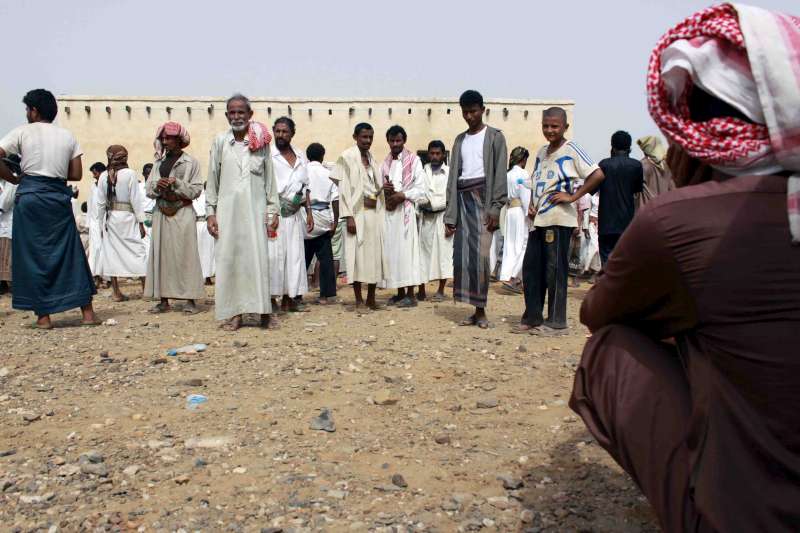
….The Saudis are guilty of aggravating and prolonging the conflict. Wary of taking too many losses on the ground and unable to do much by air and sea, they have recruited the Hashed, a local tribe, to fight against the Huthi, the tribe central to the Shia rebels. The Hashed have several incentives to continue fighting for as long as possible-they have a long-standing feud with the Huthi, and make a great deal of money from fighting for the Saudis, and may be coming up with schemes to prolong the conflict. According to a source of Al Jazeera:

If [the Hashed are] given the mission of taking a particular mountain, for example, they’ll call up the Huthi leaders and tell them: ‘We’re getting five million riyals to take the mountain. We’ll split it with you if you withdraw tonight and let us take over’… After the tribesmen take charge, they hand it over to the Saudis… The next day, the Huthi return and defeat the Saudis and retake the mountain… It’s been happening like this for weeks.

Guest Post: Charles Cameron on Khorasan – A Muslim Once and Future Kingdom

Tuesday, January 19th, 2010

 Charles Cameron, my regular guest blogger, is the former Senior Analyst with The Arlington Instituteand Principal Researcher with the Center for Millennial Studies at Boston University. He specializes in forensic theology, with a deep interest in millennial, eschatological and apocalyptic religious sects of all stripes.

Khorasan: A Muslim Once and Future Kingdom

by Charles Cameron

The title of an interview in a Taliban sponsored magazine with Hammam Khalil al-Balawi — the Jordanian jihadist physician and double-agent / informant who signed himself Abu Dujana al-Khorasani on jihadist forums, and carried out the recent CIA bombing in Khost — is intriguing in a self-referential, “Doug Hofstadter might like this” sort of way:

Interview with Brother Abu Dujanah al-Khorasani, a Well-Known Blogger in Jihadi Forums, and a Newcomer to the Land of Khorasan.

In his appearances on the web, al-Balawi / Abu Dujana had given himself the geographic cognomen “al-Khorasani” meaning “from Khorasan” — yet he was a Jordanian by birth, and the interview title calls him a “newcomer” to Khorasan, while the interviewer himself remarks, “Abu Dujanah al-Khurasani (sic) is actually now inside Khorasan, and the decision to travel to the lands of jihad is a divine blessing and a magnificent grace.”

The Khorasan that Abu Dujana “is actually now inside” is presumably Afghanistan on the literal, geographical level — but what of the Khorasan of the mind and heart to which, as his choice of handle indicates, Abu Dujana must have long aspired?

What is the significance of “Khorasan”?

It’s a bit like “Jerusalem” — only yesterday I was reading that Grand Rapids, Michigan is referred to as “Jerusalem” by some folk of Dutch extraction in the Pacific Northwest. I think we’ll get the sense of the idea if we call it of “Khorasan of sacred memory and present hope”.  As the UCLA scholar Jean Rosenfeld puts it (personal communication):

In any event, Khorasan refers to much more than a former region of the Islamic empires.  It has a mythical meaning that is being taken seriously as a “once and future kingdom” in the millennial mindset of al-Qaida.

The territory once called Khorasan — and the borders covered by that name shifted a great deal over the centuries — covered parts of what we now know as Iran (which still has a province named Khorasan), Turkmenistan, Uzbekistan, Afghanistan and NW Pakistan.  I’m finding references that suggest the name originally meant “the place where the sun rises” — the East, the Orient.

Rosenfeld suggests that Khorasan “is code in al-Qaida for the warrior sect itself” — “the army of the (future) caliphate in the mind of the International jihad” and thus, Al-Qaida in Fawaz Gerges’ broad sense.  My own reading ties it in with the ahadith about the “black banners of Khorasan” and the army which will sweep down from Khorasan to Jerusalem…

As I’ve noted before   there are many variant ahadith describing the army of the Mahdi.  Here is one commonly cited version:

If you see the black flags coming from Khurasan, join that army, even if you have to crawl over ice, for this is the army of the Caliph, the Mahdi and no one can stop that army until it reaches Jerusalem.”

Quite how we should align that with actual jihadist entities such as AQ core and or its subsidiaries or the various bodies called Taliban, however, I’m not sure. The clearest implication I can see is to the place of origin of the Mahdi’s army.

It is at least as much an eschatological as a geographic claim.

Since the imagery of Khorasan is closely tied to that of black flags, I would like to take a slight detour here.  We have seen that the black flags signify the army of the Mahdi, but what are its origins, and how widely is it used?

The Islamic Imagery Project at West Point Combating Terrorism Center lists “Black Flag” under the heading “Warfare Motifs“, saying:

The Black Flag (al-raya) traces its roots to the very beginning of Islam.  It was the battle (jihad) flag of the Prophet Muhammad, carried into battle by many of his companions, including his nephew ‘Ali ibn Abi Talib.  The flag regained prominence in the 8th century with its use by the leader of the Abbasid revolution, Abu Muslim, who led a revolt against the Umayyad clan and its Caliphate.  The Umayyads, the ruling establishment of the Islamic world at the time, were seen as greedy, gluttonous, and religiously wayward leaders.  The Abbasid revolution, then, was aimed at installing a new, more properly Islamic ruling house that would keep orthodox Islam at the center of its regime. Since then, the image of the black flag has been used as a symbol of religious revolt and battle (i.e. jihad).  In Shiite belief, the black flag also evokes expectations about the afterlife.  In the contemporary Islamist movement, the black flag is used to symbolize both offensive jihad and the proponents of reestablishing the Islamic Caliphate.

The flag is frequently identified with specific jihadist groups — thus Bill Roggio, writing in Long War Journal, refers to “the al rayah, the black flag of al Qaeda” in his 2007 article, “Musa Qala and the NATO offensive”.

Likewise, the Somalian president Abdullahi Yusuf Ahmed in 2006 is reported to have spoken in 2006 of “the ‘black flag’ of Al-Qaeda and the Taliban” — and as recently as this month, Al-Shabaab “vowed to replace the Somali flag with its (al-Shabaab’s) black flag”.

So the Black Flags or banners represent the Prophet as warrior at one end of Islamic history and the Mahdi’s army from Khorasan at the other — and have been adopted as symbols of jihad by different groups from the Abbasids to al-Shabaab. They are indeed indicative of jihad, but it is their association with Khorasan that gives them a specifically Mahdist reference.

The defeat of the Umayyads and establishment of the Abbasid caliphate, and hence also the golden age of Islamic culture, was strongly supported by forces raised in Khorasan, and David Cook in his Contemporary Muslim Apocalyptic Literature suggests that “the Abbasids sought to present their movement as the fulfillment of messianic expectations, and so they produced a great quantity of materials given in the form of hadith traditions to indicate that the Mahdi would come from this region.”

The tale lives on. As I’ve mentioned before, Cook notes that bin Laden’s mentor, Abdullah Azzam, made fresh use of this line of messianic tradition and “popularized the position of Afghanistan as the messianic precursor to the future liberation of Palestine” in his book, From Kabul to Jerusalem, while bin Laden refers to finding “a safe base in Khurasan, high in the peaks of the Hindu Kush” in his 1996 Declaration of Jihad.

The spiritual geography, then, is clear: Khorasan is that place in the east, somewhere in the general region including eastern Iran and northern Afghanistan, from which the Mahdi’s army will come — and it is very plausibly also a place the jihadist might need to “crawl over ice” to reach.

I think Rosenfeld is right in suggesting that al-Balawi’s geographic cognomen is a significant one, as is “Abu Dujana” — the name of a particularly valiant companion of the Prophet, as I discussed in a previous post.

But which of the various jihadist forces currently deployed in Afghanistan and nearby might be the nucleus of the Mahdi’s forces? The army with black flags from Khorasan has been identified with the Abbasids, with the Iranian revolutionaries, and with the Taliban. Bin Laden would presumably wish for it to be with al-Qaida, and Cook also says, this time in Understanding Jihad:

Since Afghanistan, as Khurasan, has powerful resonance with many Muslims because of the messianic expectations focused on that region, this gave the globalist radical Muslims associated with al-Qa’ida under the leadership of Bin Ladin additional moral authority to proclaim jihad and call for the purification of the present Muslim governments and elites.

In Jordan via the jihadist web forums, al-Balawi signaled his identification with the victorious army of the coming Mahdi and with jihadists in Afghanistan by his choice of the cognomen “al-Khorasani” — but the name alone does not tell us which particular jihadist group he might have been thinking of, and that may not even have been an question he felt the need to resolve at that time.

  Once in Khorasan itself, al-Khorasani left us two “media” items, a magazine interview and a video, and we might hope that they would add to our understanding of the more literal, geographical meaning his name carried, for they clearly indicate his associations.

According to Flashpoint-Intel, who provided the version of the interview I’ve seen, al-Khorasani’s interview was given to “Vanguards of Khorasan” which they describe as “a well-known Taliban propaganda magazine” and released by the Al-Fajr Media Center, which they term “the official online logistical arm of Al-Qaida”. SITE refers to “Vanguards” as “the … magazine of al-Qaeda in Afghanistan”. Others more familiar with the logistics may want to clarify the point.

The video, then, seems to give the clearest indication. Al-Khorasani was taped sitting next to Hakimullah Mehsud, the head of the Terik- i-Taliban Pakistan or TPP (whose death in a drone strike is reported but unconfirmed at the time of writing), and indicated his allegiance with the words, “We will never forget the blood of our emir Baitullah Mehsud” — referring to Hakimullah’s predecessor.

In general, “Khorasan” doesn’t appear to function as code for a particular jihadist organization, but as a more general symbol for victorious jihad — coming from the East, faithful to the truth, unstoppable, ushering in the Caliphate, serving the cause of the Mahdi, and thus heralding the End of Days.

I’m intrigued to note that the Australian analyst / scholar Leah Farrall at All Things Counter Terrorism blogged on Abu Dujana today  (after I’d “completed” this post) and closed her post with an aside. I’ll quote the whole paragraph for context, but it’s the last point that ties in here:

Another point of interest is Khorasani’s  internet history circa 2001- 2003. Despite what Khorasani said in his interview in the Taliban magazine ( I think it was the Taliban mag if memory serves), one does not get to be a forum administrator overnight. I watched another person rise through the ranks this way and he had direct contact with  a mid-level AQ commander. It still took him 18 months or so. This brings me back to my question about Khorsani’s early internet history and possible real world history. As an aside, back then, in the early days you didn’t write Khorasani, Kandahari etc unless you had been there. It was used as an identifier. This has changed in recent years but I do wonder about this with him too.

Leah’s curiosity on this point reminds me that along with the general symbolism of Khorasan, which I have tried to explore here, there are intriguing aspects to the particular use Abu Dujana made of the name.

I look forward to any further thoughts she may have.

Grateful thanks to Jean Rosenfeld for our very helpful conversations around this and related topics, and for the comment that gave me its title.

Five Questions: An Interview with Chief Ajmal Khan Zazai

Thursday, December 24th, 2009

Those of you who also regularly read Steven Pressfield’s site, It’s the Tribes, Stupid have come across his interview series with Ajmal Khan Zazai, elected paramount tribal chief of his home district in the Zazi valley of Paktia province in Afghanistan ( near Tora Bora and bordering Pakistani Waziristan). Chief Zazai fought in the Soviet War and at one time, was imprisoned by Pakistan’s ISI. On March 15, 2000, the Taliban assassinated Chief Zazai’s father, Chief Raiss Afzal Khan Zazai in his family house in Peshawar, Pakistan.

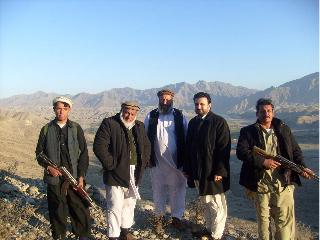
As paramount chief, Chief Zazai raised a Tribal Police Force that is presently working with the U.S. Army’s 10th Mountain Division to secure the Zazi valley. Chief Zazai’s force has come under attack, as insurgents have fought to stop his efforts.  His commander, Amir Muhammad, has personally survived several assassination attempts in the last several months. On two occasions in 2008, warlord-financed hit men attempted to assassinate Chief Zazai. One attack nearly succeeded, leaving several wounded and one man deadzazai.jpg

Steve cordially arranged for me to ask Chief Zazai a few questions via email regarding his perspective on the historical background of the war against the Taliban and the current situation in Afghanistan. My questions are in bold type and Chief Zazai’s answers are in normal text:

FIVE QUESTIONS: AN INTERVIEW WITH CHIEF AJMAL KHAN ZAZAI:

1.  Some American academics have argued that the day of “the tribe” is long past in Afghanistan, having been battered by governmental intrusion and war since at least 1978, and that a better understanding of Afghan identity for Americans is to look at the “Qaum” and other very local loyalties. How accurate is that description?:

“Qaum” means “Tribe” in Pashtu and also in the Dari Language. 

The 1978 coup was not the first bloody revolution Afghanistan saw, as I have said on many occasions, Afghanistan has gone through many turmoils and turbulences throughout its history and has survived as a nation and country. For one to get convinced that after the 1978 Red revolution that the tribal structure was gone for good, then one would also have to argue how this tribal structure survived till 1978 when Ghengis Khan burned almost half of Afghanistan?  What about Hulagu Khan, Tamerlane, the Persian empire, the Mughals and prior to all that Alexander the Great? [The tribes ] having seen all these bloody empires and survive untill 1978 is amazing, isn’t it?

To justify the argument simply by referring to the 1978 bloody Red revolution and claim the tribal structure was gone, is dead and has vanished in Afghanistan, would simply be ignorance and a lack of understanding of the rich Afghan culture and Afghan way of life.

The Bonn Agreement appointed Hamid Karzai for 6 months as an interim President of Afghanistan back in 2002. When 6 months passed, did the UN or US call for election? No, of course not. Who then who appointed Mr. Karzai as a President for 2nd time to be the President of the transitional government? It was the “Loya Jirga” and not through the election process. A Loya Jirga is a pure Afghan Tribal process and procedure of making things happen!

Let’s take a look at how the current Afghan Constitution was approved  and came into an effect:

The constitution of Afghanistan was not approved by the Afghan Parliament and Senate as the Parliament and Senate did not exist at the time. In fact the constitution was approved by the “Loya Jirga”; although there was a large presence of the Warlords and criminals in both those Loya Jirgas, nevertheless they served their purpose.

Now, why would one argue that the tribal structure does not exist in Afghanistan or it’s a thing of the past? Closing our eyes from the truth does not mean the truth would vanish. We have a phrase in Pashto which means “One can not hide the sun with just two fingers”.

If one believes they need to find local loyalties in Afghanistan, the locals are the tribes. Why would some go around in [semantic] circles and confuse themselves? 

2.  In your interviews with Steve Pressfield, you discussed the presence of warlords in the Afghan government of Hamid Karzai, men with very bad records.  There have also been reports in the media, from time to time, of Ex-Khalqi Communists serving the regime. Are these men a similar problem to the warlords in your view?

When the Russians withdrew their forces in 1989 and left behind the Communist regime of Dr Najibullah, many thought that the regime would collapse in just days or in weeks, but Najibullah’s government survived for five long years despite the daily rains of rocket attacks on Kabul and only collapsed in 1992. Then the so-called Mujahideen took charge of Kabul and Afghanistan, but soon we saw that these power hungry men started fighting each other over the Throne of Kabul. Their bloody civil war of lasted from 1992 untill 1996 and turned Afghanistan into a pile of rubble.

 Many Afghans were turned against these so-called Mujahideen because these leaders and their commanders became involved in killing innocent men, women and children, looted people’s livelihoods and literally turned all of Afghanistan into a war zone. We witnessed that in just five years these “Mujahideen” warlords destroyed Kabul and all other major cities in Afghanistan. People started to hate them more than they hated the old Communists, so in a way, the crimes which were initially committed by the Communists were covered up when the Afghan people witnessed the subsequent brutality of these so-called Mujahideen leaders and commanders.

I strongly believe the Afghan civil war was also orchestrated by the  KGB/FSB in order to engage these Freedom fighters in Afghanistan and prevent them from crossing over to infiltrate the [formerly Soviet] Central Asian States, and also to cover the atrocities committed by the Red Army against the Afghans in Afghanistan. The KGB/FSB calculated shrewdly that if these “Mujahideen” leaders accomplished a united Islamic government in Afghanistan, it would spill over into the entire Central Asian countries. Although many believed in the West at the time that Russia was almost finished and gone, that was a mistake Westerners made in trying to understand the Russian mind set. 

I strongly believe that the Afghan Communists are responsible for the destruction of Afghanistan. They still have the Marxist-Leninist theory in their heads and we recently have witnessed that many of these Afghan ex-Communists are keeping close ties to Moscow. I believe these Khalqis and Parchamis are now part of the problem as they are now receiving support from Russia.   

3.  Afghanis, especially Pushtuns, have a well-deserved historical reputation as fierce fighters.  Yet there is more to life than war, even in a warrior society. What does a young Afghan man in his late teens or twenties hope for?  What would he see as “progress” or better times?

Much is been said about the Afghans, Pashtuns in the media and honestly I disagree with much of it because no nation, no tribe no people wish for a war as war only brings devastation, destruction and miseries.

Yes, the Afghans are great fighters, but that does not mean they wish for a war all their life. We needed to fight against the Russian invasion and I still strongly believe we have done the right thing defending our country and nation against Communism; as I said earlier, things went wrong when these so-called Mujahideen or Freedom fighters leaders started fighting one another. I believe every Afghan wishes for peace and stability in Afghanistan. Yes there are some who will continue fighting, but we all know they are small in numbers and are not significant. The reason many young men are part of the Taliban and other insurgents is the lack of employment , lack of better life conditions and of course lack of any positive attention from their government in Kabul. At this moment if you ask me, why are these young men are turning to Taliban and are fighting the US, NATO and the Afghan government? You will hear a simple answer from me and that is lack of employment opportunity for these youth who are mostly uneducated.

I will tell you my own experience: I was only 16 when I used to go to Afghanistan from Pakistan from time to time to fight against the Russians. I knew the consequences of being killed, but I was not going to Afghanistan in order to be killed, I was going to Afghanistan to fight the Russians. Now things are opposite, many young men are brainwashed by evil men and these young men wish to die, that’s why there are many suicide attacks now. I remember very well in my days when we were busy fighting the Russians, that we never had suicide bombers. This is very new to us and it has been brought form outside Afghanistan.

I believe the Afghan government and the US/NATO should provide training programmes to all those young Afghan men at around age of 16 and above who have lost the chance to go to school and get education. By learning skilled trades, I believe they will be in a position to earn a loaf of bread for themselves and their family and in this way we will prevent many young men from falling in the trap of believing being a suicide bomber means a life in the hereafter with the 72 virgins which will await them at the corridor of heaven.

4.  You have spoken at length with Steve Pressfield about the 10th Mountain Division and your positive relationship with them.  How successful have American and NATO units been in making connections elsewhere with Afghan tribal leaders compared to the 10th Mountain Division?

I do not have any information to the regard that if the US Army has any close contacts with other Tribal leaders. In my case, I have pushed hard for this partnership, regardless of any obstacles that were created for us to even have a decent understanding, but now it seems to be working. In the entire Afghanistan, I am the first Tribal Leader who denounced the Taliban and Al Qaeda openly and more practically, by forming TPF (Tribal Police Force) from my Tribesmen to fight these evil men without any financial assistance from the US Army, US Government, NATO or the Afghan Government. My TPF programme is by the people and for the people – I think it is on the same lines of your democracy “By the people and for the people”!

5). A friend of mine, the strategist Thomas PM Barnett, has been advocating a much greater international presence in Afghanistan, including not just NATO but China, Russia and India, with direct business investment as well as providing military and civilian aid workers. Would this development be a welcome one?

I believe this is a positive step in bringing a broader coalition and the entire International community to help and be involved in Afghanistan; but although this approach might be purely for business purposes, it could pose a future problem as most of these nations are not very sure of the US and NATO policy in the long term and present intentions. Afghanistan has always maintained very good and close relations with India, and throughout this friendship, India had no political ambitions and that what made India look good until the 90’s when India supported the Northern alliance. [As a result] I believe India has lost that status of being a neutral friend of Afghanistan. Also, the growing presence of Indians in Afghanistan is sending some disturbing alarms to our immediate neighbor (Pakistan).

Things needs to be balanced and Afghanistan needs a better understanding [of FDI] and not just bringing in anyone which could only lead to disruption and anxiety in long term. As an example, the large copper mines in Logar Province were won in a biding by a Chinese company – later it was revealed that the Chinese paid large kick backs to the minister of mines. In my opinion, involving more Chinese and Russian corporations would mean more corruption in Afghanistan.

Russian firms are already involved in Afghanistan. Most of them are involved in espionage and there are Chinese corporations and I believe they are doing the same. It would be more fruitful [for Afghans] for your friend to encourage Western corporations and companies to invest in Afghanistan.

Thank you, Chief Zazai.


Switch to our mobile site