zenpundit.com » teaching

Archive for the ‘teaching’ Category

Systemic Curricular Choices Shape National Cognitive Traits

Thursday, March 10th, 2011

A brief point.

AFJ has a feature article by General Martin Dempsey on the need for the Army in it’s professional military education system to build future leaders who are critical thinkers:

Building Critical Thinkers

….The Army Leader Development Strategy identifies three critical leadership attributes for all Army leaders: character, presence and intellect. In addition to those three foundational attributes, we assert that strategic leaders must be inquisitive and open-minded. They must be able to think critically and be capable of developing creative solutions to complex problems. They must be historically minded; that is, they must be able to see and articulate issues in historical context. Possessed of a strong personal and professional ethic, strategic leaders must be able to navigate successfully in ethical “gray zones,” where absolutes may be elusive. Similarly, they must be comfortable with ambiguity and able to provide advice and make decisions with less, not more, information. While all leaders need these qualities, the complexity of problems will increase over the course of an officer’s career and require strategic leaders to develop greater sophistication of thought….

Read the rest here.

The nation is currently undergoing a debate about public education, of sorts. I say “of sorts” because the debate has largely been very dishonest on the part of proponents of certain kinds of “reforms” in which they hope to have a future financial interest, if radical changes can be legislatively imposed that will a) drastically lower labor costs and b) permit a “scalable” curriculum, to use the grammar of certain equity investor CEOs and lobbyists. The former does not concern this topic as much as the second, though the two will work in unison to create a profitable business model for a for-profit management company desiring to contract with local and state governments to run school systems.

“Scalability” builds upon Bush era NCLB legislation that emphasized standardized testing in basic math and reading skills, with punitive accountability measures for schools and districts failing to make “adequate yearly progress”. Due to the penalties and escalating standards, public schools have frequently narrowed their curriculums considerably, reducing instructional time for history, science, complex literature and the arts to put greater emphasis on basic skill drill instruction in just two subjects.

The net effect is that American public school students, roughly 88 % of all school children, spend a greater proportion of their day at concrete level cognitive activities than they did five or ten years ago and far less time on higher-level “critical thinking” like analysis or synthesis, making evaluative judgments, inquiry based learning or problem solving.

 “Scalability” means expanding on this dreary and unstimulating paradigm with digitally delivered, worksheet-like exercises to comprise the largest percentage of the instructional time for the largest number of children possible. It will be a low-cost, high-profit system of remedial education for would-be contractors, provided students are not able to “opt out”, except by leaving the public system entirely.

But only if their parents can afford it.

The US military relies upon the public schools to deliver the initial k-12 education of the overwhelming majority of their officer corps, to say nothing of the enlisted ranks. The soldiers, sailors, marines and airmen who went to Andover or similar private institutions before enlisting are very, very few. Today some public schools are excellent, some are failing and the rest are in-between. Most make an effort to challenge students of all ability levels, from those needing extra help to those in AP courses and gifted programs. There is systemic resiliency in a diversity of experiences.

What will be the effect on  the military leadership in the future if critical thought is methodically removed from public education by a nationally imposed, remedially oriented, uniform, “scalable” curriculum that is effectively free of science, history, literature and the arts? What kind of cognitive culture will we be creating primarily to financially benefit a small cadre of highly politically connected, billionaire-backed, would-be contractors?

Can inculcating critical thinking really be left entirely to universities and, in the case of the military, mid-career education?

What kind of thinkers will that system produce?

Better?

Or worse?

“What we think, we become” – Buddha
History as a Gen Ed Credit for Engineering Students Aspiring to Naval Leadership

Tuesday, February 15th, 2011

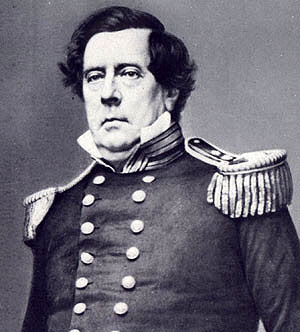
Commodore….errr….what’shisnameagain???

As a rule, I generally do not write about US Navy affairs because it is not an area of expertise for me and I think Galrahn covers that territory admirably well without my poor help. Every so often though, an item from our sea-roving friends catches my eye that I am qualified to speak about and today is one of those days.

Teaching naval history has become an inconvenience to those entrusted with training our nation’s future captains and admirals because they need to get the budgetarily “sexy” topic of “cyber warfare” into the US Naval Academy curriculum. Yes, that’s right. Because someday, in the midst of battle, the combatant commander of PACOM will be furiously barking out HTML code at the bridge of the Eisenhower, above the cries of wounded men.

Gentlemen, gentlemen….in matters of education, fundamentals come before esoterica!

I strongly recommend this post by LCDR Benjamin “BJ” Armstrong, historian, pilot and Navy officer who tackled this subject with an enviable grace and eloquence at the USNI blog:

HH104, WWATMD…

….More than policy or naval strategy, Mahan believed in teaching officers the best ways to approach the challenges of command.  He saw his job as a Naval War College plankowner in those terms, about teaching command, and to do so he turned to history.  But, it wasn’t just senior officers who needed grounding in our naval past.  He wrote in his very first published article, winning third place in “Proceedings” annual essay contest, that history was also a key foundation for learning at the Naval Academy.

When he said that history “lies at the foundation,” it wasn’t just a convenient turn of phrase.  He believed that before subjects like gunnery, engineering, or even cyber-warfare, could be taught a Midshipman needed to know why he was learning them.  Why did any of it matter?  The best way to show a student why hitting the target in gunnery class was important was to teach him the history that showed what happened when crews weren’t drilled properly.  Perhaps he would teach the Midshipman about Captain James Lawrence sailing Chesapeake out of Boston harbor with a green and undrilled crew in 1813 to face HMS Shannon, a short time later uttering his final command, “Don’t give up the ship” just before he succumbed to his wounds and the British boarding party swarmed aboard in victory.  Maybe the Midshipman would recognize the words…from the battle flag bearing the phrase in Memorial Hall that was flown at the Battle of Lake Erie.  Mahan felt that once a Midshipman understood the importance of mastering the craft, of studying their trade, a subject like weapons systems engineering would become important even to the lowly humanities major.

The second part of Mahan’s statement is also important, “all sound military conclusions and practices.”  In our age of checklist leadership and officers educated as engineers there is a desire to approach leadership challenges as equations where certain inputs are guaranteed to give you the desired results.  But Mahan doesn’t say all “correct” military conclusions and practices, he says “sound.”

Mahan recognized that both naval strategy (conclusions) and combat leadership (practices) were art, not science.  In his book “Naval Strategy: Compared and Contrasted with the Principles and Practice of Military Operations on Land,” published in 1911, Mahan compared naval officers to artists.  He wrote that artists had to learn certain techniques, mediums and certain skills, but that wasn’t what made their artwork great.  In the end “art, out of materials which it finds about, creates new forms in endless variety,” artists take those foundation basics and then mix and match them based on inspiration and experience to create a masterpiece.  History helps us understand that frequently there are no right answers to military questions of strategy or leadership.  There are only “sound conclusions,” which are drawn from understanding basics and history.  Demonstrating this great truth to Midshipman early in their education, say as a Plebe before they have taken three years worth of engineering classes that teach them there is always an equation and a correct answer, is much more valuable than having them learn it after years of service.

Bravo!

This decison is wrong on so many levels it amounts to pedagogical malpractice. It should be reversed.

What kind of mind do we want our Navy officers to have in the moment of decision?  An admiral in command of a carrier task force has more destructive power at his disposal than any man on earth except for the ruler of Russia and the President of the United States. At a crisis point, it is too late to roll back the clock to gain the benefit of a career of professional reading, discussion and reflection on the lessons of naval warfare, strategy and statesmanship. EE courses are good things, and demonstrably useful, but they do not inculcate the same habits of mind as does the learning of history.

Historically, the US Navy was the plenipotentiary service of the United States with it’s admirals and commodores assuming extremely sensitive diplomatic or even proconsular duties alongside their responsibilities of military command. The careers of Farragut, Perry, Dewey, Leahy, King, Nimitz and others of lesser rank attest to how naval command has always been deeply entwined in American history with statesmanship and keen political insight. The 21st century will be no different.

The lessons of history are a sword and shield.

Broke Down and Bought

Wednesday, January 12th, 2011

Grand Strategies: Literature, Statecraft, and World Order by Charles Hill

Heard way too many good things about this book from regular commenters like Scott Shipman (read his review here) to ignore it. The blurbs on the dust jacket are from some genuine heavyweights (and provoked an amusing academic political tantrum masquerading as a review  in FP.com from some minor departmental nemesis of Hill’s at Yale, where Hill is one of the founding lecturers of their Grand Strategy Program).

I will upjump this in my antilibrary queue to be read after I finish with Luttwak.

Guest Post: A Hipbone Approach to Analysis

Saturday, October 23rd, 2010

Charles Cameron is the regular guest-blogger at Zenpundit, and has also posted at Small Wars Journal, All Things Counterterrorism, for the Chicago Boyz Afghanistan 2050 roundtable and elsewhere.  Charles read Theology at Christ Church, Oxford, under AE Harvey, and was at one time a Principal Researcher with Boston University’s Center for Millennial Studies and the Senior Analyst with the Arlington Institute:

A Hipbone Approach to Analysis

by Charles Cameron

I think it’s about time I laid out some of the basic thinking behind the style of analysis that I refer to as the “hipbone” approach.

Seen from one angle, it has to do with Sun Tzu’s double-whammy: “know your enemy, know yourself”.

F Scott Fitzgerald wrote, “The test of a first-rate intelligence is the ability to hold two opposing ideas in mind at the same time and still retain the ability to function.” Let me be blunt about this: if you want to “know yourself” and “know your enemy” as Sun Tzu recommends you should, you’ll need to be able to keep two opposing minds in mind at the same time – and still retain the ability to function.

The hipbone approach uses very simple concept-mapping tools and some fairly subtle insights derived from a lifetime of introspection and the arts to facilitate and annotate that process, and to make the resulting understandings available to others.

But first, let’s get down to the kind of thinking that lies behind this approach.

1

One thing I want to know is: what are the most subtle and complex mini-structures that the human mind can take in, more or less at one swoop. Then I’d like to know what their moving parts are, how — to the extent that they have a “main thrust” — they handle parallelisms and reconcile oppositions to that thrust, and what they do with stuff that’s oblique or orthogonal to it, how they put constraints to use in service of expression, what use they make of decoration, how they handle ignorance, how they reconcile head and heart, certainty and doubt, and how they keep the surface mind occupied while affecting the deeper layers of our being… And I want to know that, viscerally — to feel it in my bones, if you like – because I’d like to be able to do more or less the same thing with regard to complex real-world problems, on a napkin, by myself, or with friends or enemies.

2

I want to know what those things are because (a) they’re the most nourishing things I can feed myself, and I need all the nourishment I can get, and (b) because it turns out that if I can come up with product that has the same formal properties, I’ll be able to explain things both to myself and other people that otherwise leave me stuttering platitudes.

Somewhere right about there, I run into a quotation like this one, from Cornelius Castoriadis in his World in fragments: writings on politics, society, psychoanalysis, and the imagination:

Remember that philosophers almost always start by saying: “I want to see what being is, what reality is. Now, here is a table. What does this table show to me as characteristic of a real being?” No philosopher ever started by saying: “I want to see what being is, what reality is. Now, here is my memory of my dream of last night. What does this show to me as characteristic of a real being?” No philosopher ever starts by saying “Let Mozart’s Requiem be a paradigm of being, let us start from that.” Why could we not start by positing a dream, a poem, a symphony as paradigmatic of the fullness of being and by seeing in the physical world a deficient mode of being, instead of looking at things the other way round, instead of seeing in the imaginary — that is, human — mode of existence, a deficient or secondary mode of being?

What I think I’m hearing here, half-hidden in the words, is that the Mozart Requiem is one of those high-density, subtle and complex mini-structures.

And I agree — in fact I find myself thinking of the arts that way, as the natural places to look for high-density, subtle and complex models of reality.

3

Of course, it would be absurdly neat if nobody else had ever noticed this, and I could take all the credit for myself – but no, the great anthropologist and cybernetician Gregory Bateson makes pretty much the same observation about poetry:

One reason why poetry is important for finding out about the world is because in poetry a set of relationships get mapped onto a level of diversity in us that we don’t ordinarily have access to. We bring it out in poetry. We can give to each other in poetry the access to a set of relationships in the other person and in the world that we are not usually conscious of in ourselves. So we need poetry as knowledge about the world and about ourselves, because of this mapping from complexity to complexity.

Poems are precisely “high-density, subtle and complex mini-structures” – that’s how they manage the “mapping from complexity to complexity” – and so the question comes up, what’s the role of structure in the arts?

4

Let’s take a quick look at musical structure, and at polyphony and counterpoint in particular. Your enemy’s perspective and your own – or the many perspectives of the various stakeholders in a complex, perhaps “sticky” or “wicked” problem – can be compared with the different, often discordant melodies from which a Bach or Mozart or Beethoven weaves a fugue – melodic themes which are not infrequently “inverted” or in “contrary motion”.

So what can the musical structure of counterpoint teach us, who are faced with real-world situations comprised of different needs and ideals — often discordant, often in counterpoint or opposition to one another, often in “contrary motion”?

Here’s Edward Said, discussing the Israeli-Palestinian problem in terms (gasp!) of musical form:

When you think about it, when you think about Jew and Palestinian not separately, but as part of a symphony, there is something magnificently imposing about it. A very rich, also very tragic, also in many ways desperate history of extremes — opposites in the Hegelian sense — that is yet to receive its due. So what you are faced with is a kind of sublime grandeur of a series of tragedies, of losses, of sacrifices, of pain that would take the brain of a Bach to figure out. It would require the imagination of someone like Edmund Burke to fathom.

Like him or leave him, Said in this paragraph is clearly thinking along similar lines to the ones I’m proposing.

Or to move to yet another art, that of theater — what can we learn about the simulation and modeling of complex issues from Shakespeare? Keith Oatley’s Shakespeare’s invention of theatre as simulation that runs on minds is a serious exploration of that possibility.

5

I’m going to return to the arts, and lay out a theory of what an art is and how it works, in a later post in this series – but for now, let me just say that I’ve devised a cognitive mapping tool, or more precisely a family of games and mapping tools, that I call “HipBone Games and Analysis” because they’re all about the way one idea connects with another – just as “the hip-bone’s connected to the thigh-bone” in the song.

And as I commented recently on Zenpundit:

What I’m aiming for is a way of presenting the conflicting human feelings and understandings present in a single individual, or regarding a given topic in a small group, in a conceptual map format, with few enough nodes that the human mind can fairly easily see the major parallelisms and disjunctions, as an alternative to the linear format, always driving to its conclusion, that the white paper represents. Not as big as a book, therefore, let alone as vast as an enormous database that requires complex software like Starlight to graphically represent it, and not solely quantitative… but something you could sketch out on a napkin, showing nodes and connections, in a way that would be easily grasped and get some of the human and contextual side of an issue across.

6.

To balance Sun Tzu’s “know your enemy, know yourself” with which I began, I’ll offer by way of counterpoint Christ’s “But I say unto you which hear, Love your enemies, do good to them which hate you” (Luke 6.27). And now for two of my favorite words: more soon…

Fingerspitzengefühl, Jawohl!

Friday, August 27th, 2010

Dr. Chet Richards gives a concise and practical explanation of the intuitive strategic-tactical skill, Fingerspitzengefühl.

Developing the touch

Ibis raised an interesting question in one of his comments:  If Fingerspitzengefühl can be taught, why do so few people have it?

Two points:  First, Fingerspitzengefühl is a skill, so although most people can get better at it, some are going to get a lot better.

Second, it’s a strange kind of skill, not for performing complicated or even dangerous tasks mystically well, but for sensing what is going on among groups of people in conflict and then influencing what happens.

….The first problem in learning Fingerspitzengefühl is that you can’t learn it by yourself.  You have to have at least two groups of people to practice with – your team and some opponents.  And to develop this skill, you have to practice a lot, because people, unlike clubs, don’t obey laws as simple as f=m•a.  And you have to practice influencing your own team – call that “leadership” – while also influencing the opposition – call that “strategy.”  And you have to learn it in increasingly unstructured and even threatening situations, under varying time constraints. This is the concept behind Vandergriff’s adaptive leader methodology, which I’ve referred to before….

Read the whole thing here.

ADDENDUM:

My thoughts on fingerspitzengefuhl.


Switch to our mobile site

