zenpundit.com » science

Archive for the ‘science’ Category

Augmented Reality Emerging on Major Platforms

Thursday, July 21st, 2011

This was pretty cool, from Lewis Shepherd’s blog, Shepherd’s Pi:

Virtual recipe stirs in Apple iPad, Microsoft Kinect

Who says Apple and Microsoft can’t work together?  They certainly do, at least when it involves the ingenuity of their users, the more inventive of whom use technologies from both companies (and others).

Here’s a neat example, “a just-for-fun experiment from the guys at Laan Labs” where they whip up a neat Augmented Reality recipe: take one iPad, one Kinect, and stir.


Some technical detail from the Brothers Laan, the engineers who did the work:

We used the String Augmented Reality SDK to display real-time 3d video+audio recorded from the Kinect. Libfreenect from http://openkinect.org/ project was used for recording the data coming from the Kinect. A textured mesh was created from the calibrated depth+rgb data for each frame and played back in real-time. A simple depth cutoff allowed us isolate the person in the video from the walls and other objects. Using the String SDK, we projected it back onto a printed image marker in the real world.” – source, Laan Labs blog.

Shepherd has more on the technology here.

If AR is doable on an iPad fast and dirty by wizardly geeks then Apps for the casual technoprimitives cannot be long off.

Scientific Method: Perception and Reality

Monday, May 9th, 2011

I am working on a couple of posts and a book review, but in the meantime, I thought this graphic was interesting:

sciencerage.png

From Electron Cafe:

Social and Individual Components of Creativity

Thursday, April 14th, 2011

This is very good. And it is fast.

I have enjoyed several of Steven Johnson’s previous books, Emergence and Mind Wide Open and his latest one, Where Good Ideas Come From looks to be a must read, though I think those of you who have read Wikinomics or works like Flow by Mihaly Csikszentmihalyi will find some of Johnson’s points in the video to be familiar as will those long time readers who have seen my views on horizontal thinking   and  insight.

My students watched this and reacted by defining themselves as those who were creative mostly through social collaboration but a decided minority required solitude and an environmental filter to think clearly and creatively – not a catalyst of a series of  social-intellectual stimuli. For them, the cognitive load generated by the environment amounted to an overload, a distracting white noise that short-circuited the emergence of good ideas.

This suggests to me that there are multiple and very different neuronal pathways to creativity in the brain and a person’s predisposition in their executive function, say for example the classic “ADHD” kid at the back of the class, may have different requirements to be creative than a peer without that characteristic. It also means that creativity may be subject to improvement if we can cultivate proficiency in several “styles” of creative thinking.

Somebody at DARPA is a Fan of Daniel Suarez

Tuesday, April 12th, 2011

Freedom (TM) by Daniel Suarez

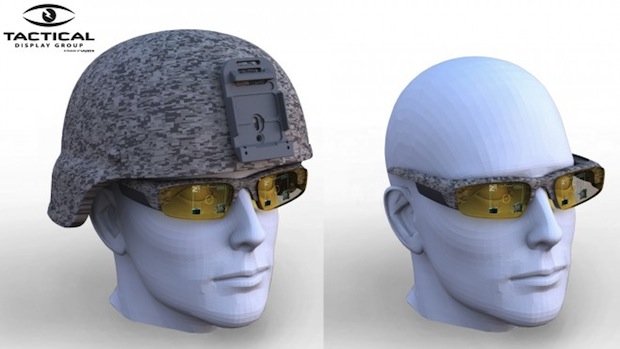
Remember those augmented reality glasses that the daemon operatives like Loki used to connect to the Darknet? Well, DARPA did…

DARPA Designing Augmented Reality Goggles to Fight Friendly Fire 
 

DARPA smart tech

Remember how the Beastmaster could see through the eyes of his pet eagle? DARPA does. And it’s pursuing augmented reality goggles tech that’ll let troops see through the eyes of a nearby unmanned aerial vehicle (UAV) in order to more accurately target its weapons.

The issue of accurate targeting and weapons-fire has a renewed interest in the wake of NATO mistakenly destroying rebel armor in Libya rather than Gadhaffi’s hardware, but it’s never been an easy task. One of the very best ways to deliver today’s smartest weapons is to have an “eyes-on” soldier in the field near the target relaying real time data up to the aircraft that’s about to drop a bomb–but this situation is not often practical or desirable and can be dangerous for both the soldier and the incoming aircraft.

vuzixgoggles

Read the rest here. 

Very cool. If John was not so busy with his new company, he probably could tell his readers how to combine this off-the-shelf modified tech with DIY drones.

An always fun thought experiment is to figure out how far ahead DARPA really is in the lab compared to whatever toy they feel comfortable giving a press release. And then there’s what exists on the drawing board that is technically feasible but not particularly economical at the present time to pursue seriously. Imagination usually far outstrips budgets

Happy Birthday, Emlyn, and Applause, xkcd

Sunday, March 20th, 2011

[ by Charles Cameron ]

*

My son, Emlyn, turns sixteen today.

He’s not terribly fond of computers to be honest — but he does follow xkcd with appreciation, as do I from time to time: indeed, I am led to believe I receive some credit for that fact.

So… this is a birthday greeting to Emlyn, among other things. And a round of applause for Randall Munroe, creator of xkcd. And a post comparing more reliable and less reliable statistics, because that’s a singularly important issue — the more reliable ones in this/ case coming from a single individual with an expert friend, the less reliable ones coming from a huge corporation celebrated for its intelligence and creativity… and with a hat-tip to Cheryl Rofer of the Phronesisaical blog.

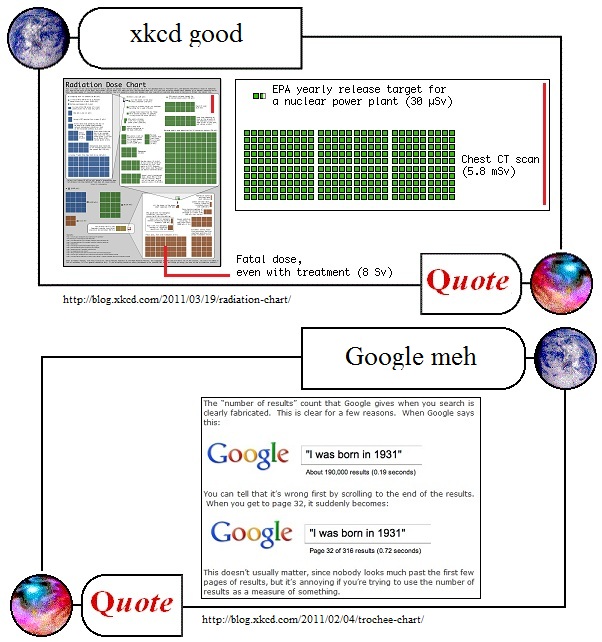
The DoubleQuote:
quoxkcd-01.jpg

Radiation exposure:

Today, xkcd surpassed itself / his Randallself / ourselves, with a graphic showing different levels of radiation exposure from sleeping next to someone (0.05 muSv, represented by one tiny blue square top left) or eating a banana (twice as dangerous, but only a tenth as nice) up through the levels (all the blue squares combined equal three of the tiny green ones, all the green squares combined equal 7.5 of the little brown ones, and the largest patch of brown (8Sv) is the level where immediate treatment doesn’t stand a chance of saving your life)…

The unit is Sieverts, Sv: 1000 muSv = 1 mSv, 1000 mSv= 1 Sv, sleeping next to someone is an acceptable risk at 0.05 muSv, a mammogram (3 mSv) delivers a little over 50,000 times that level of risk and saves countless lives, 250 mSv is the dose limit for emergency workers in life-saving ops — oh, and cell phone use is risk-free, zero muSv, radiation-wise, although dangerous when driving. [I apologize for needing to write “mu” when I intend the Greek letter by that name, btw — software glitch with the ZP version of WordPress.]

The xkcd diagram comes with this disclaimer:

There’s a lot of discussion of radiation from the Fukushima plants, along with comparisons to Three Mile Island and Chernobyl. Radiation levels are often described as “ times the normal level” or “% over the legal limit,” which can be pretty confusing.

Ellen, a friend of mine who’s a student at Reed and Senior Reactor Operator at the Reed Research Reactor, has been spending the last few days answering questions about radiation dosage virtually nonstop (I’ve actually seen her interrupt them with “brb, reactor”). She suggested a chart might help put different amounts of radiation into perspective, and so with her help, I put one together. She also made one of her own; it has fewer colors, but contains more information about what radiation exposure consists of and how it affects the body.

I’m not an expert in radiation and I’m sure I’ve got a lot of mistakes in here, but there’s so much wild misinformation out there that I figured a broad comparison of different types of dosages might be good anyway. I don’t include too much about the Fukushima reactor because the situation seems to be changing by the hour, but I hope the chart provides some helpful context.

Blog-friend Cheryl Rofer, whose work has included remediation of uranium tailings at the Sillamäe site in Estonia (she co-edited the book on it, Turning a Problem Into a Resource: Remediation and Waste Management at the Sillamäe Site, Estonia) links to xkcd’s effort at the top of her post The Latest on Fukushima and Some Great Web Resources and tells us it “seems both accurate and capable of giving some sense of the relative exposures that are relevant to understanding the issues at Fukushima” — contrast her comments on a recent New York Times graphic:

In other radiation news, the New York Times may have maxed out on the potential for causing radiation hysteria. They’ve got a graphic that shows everybody dead within a mile from the Fukushima plant. As I noted yesterday, you need dose rate and time to calculate an exposure. The Times didn’t bother with that second little detail.

In any case, many thanks, Cheryl — WTF, NYT? — and WTG, xkcd!

Google:

Once again, xkcd nails it.

I’ve run into this problem myself, trying to use Google to gauge the relative frequencies of words or phrases that interest me — things like moshiach + soon vs “second coming” + soon vs mahdi + soon, you know the kinds of things that I’m curious about, I forget the specific examples where it finally dawned on me how utterly useless Google’s “About XYZ,000 results (0.21 seconds)” rankings really are — but the word needs to get out.

Feh!

Paging Edward Tufte.

Sixteen today:

Happy Birthday, Emlyn!


Switch to our mobile site