The Sociobiological Origins of Beauty
Sunday, March 6th, 2011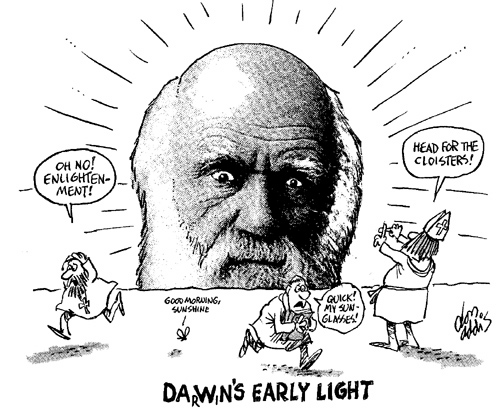
Great multidisciplinary talk by Dr. Denis Dutton on the possible evolutionary origins on culturally universal concepts of aesthetic beauty.
Great multidisciplinary talk by Dr. Denis Dutton on the possible evolutionary origins on culturally universal concepts of aesthetic beauty.
[ by Charles Cameron ]
On the face of it, the two events described here – the super-match in which IBM’s Watson computer beat two human Jeopardy champs, and the crowd-sourced protein-folding experiment in which nearly 60,000 gamers fared better than a supercomputer — would seem to say, respectively, that computers can defeat humans, and that humans can beat computers. So what’s to believe?

I don’t think the opposition holds up on closer inspection, however.
Watson may have beaten the human contestants in Jeopardy, but as the paragraph I quoted shows, it was nonetheless a human that “had the last word”.
Ben Zimmer in The Atlantic goes on to describe just how clever that “last word” actually was:
If you are a fan of The Simpsons, you’ll be able to identify it as a riff on a line from the 1994 episode, “Deep Space Homer,” wherein clueless news anchor Kent Brockman is briefly under the mistaken impression that a “master race of giant space ants” is about to take over Earth. “I, for one, welcome our new insect overlords,” Brockman says, sucking up to the new bosses. “I’d like to remind them that as a trusted TV personality, I can be helpful in rounding up others to toil in their underground sugar caves.”
.
Even if you’re not intimately familiar with that episode (and you really should be), you might have come across the “Overlord Meme,” which uses Brockman’s line as a template to make a sarcastic statement of submission: “I, for one, welcome our (new) ___ overlord(s).” Over on Language Log, where I’m a contributor, we’d call this kind of phrasal template a “snowclone,” and that one’s been on our radar since 2004. So it’s a repurposed pop-culture reference wrapped in several layers of irony.
Frankly, Watson isn’t up to that level of clever – it would take a Sherlock or a Mycroft to pull that off…
.
So in that first instance, the computer apparently beats the humans, but the humans come across as brighter than the computer all the same.
.
More or less the opposite happens with my second example. Here we have tens of thousands of humans pitted against a single computer, and the humans appear to have the edge – but do they?
.
It’s not the individual human brain that wins here, but what you might term “massively parallel human processing” – which isn’t nearly as impressive.
.
So there are in fact three kinds of ingenuity on display here: the original small-group human ingenuity that constructed the machine, the machine’s own mechanical ingenuity, and the combined ingenuity of sixty thousand humans in distributed collaboration…
*
Look, here’s my challenge. The folks at IBM need to read Hermann Hesse’s Magister Ludi, and figure out how to create the sort of computer that could best Joseph Knecht at his own game
Let’s make that a little easier. they need to be able to recognize rich analogies across wide disciplinary distances — well enough to come up with a relationship comparable in its impact on two previously unrelated fields of knowledge to, say, the Taniyama-Shimura conjecture linking elliptic curves and modular forms…
Simpler still: they need to be able to play one of my HipBone Games – see Derek Robinson‘s description of the games in The HipBone Games, AI and the rest — well enough to pass a Turing test.
*
Elementary, my dear Watson…
[ by Charles Cameron ]
You know, I really enjoy building my DoubleQuotes. They can be entirely frivolous, as is this one, for instance:
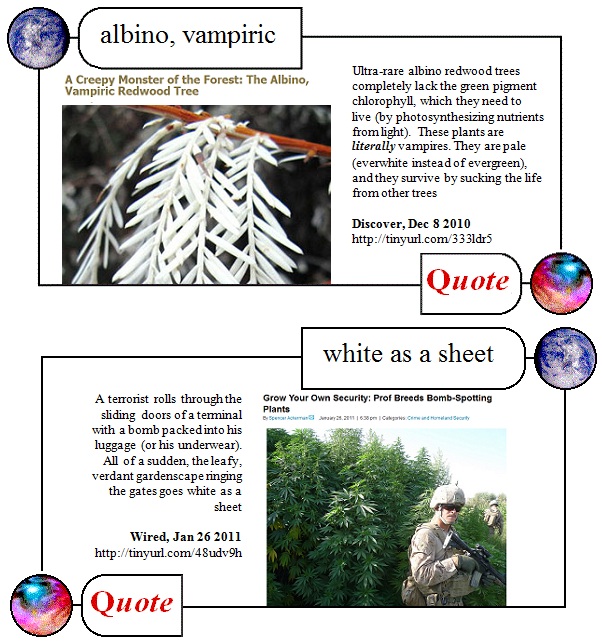
with its touch of gothic — a taste I share with my friend Bryan Alexander.
Or they can work like a Necker cube, offering opposite framings with which to view a single topic — in this case, video games.
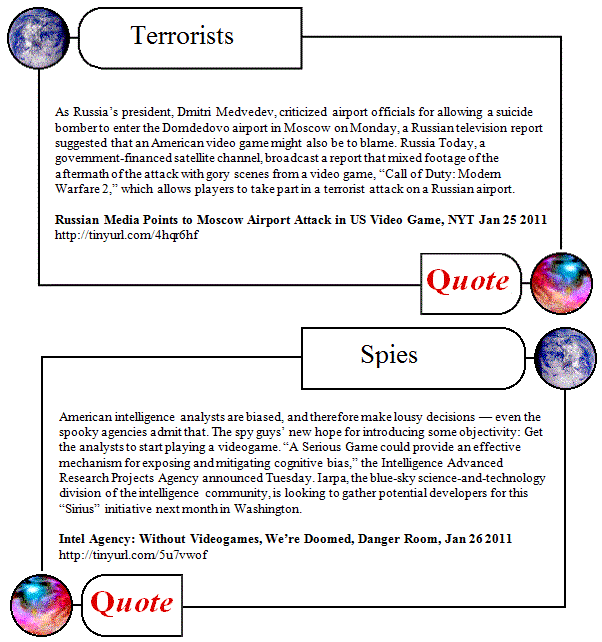
They can also work like Rorschach blots — this one compares two prophecies, one from the Quran and one from a contemporary Christian prophet (if I’m not mistaken, President Obama quoted him recently) —
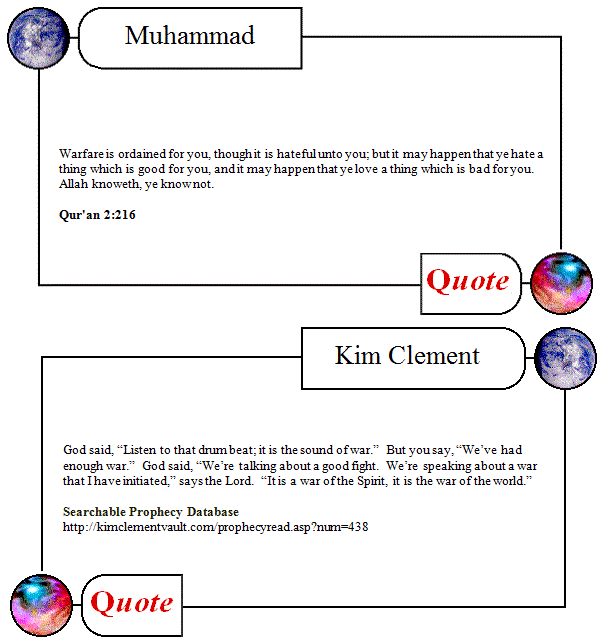
— but it is left up to the reader to determine the value of each…
And they can also pose fundamental questions of preference:
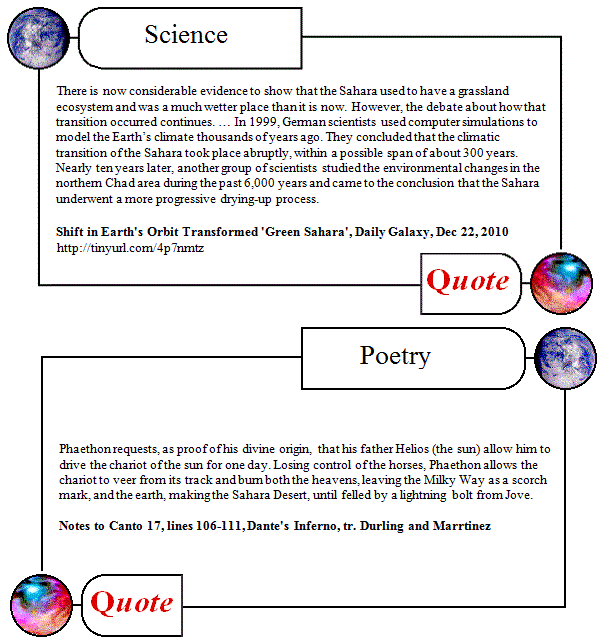
Has science simply replaced myth, d’you think? or is science for the facts, perhaps, and the mind — while poetry and myth are for the heart, and truth?

Commercialization of a step toward singularity. Impressive!
Now, all those in favor of having corporations record your unique brainwave patterns and share that data with third parties raise your hands.
[ by Charles Cameron — in playful response to M. Fouche’s recent post on ChicagoBoyz, Butterfly Effect ]
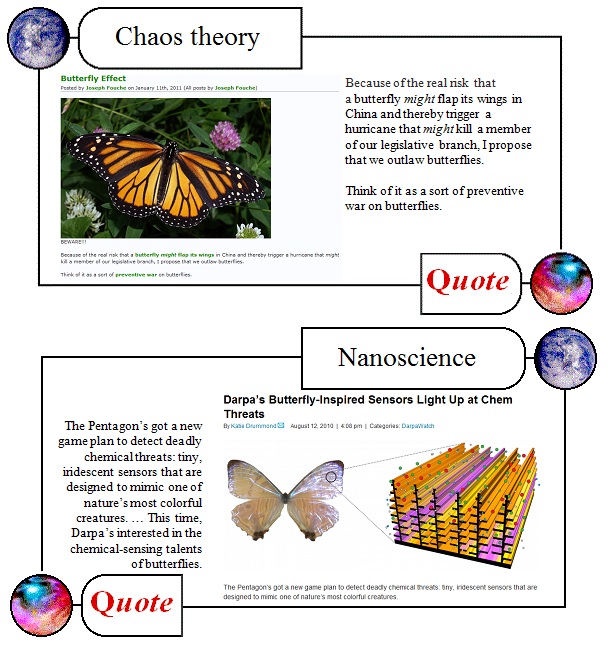
Links: Chaos theory – Nanoscience

Zenpundit is a blog dedicated to exploring the intersections of foreign policy, history, military theory, national security,strategic thinking, futurism, cognition and a number of other esoteric pursuits.
Customized Web Site & Blog Design

