zenpundit.com » complex systems

Archive for the ‘complex systems’ Category

A Hipbone Approach IV: Polar bears and polar opposites

Friday, November 12th, 2010

by Charles Cameron
pic of polar bear tenuously balanced on tiny iceberg

Norwegian photographer Arne Nævra took second prize in the “Our world” category of the Shell Wildlife Photographer of the Year 2007 competition with this photo

Bruce Sterling‘s State of the World 2010 conversation with my online friend Jon Lebkowsky on the Well’s “Inkwell” forum this year was rich in concept and language as one might expect. This in particular caught my eye:

It’s like looking at your SUV and seeing drowning polar bears. Just a minority viewpoint.

Two concepts, two dots to connect: SUVs and polar bears. Sterling chose those two concepts, no doubt, because the connection between them is non-obvious in the sense that a dictionary definition of SUV won’t contain a reference to polar bears, heck, even an encyclopedia article is unlikely to, and the reverse is also true — and obvious, in the sense that the “minority” in question can easily connect these two otherwise quite distinct and separate dots, the connection being “climate change” aka “global warming” or more specifically an entire complex dynamic systems analysis incorporating the process by which an aggregate of comparatively large and frequently used gasoline-powered internal combustion engines adds incrementally to a trend in the global weather…

Not that any of this should surprise us: Sterling’s readers presumably know that SUVs are a convenient stand-in for “gas guzzlers” and thus for the whole panoply of cars and trucks, and more abstractly for our planetary tendency to technologize our environment into greater convenience and less sustainability — and polar bears, while Sterling may like the look of them in photos, documentaries, zoos or on the occasional visit to the Arctic, serve here as a marker for the entire notion of environmental degradation, a massive die-out of species and such other non-Arctic phenomena as the loss of mountain tops in Appalachia and of rain forests in the Amazon and elsewhere.

So Sterling has played two “concepts” on the board of “connect the dots” and asserted that for some people the connection will be obvious, while for others it will be invisible — which in term of connecting the dots means it might as well not exist.

*

Indeed, some will argue that while both dots — SUVs and polar bears — exist, the connection implied between them does not.

But that’s not the topic of my consideration here.

*

Bruce Sterling’s interview gives me the pair of dots I intend to focus on today – SUVs and polar bears – but there’s another pair of dots that Sterling’s remarks forms part of, a pair in which Sterling stands at one pole (science, fiction) of the debate on climate change, with Rep. John Shimkus, R- IL, at the other (scripture, fact).

Addressing the House Subcommittee on Energy and Environment’s hearing on Preparing for Climate Change on March 15, 2009, Rep. Shimkus made the following now-celebrated remarks:

The right of free speech is a great right that we have in this country. Very few times we use it to espouse our theological religious beliefs, but we do have members of the clergy here as members of the panel. So I want to start with Genesis 8, verses 21 and 22. “Never again will I curse the ground because of man even though every inclination of his heart is evil from childhood, and never again will I destroy all living creatures as I have done. As long as the earth endures, seed time and harvest, cold and heat, summer and winter, day and night will never cease.” I believe that is the infallible word of God, and that is the way it is going to be for his creation.
 
The second verse comes from Matthew 24. “And he will send his angels with a loud trumpet call, and they will gather his elect from the four winds, from one end of the heavens to the other.” The earth will end only when God declares it is time to be over. Man will not destroy this earth. This earth will not be destroyed by a flood.
 
And I appreciate having panelists here who are men of faith, and we can get into the theological discourse of that position. But I do believe God’s word is infallible, unchanging, perfect.

I have characterized Sterling’s stance as “science, fiction” and Rep. Shimkus as “scripture, fact” – but the connection between these two dots is far from clear, and it is at leasdt arguable whether the designations shouldn’t instead be “science, fact” for Sterling, and “scripture, fiction” for Rep. Shimkus.

*

There’s a certain elegance to that – in fact it begs to be made into one of those diagrams that Jung and Levi-Strauss were fond of…
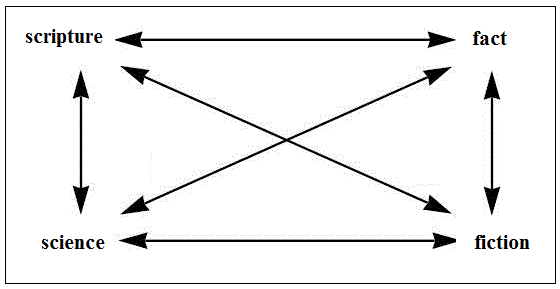
Science fact fiction scripture

Of course, fact and fiction may not be exclusive, opposed categories, and the same is true of scripture and science. Consider, for example, Kathleen Raine’s comment:

myth, when a real event may be the enactment of a myth, is the truth of the fact and not the other way around”

or the similar idea that CS Lewis once wrote to her

What flows into you from the myth is not truth but reality (truth is always about something but reality is about which truth is) and therefore every myth becomes the father of innumerable truths…

*

To return to Sterling… The game of connect the dots that Sterling plays here could be made into a simple systems diagram of the sort that Peter Senge used to illustrate his book, The Fifth Discipline, or the more elaborate form of systems dynamic model that Jay Forrester pioneered at MIT and Donella Meadows so eloquently preached in her essay, Places to Intervene in a System — complete with feedback loops in which shifts in global weather patterns and the exquisitely-patterned trails of SUVs dance the dance of complexity and emergence…

Sterling’s version of the game is verbal, minimalist, and suggestive: two phrases, not often found next to each other, quietly juxtaposed, in such a way that the mind can supply the connection that makes the leap between them. In short: the man can write.

The point I am laboring to make here has to do with communication: with getting an insight across to other people.

Writers do this by dropping verbal markers (“SUVs” and “polar bears”) into sentences. Mostly, they write many such sentences in sequence (a blog post, an article, a book), so the reader skims or skips lightly from one marker to the next, like a stone skipping across a pond in the childhood game. Individual leaps and single connections between pairs of dots are not important here, the reader’s mind half-notes them as it passes to the next dots and the next, and such things as “conclusions” and “actionable items” or in some cases “character” and “plot” far outweigh the largely subliminal links and connections triggered along the way.

From an analytic point of view, however, it is the connections that make the difference — whether those connections are causal, as in the steps of an argument; dynamic, as in the workings of a homeostatic system with feedback loops; emergent, as in the discernment of pattern at the edge of chaos; or associative, as with creative insight, metaphor and analogy.

And in each of these cases, some form of language, diagram or model can spell out the connection, some form of software can embody that language, diagram or model, and some form of human insight can assimilate its meaning and apply it to further tasks of observation, orientation, decision and action…

*

We may connect the dots for pleasure, as in one of those games that chains of restaurants print up to keep children busy while their parents talk over pancakes and bacon, or for benefit: and here the issue is not only to connect “past” dots correctly so as to understand what has already happened and can be viewed with twenty-twenty hindsight, but to make the great conceptual leap from past and present and propose connections with dots that will arise in the “future” (that zone of uncertainty): we write scenarios, we plan, we attempt to intuit an enemy’s next move, to make our own OODA loop tighter and meaner than his.

And while in the short term we may succeed, in the mid and long term we may fail.

At which point, as a depth psychologist might say, our projections tell us more about ourselves than about the reality we are attempting to grasp.

I’d include here those moments when we “see” connections that don’t exist, as well as those in which we miss connections that do: hallucinatory links, and blind spots, both.

*

Bruce Sterling, in the same forward-looking piece that contains that quick verbal aside about polar bears and SUVs, asks himself how anyone can give “a coherent picture of where your future is heading”. Without some such picture, indeed, we are at the mercy of vicious feedback loops and unintended consequences.

Here’s how he thinks about what we might call medium term scenarios:

Let’s imagine you’re three years old again. You want to give your Dad, back in 1974, a coherent picture of what 2010 looks like. You know, something very actionable, lucid and practical, where he can just slap the cash on the counter and everything works out great for the family. Okay: given what you know now about the present, tell me what you oughta tell him about 2010, back in 1974.

Forrester-style modeling won’t carry us forward thirty five years: there are simply too many shades of grey and black swans between “now” and “soon”.

And so task number one is an “ornithological” task — to peer into our own blind-spots, to see the invisible, to have what is called “vision”.

And I don’t mean a gosh-darn brand-new marketing strategy. I mean a sense of the great tides that underlie epochal changes — the kind of vision that William Blake had, which allowed him to rail on about the “satanic mills” long before the word “ecology” was a dim spark in the mind of the fellow who coined the word. The sort that Leonardo da Vinci had.

The sort, in fact, that contemplatives (all those Zen and Tibetan and Benedictine monks) and shamans (Lakota and Huichol and !Kung and all the rest) and artists (in words, in images, in sound, in film, in concept) all know about.

*

Which is to say, the sort Einstein knew about — so that when the mathematician Jacques Hadamard asked him about his thought process, he answered:

The words or the language, as they are written or spoken, do not seem to play any role in my mechanism of thought. The psychical entities which seem to serve as elements in thought are certain signs and more or less clear images which can be “voluntarily” reproduced and combined.
 
There is, of course, a certain connection between those elements and relevant logical concepts. It is also clear that the desire to arrive finally at logically connected concepts is the emotional basis of this rather vague play with the above mentioned elements. But taken from a psychological viewpoint, this combinatory play seems to be the essential feature in productive thought – before there is any connection with logical construction in words or other kinds of sign, which can be communicated to others.
 
The above mentioned elements are, in my case, of visual and some of muscular type. Conventional words or other signs have to be sought for laboriously only in a secondary stage, when the mentioned associative play is sufficiently established and can be reproduced at will.

That’s quite a mouthful, so I’d like to pick out a few points that maybe of relevance here.

Let’s clear the word “muscular” out of the way first. Some of the ideational germs of Einstein’s most brilliant work, he tells us, are “muscular”. Many of us know that visual thinking is an important component of understanding: Einstein adds thinking “of muscular type” into the mix. His body is part of his mind, and he knows it. That’s important: Einstein is, in fact, connecting dots for us here linking mind and body. But he doesn’t just link dots in his response to Hadamard — he actually talks quite a bit about making connections.

*
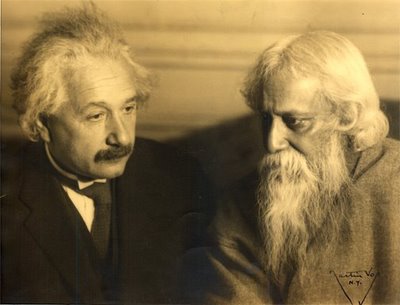
Einstein Tagore

Einstein links to Tagore

Let me rephrase his response to Hadamard the way I see the process he describes unfolding.

He has a strong emotional desire to understand, in the way that “physics” understands — which is to say, “to arrive finally at logically connected concepts” of the nature of nature. He then turns away from logic and concepts, and — still under the sway of that desire — attends to the sensations of his body and to his internal field of vision. In response to that desire and from regions of the body and mind unspecified, certain “psychic elements” of a visual and some of muscular sort arise. These he says can be “combined” — he says also that he can “play” with them — but the play is, at least at first “vague”. Indeed it is precisely this “combinatory play” which appears to Einstein to be “the essential feature in productive thought”. It is only when these elements have been voluntarily played with and satisfactorily combined that Einstein begins, internally, to verbalize and “translate” the combinations he has perceived into some form of “logical construction in words or other kinds of sign, which can be communicated to others”.

So we have three sorts of connection going on here: (i) an associative connectivity between imagistic and muscular “psychic elements” in the mode of play (ii) their “connection with logical construction in words or other kinds of sign” and (iii) the connections he can then present to others in the language of “logically connected concepts” — ie mathematical physics.

*

In all of this, I would like to highlight (i) the (perhaps unexpected) importance of the body’s connection with the mind in human thinking, (ii) the significance of a deep desire for understanding as the attractor for the largely unconscious motions of body and mind, (iii) the role of play as the mode of thinking in which creative linking occurs, (iv) the ubiquity of connectivity as the ruling imperative in all phases from the initiation of play to the communication of theoretical physics.

All four — body-mind, desire, play and connection — are key components in anything worthy of the name of vision.

John Seely Brown: “The Power of Pull”

Monday, November 1st, 2010

John Seely Brown, who is the co-author of The Power of Pull: How Small Moves, Smartly Made, Can Set Big Things in Motion along with blogfriend John Hagel and Lang Davison, is primarily speaking about education and learning in an ecological paradigm.

Note to self: I need to read this book.

That said, “pull” is the fulcrum for all 20th century orgs that hope to adapt to the 21st, not just public education. Hierarchies, including states, can no longer completely dominate, only aspire to generally arbitrate, or concentrate their powers in an asymmetric fashion. To do this, over the long term, requires putting  attracting the allegiance of clients and allies capable of taking independent initiative in harmony with the org’s vision rather than relying primarily upon coercion to force people to mechanistically follow orders.

Not sure that too many people in our hallowed institutions “get it”.

Guest Post: A Hipbone Approach to Analysis

Saturday, October 23rd, 2010

Charles Cameron is the regular guest-blogger at Zenpundit, and has also posted at Small Wars Journal, All Things Counterterrorism, for the Chicago Boyz Afghanistan 2050 roundtable and elsewhere.  Charles read Theology at Christ Church, Oxford, under AE Harvey, and was at one time a Principal Researcher with Boston University’s Center for Millennial Studies and the Senior Analyst with the Arlington Institute:

A Hipbone Approach to Analysis

by Charles Cameron

I think it’s about time I laid out some of the basic thinking behind the style of analysis that I refer to as the “hipbone” approach.

Seen from one angle, it has to do with Sun Tzu’s double-whammy: “know your enemy, know yourself”.

F Scott Fitzgerald wrote, “The test of a first-rate intelligence is the ability to hold two opposing ideas in mind at the same time and still retain the ability to function.” Let me be blunt about this: if you want to “know yourself” and “know your enemy” as Sun Tzu recommends you should, you’ll need to be able to keep two opposing minds in mind at the same time – and still retain the ability to function.

The hipbone approach uses very simple concept-mapping tools and some fairly subtle insights derived from a lifetime of introspection and the arts to facilitate and annotate that process, and to make the resulting understandings available to others.

But first, let’s get down to the kind of thinking that lies behind this approach.

1

One thing I want to know is: what are the most subtle and complex mini-structures that the human mind can take in, more or less at one swoop. Then I’d like to know what their moving parts are, how — to the extent that they have a “main thrust” — they handle parallelisms and reconcile oppositions to that thrust, and what they do with stuff that’s oblique or orthogonal to it, how they put constraints to use in service of expression, what use they make of decoration, how they handle ignorance, how they reconcile head and heart, certainty and doubt, and how they keep the surface mind occupied while affecting the deeper layers of our being… And I want to know that, viscerally — to feel it in my bones, if you like – because I’d like to be able to do more or less the same thing with regard to complex real-world problems, on a napkin, by myself, or with friends or enemies.

2

I want to know what those things are because (a) they’re the most nourishing things I can feed myself, and I need all the nourishment I can get, and (b) because it turns out that if I can come up with product that has the same formal properties, I’ll be able to explain things both to myself and other people that otherwise leave me stuttering platitudes.

Somewhere right about there, I run into a quotation like this one, from Cornelius Castoriadis in his World in fragments: writings on politics, society, psychoanalysis, and the imagination:

Remember that philosophers almost always start by saying: “I want to see what being is, what reality is. Now, here is a table. What does this table show to me as characteristic of a real being?” No philosopher ever started by saying: “I want to see what being is, what reality is. Now, here is my memory of my dream of last night. What does this show to me as characteristic of a real being?” No philosopher ever starts by saying “Let Mozart’s Requiem be a paradigm of being, let us start from that.” Why could we not start by positing a dream, a poem, a symphony as paradigmatic of the fullness of being and by seeing in the physical world a deficient mode of being, instead of looking at things the other way round, instead of seeing in the imaginary — that is, human — mode of existence, a deficient or secondary mode of being?

What I think I’m hearing here, half-hidden in the words, is that the Mozart Requiem is one of those high-density, subtle and complex mini-structures.

And I agree — in fact I find myself thinking of the arts that way, as the natural places to look for high-density, subtle and complex models of reality.

3

Of course, it would be absurdly neat if nobody else had ever noticed this, and I could take all the credit for myself – but no, the great anthropologist and cybernetician Gregory Bateson makes pretty much the same observation about poetry:

One reason why poetry is important for finding out about the world is because in poetry a set of relationships get mapped onto a level of diversity in us that we don’t ordinarily have access to. We bring it out in poetry. We can give to each other in poetry the access to a set of relationships in the other person and in the world that we are not usually conscious of in ourselves. So we need poetry as knowledge about the world and about ourselves, because of this mapping from complexity to complexity.

Poems are precisely “high-density, subtle and complex mini-structures” – that’s how they manage the “mapping from complexity to complexity” – and so the question comes up, what’s the role of structure in the arts?

4

Let’s take a quick look at musical structure, and at polyphony and counterpoint in particular. Your enemy’s perspective and your own – or the many perspectives of the various stakeholders in a complex, perhaps “sticky” or “wicked” problem – can be compared with the different, often discordant melodies from which a Bach or Mozart or Beethoven weaves a fugue – melodic themes which are not infrequently “inverted” or in “contrary motion”.

So what can the musical structure of counterpoint teach us, who are faced with real-world situations comprised of different needs and ideals — often discordant, often in counterpoint or opposition to one another, often in “contrary motion”?

Here’s Edward Said, discussing the Israeli-Palestinian problem in terms (gasp!) of musical form:

When you think about it, when you think about Jew and Palestinian not separately, but as part of a symphony, there is something magnificently imposing about it. A very rich, also very tragic, also in many ways desperate history of extremes — opposites in the Hegelian sense — that is yet to receive its due. So what you are faced with is a kind of sublime grandeur of a series of tragedies, of losses, of sacrifices, of pain that would take the brain of a Bach to figure out. It would require the imagination of someone like Edmund Burke to fathom.

Like him or leave him, Said in this paragraph is clearly thinking along similar lines to the ones I’m proposing.

Or to move to yet another art, that of theater — what can we learn about the simulation and modeling of complex issues from Shakespeare? Keith Oatley’s Shakespeare’s invention of theatre as simulation that runs on minds is a serious exploration of that possibility.

5

I’m going to return to the arts, and lay out a theory of what an art is and how it works, in a later post in this series – but for now, let me just say that I’ve devised a cognitive mapping tool, or more precisely a family of games and mapping tools, that I call “HipBone Games and Analysis” because they’re all about the way one idea connects with another – just as “the hip-bone’s connected to the thigh-bone” in the song.

And as I commented recently on Zenpundit:

What I’m aiming for is a way of presenting the conflicting human feelings and understandings present in a single individual, or regarding a given topic in a small group, in a conceptual map format, with few enough nodes that the human mind can fairly easily see the major parallelisms and disjunctions, as an alternative to the linear format, always driving to its conclusion, that the white paper represents. Not as big as a book, therefore, let alone as vast as an enormous database that requires complex software like Starlight to graphically represent it, and not solely quantitative… but something you could sketch out on a napkin, showing nodes and connections, in a way that would be easily grasped and get some of the human and contextual side of an issue across.

6.

To balance Sun Tzu’s “know your enemy, know yourself” with which I began, I’ll offer by way of counterpoint Christ’s “But I say unto you which hear, Love your enemies, do good to them which hate you” (Luke 6.27). And now for two of my favorite words: more soon…

Guest Post: Shipman on Boyd and Beyond, 2010

Thursday, October 21st, 2010

J. Scott Shipman is the owner of a boutique consulting firm in the Metro DC area that is putting Boyd’s ideas into action.

Boyd and Beyond, 2010

by J. Scott Shipman

Boyd & Beyond 2010, 15-16 October 2010

Mr. Stan Coerr (GS-15 Marine Corps, LtCol, USMCR), coordinator. Hosted by the USMC Command and Staff College at the Marine Corps University, Quantico, VA.

This was my first Boyd conference. I discovered Boyd in early 2005 through Robert Coram’s book, BOYD, The Fighter Pilot Who Changed the Art of War. I did not know what to expect of the conference, and was anxious to meet guys I’d corresponded with over the last couple of years (the ones who made it: Robert Coram, Fred Leland, Don Vandergriff, and Adam Elkus); so my thinking going in was at least I’d get to meet these guys regardless, and besides Quantico is right down I-95 from my home.

As others have already observed, Boyd 2010 exceeded any expectation. It was a pleasure to be in the same room with such an impressive collection of talent and intellect and listen to what they have done and continue to do with Boyd’s work and ideas. At the end of the first day, I felt my head was going to explode—and heard many others echoing similar sentiment. I told a friend, those two days were like drinking from a fire hydrant.

As many readers are probably already aware, the reaction to the conference has been universally positive, and calls for a 2011 event have been heard and is scheduled for 14-15 October 2011 at Quantico, same location. Stan Coerr and the USMC University deserve our gratitude for this recent event and the opportunity to reconvene next year. The bar, has indeed been set high.

What follows is from my notes, and I apologize in advance if I leave out something I should have remembered. I will try and avoid repeating too much of Adam Elkus’ excellent review, so all presenters are not covered—while all presenters provided valuable and enlightening insights. At the conclusion, I’ve added the references of books and online links that I heard (there were many more) recommended, and books and articles I recommended during the conference.

The day began with a colorful introduction to Boyd by Robert Coram. He related the circumstances of how he came to write BOYD, and shared several stories of the evolution of the book and the people he met. Coram reported that as of the conference, 73,000 copies of BOYD are in print—not bad for a book about someone most people have never heard of.

Ray Leopold, PhD, (the third acolyte) gave a touching and penetrating retrospective of how he came to be associated with John Boyd, and how that association changed his life for the better. Of interest, Ray shared a common introduction that he and Boyd used when they visited other Air Force officers. They would write the following on the blackboard:

DUTY, HONOR, COUNTRY

They would then cross these familiar words out, and replace with:

Pride, Power, Greed

From Boyd’s perspective, the military industrial complex and the inherent bureaucracy had (and in my humble opinion, continues) corrupted the original intent of those core principles military members are taught to embrace.

Don Vandergriff followed with a fast-paced explanation of his continuing efforts within the US Army to advocate Outcome Based Training and Education (T&E). He follows with successful practical examples of allowing his student to think and adapt-“off-script.” Vandergriff also recommended the work of Dr. Robert Bjork, Dean of the School of Psychology at UCLA, particularly his presentation “How We Learn Versus How We Think We Learn: Implications for the Organization of Army Training.”

General Paul Van Riper (LtGen, USMC, Ret) was the keynote and gave a compelling address on mental models and systems theory. Throughout his talk, he added insight into how John Boyd’s ideas found a home in the USMC. Gen Van Riper made the distinction between informational knowledge and transformational knowledge, and the “eloquent schema” that is OODA. He also discussed systems theory, and distinguished between linear systems (cause & effect), complex systems, and interactive complex systems. Of the later, he reminded that these systems are non-linear and unknowable using a deductive approach, and one output is emergent behavior(s).

Marcus Mainz (Major, USMC) provided insight into how he is using Boyd’s ideas in the training and development of young Marine officers and how he and his colleagues are creating the desire to learn. LtCol Mike Grice (USMC) provided our group with insight into how Boyd’s ideas translate in the field—having just returned from Afghanistan and a tour in one of Iraq’s more dangerous provinces. Both of these officers reflect well on the USMC—and if this caliber of leadership and thought is any indication, the USMC is in good hands in the years to come.

On the second day, Linton Wells, PhD, (CAPT, USN, Ret) gave a talk on naval maneuver warfare. Dr. Wells was providing a preview of his update to a seminal article of the same title he wrote for Proceedings in December 1980. Dr. Wells also provided one of the best quotes of the two days: “make knowledge accidents happen.”

Fred Leland’s presentation revolved on how he has used Boyd’s work to teach law enforcement personnel how to make good decisions. Fred began his talk with an absolutely frighteningly disturbing video from the dash-cam of a young police officer caught in a dangerous place. Fred lives his curricula, as he is an active duty police lieutenant, so his presentation had a resonance unique to our gathering.

Terry Barnhart, PhD, (Pfizer R&D) provided unique insight into how he is using Boyd’s ideas (OODA, to be specific) in his company’s R&D efforts. Barnhart, in my estimation, is onto something very powerful. He repurposed Boyd’s OODA from the traditional vernacular into: See, Reframe, Experience, Grow—but the intent remains. Dr. Barnhart placed great emphasis on “SEE” where his definition is: “assume it is wrong” and see without prejudice. He reported exciting results from using this and another model derived from Boyd’s work.

Chip Pearson, Managing Partner of a software company in Minnesota, gave an impassioned recounting of how he used/uses Boyd’s concepts to start and successfully operate his software company. His philosophy, “we make meaning, not money.” Chip focused on values, capability, and objectives. On his management philosophy, he remarked, “complete independent action scares the hell out of people”—which is how he wants his organization to operate.

Jussi Jaakonahon, from Nokia, travelled the furthest, coming from Norway, to give his talk on his experience using OODA in IT security exercises. He confirmed Boyd’s emphasis on sharing information of validity and integrity, and adapting on the fly to the mission. During this exchange someone remarked: “companies die because they do the right thing too long.” We hope he will be able to join us for both days next year.

CORRECTION:

I was contacted by Jussi Jaakonaho, I misspelled his name—this is the correct spelling. He came from Finland, not Norway. This quote should be attributed to Jussi: “companies won’t die because of their false actions. they die because of the continuing of the same actions for too long (which once were right).”

My sincere apologies for the inaccuracies. 
There was a language barrier, and as a Southerner, English is my second language:))

Dave Foster provided an introduction to his draft paper on portfolio complexities in the fog of war. One goal of his paper is helping to shrink the knowledge-doing gap. Foster is on to something, and I’m guessing this forum will help him advance his ideas.

TJ Jankowski (Col, USMCR) was the anchor man for our two days. His talk, COIN Technology and Universal Structures of Technical Knowledge, dealt with emerging theories of a taxonomy of technologies. His ideas are based on the work of Dr. Rias van Wyk which advances the idea of “a fundamental structure of technological knowledge, based in part on a very precise definition of technology and a functional  classification of all technological knowledge.” (TJ Jankowski follow-up email) The implications of these ideas could be revolutionary in our ability to conduct macro technology analysis.

Alan D. Beyerchen, Clausewitz, Nonlinearity ?and the Unpredictability of War http://www.clausewitz.com/readings/Beyerchen/CWZandNonlinearity.htm

DoD Command and Control Research Program (CCRP) by Tom Czerwinski: http://www.dodccrp.org/events/13th_iccrts_2008/CD/library/html/pdf/Czerwinski_Coping.pdf

Hew Strachan, Clausewitz’s On War: A Biography

http://www.amazon.com/gp/product/0802143636/ref=ord_cart_shr?ie=UTF8&m=ATVPDKIKX0DER

John Shook, Managing to Learn: Using the A3 Management Process

http://www.amazon.com/Managing-Learn-Using-Management-Process/dp/1934109207/ref=sr_1_1?ie=UTF8&qid=1287607276&sr=8-1

Nik Gowing, “Sky Full of Lies and Black Swans” (free registration required to access whole article)

http://www.bbcworldnews.com/Pages/Programme.aspx?id=362

Richard E. Neustadt and Ernest R. May, Thinking in Time: The Uses of History for Decision-Makers

http://www.amazon.com/Thinking-Time-Uses-History-Decision-Makers/dp/0029227917/ref=sr_1_1?ie=UTF8&qid=1287610406&sr=8-1

A few titles I recommended:

Seen recently here at Zenpundit comes with a hearty recommendation:

Magic and Mayhen, The Delusions American Foreign Policy from Korea to Afghanistan by Derek Leebaert

http://www.amazon.com/Magic-Mayhem-Delusions-American-Afghanistan/dp/1439125694/ref=sr_1_1?s=books&ie=UTF8&qid=1287610785&sr=1-1

Jim Storr, The Human Face of War. Storr does not hold Boyd and OODA in high regard, however there is much in this excellent book to admire and much to learn—it is worth the $100 price tag.

http://www.amazon.com/Human-Face-War-Birmingham-Studies/dp/1847065236/ref=sr_1_1?ie=UTF8&s=books&qid=1287611995&sr=1-1

Robert Leonhard, The Principles of War For the Information Age. Again, Leonhard is not a Boyd fan, but an important contribution to how we think—his IT ideas are dated, but the core is thought-provoking.

http://www.amazon.com/Principles-War-Information-Age/dp/0891417133/ref=sr_1_1?ie=UTF8&s=books&qid=1287612234&sr=1-1

Michael Van Nooten, The Law of the Somalis. The late Mr. Van Nooten married into a Somali tribe and used his training as an attorney to propose innovative ideas for the peaceful coexistence of Western jurisprudence with systems based on tribes or clans.

http://www.amazon.com/Law-Somalis-Foundation-Economic-Development/dp/156902250X/ref=sr_1_1?s=books&ie=UTF8&qid=1287612336&sr=1-1

Fredrich Hayek, Economics and Knowledge.

http://www.virtualschool.edu/mon/Economics/HayekEconomicsAndKnowledge.html

Fredrich Hayek, The Use of Knowledge in Society.

http://home.uchicago.edu/~vlima/courses/econ200/spring01/hayek.pdf

Many thanks to Mark for making this venue available, and I hope to see you next year at Boyd & Beyond 2011.

Moral Decay and Civilizational Rebirth

Wednesday, October 13th, 2010


John Robb at Global Guerrillas:

JOURNAL: Moral Decay?

Moral decay is often cited as a reason for why empires/civilizations collapse.  The slow failure of the US mortgage market, the largest debt market in the world and the shining jewel of the US economic/financial system, is  a good example of moral decay at work.  

Why is this market failing?  It’s being gutted — from wholesale fraud and ruthless profiteering at the bank/servicer level to strategic defaults at the homeowner level — because a relatively efficient and effective moral system is being replaced by a burdensome and ineffective one.  What shift?  Our previous moral system featured trust, loyalty, reputation, responsibility, belief, fairness, etc.   While these features were sometimes in short supply, on the whole it provided us with an underlying and nearly costless structure to our social and economic interactions.  

Our new moral system is that of the dominant global marketplace.  This new system emphasizes transactional, short-term interactions rather than long-term relationships.  All interactions are intensely legalistic, as in: nothing is assumed except what is spelled out in the contract.  Goodness is solely based on transactional success and therefore anything goes, as long as you don’t get punished for it.  

In this moral system, every social and economic interaction becomes increasingly costly due to a need to contractually defend yourself against cheating, fraud, and theft.  Worse, when legalistic punishment is absent/lax, rampant looting and fraud occurs.  

Given the costs and dangers of moral decay, it’s not hard to see why it can cause a complex empire/civilization to collapse.

John is drawing on an intellectual tradition goes back to Gibbon, Ibn Khaldun, Polybius, Confucius and Mencius  but is mashing it up with modern concepts of social complexity, such as is found in Joseph Tainter’s The Collapse of Complex Societies. This makes sense; when members of a ruling class start to behave in an unethical manner, there is a natural reaction by morally vigilant members of the ruling class to check future abuses of power by dividing administrative authority, increasing regulations, creating new watchdogs and erecting balancing countermeasures. This is an increase in complexity that decreases rather than improves efficiency. Society pays more for the same level of effective governance and the creep of corruption will soon require another “re-set” and yet another no-value added  increase in complexity as the elite multiplies and seeks their own aggrandizement.


When Robert Wright wrote of “ossifying” societies unable to stand the test of barbarians in the ancient and medieval worlds, in Nonzero:The Logic of Human Destiny, he was explicit that a moral critique often correlated with economic/darwinian fitness. Rome, for example, eschewed adaptive technological innovation due to it’s heavy reliance on inexpensive slave labor. Oligarchic societies fit the moral decay theory because oligarchies focus on the zero sum game of extracting existing wealth from the population instead of creating and accumulating it. The extraction process requires an expensive social architecture of control and this is subject to diminishing returns. At a certain point, any system reaches the tipping point on adding the next level of non-productive complexity and begins to unravel.

What if the historical ratchet could be reversed?

What if the excess complexity could be systemically pared back along with the opportunities for corruption and self-aggrandizement that required countermeasures?

Societies are occasionally capable of moral and political renovation, cases in point, the Glorious Revolution and the Meiji Restoration, both of which tied ancient ideals to new political forms while sweeping away a corrupt elite. The American Revolution period, through the adoption of the US Constitution would be another example of societal transformation. These successes, which involve constitutional reforms and a rejuvenated political economy are essentially of a social contractual nature and are rare. Failure is more common, as with Sulla’s bloody reforms that temporarily got rid of bad actors and rebooted the Roman Republic to an older, more virtuous model but failed to address the fact that the structural flaws of the Republic itself were the problem, not the ambition of Marius.

Things are not yet too far gone. There is much that is wrong with the United States but we have a more resilient and coherent foundation upon which to reconstruct than did the Romans of the 1st century BC. 

America has many Mariuses but a better Republic.


Switch to our mobile site