Freedom(TM) by Suarez
Tuesday, March 23rd, 2010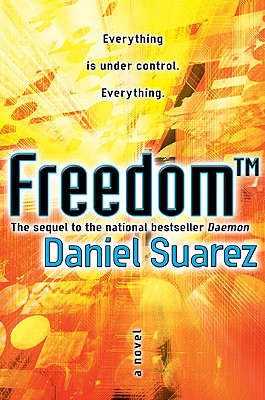
 by
byShlok and John Robb have already endorsed Freedom(TM) by Daniel Suarez, the sequel to his earlier bestselling Daemon
Other Posts on Freedom(TM):
Shlok and John Robb have already endorsed Freedom(TM) by Daniel Suarez, the sequel to his earlier bestselling Daemon
Other Posts on Freedom(TM):
A big hat tip to John Robb for finding and posting this gem. I guess Nazism, the French and Russian Revolutions, the Spartacus Revolt and several world religions could all have been ignited by an inspired moment of interpretive dance:
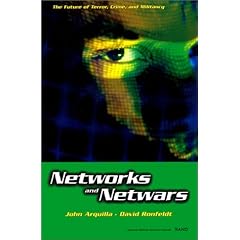
John Arqilla, along with David Ronfeldt, was the pioneering military and security theorist who forseaw the rise of networked non-state adversaries, which they detailed in their now classic book, Networks and Netwars. Below, in a Foreign Policy mag article, Arquilla expounds on the failure of the Pentagon to adapt sufficiently to leverage the power of networks or counter those opponents who have done so.
When militaries don’t keep up with the pace of change, countries suffer. In World War I, the failure to grasp the implications of mass production led not only to senseless slaughter, but also to the end of great empires and the bankruptcy of others. The inability to comprehend the meaning of mechanization at the outset of World War II handed vast tracts of territory to the Axis powers and very nearly gave them victory. The failure to grasp the true meaning of nuclear weapons led to a suicidal arms race and a barely averted apocalypse during the Cuban missile crisis.
Today, the signs of misunderstanding still abound. For example, in an age of supersonic anti-ship missiles, the U.S.Navy has spent countless billions of dollars on “surface warfare ships” whose aluminum superstructures will likely burn to the waterline if hit by a single missile. Yet Navy doctrine calls for them to engage missile-armed enemies at eyeball range in coastal waters.
The U.S. Army, meanwhile, has spent tens of billions of dollars on its “Future Combat Systems,” a grab bag of new weapons, vehicles, and communications gadgets now seen by its own proponents as almost completely unworkable for the kind of military operations that land forces will be undertaking in the years ahead. The oceans of information the systems would generate each day would clog the command circuits so that carrying out even the simplest operation would be a terrible slog.
And the U.S. Air Force, beyond its well-known devotion to massive bombing, remains in love with extremely advanced and extremely expensive fighter aircraft — despite losing only one fighter plane to an enemy fighter in nearly 40 years. Although the hugely costly F-22 turned out to function poorly and is being canceled after enormous investment in its production, the Air Force has by no means given up. Instead, the more advanced F-35 will be produced, at a cost running in the hundreds of billions of dollars. All this in an era in which what the United States already has is far better than anything else in the world and will remain so for many decades.
These developments suggest that the United States is spending huge amounts of money in ways that are actually making Americans less secure, not only against irregular insurgents, but also against smart countries building different sorts of militaries. And the problem goes well beyond weapons and other high-tech items. What’s missing most of all from the U.S. military’s arsenal is a deep understanding of networking, the loose but lively interconnection between people that creates and brings a new kind of collective intelligence, power, and purpose to bear — for good and ill…..”
Read the rest here.
It was nice to see Arquilla give some props to VADM Art Cebrowski, who is underappreciated these days as a strategic thinker and is much critricized by people who seldom bothered to read anything he actually wrote. Or who like to pretend that he had said a highly networked Naval task force is a good way to tackle an insurgency in an arid, mostly landlocked, semi-urban, middle-eastern nation.
It also occurs to me that one of the reasons that the USAF resisted drones tooth and nail is that robotics combined with swarming points to en end ( or serious diminishment) of piloted warplanes. Eliminating the design requirements implicit in human pilots makes for a smaller, faster, more maneuverable, more lethal aircraft that will probably be infinitely cheaper to make, more easily risked in combat and usable for “swarming”. Ditto attack helicopters.
Of course, nuclear bombers will probably stay in human hands. Probably.
ADDENDUM:
Contentious Small Wars Council thread on Arquilla begun by “student of war” and defense consultant Wilf Owen. I have weighed in as has Shlok Vaidya.


Complicit: How Greed and Collusion Made the Credit Crisis Unstoppable
Inside Cyber Warfare: Mapping the Cyber Underworld
Received courtesy review copies of two books that will serve to “stretch” my knowledge base and increase my cognitive map.
Mark Gilbert is a financial columnist and bureau chief for Bloomberg News in London and he has written a hard hitting deconstruction of  the great credit collapse and crisis bail-out of 2008-2009. Gilbert is telling a story of breathtaking risk assumption, regulatory capture, academic hubris, central bankers as naked emperors and unrepentant banksters who have learned nothing and forgotten nothing from the crisis. My personal background in credit issues is rooted solidly in the dustily agrarian economic history of the 19th century and the painful transition from yeoman “book debt” to gold standard dollars, so I look forward to broadening my understanding of modern financial systems from reading Complicit.
I will probably review Complicit in a cross-blog conjunction with Lexington Green, who also has a copy in his possession.
Jeffrey Carr is the CEO of GreyLogic and a researcher, presenter and consultant on issues related to cybersecurity, hacking, cyberterrorism and asymmetric conflicts in virtual domains. Carr offers a cohesive and compact look at the major problems and players in the uncertain crossroads of national security and cyberspace. Non-geeks (like myself) will appreciate Carr’s focus in Inside Cyber Warfare on the connection to the worlds of intelligence, law enforcement, international law and military operations and doctrine. As an added bonus, the foreword is by Lewis Shepherd, another blogfriend and the former Senior Technology Officer of the DIA.
Originally, I had wanted to review Inside Cyber Warfare before last Christmas, so now that I have the book, I will move it to the top of my titanic reading pile.


Emergence: The Connected Lives of Ants, Brains, Cities, and Software
This classic popular text from 2001 still holds up well as an introduction into the phenomena of emergence and the nature of self-organizing systems. Johnsaon uses a rich array of analogies and historical anecdotes to bring  the reader to an understanding how bottom-up, “blind”, systems work and the principles behind them. Highly readable and next to no jargon. Probably due soon for an updated edition though, given the scientific advances in research in network and complexity studies.
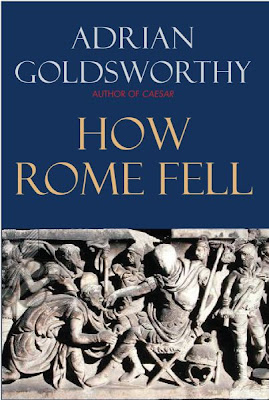
How Rome Fell: Death of a Superpower
Superb overview of the decline and fall of Rome with a rejection of the traditional assertions of causations for the end of the Roman empire ( Barbarians, Christianity etc.). Goldsworthy also sharply criticizes the popular idea among postmodern classicists today that the Roman Empire was “really” as strong during the fourth and fifth  centuries as it was during the golden age of philosopher-warrior-emperor Marcus Aurelius. Or that there was no fall of the empire at all, just a gentle “transformation” into something new. Goldsworthy discusses the likelihood of Late antquity “paper legions” of Roman armies which, in any event, scarcely resembled in elan, tactics or fighting strength the ones that Julius Caesar wielded in Gaul. A tour de force marred only by a weird epilogue that ranges from pedestrian to ( in it’s last sentences) truly awful – was it it tacked on as an afterthought? Did the editor of the rest of the book die before it was completed? Regardless, How Rome Fell is a worthy addition to an collection of popular ancient histories.
The War of Art: Break Through the Blocks and Win Your Inner Creative Battles
A rare, nonfiction book by novelist and blogger Steven Pressfield. The War of Art is a book that I strongly recommend to aspiring writers ( which includes most bloggers) and other people pursuing dreams, not because it  is brilliant but because it is profound. Utilizing select personal vignettes and other anecdotes, Pressfield distills in everyday language the essence of what creative people need to understand if they are to succeed – concepts of “resistance”, which seductively undermine your efforts, and being a “professional”, which is the mindset that will get you there.
Most of the readers of this blog are interested in military affairs to some extent so I will use this reference to explain why I read The War of Art from cover to cover. Pressfield captures the difference in what Col. John Boyd called the question of “To be or to do. Which way will you go?”. By Boyd’s definition, Pressfield is a doer.
Steven Pressfield blogs on The War of Art of writing every Wednesday.

Zenpundit is a blog dedicated to exploring the intersections of foreign policy, history, military theory, national security,strategic thinking, futurism, cognition and a number of other esoteric pursuits.
Customized Web Site & Blog Design