zenpundit.com » africa

Archive for the ‘africa’ Category

Nairobi tweets 1: Bulletproof?

Sunday, September 22nd, 2013

[ by Charles Cameron — taking a hint from the twitter stream of HSM Press and running with it ]

Update:


As of Monday morning 11am California time:

I now think it’s clear that the twitter stream I was commenting on in this post and the second in the series was not an official Shabaab feed, and thus untrustworthy as to its statements — although it’s exact status (fan, mimic, troll, loosely connected?) is undetermined.

I am leaving the post up (a) for the record, and (b) for whatever minor interest it may still have.

Original post:

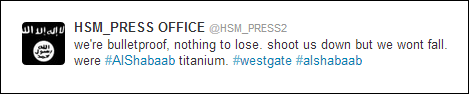
Al-Shabaab’s “HSM Press Office” had been tweeting up a storm during the Nairobi mall “operation” — it’s been shut down at least rwice, maybe more? — and some of the claims made are worth a little exploration. Let’s start with the “bullet-proof” claim:
**

For some (not by any means exhaustive) historical context on that, consider this report from the Phillipines a decade ago:

The kidnapped head of the Jesus Miracle Crusade, fiery televangelist Wilde Almeda, particularly has special powers that will protect him from bullets, said Robert Chua, a member of the group. Almeda and the 12 other members of his ministry went to the camp of the Muslim extremist group Abu Sayyaf in southern Jolo island on Saturday to pray over 20 mostly-foreign hostages seized by the rebels from a Malaysian resort on April 23 and to convince the kidnappers to free their captives. The military says they together with a German journalist, Andreas Lorenz, are also now being held hostage by the notorious Abu Sayyaf.

This, from Myanmar:

Thailand said Wednesday it may give humanitarian asylum to Johnny and Luther Htoo, the twin boy leaders of a mystical rebel movement from Myanmar who have surrendered with some of their followers. Hunted and hungry, 14 members of the God’s Army group – nine of them children, including the charismatic twins – turned themselves over to Thai authorities on Tuesday after a year on the run along the Thai-Myanmar border. For more than three years, the boys fought to overthrow Myanmar’s military government, and their followers believe Johnny and Luther have magical powers that make them invincible in battle.

Or this from the Lakota Ghost Dancers:

The presence of the troops frightened the dancers into running for the outlying areas of the some skirmishes fought. One legend of the Ghost Shirt was born during one of these skirmishes. The Ghost Shirt was part of the special clothing worn while dancing the Ghost Dance. The Sioux were the only Indians to give the Ghost Shirt bullet proof qualities. (2-42) During one of the skirmishes with the soldiers, a lone Indian rode his pony within easy rifle range of soldiers, line and allowed them to fire on him. Whether true to the qualities of the Ghost Shirt he was wearing, or due to the poor shooting of the soldiers he escaped unscathed.

And this, from Thomas Muentzer‘s Anabaptist deviants in Martin Luther‘s early Protestant Europe:

They’re singing hymns. They literally are awaiting a glorious triumph. Muentzer assures them that he will catch the cannonballs in his shirthhsleeves. Of course, it turned into a slaughter. Five thousand ill-equipped peasants were slaughtered. The Peasants’ Revolt was utterly destroyed. It was one of those incredible explosions of apocalypticism that arise in history.

**

Just whether the individuals in the Nairobi mall or tweeting for HSM Press take that “bullet-proof” reference literally or figuratively is an open question.

For a sense of the levels of non-scientific thinking — ie shamanism aka “witchcraft” — in today’s Kenya, see for instance this semi-skeptical account and its apocalyptic touch, or perhaps Believe it or not: Witchcraft in Kenya, with this interesting and quite relevant paragraph:

Another friend’s sister was victim of a grenade attack at a church in Mombasa. Shattered glass went everywhere but she, standing at the window, was not injured. She said that people were muttering things about the protection afforded by genies. Interestingly, she was at church but had recently converted to Islam, not that anyone knew. Not anyone visible, anyway.

And before we assume that all these experiments pitting prayer against guns always turn out badly for the prayerful side — it’s worth noting that “fiery televangelist Wilde Almeda” survived to tell the tale….

**

There’s a great deal more of interest on several levels in the HSM tweets, but I’ll break here and pick up in a following post.

Vital knowledge — or fatal ignorance?

Sunday, September 22nd, 2013

[ by Charles Cameron — a DoubleQuote in two tweets on the importance of religious knowledge in due season ]
.

From about a month ago:

**

Today:

News from the near blogosphere: I

Wednesday, July 10th, 2013

[ by Charles Cameron — listen up if you get the chance ]
.

It is possible that this post will reach some of you in time to tune in to this testimony:

**

I’m posting this here because I hope some of you will be able to watch this session live, but also because I think it’s indicative of a shift that is happening — and it’s a shift I’ve been hoping for and wanting to talk about here on Zenpundit. That shift has to do with the blogosphere, and to my mind it’s a very positive one.

I’ll have more on that later — but first, I wanted to get the word out about this session. More, hopefully, a few hours from now.

Moral Degeneration in the Crucible of War

Wednesday, June 12th, 2013


The recent post on Is 4GW Dead? stirred a great deal of interest, so I would like to extend the discussion on a point that that is critical not only for those who have responsibility for conducting military campaigns, but for statecraft and policy as well.

One of more important tenets of 4GW was the importance of “the moral level of war”, drawn from Colonel John Boyd’s thinking on the strategic impact of a combatant’s behavior, immoral  or exemplary, on all observers – belligerents, civilian noncombatants, neutral third parties, the media, the combatant’s own soldiers and citizens back home. Here is Boyd:

Morally our adversaries isolate themselves when they visibly improve their well being to the detriment of others (allies, the uncommitted), by violating codes of conduct or behavior patterns that they profess to uphold or others expect them to uphold.

· Morally we interact with others by avoiding mismatches between what we say we are what we are and the world we have to deal with, as well as by abiding by those other cultural codes or standards we are expected to uphold.

In a Reader’s Digest version of Boyd,  heroic, noble and magnanimous  behavior is admirable and attractive while hypocrisy, cruelty and cowardice are repulsive and antagonizing characteristics. While the former won’t guarantee your victory and the latter, unfortunately, won’t ensure your defeat, they will be a significant factor in ameliorating or generating friction.  The impression given by an army impacts the will of the enemy to fight, the morale and discipline of the soldiers, the restiveness of the civilians, the loyalty of allies and the goodwill of neighbors.

Boyd developed his thinking about the moral level of war in Patterns of Conflict  all the way up to grand strategy and above. The rub about the moral level  is that war is a crucible that puts every “cultural code” or “standard” to the test, as well as the character of the men fighting it and their leaders upon whom great responsibility rests.  Even with the best of intentions in policy and careful generalship in the field, the horrors of war can erode moral fiber and military discipline in an army, in a company or in the heart of one man. Nor does every army begin with good intentions and effective discipline – some fighting forces are scarcely to be regarded as “armies” at all while others embrace the darkness as a matter of policy.

In terms of warfare, let us define “moral degeneration” as a degraded state of moral decline where a belligerent has effectively abandoned the operational and tactical restraints on conduct mandated by the Laws of War (i.e. war crimes are SOP) and in some instances, the vestiges of civilization.

A textbook example of this kind of moral degeneration came to light a few weeks ago when a jihadi lunatic in Syria, a rebel commander Khalid al-Hamad, who goes by the name of “Abu Sakkar”, cut out the heart of a (presumably) dead government soldier and ate it on video. Charles Cameron expounded at length upon this minor atrocity here. I am not, to say the least, a fan of radical, revolutionary, transnational Sunni Islamism but I cannot honestly say that its proponents like Abul Mawdudi , Sayid Qutb, Abdullah Azzam, Osama bin Laden and their ilk ever openly advocated cannibalism. It is much more likely that Mr. al-Hamad’s behavior is explained by the ferocity of the civil war in Syria eroding customary norms of the combatants than  it is by Islamist ideology.

Moral degeneration in war seems to spring from two directions:

a) As a calculated act of Policy, from the top down, enforced by the leadership by military discipline and bureaucratic control.

b) As a spontaneous reaction by soldiers or fighters, appearing from the bottom up, without orders and frequently, in spite of them, possibly due to a breakdown in the chain of command, an erosion of discipline or sheer mutiny for the age-old purpose of reprisal, pillage and rapine.

The first category often occur with war as a convenient cover rather than a cause of grave crimes against humanity that leaders and  ideologues had long wished to carry out. The Armenian Genocide, as John Keegan wrote, belongs properly to the history of Ottoman imperial policy than it did WWI; in truth, the Genocide was the greatest and worst in a long succession of vicious pogroms that the Ottomans had launched against their Armenian Christian subjects during the reign of Abdul Hamid and the Young Turks. The Holocaust (which had some inspiration in Hitler’s mind, from the fate of the Armenians) was more closely tied to the evolution of  Nazi war policy but once Operation Barbarossa opened up the vast spaces of Soviet Eurasia, “the East” in Nazi parlance, the war itself increasingly took a backseat to expediting Hitler and Himmler’s ghastly and murderous racial priorities. This is a pattern of a priori planning, an escalating ideological radicalization of society that tends to be present with most of the large scale democides and genocides. It is the organizational powers of  coercion utilized by the state, or a mobilized faction of , it that makes the enormous scale of death possible, not the war.

What is different and also dangerous about moral degeneration from the bottom-up, is that it is cultural evolution driven by the psychological effects of extreme violence at work and, unlike an act of policy, more likely to be diffused widely across society as a permanent change for the worse. Too many German soldiers in WWI, former peasants and artisans and boys from middle-class families, returned from the Western Front morally coarsened and addicted to the adrenalin rush of combat and became in succession Freikorps paramilitaries, Communist streetfighters, Nazi Stormtroopers and SS men. The World War also gave Russia the men of the Cheka, the Red terror and the first Gulags on the Bolshevik Left and brutal and mad warlords on the White Right.

In more recent two decades, the break-up of Yugoslavia unleashed atavistic passions of ethnic hatred and atrocity, while organized society in Western African states and central Africa broke down entirely in transnational regional civil wars with unrestrained massacres and mass rape. As a result, there is little that is political but much that is primeval, at this juncture, to explain Joseph Kony’s motivations; he resembles nothing so much as a 21st century Kurtz. Mexico too is degenerating from the escalating violence of cartel insurgency and narco-cultas – there is not much tactical or strategic value in pagan death cults or human sacrifice but it is spreading:

…Our impression is that what is now taking place in Mexico has for some time gone way beyond secular and criminal (economic) activities as defined by traditional organized crime studies.3 In fact, the intensity of change may indeed be increasing. Not only have de facto politicalelements come to the fore-i.e., when a cartel takes over an entire city or town, they have no choice but to take over political functions formerly administered by the local government- but social (narcocultura) and religious/spiritual (narcocultos) characteristics are now making themselves more pronounced. What we are likely witnessing is Mexican society starting to not only unravel but to go to war with itself. The bonds and relationships that hold that society together are fraying, unraveling, and, in some instances, the polarity is reversing itself with trust being replaced by mistrust and suspicion. Traditional Mexican values and competing criminal value systems are engaged in a brutal contest over the ?hearts, minds, and souls‘ of its citizens in a street-by-street, block-by-block, and city-by-city war over the future social and political organization of Mexico. Environmental modification is taking place in some urban centers and rural outposts as deviant norms replace traditional ones and the younger generation fully accepts a criminal value system as their baseline of behavior because they have known no other. The continuing incidents of ever increasing barbarism-some would call this a manifestation of evil even if secularly motivated-and the growing popularity of a death cult are but two examples of this clash of values. Additionally, the early rise of what appears to be cartel holy warriors may now also be taking place. While extreme barbarism, death cults, and possibly now holy warriors found in the Mexican cartel wars are still somewhat the exception rather than the rule, each of these trends is extremely alarming, and will be touched upon in turn.

The crucible of war either tempers a people or it breaks them.

Of images and likenesses

Thursday, May 30th, 2013

[ by Charles Cameron — a storm in a tea-kettle, various resemblances to Hitler, how Pudovkin perceived and practiced montage, what happened when the talkies came along, and four faces of Christ ]
.

It begins with something as innocent ad a tea kettle:

Does this otherwise innocuous tea kettle resemble Hitler? Does it look enough like Hitler to merit JC Penney withdrawing it from sale?

**

Let’s take a look at a couple of other “resemblances to Hitler”:

Who most resembles Hitler — Chaplin, or Stalin?

On the face of it, that’s an easy question. If I were to just ask you the question “who is most like Hitler” in words, you might very well say Stalin, or Pol Pot perhaps — or, I suppose, if you were very focused on World War II and the Axis leaders, Mussolini.

And if I asked you “who looks most like Hitler?” you might well say Charlie Chaplin — but you’d be “thinking visually” in terms of appearances, rather than “verbally” in terms of meanings.

So there are at least two different ways someone can resemble Hitler — in terms of appearance, and in terms of behavior.

**

We don’t notice our own noses most of the time, even though they’re within our field of vision — and it’s a bit like that with likeness. We don’t have a grammar of resemblance, and that’s part of what I want to explore here, in drawing your attention to these two ways (at least) in which we can think of someone resembling Hitler.

Placing two pictures side by side — Charlie Chaplin and Hitler, Hitler and Joseph Stalin — gets us to think a bit about the parallelisms and oppositions. And that’s a large part of what my DoubleQuotes format is good for. I am interested in what the mind does with juxtapositions, and I’m interested in getting us able to hold two contrasting thoughts in mind at the same time. As F Scott Fitzgerald said:

The test of a first-rate intelligence is the ability to hold two opposed ideas in mind at the same time and still retain the ability to function.

I’m in two minds as to whether he’s right, of course.

**

So montage. So the beginnings of Russian cinema, and the great directors of the silent era in film, Vsevolod Pudovkin and Sergei Eisenstein.

Pudovkin wrote quite a bit about montage, about what he called relational editing, telling us:

editing is not merely a method of the junction of separate scenes or pieces, but is a method that controls the “psychological guidance” of the spectator.

He talked about five modes of editing, getting close to the foundations of a grammar of resemblance of the kind I mentioned above — contrast, paralleliem, symbolism, simultaneity and leit-motif. He said, for instance:

Suppose it be our task to tell of the miserable situation of a starving man; the story will impress the more vividly if associated with mention of the senseless gluttony of a well-to-do man.

and went on:

it is possible not only to relate the starving sequence to the gluttony sequence, but also to relate separate scenes and even separate shots of the scenes to one another, thus, as it were, forcing the spectator to compare the two actions all the time, one strengthening the other.

Under the heading of Symbolism, he noted:

In the final scenes of the film Strike the shooting down of workmen is punctuated by shots of the slaughter of a bull in a stockyard. The scenarist, as it were, desires to say: just as a butcher fells a bull with the swing of a pole-axe, so, cruelly and in cold blood, were shot down the workers.

I don’t suppose I’m alone in thinking here of the ending of Coppola‘s Apocalypse Now — and I doubt Coppola would have been unaware of the tribute he was paying to one of the early masters of cinematography, either. And what doe Pudovkin say about the symbolic editing together of the shooting of workmen punctuated by the slaughter of a bull?

This method is especially interesting because, by means of editing, it introduces an abstract concept into the consciousness of the spectator without use of a title.

**

All this, of course, during the silent era. And when the talkies begin…

After the advent of the talking pictures, Eisenstein, Pudovkin, Alexandrov and Vertov issue a statement, attempting to salvage the emotional impact of montage which is in danger of being capsized by the oh so new and glittery charm of verbals — of people talking:

Only a contrapuntal use of sound in relation to the visual montage piece will afford a new potentiality of montage development and perfection.

The first experimental work with sound must be directed along the line of its distinct nonsynchronization with the visual images. And only such an attack will give the necessary palpability which will later lead to the creation- of an orchestral counterpoint of visual and aural images

You see what’s going on here? Eisenstein, Pudovkin, Vertov want the mind to be working on two tracks of ideation at once — a visual track, full of emotional impact, and a verbal track, in counterpoint to the visual.

They want us to be able “to hold two opposed ideas in mind at the same time” — not in synchrony but in counterpoint.

So this business of juxtaposition, of contrapuntal thinking, goes quite deep, and it’s my contention that it’s a skill we need both to develop and to understand — hence my interest in building a grammar of resemblance, of rhyme, of fugue, of graphic match, of equation.

**

One final example. If the “likeness of Hitler” example confronted us with the “nature of likeness” as between facial resemblance and similarities of behavior, this next instance will deal more with “evidence of likeness”:

Here’s the question: are these “real” likenesses?

**

The two likenesses above are both of interest as possible “likenesses of Christ” — the top one taken from the Shroud of Turin, the lower one allegedly photographed in the snow, perhaps in China. The image on the Shroud might be a sort of “photographic negative” of the actual face of man a crucified two thousand years ago — and scientific techniques may or may not offer us evidence as to that likelihood. The other image — supposedly of the face of the same Christ, this time seen and recognized by a photographer in shadows on snow — how does one check the provenance of an image like that?

We don’t have a photographic record of what Christ looked like to compare our own images with — unless the Shroud turns out to offer us just that — so it’s likely we’re back at the distinction first drawn by theologians over a century ago, between “the Jesus of History” and “the Christ of Faith”.

Consider the two images below, neither one perhaps what a camera might have seen if a photographer could time-travel back two thousand years, but each suited to the people for whom it was produced — in China, in Africa:

The Christs these two images evoke come from a different mode of seeing to the images captured in biometric scans and on ID cards — yet they are well-suited for devotion and inspiration…


Switch to our mobile site

