zenpundit.com » humor

Archive for the ‘humor’ Category

On the felicities of graph-based game-board design: ten

Sunday, October 9th, 2016

[ by Charles Cameron — a long, lazy Sunday post, packed with quirky interest and neat maps ]
.

Ten? What’s so special about ten, hunh? Just because you have ten fingers, you suppose that makes ten special?

**

One:

As simple as a map can get:

worry-line
Simon Kirby, The Worry Line

Two:

As complex as one can get:

most-complex-ny
Eric Jaffe, The World’s 15 Most Complex Subway Maps

And I mean complex, cognitively complex:

When it comes to information processing, an average person’s “cognitive threshold” is about 250 connections, or the equivalent of roughly eight bits of data, according to the researchers. New York’s system neared that limit, with 161 total connections, and the most complicated two-transfer trip a person could make on the subway exceeded it—clocking in at 8.1 bits. Maps for the Paris Metro (with 78 total connections), Tokyo Metro (56), and London Tube (48) clustered around six bits of information.

Three:

Naked:

naked-map
Nick van Mead, Can you identify the world cities from their ‘naked’ metro maps?

The Guardian wanted to know if you could recognize various cities if shown their metro maps without the stations markings.. and i could manage Chicago (above).

Four:

Coffee:

coffee-shop-mapo
Chris Ward, Coffee Stops

Sadly, the map is not the territory, or I could get my Java from South Ken while sitting at my desk just outside Sacramento.

The London Coffee Map, “Coffee Stops,” was designed by Chris Ward, who calls himself “the boss who works from coffee shops.” He recently published Out of Office: Work Where You Like and Achieve More, a best-selling guide to leading a successful working life outside an office building. Apparently, being properly caffeinated is one of his biggest tips. Now you can grab your joe at local London cafes with quaint names like Scooter and Electric Elephant.

Five:

Mug:

I could then quaff it from an appropriately poetical Map Mug:

50112-greater-shakespeare-map-mug-normal
Royal Shakespeare Company, Greater Shakespeare Map Mug

The map here representing affinities between characters in the Bard’s various plays:

greater-shakespeare-map-rsc

**

Interlude:

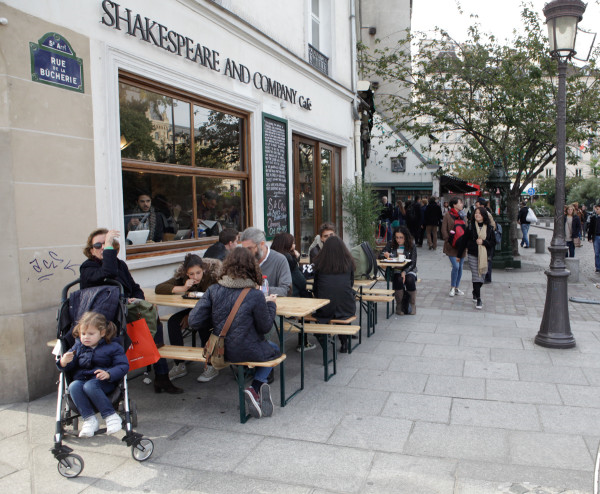
— and we’re half way to ten, let’s imagine ourselves at Shakespeare and Co‘s bookstore and cafe in Paris

shakespeare-co

**

Six:

Calvino

While we’re on a literary streak, here’s a thumbnail of one of artist Rod McLaren‘s illuminations of Italo Calvino‘s Invisible Cities:

italo-calvino-mapped
Rod McLaren, Invisible Cities Illustrated #2: Trude/Ersilia

The detail here is fantastic, as befits Calvino’s work:

The diagram, a network of curved lines connecting to every other node on a 6 x 5 grid, has two configurations: if the picture is hung one way up, it shows the “Ersilia configuration” (where the lines are like the threads strung between the buildings of Ersilia); if hung the other way up, it shows that of Trude (where the lines are like a complicated airline route map).

Ersilia (Trading Cities 4, p78):

In Ersilia, to establish the relationships that sustain the city’s life, the inhabitants stretch strings from the corners of the houses, white or black or gray or black-and-white according to whether they mark a relationship of blood, of trade, or authority, agency. When the strings become so numerous that you can no longer pass among them, the inhabitants leave: the houses are dismantled; only the strings and their supports remain. From a mountainside, camping with their household goods, Ersilia’s refugees look at the labyrinth of taut strings and poles that rise in the plain. That is the city of Ersilia still, and they are nothing.

They rebuild Ersilia elsewhere. They weave a similar pattern of strings which they would like to be more complex and at the same time more regular than the other. Then they abandon it and take themselves and their houses still farther away.

Thus, when travelling in the territory of Ersilia, you come upon the ruins of the abandoned cities, without the walls which do not last, without the bones of the dead which the wind rolls away: spiderwebs of intricate relationships seeking a form.

Trude (Continuous Cities 2, p128):

If on arriving at Trude I had not read the city’s name written in big letters, I would have thought I was landing at the same airport from which I had taken off. The suburbs they drove me through were no different from the others, with the same greenish and yellowish houses. Following the same signs we swung around the same flower beds in the same squares. The downtown streets displayed goods, packages,signs that had not changed at all. This was the first time I had come to Trude, but I already knew the hotel where I happened to be lodged; I had already heard andspoken my dialogues with the buyers and sellers of hardware; I had ended other days identically,looking through the same goblets at the same swaying navels.

Why come to Trude? I asked myself. And I already wanted to leave.

“You can resume your flight whenever you like,” they said to me, “but you will arrive at another Trude, absolutely the same, detail by detail. The world is covered by a sole Trude which does not begin and does not end. Only the name of the airport changes.”

All of which reminds me of nothing so much as Antonio Gaudi‘s model — made of hanging chains — catenaries —

inverted-model-barcelona

which when turned upside down provide the structure for his Sagrada Familia cathedral in Barcelona:

sagrada-familia

Seven:

Ghost:

Meanwhile, back in London, we have maps of the ghost (ie abandoned) London tube stops:

ghost-stations
Dylan Maryk, Ghost Stations On The London Underground

Eight:

That’s one way to de-clutter the Tube map — show what ain’t there any more.

Here’s another —

declutteredtubemap
Matt Thomason, 150 years of The London Underground

Don’t ask me what it means — seeing as Hugh Grant gets a station, it’s either gentlemanly or ungentlemanly, I’m not sure which.

Nine:

Music:

I simply didn’t know you’d have to travel this far to get from Dylan to the Beatles:

london_music_genres_detail
Dorian Lynskey, in Tufte, Response to London Underground maps

I mean —

bob-dylan-john-lennon
Michelle Geslani, The Beatles and Bob Dylan met 50 years ago today

Ten:

I’ve kept this one for last because in some ways it’s the subtlest:

exhibition-in-borders-we-trust

It’s the work of architect Jug Cerovic., and on his page In Borders We Trust he offers this conceptual comment:

Borders are primarily a mental construct.

Just like a deity, they exist only insofar as People believe in them. Question is however how necessary our belief in their existence is and when exactly does that belief start harming us?

At which point do borders cease to be a convenient orientation marker, a helpful tool for the comprehension of the land we inhabit, a common identifier for the construction of a shared identity? At which point do borders become a dogmatic limitation to imagination, a terrifying prison for the body and mind, a symbol and support of hatred?

Borders do not possess an inherent bad or good character, on the contrary they are a malleable concept subject to appropriation and interpretation.

“In borders we trust” examines the perception, physical manifestation and enforcement of the couple formed by People and Borders focusing on three key areas of the contemporary migration routes:

  • Gibraltar
  • Serbia
  • Levant
  • For this purpose the peculiar relationship between Borders and People is illustrated with a sequence of three distinct maps:

  • Borders without People
  • Borders with People
  • People without Borders
  • This novel perspective of a seemingly familiar representation, with each component of the couple shown separately and juxtaposed to their combined illustration, questions the articulation and pertinence of our present predicament.

    Happily, this is an area that I’ve delved into at some length myself in my earlier post, No man’s land, one man’s real estate, everyone’s dream? — with specific reference to ISIS’ bulldozing of the border between Iraq and Syria, and the Basque country, Euskadi, saddling the French / Spanish border.

    Cerovic has achieved an eminently practical limited version of one of my own grandiose castle-in-air schemes — building a universal graphical mapping system. Cerovic’s version offers us a universal graphical underground / tube / metro mapping system, in the form of his book One Metro World — you still have a couple of weeks to support it on Kickstarter!

    map-app

    **

    Earlier in this series:

  • On the felicities of graph-based game-board design: preliminaries
  • On the felicities of graph-based game-board design: two dazzlers
  • On the felicities of graph-based game-board design: three
  • On the felicities of graph-based game-board design: four
  • On the felicities of graph-based game-board design: five
  • On the felicities of graph-based game-board design: six
  • On the felicities of graph-based game-board design: seven
  • On the felicities of graph-based game-board design: eight
  • And hey, and we’re back at maps — where we started in

  • On the felicities of graph-based game-board design: nine

  • WaPo just can’t bear their faces?

    Sunday, October 9th, 2016

    [ by Charles Cameron — the words “substitute teachers” come to mind ]
    .

    There’s nothing like quoting the recent past to illustrate the near future, eh?

    presidential-vice-presidents-wapo-savedhttps://twitter.com/postpolitics/status/785172785417125889

    I guess these guys seem more presidential?

    **

    Edited to add: Okay, revised version, 20 minutes later:

    https://twitter.com/washingtonpost/status/785177688839520257

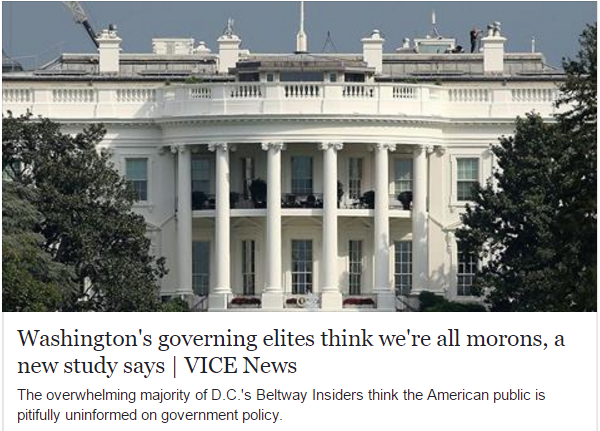
    Washington’s governing elites think we’re all morons

    Monday, October 3rd, 2016

    [ by Charles Cameron — a study in the mighty and their lowly, knowledge and ignorance, truth and falsehood ]
    .

    all-morons

    Vice News, Washington’s governing elites think we’re all morons

    **

    First, if you’ll permit, the simple truth:

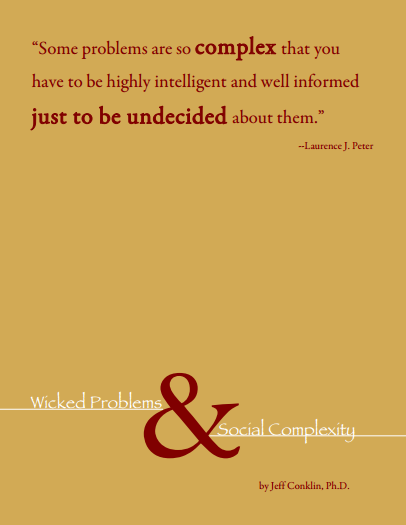
    Some problems are so complex that you have to be highly intelligent and well informed just to be undecided about them.

    That’s Laurence J Peter, and it’s a quote so succinct and powerful that Jeff Conklin puts it, in large print, above the title of his pamphlet on wicked problems:

    conklin-cover-wicked-problems

    The simple truth is that the truth is complex, beyond the minds of elites and morons, deplorables and desirables alike.

    **

    Next, the untruth:

    The untruth is in a view down the nose from one human person at another, or at a group, a crowd, a mob — a diversity of others.

    Clinton:

    You know, to just be grossly generalistic, you could put half of Trump’s supporters into what I call the ‘basket of deplorables’. Right? The racist, sexist, homophobic, xenophobic, Islamaphobic – you name it.

    Romney:

    There are 47 percent of the people who will vote for the president no matter what. All right, there are 47 percent who are with him, who are dependent upon government, who believe that they are victims, who believe the government has a responsibility to care for them, who believe that they are entitled to health care, to food, to housing, to you-name-it. That that’s an entitlement. .. These are people who pay no income tax. Forty-seven percent of Americans pay no income tax. So our message of low taxes doesn’t connect. .. And so my job is not to worry about those people. I’ll never convince them they should take personal responsibility and care for their lives.

    Such sentiments remind me irresistably of the Magnificat — given here in my own version:

    He is not one who is ashamed to show his strength,
    and buffets proud folk about like leaves in a gale.
    He upsets those that hold themselves high and mighty
    and rescues the least one of us.
    He feeds the hungry,
    and tells the rich they can go fetch their own food.

    **

    And then the nuance..

    Let’s start with the fact that I’m a snob. I’m an almost equal-opportunity despiser. I prefer not to act on my snobbery, except when choosing which sorts of books and music I wish to consume, but it’s there in me, like an undertow, like an unrest.

    Now we’ve gotten that out of the way, here’s the setup, as described in What Washington Gets Wrong:

    73 percent of government officials think the public knows little or nothing about programs aimed at helping the poor, 71 percent of them think the public knows little or nothing about science and technology policy, and 61 percent of them think the public knows almost nothing about childcare. In fact, when it comes to fundamental policy areas like social security, public schools, crime, defense and the environment, it was hard to find government officials who thought the public knew “a great deal.”

    Assuming Americans know so little, government officials tend to use their own judgment rather than the people’s when making policy decisions. With issues of science and defense, more than half of officials think they should “always” or “mostly” heed their own opinions. With crime, welfare and the environment, at least 42 percent of officials who felt the same way.

    Okay, first off, government officials — how well do they stack up?

    This is from Counterpunch — it’s a succinct summary of a Jeff Stein piece from the New York Times:

    There are very few people in the U.S. government who understand basic Islamic history or even regard it as important. In 2002 Silvestre Reyes (D-Tex.), the incoming chairman of the House of Representatives Permanent Select Committee on Intelligence, was asked by a reporter whether al-Qaeda was Sunni or Shiite. “Predominantly — probably Shiite,” he responded stupidly. And what about Lebanon’s Hizbollah? “Hizbollah. Uh, Hizbollah . . . Why do you ask me these questions at 5 o’clock?” He later added, “Speaking only for myself, it’s hard to keep things in perspective and in the categories.” Obviously the Intelligence Committee chairman was unaware that Hizbollah is a Shiite organization aligned with Shiite Iran and Shiite-led Syria against al-Qaeda-type Sunni Islamist forces.

    Jeff Stein, the national security editor of Congressional Quarterly, wrote a New York Times op-ed in 2002 highlighting the (bipartisan) ignorance among Washington “counterterrorism officials” including key Congressional committee members about the divisions within Islam. He had asked many of them the fundamental question, “What’s the difference between a Sunni and a Shiite?” and was shocked by their responses. “Most American officials I’ve interviewed,” he concluded, “don’t have a clue.” Rep. Jo Ann Davis, Republican Congresswoman from Virginia then heading the subcommittee overseeing much of the CIA’s work with Muslim assets, told Stein, “The Sunni are more radical than the Shia. Or vice versa.” (In other words, all Muslims are radical; it’s just a question of degree. Talk about Islamophobia. And talk about ignorance!)

    Alabama Republican Congressman Terry Everett, head of a subcommittee on tactical intelligence, told Stein after some briefing, “I thought it was differences in their religion, different families or something. Now that you’ve explained it to me, what occurs to me is that it makes what we’re doing over there extremely difficult.” In 2001, after FBI counterterrorism chief Gary Bald had publicly revealed his ignorance about Islam, FBI spokesman John Miller declared such knowledge to be unnecessary, and indeed made it a point to belittle it. “A leader needs to drive the organization forward,” he told Stein. “If he is the executive in a counterterrorism operation in the post-9/11 world, he does not need to memorize the collected statements of Osama bin Laden, or be able to read Urdu to be effective. … Playing ‘Islamic Trivial Pursuit’ was a cheap shot for the lawyers and a cheaper shot for the journalist. It’s just a gimmick.”

    That was in 2006, ten years after Osama bin Laden’s Decxlaration of War against the United States, and five years after the 9/11 attacks on New York and Washington.

    In fact, one might say, when it comes to fundamental policy areas like defense.. government officials aren’t necessarily terribly savvy. And I’m relieved to know that by March 2014, at least, the then Chairman of the Joint Chiefs, Gen. Martin Dempsey, knew that ISIS has an “apocalyptic, end-of-days strategic vision.”

    Of course, if Dabiq falls, as it very soon many, that strategic vision may get stretched to breaking point..

    **

    So much for government officials. What of the general population, down on whom those paragons of virtue look?

    In November 2002, a year after the 9/11 attacks, according to National Geographic News:

    In a nation called the world’s superpower, only 17 percent of young adults in the United States could find Afghanistan on a map, according to a new worldwide survey released today.

    Ast forward to 2006, and a National Geographic-Roper Public Affairs Geographic Literacy Study of American youth between ages 18 and 24 finds:

    Six in ten (63%) cannot find Iraq on a map of the Middle East, despite near-constant news coverage since the U.S. invasion of March 2003. Three-quarters cannot find Indonesia on a map ñ even after images of the tsunami and the damage it caused to this region of the world played prominently across televisions screens and in the pages of print media over many months in 2005. Three-quarters (75%) of young men and women do not know that a majority of Indonesiaís population is Muslim (making it the largest Muslim country in the world), despite the prominence of this religion in global news today. Neither wars nor natural disasters appear to have compelled majorities of young adults to absorb knowledge about international places in the news.

    Of course, that’s young people.

    Young people today .. if you want to dismiss these findsings .. or young people are our future .. if you want to let the impact settle in.

    **

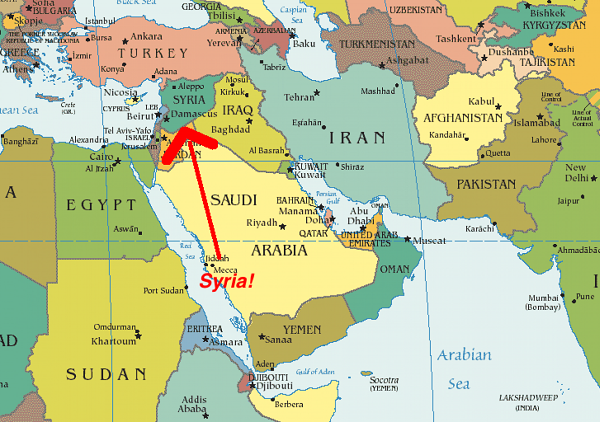
    Here, for my convenience, is a map kindly provided by The Washington Post in 2013, in an intriguing Ezra Klein piece aptly titled Most Americans can’t find Syria on a map. So what?

    syria-on-the-map

    Maybe Firesign Theater had it right when they titled their 1971 album: I Think We’re All Bozos on This Bus.

    Brutal Times 01

    Friday, September 30th, 2016

    [ by Charles Cameron — “You’re not haunted by the war, Dr Watson. You miss it.” Yes, this will be a series. ]
    .

    brutal-times-dq

    **

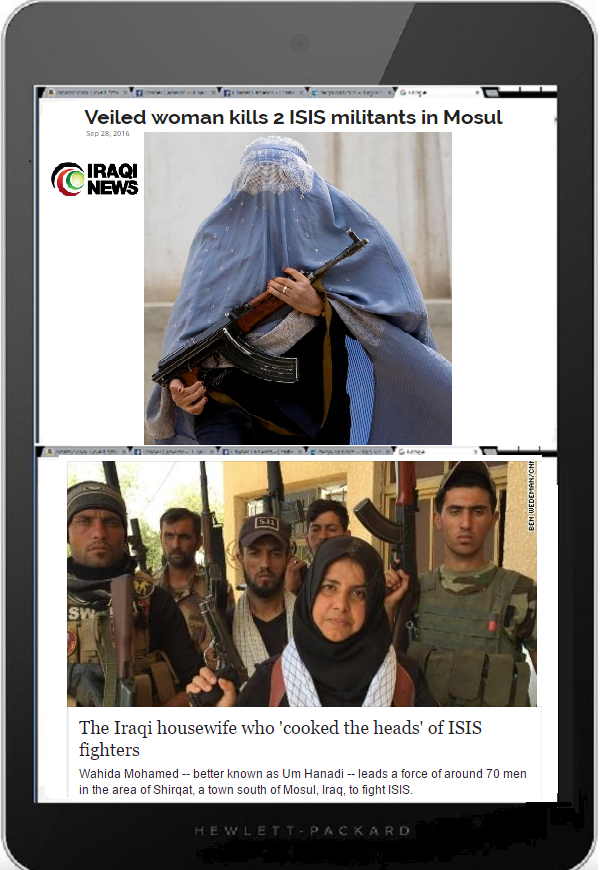
    Part of what’s interesting about the upper image above, the one of a woman (presumably) wearing a burqa and holding a gun, is the number of times it has been used by the Daily Mirror — in articles on such topics as:

    ISIS bans the BURKA after ‘veiled female assassin’ kills two terrorist commanders in Iraq
    Desperate ISIS commanders now sending female fighters to die in combat
    See US army taunt ISIS with special message in footage of coalition airstrike
    Hundreds of ISIS brides sent for COMBAT TRAINING in Libya after being ‘promoted’ from role as wives

    The legend under that last one reads “ISIS is using hundreds of women on the frontline in Libya” — which might lead one to believe the photo was taken there, in Libya. Why, then, would it also be applicable to two pieces about ISIS in Iraq?

    That image is a glorious stimulus for hatred, though, which seems to mean it bears frequent repetition. And guess what, it might have been shot with a model, a male model for that matter, in Brixton, not Libya or Afghanistan (where blue burqas are common) or Iraq…

    **

    Um Hanadi (the cook, whom you’ll notice, lower image above, does not wear a burqa) is on Facebook, CNN reports:

    After listing all the attacks against her, and all the loved ones lost to ISIS, Um Hanadi said: “I fought them. I beheaded them. I cooked their heads, I burned their bodies.”

    She made no excuses, nor attempted to rationalize this. It was delivered as a boast, not a confession.

    “This is all documented,” she said. “You can see it on my Facebook page.”

    So we checked. Among many pictures of her with her dead husbands, fighters and generals, there was a photo of her in the same black combat fatigues and headscarf holding what appeared to be a freshly severed head. Another showed two severed heads in a cooking pot. In a third photograph, she is standing among partially-burned corpses. It’s impossible to verify whether the photos are authentic or Photoshopped, but we got the point.

    Two questions for moralists / ethicists:

  • Is a woman killing ISIS militants morally or ethically any different from a man doing so?
  • Is a woman who cooks the heads of her and our deceased enemies a desirable ally?
  • **

    Hey, that Express piece about the “veiled female assassin” who killed two ISIS militants even gets to offer you this tasty view, with the accomnpanying legend “A woman wears a veil, which is now being banned in parts of northern Iraq”:

    muslim-woman-wearing-black-veil

    Now, is that hot, or what?

    **

    Sources:

  • Iraqi News, Veiled woman kills 2 ISIS militants in Mosul
  • CNN, The Iraqi housewife who ‘cooked the heads’ of ISIS fighters
  • On going shopping

    Sunday, September 25th, 2016

    [ by Charles Cameron — this one’s for the Thomas Hegghammer’s “Bored Jihadi” archives ]
    .

    For that special occasion when formal “penguin” attire is required, all black and white — yet with a casual artistic / rebellious flair:

    isis-fashion-poster2239940377

    A good place to shop for such things if you happen to be in Istanbul — Islami Giyim, or Islamic Clothing:

    jihadi-gift-shop

    Of course, you may not feel like dressing in support of terror — but you can still have swag:

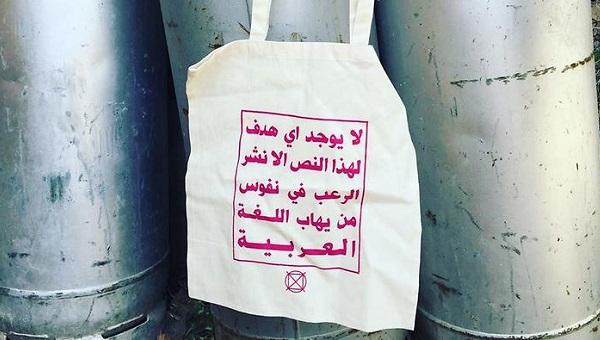
    tote

    This tote-bag carries an Arabic inscription that reads:

    The only goal of this text is to spread panic among those who fear the Arabic language.

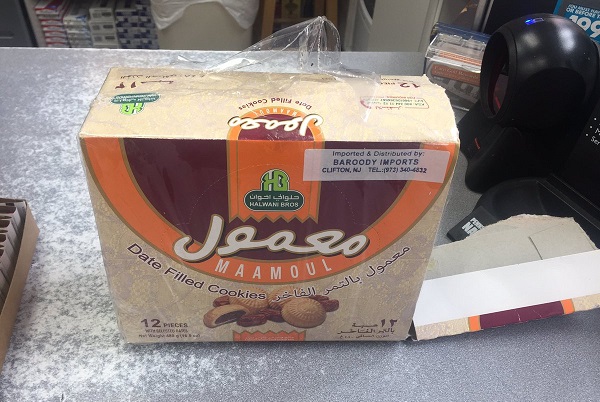
    And there are in fact people for whom a small amount of Arabic script is enough to call in the bomb squad, as occurred a few days back in Marshall’s Creek, Pennsylvania:

    cookies

    Mmm, date-filled cookies!

    **

    Sources:

  • Vocativ, The Perfect Gift for the Jihadi on Your Shopping List
  • Roads & Kingdoms, The Jihadi Gift Shop in Istanbul
  • Special Broadcasting Service, The Arabic on this tote bag is hilariously edgy
  • WNEP The News Station, Bomb Unit Investigates Box Left at Gas Station

  • Switch to our mobile site