zenpundit.com » non-state actors

Archive for the ‘non-state actors’ Category

Wikileaks and the Search for a Cryptographic Mythology

Thursday, December 2nd, 2010

[ by Charles Cameron ]

Jean Rosenfeld of the UCLA Center for the Study of Religion just posted a comment on an earlier Zenpundit post of mine, opening up a topic which may interest some readers here: that of Wikileaks founder Julian Assange’s mythological associations.

1

Jean had earlier pointed me to Assange’s use of the name “Marutukku” to describe his encryption program, and a little fishing brought me to these two Assange-related documents:

One Man’s Search for a Cryptographic Mythology
Enuma Elish

2

I’d been idly wondering about cryptographic mythology myself, as it happens, nudged by vague memories of a cache of porno images tweaked by jihadists as encoding devices for steganography.

Steganography is the cryptographic – or is it kabbalistic? — art devised by one Abbot Trithemius, whose 1518 Polygraphia is the first work on cryptography printed in Europe, and whose Steganographia was known in MS to such hermetic philosophers as Cornelius Agrippa, Giordano Bruno and John Dee. Jim Reeds captures the ambiguity of Trithemius’ work nicely in his paper, Solved: The Ciphers in Book III of Trithemius’s Steganographia, when he asks:

Is it [the Steganographia] primarily an exposition of cryptographic techniques disguised as angel magic, or is it primarily a magic work disguised as cryptography?

Readers of Frances Yates and Ioan Couliano will be somewhat familiar with these matters.

And jihadist steganography? The technique itself is described in the al-Fajr Information Center’s Technical Mujahid magazine of Feb. 2007 according to a Jamestown Foundation Terrorism Monitor piece, but the reports of actual jihadist use of the technique may turn out to be fabrications.

3

But it was Julian Assange‘s bliss we were trying to follow, right?

Assange sidekick Suelette Dreyfus wrote The Idiot Savants’ Guide to Rubberhose — which is the manual for Assange’s crypto program… but this business of naming the program gets complicated, eh?

Dreyfus explains:

If you’re wondering about the name of this program, Marutukku is the internal development name (it’s spelled Ru-b-b-e-r-h-o-s-e, but it’s pronounced M-a-r-u-t-u-k-k-u)

In case you didn’t get it, there may be a play on Lewis Carroll there, and the exchange Alice has with the White Knight in Through the Looking-Glass as to what the name of a certain very sad song is called.

Alice aside – and such detours are in fact the very method of discovery in non-linear thinking – Dreyfus offers as an epigraph to her piece the following quote:

The third name is MARUTUKKU, Master of the arts of protection, chained the Mad God at the Battle. Sealed the Ancient Ones in their Caves, behind the Gates.

which she attributes to “The Akkadian Creation Epic”. That would be the Enuma Elish.

Assange, in his One Man’s Search for a Cryptographic Mythology, attributes his choice of the name Marutukku to a conversation he had with a friend concerning the Enuma Elish, telling us (after much other curious and wandering stuff) that his friend recommended the god Marduk’s third name to him, saying

The third name is MARUTUKKU, Master of the arts of protection, chained the Mad God at the Battle. Sealed the Ancient Ones in their Caves, behind the Gates.

Assange liked the idea, observing, “Even the very word MARUTUKKU looked like it had been run through a product cipher”.

A little later in the same document, he quotes from the Enuma Elish, and the phrases given above appear in the quoted excerpts from that text – although they are not present in the version “Based on the translation of E. A. Speiser, with the additions by A. K. Grayson, Ancient Near Eastern Texts Relating to the Old Testament, third edition, edited by James Pritchard (Princeton, 1969), pp. 60-72; 501-503, with minor modifications” that Assange offers us on the sibling-page at Enuma Elish.

As Dr. Rosenberg pointed out to me, “the quote — if it is a translation — differs from other translations I found on the Internet. It is more specific and extensive and ‘mythological.'”

4

Okay, I’ve kept what may be the most practical (ie 21st century) “creative leap” made by my skittish and wandering mind for this, my penultimate paragraph.

Oxford’s Anders Sandberg blogs today about Assange’s application of network theory to conspiracies, quoting Assange as saying:

Conspiracies are cognitive devices. They are able to out think the same group of individuals acting alone Conspiracies take information about the world in which they operate (the conspiratorial environment), pass it around the conspirators and then act on the result. We can see conspiracies as a type of device that has inputs (information about the environment) and outputs (actions intending to change or maintain the environment).

And Anders’ summary of Assange’s position? “In short, conspiracies are a kind of collective intelligence enhancement.”

[ admission: I associate the name Anders Sandberg with some brilliant early net writings on role-playing games and the hermetic tradition – I’m hoping this is the same guy ]

5

Finally, let’s go back to that enhancement of the Enuma Elish text. That phrase, “Sealed the Ancient Ones in their Caves, behind the Gates” struck me, too – it reminded me of the Chthulu Mythos of HP Lovecraft, and its apocalypse:

That cult would never die until the stars came right again and the secret priests would take Cthulhu from His tomb to revive His subjects and resume His rule of earth. The time would be easy to know, for then mankind would have become as the Great Old Ones; free and wild, and beyond good and evil, with laws and morals thrown aside and all men shouting and killing and revelling in joy. Then the liberated Old Ones would teach them new ways to shout and kill and revel and enjoy themselves, and all earth would flame with a holocaust of ecstasy and freedom.

And with that quote from Lovecraft, courtesy of Erik Davis, we have returned by a commodius vicus of recirculation back to the hermetically sealing and revealing world of John Dee.

RESTREPO on Television this Monday

Monday, November 29th, 2010

An important announcement from my colleague, Lexington Green:

Lexington Green – (1) RESTREPO Monday, 11/29/10 at 9PM ET/PT; (2) Maj.Gen. Scales on Small Unit Dominance

This is the television premier of this extraordinarily film. I wrote about seeing this film here.

Restrepo chronicles the deployment of a platoon of U.S. soldiers in Afghanistan’s Korengal Valley. The movie focuses on a remote 15-man outpost, Restrepo, named after a platoon medic who was killed in action. It was considered one of the most dangerous postings in the U.S. military. This is an entirely experiential film: The cameras never leave the valley; there are no interviews with generals or diplomats. The only goal is to make viewers feel as if they have just been through a 94-minute deployment. This is war, full stop. The conclusions are up to you.

I highly recommend this film to all of our readers.

An information page for Restrepo is here, including video.

RESTREPO, an award winning documentary, was based on (or more precisely, closely related to) the book WAR by Sebastian Junger, which told the story of the war against the Taliban in the Korengal Valley, waged by the soldiers of the 2nd Platoon of Battle Company.

I previously reviewed WAR here and the movie RESTREPO here.

Guest Post: Mexico, Africa, Zarqawi?

Thursday, October 28th, 2010

Charles Cameron is the regular guest-blogger at Zenpundit, and has also posted at Small Wars Journal, All Things Counterterrorism, for the Chicago Boyz Afghanistan 2050 roundtable and elsewhere.  Charles read Theology at Christ Church, Oxford, under AE Harvey, and was at one time a Principal Researcher with Boston University’s Center for Millennial Studies and the Senior Analyst with the Arlington Institute:

Zen here – I think Charles has hit upon a primal psychological mechanism that comes into full flower as societies break down and war begins to shade into warlordism. We have seen this repeatedly in history from Tamerlane’s mounds of skulls to Khmer Rouge killing fields. Mad Barons, Dogmeat Generals, Friekorps kapteins and butchers long since forgotten by history- there’s a gravitational pull toward atavistic, symbolic, destruction as social norms erode under the corrosive effects of escalating violence.

Mexico, Africa, Zarqawi?

by Charles Cameron

I’ve been struck by a couple of passages I’ve run across in my reading recently that remind me of what I can only call “brutality with religious overtones”.
1. Mexico

There have been a fair number of articles about the various Mexican cartels, but the excerpt from Ed Vulliamy’s book, Amexica: War Along the Borderline that’s now online at Vanity Fair is the one that caught my eye yesterday.

Here’s Vulliamy’s account of a conversation with Dr. Hiram Muñoz of Tijuana:

He explained his work to me during the first of several visits I have made to his mortuary. “Each different mutilation leaves a message,” he said. “The mutilations have become a kind of folk tradition. If the tongue is cut out, it means the person talked too much—a snitch, or chupro. A man who has informed on the clan has his finger cut off and maybe put in his mouth.” This makes sense: a traitor to a narco-cartel is known as a dedo — a finger. “If you are castrated,” Muñoz continued, “you may have slept with or looked at the woman of another man in the business. Severed arms could mean that you stole from your consignment, severed legs that you tried to walk away from the cartel.”<¶>Earlier this year, 36-year-old Hugo Hernandez was abducted in Sonora; his body turned up a week later in Los Mochis, Sinaloa, but not in a single piece. His torso was in one location, his severed arms and legs (boxed) in another. The face had been cut off. It was found near city hall, sewn to a soccer ball.

That’s the brutality — I haven’t see the book itself yet, but I gather it also gets into the narco-corrida music and the “quasi-Catholic cult of Santíssima Muerte” — which brings me to the second part of my interest – the religious aspect.

As Vulliamy mentions, there’s the cult of Holy Death, to be sure, a sort of shadow or inverse of the Blessed Virgin — a Dark Mother for dark times, or perhaps a revival of the ancient Mictlancihuatl, lady of the Dead? — with her own liturgy, too:

Almighty God: in the name of the Father and of the Son and of the Holy Spirit, we ask for your permission to summon Saint Death. Welcome, White Sister: we find ourselves gathered here at this altar of the Romero Romero family and of each one of us, to offer you a Mass that we hope you will like…

Which brings us to the Robin-Hood-like bandit and folk-saint, Jesus Malverde, to whom prayers such as the following [FBI .pdf, see p. 20] are offered:

Lord Malverde, give your voluntary help to my people in the name of God. Defend me from justice and the jails of those powerful ones. Listen to my prayer and fill my heart with happiness. For you shall make me fortunate.

There are even miracles attributed to him:

Oh Malverde! The Vatican did not believe you to be holy and would not canonize you, but when they brought the Caterpillars to tear down your hood, you broke one machine and nobody could move you away, you broke another, leaving those who disrespect you speechless — and when the third one broke, they said, “Let Malverde’s chapel alone.”

Right beside the syncretistic quasi-Catholicism, there’s also a Protestant angle: La Familia is the group that, in Vulliamy’s words, “made its ‘coming out’ known in a famous episode: bowling five severed heads across the floor of a discotheque.” Time magazine reported on what it termed Mexico’s Evangelical Narcos:

Federal agents seized one copy of La Familia’s Bible in a raid last year. Quoted in local newspapers, the scripture paints an ideology that mixes Evangelical-style self-help with insurgent peasant slogans reminiscent of the Mexican Revolution. “I ask God for strength and he gives me challenges that make me strong; I ask him for wisdom and he gives me problems to resolve; I ask him for prosperity and he gives me brain and muscles to work,” Moreno writes, using terms that could be found in many Christian sermons preached from Mississippi to Brazil. But on the next page, there’s a switch to phrases strikingly similar to those coined by revolutionary Emiliano Zapata. “It is better to be a master of one peso than a slave of two; it is better to die fighting head on than on your knees and humiliated; it is better to be a living dog than a dead lion.”

As I commented on Zenpundit a while back,

What’s troubling here is that there is only one undoubtedly “evangelical” phrase in all those that Time quotes, and it is one of then ones said to resemble the aphorisms of Emilio Zapata. “It is better to be a living dog than a dead lion” is a pretty direct borrowing from Ecclesiastes 9.4 in the King James Version: “To him that is joined to all the living, there is hope: for a living dog is better than a dead lion.”

But that’s not actually all. I didn’t mention it at the time, but “I ask God for strength and he gives me challenges that make me strong; I ask him for wisdom and he gives me problems to resolve; I ask him for prosperity and he gives me brain and muscles to work” is almost word-for-word the same as a poem attributed to Islam — or Judaism for that matter. Indeed, it can be hard to tell who is borrowing from whom – but one final source for the La Familia bible is known – it’s the book Wild at Heart by John Eldredge, the pastor of a ministry in Colorado Springs, who must have been surprised at the uses to which his writings were being put.

In any case, as I said on Zenpundit: These people have a theology, and we should be studying it.
2. Africa

My thoughts turned to Africa when I read another paragraph recently, this one from Johann Hari’s review, The Valley of Taboos, of V.S. Naipaul’s new book, The Masque of Africa: Glimpses of African Belief:

I have stood in a blood-splattered house in Tanzania where an old woman had just been beaten to death for being a “witch” who cast spells on her neighbors. I have stood in battlefields in the Congo where the troops insist with absolute certainty they cannot be killed because they have carried out a magical spell that guarantees, if they are shot, they will turn briefly into a tree, then charge on unharmed. I have been cursed in Ethiopia by a witch-doctor with “impotence, obesity, and then leprosy” for asking insistently why he charged so much to “cure” his patients. (I’m still waiting for the leprosy.) Where do these beliefs come from? What do so many Africans get out of them? Can they be changed? These are questions that are asked in Africa all the time, but we are deaf to the conversation.

That sent me in search of some early military anthropology related to guerrilla warfare I’d come across in earlier readings.

James R Price and Paul Jureidini’s 1964 Witchcraft, Sorcery, Magic, and Other Psychological Phenomena and their Implications on Military and Paramilitary Operations in the Congo, and Roger D Hughes’s 1984 Emergency in Kenya: Kikuyu and the Mau Mau Insurrection are both of considerable interest here — but it is LSB Leakey, the world-class British archaeologist initiated as a boy into the Kikuyu ways, who has written the most provocative summary of the relationship between political and religious violence and ritual that I’m interested in tracking.

I’m quoting here from the chapter on “The Mau Mau Religion” in Maj. Hughes paper:

Leakey’s original hypothesis in Mau Mau and the Kikuyu: “Mau Mau was nothing more than a new expression of the old KCA … a political body that was banned … because it had become wholly subversive.” Furthermore, “Mau Mau was synomomous with the new body called the in school, Kenya African Union…” However, Leakey admits to a reversal of his original hypothesis in Defeating Mau Mau, and goes on to say, “Mau Mau, while to some extent synonymous with these political organizations, was in fact a religion and owed its success to this fact more than to anything else at all.”<¶>He then proceeds to attribute the origin of Mau Mau to an “ideology transfer,” wherein the religious beliefs of the Kikuyu transitioned from their ancient tribal religion to Euro-Christianity to Mau Mau. The first transition took place artificially, as the missionaries stripped away the traditional beliefs and supplanted them with “20th Century Europe’s concept of Christianity.” The second transition was more natural and evolutionary than the first. A reactionary hybrid of the old and the new developed, because the supplanted concepts would not hold up in their society. There were too many contradictions between the old and the new, mainly due to the 20th Century European “add-ons.”

Most of us have a pretty fixed view of what religion is, should be, or isn’t. Some of my readers no doubt hold to a evangelical Christian position, some are Catholic, some perhaps Buddhist, agnostic or atheist, and some perhaps Muslim. Each of us tends to take our own view of a particular religion as normative, but the reality is that the history of each of the great world religions contains sanctions for both peace-making and warfare — and human nature itself encompasses a range of behaviors that run from the kind of atavistic violence described above to the forgiving and compassionate impulse behind the Beatitudes…

And while economic pressures and political frustrations may be enough to power great struggles, when religious rituals, beliefs and feelings are added into the mix, it can quickly become even more lethal.
3. And Zarqawi?

All of which leaves me wondering how close the parallels are between the Mau Mau in LSB Leakey’s account, La Familia and the other Mexican cartels — and the brutalities of jihadists such as Abu Musab al-Zarqawi.

Guest Post: The United States of Islam

Tuesday, October 26th, 2010

 Charles Cameron is the regular guest-blogger at Zenpundit, and has also posted at Small Wars Journal, All Things Counterterrorism, for the Chicago Boyz Afghanistan 2050 roundtable and elsewhere.  Charles read Theology at Christ Church, Oxford, under AE Harvey, and was at one time a Principal Researcher with Boston University’s Center for Millennial Studies and the Senior Analyst with the Arlington Institute:

The United States of Islam Video

by Charles Cameron

[ the first in a series, cross-posted from Chicago Boyz ]

Let’s take a closer look at the United States of Islam video which I mentioned in my post Of Weaponry and Flags.

 USI Films

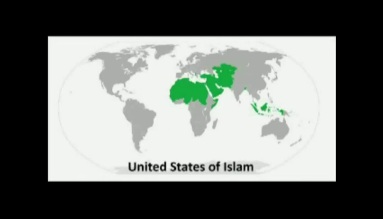
The video announces itself as “an USI Films production”. It then opens with the words “since 911 the world has changed” in white type against black, followed immediately by news clips of the WTC attacks and of President Bush describing them as “evil acts” and declaring “I have directed the full resources of our intelligence and law enforcement communities to find those responsible, and to bring them to justice.” What we shall be seeing, then, is a time-oriented video, presenting a historical context for the present moment with implications for the near future. From here we cut by way of another white on black typed message — “they started this war in afghanistan” – via clips of war footage to another – “but their agenda is much bigger and brutal than that” – and then to another clip of Pres. Bush: “Our war on terror begins with al-Qaida but it does not end there. It will not end until every terrorist group of global reach has been found, stopped, and defeated.” By this point, the background music, which is taken (for reasons both political and musical?) from Vangelis’ 1492 – Conquest of Paradise soundtrack, is swelling. A global map appears, showing much of north Africa, the middle east, Indonesia and Malaysia in green, with Pres. Bush in voice over speaking of the establishment of “a violent political utopia across the middle east which they call a Caliphate where all will be ruled according to their hateful ideology.”

USI world map

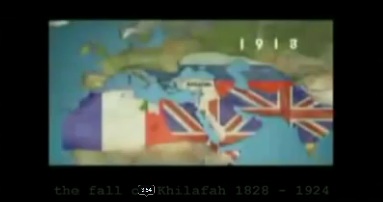
The map is titled United States of Islam. The words “they have done this before” are then followed by a series of film clips showing “the fall of the Khilafa 1828 -1924” and maps showing the slow spread of the British and French flags across north Africa and the middle east, with glimpses of Lawrence of Arabia, the Balfour declaration, and General Allenby, accompanied by the voice-over of someone I’d tentatively identify as Sheikh Imran Nazar Hosein, declaring: The Khilafa was destroyed. Who destroyed it? Why did they destroy it? How did they destroy it? When did they destroy it? What did they replace it with? With what was it replaced? And what is its destiny?

These are awesomely important questions which very few can answer today.

Caliphate divided

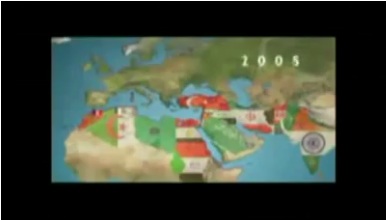
The text then states that (the west) “divided us into 54 states” and the map begins to show the various flags of the Islamic states intowhich the region was more recently divided…

Carved up

ending up in 2006. And what do we want now? You might be forgiven if you haven’t already guessed:

Total Annihilation

Clips then show the toppling of Saddam’s statue in Baghdad, the Israeli army in Gaza with casualties, the October 2009 Pishin attack on the Revolutionary Guard in Iran (which was claimed by Jundullah), and a first mention of the Christmas bomber, Al Qaida and Yemen… a quick mention of Nigeria and Somalia… and “Pakistan from which they fear the most”. A newscaster from, presumably, Pakistan intones “this is called the fourth generation warfare.” That essentially brings us up to the present moment. * We have arrived at the half way point in the 10 minute video and seen the global historical context, laid out in maps and flags. We have focused in on the present from a two-hundred year sweep, and on Pakistan from the distributed ummah. What follows will expound and expand on this present moment, bringing Afghanistan into the picture alongside Pakistan, emphasizing the spiritual significance of Khorasan, and taking the battle variously to India and Jerusalem…

[ to be continued ]

Guest Post: Connecting the Dots: Light on Light

Monday, October 25th, 2010


 Charles Cameron is the regular guest-blogger at Zenpundit, and has also posted at Small Wars Journal, All Things Counterterrorism, for the Chicago Boyz Afghanistan 2050 roundtable and elsewhere.  Charles read Theology at Christ Church, Oxford, under AE Harvey, and was at one time a Principal Researcher with Boston University’s Center for Millennial Studies and the Senior Analyst with the Arlington Institute:

Connecting the Dots: Light on Light

by Charles Cameron 

In a recent blog-post on MahdiWatch, Timothy Furnish draws our attention to an Islamic think tank named Grande Strategy.

1.

Their page of further readings on a future Islamic state includes works by an eclectic bunch – including Sir Muhammad Iqbal, recognized after his death and the foundation of the State as the national poet of Pakistan; Sheikh Taqiuddin An-Nabhani, the founder of the Hizb-ut-tahrir movement; Ali Shariati, the Marx-influenced Shi’ite radical intellectual viewed by some as the ideological force behind the Iranian revolution; Abul A’ala Maududi, Sunni writer and founder of Jamaat-e-Islam; Harun Yahya, also known as Adnan Oktar, a major Islamic creationist writer who holds that “Alawites, Wahabbites, Jafarites, they are all pure Muslims; harboring enmity against them is by no means acceptable”; Sayyid Qutb, Sunni author and Muslim Brotherhood member; and Ayatollah Ruhollah Khomeini, father of the Iranian Revolution.

Let’s just say that if the books of all these worthies were placed on a single bookshelf and given voices, the ensuing hubbub would resemble the House of Commons at Question Time.

2.

One article on the Grande Strategy site – the one that caught Timothy Furnish’s attention – is titled To the Unknown Mujahid, May We Never Forget You. It is interesting, as Furnish notes, because it is yet another sign of Mahdist thinking in the region of Afghanistan / Pakistan. It describes a man seen teaching in a mosque in the Faisal Masjid (presumably in Islamabad):

I have never seen a human spirit glow in this manner. I did not think this was even possible. I checked myself by discretely asking a few other brothers (perhaps it was some deficiency in me), and they too confirmed. Let me intimately describe you this man, he was tall, bearded wore a military camo jacket and in all his manners was as if he had walked out of the 1st century Hijri. He spoke English well enough that you could tell he was well-educated and belonged to a noble family. He was from Kashmir, in fact an elected member of the local government (back then Musharaf was all about devolution of power to press the national parties). Some close relatives of his were also senior officers in the Pakistan Army. He was obviously a mujahid, although in my opinion one that was fighting against India and in Kashmir and had nothing to do with the Afghanistan war.

The writer recounts his experience of this man because, as he puts it…

Because I believe (and Allah knows best) that if he is not the Mahdi himself or one of his men, at the least he is the precursor to the kind of men that would make up the army of the Mahdi. Or for those who do not believe in the Mahdi, he is the category of men that can save us from our present circumstances. A prototype to our success. And Allah knows best. Disclaimer: I don’t want to claim that he is the Mahdi.

3.

There’s also an article on the site about the Black Banners from Khurasan — another marker for Mahdist expectation — that includes quite a mix of sources and resources: commentary, for instance, on the Scofield Reference Bible (a major source of “dispensationalist” end times beliefs) and the “Project for New American Century”, together with some conspiracism about 9/11 specifically and US policy in general:

The US’s War on Terror is a deceptive game and a mind boggling riddle. The term terrorism is itself vague and un-defined and built on repetitive lies upon lies as evident in the case of 9/11. It is almost always blindly used against Muslims. The unilateral, pre-emptive extra-judicial violence by the western powers is always named as wars of democracy and freedom.

— plus for good measure some information about the Jewish origins of the Pashtun / Pathan peoples, and this intriguing statement:

According to Syed Saleem Shehzad of Asia Times Online, Al Qaeda shares this belief with the Taliban that Afghanistan is the promised land of Bilad-e-Khurasan.

— which would mark both as apocalyptic movements (see here and here).

4

On the other hand, one comment from a Shi’ite reader suggests that President Ahmadinejad will be the one who recognizes the Mahdi and brings the victorious army to meet him:

When Shuayb Ibn Saleh (Pres. Ahmedinejad) learns of Al Mehdi (as) emergence he will head towards Syria under three banners each of which has 4,000-5,000 men. It is these banners that are of gaudiance that Allah’s Messenger (saas) spoke of when he mentioned that ‘ when you see this army coming from Khursan, then go and join that army even if you have to crawl over snow, because in that army is the Caliph Al Mehdi[as]’. This holds true because it is Shuayb Ibn Saleh who will consolidate the government of Al Mehdi (as) in Jerusalem within 6yrs (72months).

and:

The Black Flags Coming from Khurasan is not of the Taliban … These Black Flags Belongs To Only Shuayb Ibn Saleh (Pres. Ahmedinejad)

5

But let’s get back to that business about the “Unknown Mujahid”. According to the report Furnish quotes from:

This particular class was being taught by a man, the like of whom I had never seen before, nor since have ever seen again. When you reach a certain level of spiritual enlightenment… sometimes you can “see” or “feel”… the “noor” or “aura” or “spiritual light” of another… This man did not have a glow – it was like a 1000 watt halogen lamp…

I have to say I find that report particularly interesting because, as Dr. Furnish notes, it offers a Sunni parallel to the self-description given by Iran’s Shi’ite President Ahmadinejad — who claimed on video that he’d been told by someone who was there, “When you began with the words ‘in the name of God,’ I saw that you became surrounded by a light until the end [of the speech]”, and commented, “I felt it myself, too. I felt that all of a sudden the atmosphere changed there, and for 27-28 minutes all the leaders did not blink.”

The thing is, this sort of report can also be found on both sides of the Iranian / Israeli aisle.

Gershon Salomon – who as leader of the Temple Mountain Faithful has the twin goals of “the liberation of the Temple Mount from Arab (Islamic) occupation” and “the building of the Third Temple on the Temple Mount in Jerusalem in our lifetime” – wrote a revealing memoir in which he recounted:

I had the privilege to experience the appearance of the G–d of Israel and His angels in one of the critical battles of Israel when I served in the Israeli Army as a young officer and my small unit was attacked by thousands of Syrian Arab soldiers. … It was night but I could see a light covering me from all sides and lighting the dark night. At the same moment, I could see the Syrian soldiers not shooting me but turning and running very fast back to the mountains. I again lost consciousness. I was told later that the Israeli soldiers looking for me in the darkness were only successful in locating me when they saw the light.

6

For what it’s worth, such stories can also be found about the divine or saintly figures of many religions.

Martin Buber tells a legend of the great Hassidic rabbi the Baal Shem Tov, in which a visiting rabbi saw that “the head of the master stood entirely in the white light … The rabbi saw that the master stood entirely in white light.

The Bhagavad Gita describes a moment when Krishna shows his divine form to Arjuna, who describes it thus: “If a thousand suns were to light up the sky all at once, that radiance would equal the radiance of my Lord.”

In the New Testament, Matthew describes how “Jesus taketh Peter, James, and John his brother, and bringeth them up into an high mountain apart, And was transfigured before them: and his face did shine as the sun, and his raiment was white as the light.” (Matt. 17:1-2).

7

If I have points to make, there are several of them:

  • That religious motivations can be powerful drivers at the level of popular morale.
  • That we frequently overlook religious motivations.
  • That reports of apocalyptic signs and miracles are potent amplifiers of religious motives.
  • That when we study religions, we frequently overlook the miraculous and the apocalyptic.
  • That comparative religious studies give context to events that seem extraordinary and affirming within a single religious tradition.
  • That when we study religions, we frequently overlook its comparative aspects.

Oh – and that depth psychology (Freud, Brown, Jung, Hillman) and cultural anthropology (Bateson, Turner, Lansing) also have much to teach us.

8

Connecting dots is not so hard once you can see them — but how do you connect your blind spots?


Switch to our mobile site