zenpundit.com » society

Archive for the ‘society’ Category

The Apple II of 3 D Printing?

Thursday, February 28th, 2013

It may be 1977 all over again.

Check out the Form 1 Kickstarter page 

The Formlabs home page and their blog.

I recently reviewed Chris Anderson’s book Makers. What 3 D printing needs is the affordable, user-friendly, versatile device to move 3 D printing from the arcane realm of  techno-hobbyist geeks to the general population’s “early adapters”, which will put the next “consumer model” generation on everyone’s office desk; eventually as ubiquitous as cell phones or microwaves.

Formlabs should send one of these to John Robb and Shloky for a product review.

Hat tip to Feral Jundi


Elkus on Policy Relevance

Monday, February 18th, 2013

Intriguing and vigorously argued piece by Adam over at Abu Muqawama

Relevant to Policy?

Are we in a 1914 scenario in East Asia? How often do guerrillas succeed? Did counterterrorism law erode national sovereignty? These are just a few of the important questions that political science has some bearing on. Yet barely a couple months goes by without an op-ed decrying political science’s alleged lack of relevance to the outside world.

Political scientists are frequently told their research is too arcane, mathematical, and self-involved to be of possible value to anyone in Washington dealing with real-world policy problems. There’s a grain of truth here. As international political economy whiz Kindred Winecoff observes, political scientists need to make a better “elevator pitch.” But here’s the problem: at the end of the day, there is a difference between what Max Weber dubbed science as a vocation and the subjective policy lessons we can take from our study. Part of that gap is reflected in the difficulties that people with purely policy interests inevitably encounter in PhD programs.

From my own (minor) experience so far, it is grueling, necessitates the assimilation of difficult methodologies, and involves having to think about intellectual questions that many people would regard as hopelessly arcane. Even a good PhD program that directly tackles policy questions will likely demand the student grapple with questions of esoteric theory and method. And not all research that tackles highly abstract questions is policy-irrelevant. Highly technical analysis of game theory and economics generated useful policy applications form the World War II convoy system to nuclear strategy and wargaming.

All of these advances began from the desire to grapple with difficult questions to produce knowledge, something many critics of political science research do not acknowledge. Take Greg Ferenstein, who penned an article supporting Eric Cantor’s call to defund the NSF. His gripe is familiar. Political science is obscuratist, hyper-mathematical, and disconnected from the policy world. Political scientists don’t do enough to make their research accessible to policymakers. Ferenstein wants a political science that his mother-in-law can understand, and he thinks starving academia of resources will motivate hungry researchers to do better. So is modern political science irrelevant to policy needs?

Contra Ferenstein, policymakers have thrown substantial $$ at the kind of research he regards as navel-gazing arcana. The RAND Corporation got a lot of mileage using what Ferenstein derides as “clever mathematical models” during the Cold War.  I’m not sure that Jay Ulfelder, who worked for the intelligence community-funded Political Instability Task Force, would agree that his quantitative forecasting methodologies must pass a mother-in-law test to be valuable. And when New York University’s game theory guru Bruce Bueno De Mesquita speaks, the CIA listens. Drew Conway, a man that could easily teach a computer programming course just as well as poli-sci 101, gives invited talks at West Point on analyzing terrorist networks. I don’t think Ulfelder, Mesquita, or Conway have sleepless nights pondering the relevance of their research to the govermment!

Read the rest here 

As an aside, I have found Ulfelder’s posts on his research or comments on the field at Dart Throwing Chimp to be very useful and worth reading.


Robb on the Networked Age

Saturday, February 16th, 2013

John is en fuego today:

Life in a Networked Age

.….In the last thirty years, we’ve seen a shift in the technological substrate.  This new susbstrate is increasingly a family of technologies related to information networks.

As this new substrate begins to take control, we’re going to need new management forms.  Both bureaucratic and market systems are proving insuffient solutions to the challenges of a networked age.  

In both cases, the emergence of a global network is eroding the efficacy of bureaucracy and markets as solutions.  How?  One reason is scale.  

A global network is too large and complex for a bureaucracy to manage.  It would be too slow, expensive, and inefficient to be of value.  Further, even if one could be built, it would be impossible to apply market dyanmics (via democratic elections) to selecting the leaders of that bureaucracy.  The diversity in the views of the 7 billion of us on this planet are too vast.  

In terms of markets, a global marketplace is too unstable.   Interlinked, and tightly coupled markets are prone to frequent and disasterous failures.  Additionally, a global marketplace is easy for insiders to corrupt and rig, as we saw with the 2008 financial melt-down.   Given instability and unmitigated corruption, markets will fail as a decision making mechanism.  

So, what’s going to replace bureaucracy and markets?

Read the rest here.

In very strong agreement with John. I like markets and think they produce efficient and optimized results for many things ( not all things) but free markets currently face massive (and sadly bipartisan) efforts to rig them by the oligarchy here at home, much less in autocratic states where the  practice of state socialism, kleptocracy and government by mafia or tribal/sectarian minority is the norm.  People will seek work-around structures to adapt, thrive and evade extortionate schemes by elites that have hijacked the state.

Hat tip to Lexington Green

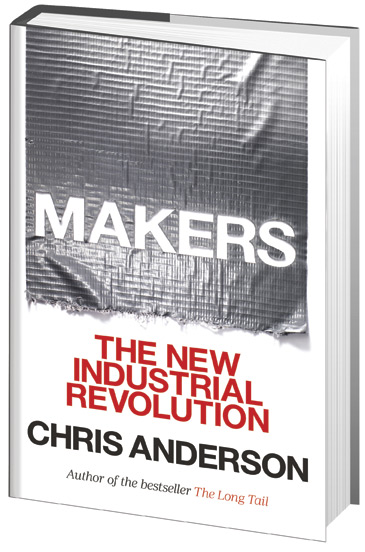
Book Mini-Review: Makers: the New Industrial Revolution by Chris Anderson

Wednesday, February 13th, 2013

Makers: The New Industrial Revolution by Chris Anderson 

This is a fun book  by the former editor-in-chief of WIRED , author of The Long Tail and the co-founder of 3D Robotics, Chris Anderson. Part pop culture, part tech-optimist futurism and all DIY business book, Anderson is preaching a revolution, one brought about by the intersection of 3D printing and open source “Maker movement” culture, that he believes will be bigger and more transformative to society than was the Web. One with the potential to change the “race to the bottom” economic logic of globalization by allowing manufacturing entrepreneurs to be smart, small, nimble and global by sharing bits and selling atoms.

Anderson writes:

Here’s the history of two decades of innovation in two sentences: The past ten years have been about discovering new ways to create, invent, and work together on the Web. The next ten years will be about applying those lessons to the real world.

This book is about the next ten years.

….Why? Because making things has gone digital: physical objects now begin as designs on screens, and those designs can be shared online as files…..once an industry goes digital in changes in profound ways, as we’ve seen in everything from retail to publishing. The biggest transformation, but in who’s doing it. Once things can be done on regular computers, they can be done by anyone. And that’s exactly what we’re seeing happening in manufacturing.

…..In short, the Maker Movement shares three characteristics,  all of which I’d argue are transformative:

1. People using digital desktop tools to create designs for new products and prototype them (“digital DIY”)

2. A cultural norm to share those designs and collaborate with others in online communities.

3. The use of common design file standards that allow anyone, if they desire, to send their designs to commercial manufacturing services to be produced in any number, just as easily as they can fabricate them on their desktop. This radically foreshortens the path from idea to entrepreneurship, just as the Web did in software, information, and content.

Nations whose entire strategy rests upon being the provider of cheapest labor per unit cost on all scales are going to be in jeopardy if local can innovate, customize and manufacture in near-real time response to customer demand. Creativity of designers and stigmergic /stochastic collaboration of communities rise in economic value relative to top-down, hierarchical production systems with long development lags and capital tied up betting on having large production runs.

Interesting, with potentially profound implications.

America the Home of the Brave?

Sunday, February 3rd, 2013

An excellent op-ed in the Washington Post by Small Wars Journal editor and author of War, Welfare and Democracy,  Peter J. Munson 

An America Cramped by Defensiveness by Peter J. Munson 

….Since I returned home, a darkness has grown in me as both I and our nation have failed to live up to the sacrifices of these young men and women. I had no expectation of “victory” in Afghanistan or Iraq, whatever that would mean. Nor did I expect some epiphany of strategic insight or remorse from the nation’s brain trust.

I just found that I could not square the negativity, pettiness and paranoia in the discourse of our country’s elders with the nobility and dedication of the men and women I had seen and served with in Afghanistan.

Over time, as I listened to the squabbling, I realized that about the only thing Americans agree on these days is gratitude bordering on reverence for our military. It troubled me that the sum total of consensus in our discourse is deference toward the defenders of our nation.

Eventually, it dawned on me that the focus on defense was the root of our problem.

After the Sept. 11, 2001, attacks, the United States sent its military off to war and fretted about post-traumatic stress disorder — but paid little attention to the fact that America itself was traumatized. Americans became angry and withdrawn. We are fearful and paranoid because after a strike on our nation we chose to focus on defense rather than the resilience and vitality that made America great. In our defensive mind-set, we bristle at every change in a world undergoing an epochal transformation.

We have little reason to be so negative. Certainly the rest of the world is gaining on us, but this represents the success of explicit U.S. policies. After World War II, the United States sought to create a world of economic interdependence and prosperity, hoping to banish the malaise that helped precipitate a global conflict. The prospect of rapid growth in the developing world was not viewed as a threat but rather offered the promise of robust markets for American goods and ingenuity. We were confident and focused on the positive tasks of expanding our economy rather than fearing change…..

If you go back and look at news coverage of September 11, you will be struck by the calmness of ordinary citizens in New York in the face of carnage, their lack of panic and firm determination to help. The bravery and sacrifice of firefighters, EMT and police, the dogged resolution of rescue workers digging for victims, the sheer heroism of the passengers of  United Airlines Flight 93 who, led by Todd Beamer, stopped the al Qaida hijackers from ramming another plane into another skyscraper or perhaps the Capitol Building.

All of the security theater, the attacks on liberty, the surveillance state machinations, creeping normalization of government thuggery, bureaucratization, centralization and paternalism that have since been justified in the name of 9/11 were not needed on that day nor wanted by the overwhelming mass of American citizens afterwards.  It was wanted by our “leaders” – who were largely irrelevant to events on September, 11 – because it conformed to their worldview and overweening personal need for “control” of a democratic citizenry they would prefer to be less autonomous and more passive, docile, compliant and disengaged.

We need to revive the American spirit and the first steps are rolling back much of the illiberalism of the past decade.


Switch to our mobile site
