The Said Symphony: Board and Gameplay
Thursday, June 16th, 2011[ by Charles Cameron – extended analytic game on Israeli-Palestinian conflict — see Said Symphony: Intro ]
.
All the games of the HipBone family use the juxtaposition of ideas on a game-board to develop a web of associations that is larger and more complexly interwoven than the same ideas gathered in a simple list, didactic argument or sequence.
.
The Said Symphony board:
.
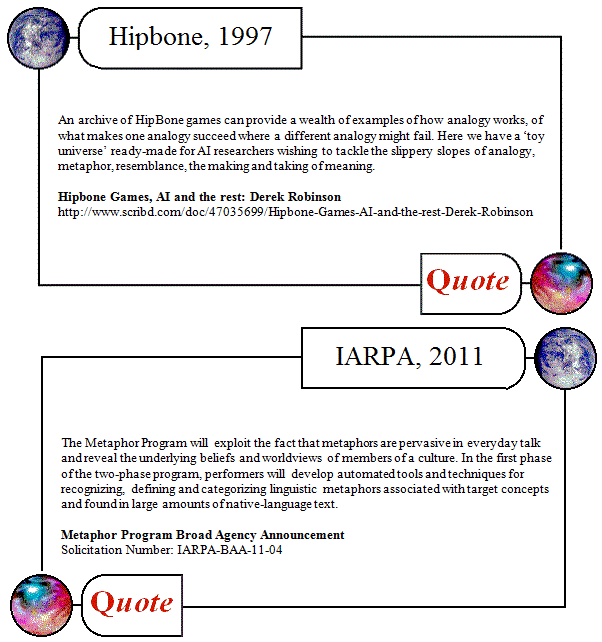
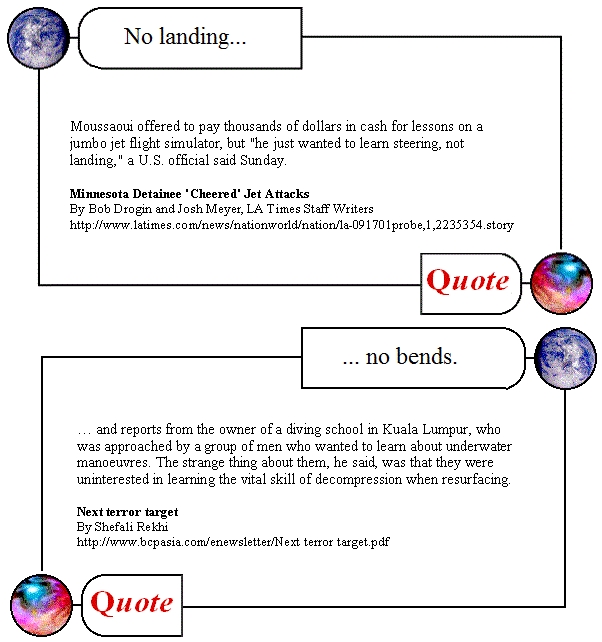
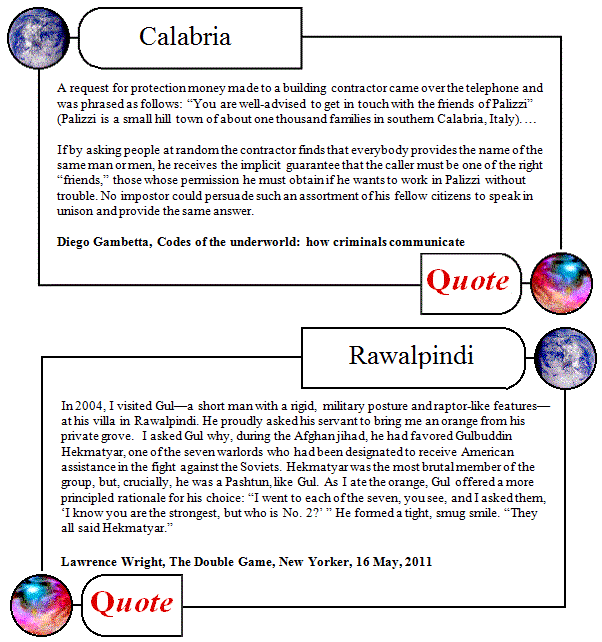
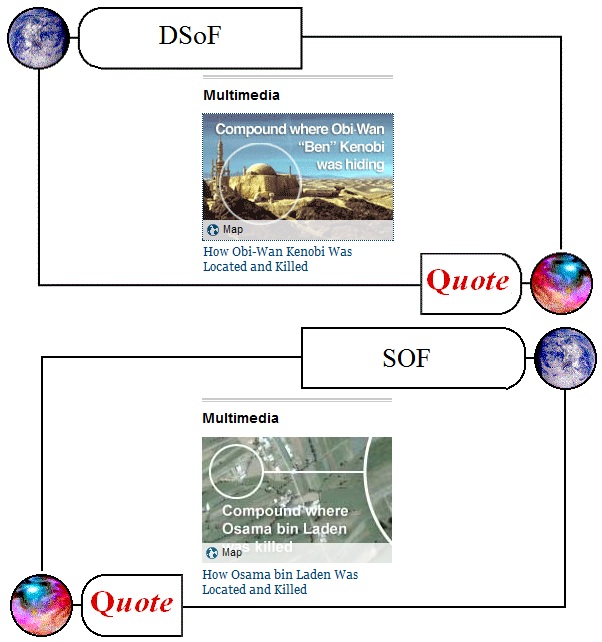
The simplest of these games uses the DoubleQuotes format, with which regular Zenpundit readers will already be familiar (i, ii, iii, iv). More complex games have been played on the Dart and WaterBird boards among others, some light-hearted (Movie Trivia Game), some quite serious (What Sacred Games?).
For quite a while now, I have wanted to play a solo game — something more epic in scale than a two-move DoubleQuote or even a ten-move game on the WaterBird board – that “scored” the symphony that Edward Said intuited, as mentioned in my previous post.
Not so long ago, I found the perfect board…
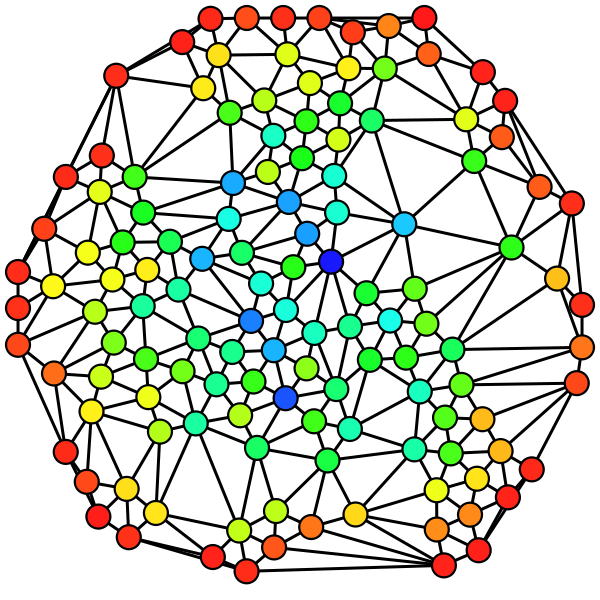
Board credit: Claudio Rocchini
.
The HipBone gameplay
.
Here’s how the gameplay works.
Slowly, I am going to “place” one quote (or image) after another on that board.
Each of these quotes or images (or equations, or sound-clips, or even blanks / silences) will be assigned a “position” (circle) on the board, a name or “move title“, some “move content” that features the quote or image and enough associated content to explain it, a series of “links claimed” in which I build bridges to directly adjacent moves already in play, and on occasion a “comment” which will allow me to weave in an overview of how the game is going, some footnotes, whatever seems helpful.
A board position, move title, move content, links claimed and comment, taken together, will comprise a single “move” on the board.
I hope to cover a wide range of issues here, political and religious, riparian and agrarian, Judaic and Christian and Muslim, secular and sacred, local, regional and international, disputed and agreed, in parallel and orthogonal and in opposition, violent and peaceable, ancient and modern and futuristic, social and individual… thesis and antithesis and synthesis, you get the drift.
Let me be clear: wherever the board shows two circles (‘board positions”) directly linked by a line, the ideas (“moves”) assigned to those two circles should have some form of linkage – associative, analogical, metaphorical, metonymic, causal, illustrative, oppositional, paradoxical, biographical, bibliographic… and so forth.
Putting that another way, I shall try to place my moves in such a way that moves joined by lines between them will indeed provoke thought and insight — about the facts on the ground, the myths in the air, the dreams and hopes and dashed hopes, the people…
So that the whole sorry, glorious story will hover behind the board, with pinpoint quotes and details shining through the moves on the board like constellations in the night sky.
Thus it is not the ideas themselves but their relationships – their duels and duets – which form the fabric of this work of architecture, the counterpoint of its music.
.
Playing and following along:
.
I shall play my moves first, one at a time, in the forums my friend Howard Rheingold, web pioneer and author of Smart Mobs, has set up for graduates of his online classes. I may at times make two or three moves there in a day — or wait a week and ponder what my next move should be.
But I don’t want to clutter up ZP every time I made a move, so I shall wait and gather them, and post here on Zenpundit when I have a suitable cluster to offer.
It was Howard‘s gracious invitation for me to introduce my games to his alumni that first nudged me off my perch and got me started playing this game that I have been thinking about for some years now –and Zenpundit is my home on the open web – so this double presentation is natural.
You are most welcome to follow along, comment and kibitz – but let me make two things clear from the outset:
The fact that I “play” a particular person, image, work of art or headline in no way means that I endorse that person or point of view – any more than a novelist or historian quoting Hitler, Churchill, or Stalin necessarily endorses the swastika, Union Jack or hammer and sickle:
Quotation does not imply endorsement or disparagement.
And the fact that I juxtapose two situations, events, anecdotes, quotes, processes or persons in no way means that I equate them – any more than a juxtaposition between the soccer game that kicked off the Football War (El Salvador and Honduras, 1969) and the Fischer-Spassky match that was a minute but focused skirmish in the Cold War (USA vs USSR, 1972) implies that soccer is or somehow equals chess — or is its exact opposite — or provides or implies a moral equivalence between America and Russia:
Linkage does not imply equivalency, moral or otherwise.
There will be symmetries, there will be asymmetries, as you’ll see — and indeed it may well prove that the discrepancies, oppositions and imbalances between two adjacent moves will be as fruitful as any parallelisms.
What I would suggest is that every move, like it or loathe it, should be heard.
.
And briefly, the HipBone Games:
.
The project builds on my previous development of the HipBone family of games, which began as an attempt to make a playable variant of the Glass Bead Game described in Hermann Hesse‘s Nobel winning novel, Magister Ludi.
I recently posted an introductory account of the games on Bryan Alexander‘s New Digital Storytelling blog; game boards are available for download at HipBoards; and the basic games rules and invitation to play are still up at my now ancient HipBone Games website.
I’m happy to take questions in the comments section.
.
Next up:
.
In my next post, I’ll play the opening moves…