zenpundit.com » art

Archive for the ‘art’ Category

Theology for artists and musicians, Buddhist & Christian

Monday, April 18th, 2016

[ by Charles Cameron — with side-trips to China, ancient and modern ]
.

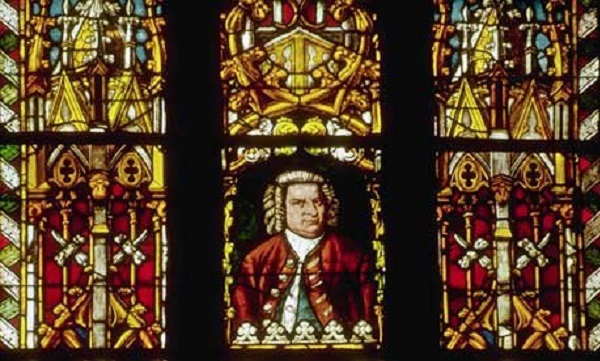
The-Bach-Window-Saint-Tho-007
Bach window in the Thomaskirsche, Leipzig, where Bach was Cantor

**

The Dalai Lama has a fascinating article out about reincarnating lamas (“tulkus”) which has direct relevance to discussions of what happens when he died — whether he decides to reincarnate as a new Dalai Lama, whether the Chinese decide to do it for him, etc.

I learned a lot — but the piece that really caught my eye was this:

The Emanation Body is three-fold: a) the Supreme Emanation Body like Shakyamuni Buddha, the historical Buddha, who manifested the twelve deeds of a Buddha such as being born in the place he chose and so forth; b) the Artistic Emanation Body which serves others by appearing as craftsmen, artists and so on; and c) the Incarnate Emanation Body, according to which Buddhas appear in various forms such as human beings, deities, rivers, bridges, medicinal plants, and trees to help sentient beings.

I love the ontology that gives us “human beings, deities, rivers, bridges, medicinal plants, and trees” and which reminds me of Borges‘ scheme, allegedly derived from a Chinese encyclopedia, The Celestial Empire of benevolent Knowledge, for the classification of animals:

In its remote pages it is written that the animals are divided into: (a) belonging to the emperor, (b) embalmed, (c) tame, (d) sucking pigs, (e) sirens, (f) fabulous, (g) stray dogs, (h) included in the present classification, (i) frenzied, (j) innumerable, (k) drawn with a very fine camelhair brush, (l) et cetera, (m) having just broken the water pitcher, (n) that from a long way off look like flies.

**

But really, that’s a bonus.

It’s the inclusion of “craftsmen, artists and so on” as being potentially Artistic Emanation Bodies of Buddha that gets me. I see it as a viable counterbalance to the current emphasis in the west — and in the westifying east — on STEM topics, science, technology, engineering and mathematics, as the ultimate desirables in education.

And for what it’s worth, the idea is not without comparative equivalents. July 28 is the commemoration, in the Episcopalian Calendar of Saints, of “Johann Sebastian Bach, 1750, George Frederick Handel, 1759, and Henry Purcell, 1695, Composers” — while the Lutherans on the same day commemorate “Johann Sebastian Bach, 1750; Heinrich Schütz, 1672; George Frederick Handel, 1759; musicians”.

From a set of Episcopalian lectionary readings:

Almighty God, beautiful in majesty and majestic in holiness: Thou gavest to thy musicians Johann Sebastian Bach, George Frederick Handel, and Henry Purcell grace to show forth thy glory in their music. May we also be moved to sound out thy praises as a foretaste of thy eternal glory; through Jesus Christ our Savior, who liveth and reigneth with thee and the Holy Spirit, one God, for ever and ever. Amen.

Arthur Waley, in his slim volume on Li Po, puts a somewhat ironic spin on the idea, telling us:

It was commonly believed that immortals who had misbehaved in Heaven were as punishment banished to live on earth for a fixed time, there they figured as wayward and extraordinary human beings. They were what was called ‘Ministers Abroad of the Thirty-Six Emperors of Heaven.’

Falling, drunk, into the Yellow River while attempting to kiss the moon would appear to qualify one for this honorific.

**

Not to worry, btw. According to an announcement issued yesterday:

The Tibetan spiritual leader told a group of abbots not to worry as he is in good health and still has recurring dreams indicating that he will live for at least 113 years.

Pope Francis : Francis Bacon

Monday, March 28th, 2016

[ by Charles Cameron — and a tradition of natural philosophy profound enough to include Francis of Assisi ]
.

It’s a small point, perhaps, but M. Anthony Mills had a piece in The New Atlantis last Fall titled Is Pope Francis Anti-Modern? — which I ran across today because today 3 Quarks Daily posted it — and in it, Mills to my mind makes a false dichotomy between Pope Francis and Francis Bacon.

Thus Mills writes:

Pope Francis’s picture of nature is indebted to Genesis, the Biblical prophets, and the writings of Irenaeus, Aquinas, and Francis of Assisi — and, arguably, Plato and Aristotle — as well as to the twentieth-century theologian Romano Guardini (whose book The End of the Modern World is cited a number of times in the encyclical). But it is not true that doing so puts Pope Francis at odds with modern science. It does pit him against a particular understanding of modern science, bequeathed to us by Francis Bacon and, perhaps more importantly, by the Enlightenment philosophes such as Voltaire who claimed Bacon as the “father of experimental philosophy.” This view of science continues today in the cult of technological progress, which sees every problem as amenable to technocratic solution, no matter the environmental, social, cultural, or spiritual cost. This is what Pope Francis refers to and criticizes as the “technocratic paradigm.”

To the contrary, at the end of his Preface to the Instauratio Magna, which Jerome Ravetz quotes in the final paragraph of his magisterial Scientific knowledge and its social problems, Bacon writes:

Lastly, I would address one general admonition to all; that they consider what are the true ends of knowledge, and that they seek it not either for pleasure of the mind, or for contention, or for superiority to others, or for profit, or fame, or power, or any of these inferior things; but for the benefit and use of life; and that they perfect and govern it in charity. For it was from lust of power that the angels fell, from lust of knowledge that man fell; but of charity there can be no excess, neither did angel or man ever come in danger by it.

And to bring the opposition between their two views into a nutshell, Mills writes of “the Baconian technocratic paradigm, which understands science and technology together as instruments for controlling and exploiting all of creation” — while Bacon is in fact opposed to such control and exploitation, as we see when he attacks certain of his contemporaries for precisely those failings:

For we create worlds, we direct and domineer over nature, we will have it that all things are as in our folly we think they should be, not as seems fittest to the Divine wisdom, or as they are found to be in fact.

**

There are indeed two visions of science at work across history, as Ravetz is at pains to show. Perhaps we can see them best by comparing the two instances in which Mills and Ravetz respectively situate yet another Francis, St Francis of Assisi.

Mills, as we have seen, locates him — along with the current Pope — on the anti-modern, and hence anti-Baconian, side of the ledger:

Pope Francis’s picture of nature is indebted to Genesis, the Biblical prophets, and the writings of Irenaeus, Aquinas, and Francis of Assisi — and, arguably, Plato and Aristotle — as well as to the twentieth-century theologian Romano Guardini

For Ravetz, St Francis is indeed a participant in one of two distinct streams of world exploration — the one he terms a “romantic” philosophy of nature:

Looking back into history, we can find a similarity of doctrine or style, and sometimes a linking tradition, as far back as the Taoists of ancient China, through St. Francis of Assisi, to Paracelsus, William Blake, and Herbert Marcuse.

He continues:

Not every one of these figures would claim to be a natural scientist of any description; but as philosophers, poets or prophets, they must be recognized as participating in and shaping a tradition of a certain perception of nature and its relation to man. Granted all the variety of their messages and styles, certain themes recur. One is the ‘romantic’ striving for immediacy, of contact with the living things themselves rather than with book-learned descriptions. Another is ‘philanthropy’; the quest is not for a private realization, but for the benefit of all men and nature.

And here’s the difference. Francis Bacon, Ravetz finds, stands clearly on this same “romantuc” side of the ledger. For:

As deeply as any of his pietistic, alchemical forerunners, he felt the love of God’s creation, the pity for the sufferings of man, and the striving for innocence, humility, and charity; and he recognized vanity as the deadliest of sins.

**

Let me recapitulate that final paragraph of Ravetz’ book, quoted entirely from Bacon:

Lastly, I would address one general admonition to all; that they consider what are the true ends of knowledge, and that they seek it not either for pleasure of the mind, or for contention, or for superiority to others, or for profit, or fame, or power, or any of these inferior things; but for the benefit and use of life; and that they perfect and govern it in charity. For it was from lust of power that the angels fell, from lust of knowledge that man fell; but of charity there can be no excess, neither did angel or man ever come in danger by it.

This is virtually a monastic ideal of science, one which would be found most suitable in the halls of Hesse’s Castalia, and one well-suited to the Benedict Option as formulated by Rod Dreher.

It is also, and significantly, as Ravetz points out, compatible with the truth concerns of Taoists, poets and theologians…

**

Hermann Hesse, it seems to me, gives a deeper and wider acknowledgment of both streams, bringing their “hard” and “soft” strands together in his history of the Glass Bead Game:

How far back the historian wishes to place the origins and antecedents of the Glass Bead Game is, ultimately, a matter of his personal choice. For like every great idea it has no real beginning; rather, it has always been, at least the idea of it. We find it foreshadowed, as a dim anticipation and hope, in a good many earlier ages. There are hints of it in Pythagoras, for example, and then among Hellenistic Gnostic circles in the late period of classical civilization. We find it equally among the ancient Chinese, then again at the several pinnacles of Arabic-Moorish culture; and the path of its prehistory leads on through Scholasticism and Humanism to the academies of mathematicians of the seventeenth and eighteenth centuries and on to the Romantic philosophies and the runes of Novalis’s hallucinatory visions. This same eternal idea, which for us has been embodied in the Glass Bead Game, has underlain every movement of Mind toward the ideal goal of a universitas litterarum, every Platonic academy, every league of an intellectual elite, every rapprochement between the exact and the more liberal disciplines, every effort toward reconciliation between science and art or science and religion. Men like Abelard, Leibniz, and Hegel unquestionably were familiar with the dream of capturing the universe of the intellect in concentric systems, and pairing the living beauty of thought and art with the magical expressiveness of the exact sciences. In that age in which music and mathematics almost simultaneously attained classical heights, approaches and cross-fertilizations between the two disciplines occurred frequently. And two centuries earlier we find in Nicholas of Cues sentences of the same tenor, such as this: “The mind adapts itself to potentiality in order to measure everything in the mode of potentiality, and to absolute necessity in order to measure everything in the mode of unity and simplicity as God does, and to the necessity of nexus in order to measure everything with respect to its peculiar nature; finally, it adapts itself to determinate potentiality in order to measure everything with respect to its existence. But furthermore the mind also measures symbolically, by comparison, as when it employs numerals and geometric figures and equates other things with them.”

Basta!
Is claustrophobia the fear of walls — or of eyes?

Friday, March 25th, 2016

[ by Charles Cameron — something’s closing in on us ]
.

Tablet spec escher drone

**

Sources:

  • Adam Elkus, I was not kidding
  • Plain Dealer, Akron Art Museum rescues M.C. Escher from his reputation
  • Getting deeper into Koestler

    Friday, March 18th, 2016

    [ by Charles Cameron — on creativity at the intersection of the fleeting and the eternal ]
    .

    centaur skeleton
    Centaur, displayed in the International Wildlife Museum, Tucson, AZ

    **

    You know Lao Tzu’s “uncarved wood” (pu) — and Spencer Brown’s “Mark” or “first distinction? It is hard to speak of “the one and the many” without language itself favoring the many, the one being “one” and the many “another”. The Greek phrase “Before Abraham was, I am” attributed to Christ may be as close as we get.

    The “uncarved wood” is not some definite -– named and thus defined -– “one” -– it is also “raw silk” (su), the simple -– the natural way or stream, from which things have not yet been separated out by naming.

    There is delight, however, both in one becoming two and thus many, in the making of distinctions and naming of names, and no less in two (or the many) becoming one, in the resolution of paradox, the release of tension, peace after strife. In human terms, there is joy in both solo and collaborative achievement.

    What better, then, than the perfect fit between disparate entities?

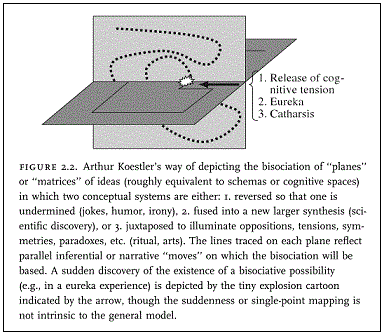
    I have written often enough about Arthur Koestler and the place where two disparate spheres of thought link up — the centaur links horse and man in an indissoluble unity — there’s no question here of dismounting after a ride, giving the horse a rub down and some feed, then retiring to the verandah for a whiskey…

    The mythological aha! we get from the centaur displayed in the museum hinges on the fit of horse and human skeletons, the perfection with which disparates are joined.

    **

    Thus far, whenever I’ve discussed Koestler‘s notion of bisociation, I’ve focused on the sense that it liea at the heart of creativity. Koestler himself takes it deeper. Here’s Nicholas Vajifdar, in a review titled Summing Up Arthur Koestler’s Janus: A Summing Up:

    Koestler .. asserts that there are two planes of existence, the trivial and the tragic. The trivial plane is the stage for paying bills, shopping, working. Most of life takes place on the trivial plane. But sometimes we’re swept up into the tragic plane, usually due to some catastrophe, and everything becomes glazed with an awful significance. From the point of view of the tragic plane, the trivial plane is empty and frivolous; from the point of view of the trivial plane, the tragic plane is embarrassing and overwrought. Once we’ve moved from one plane to the other, we forget why we could have felt the way we used to.

    That’s not just any old distinction between two realms, that’s the one Koestler himself prioritizes. And following his basic principle that a creative spark is lit when two disparate “planes of ideas” intersect, we shouldn’t be too surprised to find Vajifdar continuing:

    “The highest form of human creativity,” Koestler writes, “is the endeavor to bridge the gap between the two planes. Both the artist and the scientist are gifted — or cursed — with the faculty of perceiving the trivial events of everyday experience sub specie aeternitatis, in the light of eternity…”

    William Blake made a similar observation in The Marriage of Heaven and Hell, writing:

    Eternity is in love with the productions of time.

    Finally, Vajifdar tells us why he finds Koestler’s definition of art maybe the best he’s ever read:

    What I value in this definition of creativity is its emphasis on the subjective being of those who experience the work of art or scientific theory, a surer gauge than cataloguing formal properties or whether it’s “interesting.” Art has always seemed like a kind of sober drunkenness, or drunken sobriety. Most people probably have wondered whether the feelings they felt while drunk were more or less real than their sober feelings. Koestlerian art joins these seemingly irreconcilable feelings together.

    Let’s just go one step further. In Promise and Fulfilment – Palestine 1917-1949, Koestler specifically singles out this intersection as an aspect of the experience of warfare:

    This intense and perverse peace, superimposed on scenes of flesh-tearing and eardrum-splitting violence, is an archetype of war-experience. Grass never smells sweeter than in a dug-out during a bombardment when one’s face is buried in the earth. What soldier has not seen that caterpillar crawling along a crack in the bark of the tree behind which he took cover, and pursuing its climb undisturbed by the spattering of his tommy-gun? This intersecting of the tragic and the trivial planes of existence has always obsessed me in the Spanish Civil War, during the collapse of France, in the London blitz.

    **

    I am grateful to David Foster for his ChicagoBoyz post The Romance of Terrorism and War which triggered this exploration, and that on the glamour of war which will follow it.

    Carambolages, huzzah!

    Monday, March 14th, 2016

    [ by Charles Cameron — a brilliant new exhibition breaks the usual museum rules to provoke prodigious & repeated leaps of imagination ]
    .

    Carambolages Dominos

    **

    Cath Styles, whose Sembl games are closely related to my own HipBone variants on Hermann Hesse‘s Glass Bead Game, recently pointed me to an exhibition called Carambolages that opened recently at the Grand Palais, Galleries Nationales, 3, avenue du General Eisenhower, Paris.

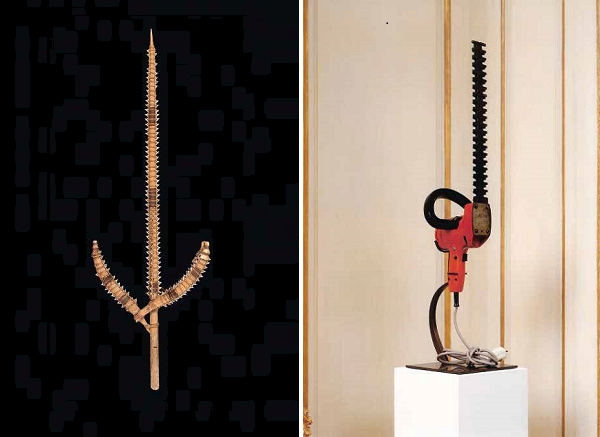
    Strolling their website, I was struck by this double image, which in HipBone terms would be called a DoubleQuote, or a Sembl in Cath’s Sembl game:

    Carambolages
    (left) Sword, Kiribati, Micronesia Islands, Oceania, sd, Paris, Musée du Quai Branly
    (right) Bertrand Lavier, Black & Decker, 1998 collection Giuliana and Tommaso Setari

    It appears, indeed, that the exhibit in question features a Domino game of Sembls or DoubleQuotes —

    Fascinating — and definitely a notable step in the expanding history of bead game variants — which I view, among other things, as an art movement that has yet to be written up as such.

    Congratulations, Jean-Hubert Martin! The catalogue will no doubt be as close as I can get physically, but I’m all the way with you in spirit…

    Bonne idée, bon chance!


    Switch to our mobile site