zenpundit.com » innovation

Archive for the ‘innovation’ Category

Trial of a Thousand Years, by Charles Hill—a review

Thursday, August 11th, 2011

 trial of thousand years

by J. Scott Shipman 

Trial of a Thousand Years, World Order and Islamism, by Charles Hill

Ambassador Charles Hill’s Grand Strategies, Literature, Statecraft, and World Order was the best book I read in 2010, so I had high expectations for this volume and was not disappointed. Ambassador Hill provides a 35,000-foot view of the relationships between the West and Islam in history focusing on the subtitle of his earlier work in the form of “world order.”

Unsurprisingly, as in Grand Strategies Hill goes back to the roots of modern order in the Treaty of Westphalia (1648). He provides a brief review of the world ushered in by the men who negotiated, and quotes another historian who said, “men who were laboring, each in his own way, for the termination of a terrible war. They had no idea of progress. The word “innovation” was anathema to them. The last thing on their minds was the creation of a new system of sovereign states…” Here we are 363 years later and “from the seeds sown at Westphalia” the system they set in place is has grown, but has been under siege many times from many fronts.

Westphalia was distinctive because it was “procedural, not substantive” and required a minimum number of procedures/practices to which to adhere and allowed disparate parties with different, “even mutually antagonistic, substantive doctrines and objectives” to work together. Hill points out four distinctions:

  • Religious arguments were not allowed in diplomacy.
  • The State was the fundamental entity.
  • Interstate/international norms and laws were encouraged, absent “divine sources” but based on mutually beneficial/positive agreements.
  • Use of professional military and diplomats with “its own set of protcols.” [Personal note: In another life, I was an arms control inspector enforcing the START I and INF Treaties—protocol was very serious and the true measure of the actual treaty language. There was also a strong and consistent application of reciprocity that made each party think before stretching protocol—this happened to my teams more than once.]

For Hill a central mission of the United States is the defense of the Westphalian world order. In less than 165 pages and six chapters, he outlines the origins of modern Western order and correspondingly covers Islamic order. From the beginning to the end Hill provides ample evidence of challenges to Westphalia, often from indigenous Western sources, but focusing mostly on our trials with Islam.

Hill sets the sources from whence the Western and Islamic world orders arose, where the West was grounded in Christianity, and the Islamic in the Caliphate. For two religions claiming Abrahamic roots, their worldviews were, and in many instances remain diametrically opposed. Central was the question of duality or unity. For the West, the State and religion were two complementary systems/powers—following the teaching of Christ ““Render unto Caesar the things which are Caesar’s, and unto God the things that are God’s” (St Matthew’s Gospel 22:21) For Islam there was no distinction, and the very thought was hateful to Islamists. Islam’s “unswerving devotion to monotheism” continues to this day among those groups and states using terror to upend existing world order.

I am sympathetic to Hill’s ideas; however recognize with globalization and the internet tweaks may be required. And I’ll take this segue to introduce an idea for consideration.

Westphalia’s removal of religion made trade possible among former religious enemies. Unambiguous rules for contracts and dispute resolution evolved. What if we could bridge the gap between Western jurisprudence and tribal, or non-Western legal systems? What if, instead of insisting our way or the highway we design a solution that would allow both sides to keep their respective legal processes and procedures, thereby opening untapped markets?

At least one person has already considered these alternatives. Michael Van Notten (1933-2002) was a practicing lawyer in the Netherlands and married into a Somali tribe. Van Notten used his legal training and insights gained as a member of his new family to design a method of contracting where tribal law and Western jurisprudence could peacefully and prosperously coexist. Van Notten recorded his ideas in a book called The Law of Somalis, A Stable Foundation for Economic Development in the Horn of Africa. I’ll not review this book, but wanted offer this as a teaser alternative.

After reviewing the history of the West and Islam, Hill identifies seven Clausewitzian centers of gravity for both: legal, military, the State, women, democracy, nuclear weapons, and values. Hill makes the distinction between the use of diplomacy by Islam and the Islamist (the fundamental variety). No surprises, to the Islamist a secular State is an “apostasy,” as is international law (Sharia being the single source), democracy and the rights of women.

Hill concludes, “Islamic civilization entered the international system under duress,” which he believes has contributed to the current situation of failing states and lagging economies that establish conditions where radicalized Islam can flourish. The radicalized elements reject the secular Westphalian world order, however Hill points out that some in Islam insist that sharia imposed by the state “cannot be the true law of Islam. It is not possible to apply sharia through the state; it can only be applied through acceptance by human beings (An-Na’im).” Another alternative is the Medina polity established by the Prophet (“later called the Pact—kitab—of Medina) “guaranteeing each tribe the right to follow its own religion and customs, imposing on all citizens rules designed to keep the overall peace, establishing a legal process by which the tribes settled purely internal matters themselves and ceded to Muhammad the authority to settle intertribal disputes…Although this document has been called the first written constitution, it was really more of a multiparty treaty” (Ansary).

Hill convincingly demonstrates that more often than not, rulers have co-opted Islam as a way to dominate the people (Iran comes to mind.). He quotes Professor L. Carl Brown of Princeton, “nothing exclusively “Islamic” about this Muslim attitude towards politics, any more than the politics of feudalism or of imperial Russia was distinctly “Christian.” It is the political legacy of Muslims, not the theology of Islam…”

For the Islamist, secularism is the booger man, but secularism in the Westphalian order has its own set of problems. Hill writes, “A new phenomena arose: wars motivated by religious convictions were replaced by wars driven by ideologies—surrogates for religion—each aimed to oppose, undermine, destroy and replace the Westphalian system. The greatest of these was international communism, the latest is international Islamism.”

In many respects, Trials is as good as Grand Strategies. Ambassador Hill is to be commended for his insight, courage, and conviction—this little book packs a big, enlightening punch. Strongest recommendation.

References you may find of interest (links to quoted authors above are links to the respective reference):

The Incoherence of the Philosophers, Abu Hamid Muhammed Al-Ghazali

The Crisis of Islamic Civilization, Ali A. Allawi

The Caliphate, Thomas W. Arnold

Sayyid Qutb and the Origins of Radical Islamism, John Calvert

Crimea: The Last Crusade, Orlando Figes —Figes’ The Whisperers was very good.

The Morality of Law, Lon L. Fuller

The Muqaddimah, Ibn Khaldun (Translated Franz Rosenthal)

The Clash of Empires: The Invention of China in Modern World Making, Lydia H. Liu

The Government of the Ottoman Empire in the time of Suleiman the Magnificent, Albert Lyber

Byzantine Civilization and The Fall of Constantinople, both by Steven Runciman

The First World War, Hew Strachan

Mozart and the Enlightenment; Truth, Virtue and Beauty in Mozart’s Operas Nicholas Till

Muslim Intellectual: A Study of Al-Ghazadi, W. Montgomery Watt

Dialectic of Enlightenment, Max Horkheimer and Theodor W. Adorno 


A Culture of Punitive Raiding

Saturday, July 9th, 2011


Robert Haddick agrees with me, albeit with greater eloquence and length ( hat tip to Colonel Dave).

From SWJ Blog:

This Week at War: Rumsfeld’s Revenge

….Rumsfeld’s and Schoomaker’s redesign of the Army into a lighter, more mobile, and more expeditionary force seems permanent. Gone is the Cold War and Desert Storm concept of the long buildup of armor as prelude to a massive decisive battle. Instead, globally mobile brigade combat teams will provide deterrence, respond to crises, and sustain expeditionary campaigns. Gen. Martin Dempsey, the current Army chief of staff (and soon to be chairman of the Joint Chiefs of Staff) recently described a sustainable brigade rotation system, an expeditionary adaptation that the Navy and Marine Corps have employed for decades. In addition, both the Army and Marine Corps have drawn up plans to shrink their headcounts back near the Rumsfeld-era levels. Rumsfeld’s concerns about personnel costs sapping modernization are now coming to pass.

There now seems to be a near-consensus inside Washington that the large open-ended ground campaigns that Rumsfeld resisted are no longer sustainable. The former defense secretary’s preference for special operations forces, air power, networked intelligence, and indigenous allies is now back in vogue. Even Gen. David Petraeus, who burnished his reputation by reversing Rumsfeld’s policies in Iraq, will now implement Rumsfeld’s doctrine in eastern Afghanistan. According to the New York Times, the U.S. will counter the deteriorating situation there not by shifting in conventional ground troops for pacification, but with “more special forces, intelligence, surveillance, air power … [and] substantially more Afghan boots on the ground.”

While we agree that this is “Rumsfeld’s revenge”, unlike Haddick, I would not choose “doctrine” to describe it. This is really about a “Community of Operators” across services , agencies and their White House superiors adopting a culture of punitive raiding for at least the medium term. A doctrine might come along later but there are downsides to institutionalizing punitive raiding that have already been very well expressed by others (see comments section at SWJ). I’d prefer punitive raiding remain a flexible tool rather than a reflexive response ( it might help if we created a “Community of Thinkers” before we get too comfortable as an international flying squad).

At this point, I will stop and recommend a fine piece by Adam Elkus on the subject of punitive raiding, From Roman Legions to Navy SEALs: Military Raiding and its Discontents. A good primer on the history, implications and drawbacks.

Why is this happening?  Economics and the subsequent electoral politics of a finance-sector driven global depression. The same thing that brought COIN to an end and then finally killed it as an operationally oriented policy.

Punitive raiding is relatively cheaper. It permits defense cuts in the size of the Army and Marine Corps that are badly desired by the administration and Congress. It preserves and justifies investments in naval and air striking power that will bring joy to the Lexington Institute and satisfy many MoC concerned about defense jobs for constituents. On a point of genuine importance, this also hedges against near peer competitors (ahem…cough…China).

Is it a done deal? Unless the economy roars back, yes.

ADDENDUM:

Check out these two directly related posts by Pundita and Joseph Fouche:

America’s Light Footprint Era (Revised) 

Unhappy Medium: The Perils of Annoyance as Your Strategic Default

2011, meet 1997 (and 1995, and 1943…)

Wednesday, May 25th, 2011

[ by Charles Cameron — creativity, IARPA, HipBone Games, h/t Hermann Hesse ]

.
Funny thing, that.

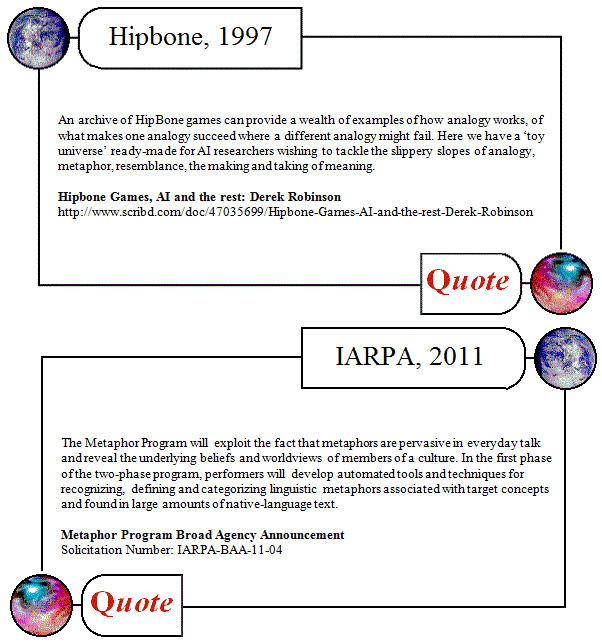
quo-iarpa.gif

In 1997, Derek Robinson wrote a short piece about my HipBone Games, indicating what they were good for. Read it – then read the IARPA solicitation that just came out.

My approach is to lure people into discovering analogies, metaphors, parallels and oppositions by playing a game which elicits them as game moves — a live process, and one that cuts to the very heart of creativity — IARPA wants an automated version, which will be clunky by comparison. And as Derek points out in his piece — pointed out, that is to say, fourteen years ago, quoting an even earlier (1995) comment from Douglas Hofstadter:

If, instead of using the real world, one carefully creates a simpler, artificial world in which to study the high-level processes of perception, the problems become more tractable.

That’s what my games are — “a simpler, artificial world in which to study the high-level processes of perception” — specifically, “of analogy, metaphor, resemblance, the making and taking of meaning”.

I’ve been working on this stuff for at least fifteen years… inspired by a book Hermann Hesse published in 1943.

*

And oh yes, there’s a “future of search engines” hiding in there, too.

On “occultation” (ghayba) and bin Laden

Wednesday, May 4th, 2011

[ by Charles Cameron ]

.

Dr. Timothy Furnish, the author of Holiest Wars: Islamic Mahdis, their Jihads and Osama bin Laden and a keen student of both Shi’ite and Sunni Mahdism, proposed on Twitter yesterday:

Without UBL’s body (or at least pix) claims will come soon that UBL merely “occulted” (like 12th Imam), not dead, and will return.

*

It might be thought that occultation (ghayba) was a Shi’ite concept, extremely unlikely to be espoused by the Sunni (and indeed Salafist) followers of bin Laden.

What exactly is meant by the term “occultation”?

Gershom Scholem in his definitive study of the Jewish heretical messiah-claimant (and eventual Muslim convert) Sabbatai Sevi quotes Elias Bickerman‘s “study of the ideas of occultation in early Christianity and in the cult of the apotheosis of the Roman emperors”, in which the hero “by the grace of God, is liberated from death at the very moment of death, and is removed to Paradise, Heaven, or a distant land where he continues to live in the body.” (Scholem, Sabbatai Sevi: The Mystical Messiah, 1626-1676, p. 923)

Scholem uses the term “occultation” to describe the belief of Sevi’s followers after his death in a way which illustrates comparable beliefs among both Christians and Shi’ite Muslims (p. 314):

In itself the doctrine of occultation could also point to Shi’ite Muslim influence. In the theology of the more radical Shi’ite groups the doctrine of the the occultation of the imam was widely accepted. But in the historical context of Sabbatai’s biography before his apostasy, such Shi’ite influence would seem highly improbable. The messiah — according to Sabbatai’s and Nathan’s teaching — will, then, not die, but will be translated to higher worlds. The idea would agree well with what we know of Sabbatai’s illuminations and the concomitant psychological experiences of exaltation and ascensions to the celestial lights. It is not impossible that conversations with Christians suggested to Sabbatai the very congenial idea of the messiah’s transfiguration.

And notes of this Jewish variant (p. 923):

The Sabbatian doctrine of occultation was not borrowed from other systems but — as happens more often in the history of religions — is the result of similar structures of faith.

More recently, some followers of the late Lubavitcher rebbe have proposed that he is “hidden” and will return… See, for instance:

Since the Third of Tammuz, we are no longer able to physically see the Rebbe King Moshiach. The Rebbe remains physically alive just as before, it is only to our eyes that he is concealed. Therefore, we call this a day of concealment, and many refer to this as the “last test.”
.
— from the brochure “Chasidim Proclaim to the Lubavitcher Rebbe: Long Live our Master, our Teacher, our Rebbe King Moshiach Forever and Ever” as quoted by Rabbi Chaim Dov Keller

*

That’s the sort of background I’d want to have, before dismissing Tim Furnish’s suggestion out of hand. The Qur’an, after all, states at 3.169:

Think not of those who are slain in Allah’s way as dead. Nay, they live, finding their sustenance in the presence of their Lord…

Having said that, it is also true that the Prophet himself treats the notion of his own return as a metaphysical “wish” rather than a realistic possibility, in the hadith attested in both Bukhari and Muslim:

I wish that I could be killed in the Path of Allah, then be brought back to life, then be killed, then be brought back to life, then be killed.

It will be instructive to watch how the narratives of bin Laden’s death and/or continuing life develop.

The tightly woven web of Jarret Brachman

Wednesday, May 4th, 2011

[ by Charles Cameron — cross-posted with minor alteration from SmartMobs ]
*

Jarret Brachman is one of our brightest analysts of jihadist behavior on the internet. He was the first Director of Research with the Combating Terrorism Center at West Point, and is the author of Global Jihadism: Theory and Practice.

His blog today featured an extraordinary post titled My One Fan in Abottabad.

First he writes:

Out of sheer curiosity, I ran a google analytics search to see if I’ve ever had any hits from Abbottabad, Pakistan to the blog.

Then he shows us the map his research produced :

abbot

and then he comments:

Sure enough, I’ve got one fan there who has been checking the blog randomly over the past couple years.

*

As my Watchmen-hip son might say, … Quis custodiet ipsos custodes?


Switch to our mobile site