zenpundit.com » innovation

Archive for the ‘innovation’ Category

More on Where Good Ideas Come From

Tuesday, April 19th, 2011

Dr. Von weighed in on Steven Johnson’s Where Good Ideas Come From with an extensive book review last December( I posted on Johnson here. On a related note, read Charles Cameron’s comment about the limitations of linear thinking here):

Where do New Ideas come from?

….But what exactly are innovation and creativity? The dictionary definition of innovation is ‘the introduction of new things or methods,’ while creativity is ‘the ability to create meaningful new ideas, forms or methods’ that are original and imaginative. So the key notion is the development of new ideas in whatever field one is working. A question naturally develops, which is where do new ideas come from? How do we begin preparing children now to be creative and innovative in the future? In the past, many would have first thought about the arts as being the training ground for creativity. Now, we realize that the development of the abilities and mindsets and skills necessary to be creative in every field of study is necessary.Steven Johnson’s new book, Where Good Ideas Come From: The Natural History of Innovation, provides the argument that there are seven common themes that have led to the vast majority of great ideas throughout history. He gives numerous examples of such ideas, ranging from Darwin’s development of the theory of evolution to the of the GPS system, from Google to the creation of the first mechanical computing devices centuries ago, and so on. It is an interesting read.Here is a summary of the seven themes that lead to good ideas. Keep in mind there is certainly some degree of overlap and relationships between the themes, but overall they can be thought of as distinct concepts.1. The Adjacent Possible: Even if you have an interest in some topic or problem, if there is not a good environment conducive to presenting the necessary pieces to solve the problem, good ideas will almost certainly not develop. You may be brilliant with some of the information (i.e. pieces of a puzzle) in your mind that is necessary to solve a problem, but if your surroundings are not able to provide the remaining pieces of information or experiences, you will endlessly search for them to no avail. If you are isolated from others who know something about your problem or issue, or if there is no means of gathering further information (which is becoming less of a problem with the advent of the Internet), or if your environment does not provide the physical infrastructure or supplies to finish building a new physical device, you will be unable to develop the Idea or solution to your problem.

2. Liquid Networks: Great ideas can develop when information is allowed to flow through a larger network. One possible network is a social network, or often and more specifically, a professional network. The focus of this is the ability to collaborate to solve problems. It turns out that there are almost no great ideas throughout history that have been developed in isolation or by an individual who did not need any help in the development of that great idea. One may think Newton or Einstein did their work in isolation, but this is not entirely true. Those two individuals come about as close as you can get to not needing a network to develop the laws of motion or relativity, but they relied on some level of feedback, reading others’ work, and ultimately talking and discussing issues with close colleagues and friends.
An interesting study was done that looked at how research groups reach the coveted ‘Eureka!’ moment, where a new discovery is made. It turns out that these rare moments of discovery or problem solving almost never happen in the lab! Instead, the ‘Aha!’ are yelled out at the conference table, where members of the group are throwing ideas around and sharing results of their latest work over the past week. The person who figures it out needs to have input they have not thought about from the larger group or network, before the grand idea is formed….

Read the rest here.

Social and Individual Components of Creativity

Thursday, April 14th, 2011

This is very good. And it is fast.

I have enjoyed several of Steven Johnson’s previous books, Emergence and Mind Wide Open and his latest one, Where Good Ideas Come From looks to be a must read, though I think those of you who have read Wikinomics or works like Flow by Mihaly Csikszentmihalyi will find some of Johnson’s points in the video to be familiar as will those long time readers who have seen my views on horizontal thinking   and  insight.

My students watched this and reacted by defining themselves as those who were creative mostly through social collaboration but a decided minority required solitude and an environmental filter to think clearly and creatively – not a catalyst of a series of  social-intellectual stimuli. For them, the cognitive load generated by the environment amounted to an overload, a distracting white noise that short-circuited the emergence of good ideas.

This suggests to me that there are multiple and very different neuronal pathways to creativity in the brain and a person’s predisposition in their executive function, say for example the classic “ADHD” kid at the back of the class, may have different requirements to be creative than a peer without that characteristic. It also means that creativity may be subject to improvement if we can cultivate proficiency in several “styles” of creative thinking.

Robert Scoble on “Revolutionary” Apps that Fuse TV, Streaming and the iPad

Thursday, April 14th, 2011

Scoble claims AirPlay will be on par with the advent of RSS.

Oddly enough, when I first got an iPad my first thought was to find a way to stream it through an LCD projection system at work through our network ( giving the IT department much cause for amusement). Now I am wondering if the AppleTV device and/or AirPlay will get this idea off the ground….

Comments from the technophile-geek portion of the readership are cordially invited.

Somebody at DARPA is a Fan of Daniel Suarez

Tuesday, April 12th, 2011

Freedom (TM) by Daniel Suarez

Remember those augmented reality glasses that the daemon operatives like Loki used to connect to the Darknet? Well, DARPA did…

DARPA Designing Augmented Reality Goggles to Fight Friendly Fire 
 

DARPA smart tech

Remember how the Beastmaster could see through the eyes of his pet eagle? DARPA does. And it’s pursuing augmented reality goggles tech that’ll let troops see through the eyes of a nearby unmanned aerial vehicle (UAV) in order to more accurately target its weapons.

The issue of accurate targeting and weapons-fire has a renewed interest in the wake of NATO mistakenly destroying rebel armor in Libya rather than Gadhaffi’s hardware, but it’s never been an easy task. One of the very best ways to deliver today’s smartest weapons is to have an “eyes-on” soldier in the field near the target relaying real time data up to the aircraft that’s about to drop a bomb–but this situation is not often practical or desirable and can be dangerous for both the soldier and the incoming aircraft.

vuzixgoggles

Read the rest here. 

Very cool. If John was not so busy with his new company, he probably could tell his readers how to combine this off-the-shelf modified tech with DIY drones.

An always fun thought experiment is to figure out how far ahead DARPA really is in the lab compared to whatever toy they feel comfortable giving a press release. And then there’s what exists on the drawing board that is technically feasible but not particularly economical at the present time to pursue seriously. Imagination usually far outstrips budgets

The integration of religion and popular culture

Friday, March 25th, 2011

[ by Charles Cameron ]

*

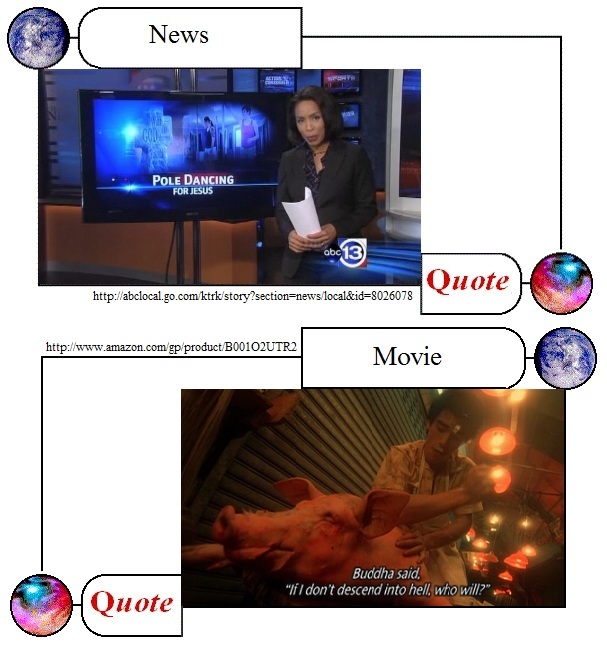
Yesterday, I stumbled on the account of pole dancing for Jesus with the accompanying graphic. I was a little taken aback, I’ll admit, but Jesus didn’t confine his ministry to the pious and scholarly, he befriended women of questionable morals and enforcers from the Roman mob as I recall, or “publicans and sinners” to give them slightly more pleasant names – so I sat up, took notice, downloaded the image, and re-sized it to fit in the top position of one of my DoubleQuotes – while wondering if I’d have to wait till Doomsday to find a suitable companion piece.

quopole-dancing.jpg

All in a day’s screen-gazing, I wound up watching the Wong Kar-Wai film, Fallen Angels, last night, and lo: the screen-shot in the lower part of the DoubleQuote revealed itself.

There are interesting paradoxes embedded in each image, of course, pitting what you might call “deep” theology against pious expectation – but they also illustrate another matter of some interest to me, the degree to which religion is now richly integrated into popular culture.

*

My second DoubleQuote, which contains today’s haul, deals with the same theme, I suppose — this time showing how what used to be the separate realms of science fiction and religion are now intermingled, with Minister Farrakhan speaking of an “end times” space craft that is an integral part of NoI eschatology in his annual Saviours’ Day speech, while alien aircraft flown by religious robots feature in a tongue-in-cheek news report about the war over Libya from Spencer Ackerman at the Wired War Room.

It is perhaps not surprising that Minister Farrakhan also cites Scientology with approval in the same speech, nor that that religion was itself the offspring of science fiction writer L Ron Hubbard. We are in a fertile period for the religious imagination, I believe, grappling to find new ways to answer the age-old questions — and science fiction and “signs in the skies” are among the vehicles, along with new religious movements and old religions renewed, by which we are coming to terms with life in this post-nuclear age…

quosigns-in-the-sky.gif

I’m not much of a prophet, but I predict that the confluence of science fiction with religion will prove to be one of the keys to an understanding of our times…


Switch to our mobile site