zenpundit.com » military

Archive for the ‘military’ Category

“We’ll Start the War From Right Here!”

Monday, June 6th, 2016

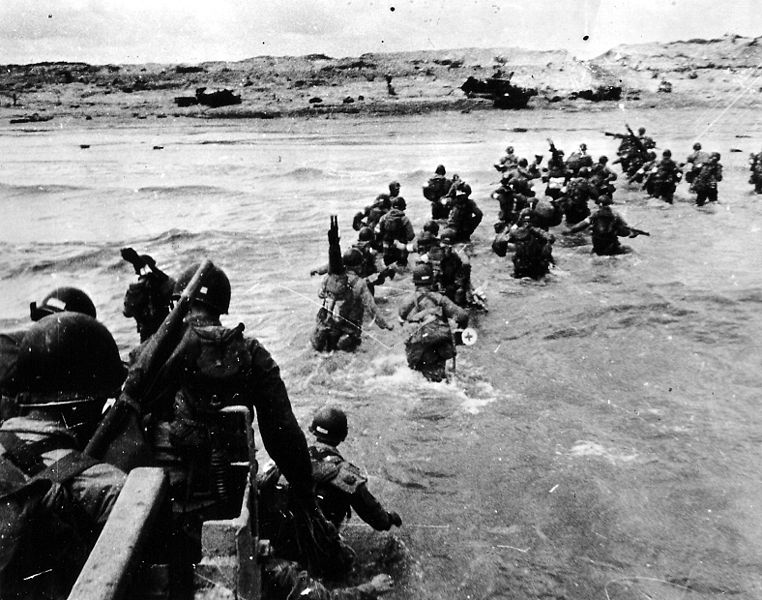
JUNE 6, 1944…..72 Years Ago Today….

Seventy-two years ago over 9,000 American men, some hardly older than boys, laid down their lives on the beaches of Normandy in the greatest military operation in the history of the world. The white crosses stand row upon row in Colleville-sur-Mer,  in silent testimony of their supreme sacrifice.

Others who scrambled ashore on bloody Omaha Beach, or who climbed the rocky cliffs of Pointe du Hoc or who parachuted behind enemy lines with the 82nd and 101st Airborne lived to fight their away across France and across the Rhine into the heartland of Germany to break the power of the Third Reich forever. Others who survived the terrible ordeal of D-Day and fought on were not so lucky and did not come home.

Brigadier General Theodore Roosevelt, Jr. at age fifty-six was the oldest man, the highest ranking soldier and the only general officer in the first wave of the Normandy invasion. Roosevelt was seriously ailing and relied on a cane; he had been refused permission to join the landings twice before his superiors finally relented. Roosevelt’s 8th Regiment missed their objective at Utah Beach by a mile. There was no cover from withering German fire or prospect of swift reinforcement. Allied bombardment there had been light and the men had to cross hundreds of yards of beach to engage the enemy. When nervous subordinates asked if they should re-embark, Roosevelt seized the moment:

“We’ll start the war from right here!”

Heedless of enemy fire Roosevelt strode up and down the beach, reorganized units, directed landings and led his men in battle. By the end of the day the 8th Regiment had taken their sector and Roosevelt had earned the Medal of Honor.

He died forty-four days later during the Battle of France, one among many American GIs.

The “Greatest Generation” is receding into history in increasing numbers with each passing year but their deeds are destined to become legend.

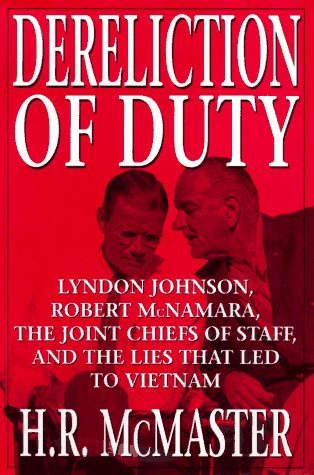
Manea interviews H.R. McMaster at SWJ

Wednesday, June 1st, 2016

[by Mark Safranski / “zen“]

Octavian  Manea sits down with historian, military futurist and veteran of 73 Easting and Tal Afar,  LTG H.R. McMaster at Small Wars Journal.

Future Missions Through the Lens of the US Army Operating Concept

Q: Let’s revisit your Tal Afar experience with an eye to the future operational environment where (mega)cities, urban slums and operating among populations is becoming the new normal. What are some of the personal lessons that you see relevant for this not very distant future?

A: Most importantly, we need to generate, develop and maintain understanding in these very complex environments. We need to understand our enemies and we also need to understand the populations among whom these wars are fought. We need to understand the political, tribal, religious, ethnic dynamics that often affect the missions and the security situation. The cultural, social, economic, religious, and historical considerations that comprise the human aspects of war must inform wartime planning as well as our preparation for future armed conflict. In Iraq in particular and across the Middle East if we look at Daesh; they are able to use violence and propaganda to excite historical grievances, magnify sectarian identities, and pit communities against each other and then portray themselves as patrons and protectors of an aggrieved party. Once they are in those communities they establish control mainly through intimidation and coercion, and also through a broad range of other incentives and disincentives they apply among the populations. They use that control of territory to mobilize resources in order to perpetuate and accelerate the conflict usually by committing mass murder and mass rape and mass child abuse.  Daesh directs violence against the other community in order to incite retribution which then fuels the cycle of violence. The cycle of violence creates chaos and Daesh use that chaos to establish control over territory, populations and resources. We need to understand the fear, the sense of honor, and the interests of communities that are party to that conflict.  What Daesh does is they essentially use ignorance to perpetuate hatred, hatred to justify violence, and violence prevents education and perpetuates ignorance, and it becomes a cycle. This is perfect for them. They will have a population that is undereducated, largely illiterate, and susceptible to demagoguery. The cycle has to be broken by defeating the enemy physically and then by consolidating gains to protect populations and territory. What it is equally important is to consolidate gains psychologically by addressing the fear, sense of honor and interests of the communities that are in conflict. This was what was critical in Iraq especially between 2007 and 2010 where we were able, along with Iraqi leaders, to forge what turned out to be a very fragile political accommodation between the parties in the sectarian civil war. I think it is clear in retrospect that we didn’t do enough to sustain that fragile political accommodation and as a result there was a return of large scale communal violence that set the conditions for the ISIL/Daesh to establish control over territory in Iraq and create this horrible situation. The lesson is that we have to understand these complex environments and we have to address what is driving the conflict.  And ultimately what is necessary is mediation between the parties that were in conflict to remove support among the population for murderers and extremists on all sides of the conflict.

 [Emphasis in the original]
 .
Read the rest here.

On militarizing the concept of Thought Police

Wednesday, April 20th, 2016

[ by Charles Cameron — a renewed emphasis on the war of ideas? ]
.

A cluster of items from JM Berger‘s twitter feed this morning gave me pause for thought — but I was careful not to think anyway.

Here’s the basic concept:

The most overt example:

Independent corroboration:

Connecting the dots:

And for the Illustrated Executive Brief:

Across the great divide

Friday, April 8th, 2016

[ by Charles Cameron — philosophy during a bank heist — and its implications in terms of military doctrine ]
.

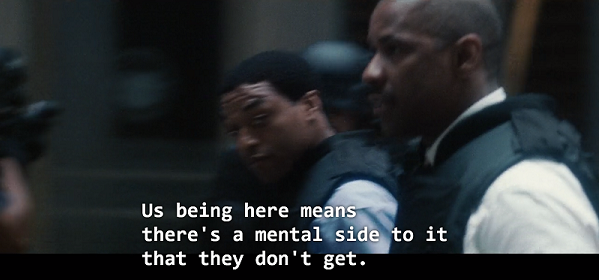
tactical

mental

Two screenshots in sequence from the Denzel Washington movie, Inside Man, bring me back to the philosophical fissures and fusions between mind and brain, subjective and objective, quantitative and qualitative, man half-angel and half-beast — in a law enforcement context.

**

When one side has reached the limits of its material strength, it can always add to its military efforts by mobilizing all possible moral strength.

I often need to talk about this. As material, for Clausewitz, is the counterpart to moral, what for TRADOC is the counterpart to Human Terrain?

Anne Smedinghoff Didn’t Have to Die Part 2

Wednesday, March 30th, 2016

[ Last week, Zen hosted Pete Turner’s guest post, PRT and State Department Ignorance Fails Us All. Here is part 2 of that article — posted by Charles Cameron for Zen ]
.
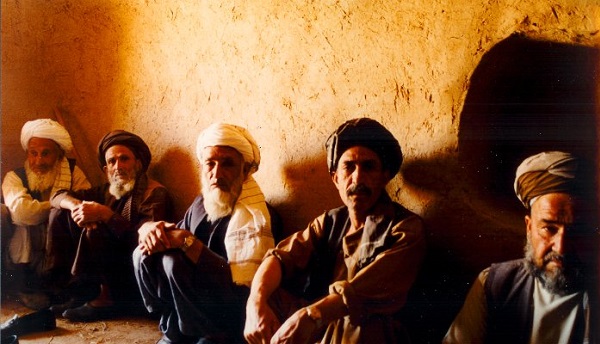
pete turner header

**

Last week I wrote about the tragedy of Anne Smedinghoff, who died on a patrol in Qalat Afghanistan.  This is part 2 of the story–

My intention here is to illustrate HOW? rather than “what” we (Dr. Rich Ledet and I) did regarding the proper means to improve education in rural Afghanistan.  I submit that our method is more reliable, predictable, measurable and can be replicated; yay scientific method.  

Dr. Ledet and I leveraged an unusually strong partnership with a key Afghan political-religious leader.  More than simply believing that we had a great relationship, we’d taken steps to build and validate the strength of our partnership, leveraging tools I had personally developed over years of immersion in conflict environments.  

To begin with, we avoided the common US “crutch” of dominance, never assuming that we were “in charge.”  Not only did we share many meals and tea with him, but we socialized with him and his family apart from any other American military elements. We also invited this leader to our dining facility to eat with us on numerous occasions.  We shared our relevant reports (normally made for US elements only, these reports dealt with our evaluation of his region) with him (unclassified or FOUO) so that he could better understand our role and how the US was attempting to support him–This post is long enough already. I’ll have to come back to this particular topic later.

As a side note, I thought I had a great relationship with this leader after working with him almost daily for months.  One day, he sat back, put his hand above his head and said, “I get what you are doing now.  I understand that you are truly helping me with the Americans.”  This breakthrough was surprising, as I thought we already had a good partnership.  But I had misjudged what was previously accomplished, and the lesson I learned was that not only is trust VERY hard to earn, but also that there are different forms of trust to be accounted for when attempting to partner with leaders in conflict environments.  Only after this point did I realize that I had earned an additional level of trust, and that he allowed me more latitude and access than he afforded any other American.  In fact, I could come to him for advice, as he knew that I was genuinely working to support the Afghans in a way that was within the bounds of their customs.

We brought our research problem regarding education to our partner, and asked him how to best work toward a solution.  He immediately identified the other elders with whom we needed to discuss and work, while providing us with the new Provincial Minister of Education’s (MoE) personal phone number (which we did not previously have on record) and advised us to mention his name when we talked.  He noted that he was also attempting to work with the MoE on education in his district, and although they hadn’t always agreed, he felt the MoE was an honest man.

This process of partnering, and acquiring information about other leaders and the MoE, demonstrated a measure of trust indicating that our partner indeed valued us and our efforts.  Further his validation through providing us with an introduction to other key decision-makers in the province which gave us unique access to a set of leaders that didn’t typically interact with US elements.  We had truly entered through a more culturally appropriate door, as our partner trusted that we would not expose him in a negative light to the other leaders.  

Once we were able to make contact with the recommended leaders, we were careful to explain the agenda, set up appointments, and accommodate their schedules as best as possible.  We never showed up unannounced, or uninvited.  With the safety of all involved in mind, we took time to determine their preferred place of meeting, which was critical considering that we lived on an American forward operating base, and could move in heavily protected convoys.  We were remarkably “safer” than those leaders, as they lived in constant threat.  We displayed a respect for their safety when we considered their venue preference.  While these logistical steps seem obvious, we found this level of respect nonexistent in DoS, PRT and US forces attempting to work with local leaders, again relying on domination to achieve goals; US forces prefer to show up unannounced, unscheduled and take over the Afghan leader’s schedule as we set fit.  

When we met, the recommended leaders were also accompanied by multiple religious elders.  We didn’t ask them to do this, by the way, but it was something that was required in their culture.  This was also an indicator to us that we approached the problem from the most culturally appropriate angle known to us (and recommended by our Afghan partner who originally set us up for success).  Afghan leaders, when not influenced by Americans, will have a religious leader (mullah) present as they make decisions.  

Over the course of several meetings, and after deliberation between the MoE and other family and religious leaders, we were able to ascertain what was expected in terms of US assistance.  Keep in mind that what we were also doing was helping to link family, religious, and political leaders with a valid MoE backed plan to improve education throughout all of Zabul province; a critical element of creating stability wins.  

These leaders never asked for money. They never asked us to build another school.  They recognized that we could help, and they also wanted us to help them determine if these programs were working.  They knew we had the capacity, which they knew they did not, to help them measure the success of the program.  

What is most telling is that these leaders noted a lack of security, which is a common theme throughout my time in conflicted areas.  Security concerns are superior, and every other effort is subordinate.  This is where you need to pay attention DoS–The MoE asked that he never be seen engaging with the US at his office, as US patrols could only expose him to harm, he and other leaders wanted to reduce the amount of contact between US forces and their children for the same reason.  Moreover, leaders in the district wanted us in the background, as they wanted to see the Afghan government and the MoE doing their job.  They wanted the people living in Zabul Province to see the same–This is setting the stage for believable, culturally based stability win…and there is no photo op.

Our work established the beginnings of a clear plan that meets the requirements for creating stability. It satisfies a test we developed that indicates potential success when conducting non-lethal missions or operations…Is the operation Afghan inspired, Afghan led, Afghan provisioned, and sanctioned by a Mullah?  

Is it possible that if DoS had bothered to teach Anne this test or heed our report, that she would still be alive?

Switch to our mobile site