zenpundit.com » ancient history

Archive for the ‘ancient history’ Category

Hoover on Charles Hill and Hill on Grand Strategy

Tuesday, November 8th, 2011

Lexington Green sent this extended profile/interview with Charles Hill by Emily Esfahani Smith. The tone of the article is somewhat hagiographic because Hill is a fellow at the Hoover Institution and….well…. this is in Hoover’s journal 😉  If you can get past that, it is a worthwhile read about a deep thinker and scholar of grand strategy.

Profile in Strategy: Charles Hill

….In diplomacy, literature is relied upon because, as he writes in “Grand Strategies,” “The international world of states and their modern system is a literary realm; it is where the greatest issues of the human condition are played out.” That is why Alexander the Great carried the Iliad with him on his conquests, and why Queen Elizabeth studied Cicero in the evenings. It is why Abraham Lincoln read, and was profoundly influenced by, Walt Whitman’s “Leaves of Grass,” and why Paul Nitze paged through Shakespeare on his flights to Moscow as America’s chief arms negotiator.

Hill, for his part, has always kept the “History of the Peloponnesian War” in his mind as the “manual of statecraft.”

Why Thucydides? He explains: “When you read the Peloponnesian War, you realize that Thucydides is moving from one set of problems to another, and you have to deal with them all-rhetorical problems, material problems, and moral problems. That’s the closest literary work related to statecraft that I can imagine.”

To understand world order-and those who manipulate it for their own aims-requires a literary education, the kind students were once able to find at such places as Yale, where Hill now teaches the humanities to freshman undergraduates.

This is a departure from his days at the State Department, where he helped orchestrate monumental events in the grand strategy of the Cold War. One of his first memories as a diplomat was of being seated behind Adlai Stevenson at the UN during the Cuban missile crisis, characteristically scribbling notes-in grand strategy, no detail can be lost. Later, Hill was a “China watcher” during that country’s Cultural Revolution. And when the Iran-Contra scandal nearly brought down the Reagan administration, Hill’s meticulous notes played an influential role in the Congressional investigations by shedding light on the chronology of then-Secretary of State George Shultz’s knowledge of the arms sale. Over the years, Hill has also served as confidante to Secretaries of State. For Henry Kissinger, Hill was speechwriter and policy analyst. For Shultz, Hill was an executive aide and trusted ally.

These days, Hill embodies grand strategy in a different way. After a long and distinguished career as a diplomat, Hill is now a heralded figure in academia. Beyond his appointment as a research fellow at the Hoover Institution, he is the Brady-Johnson Distinguished Fellow in Grand Strategy, a Senior Lecturer in Humanities, and a Senior Lecturer in International Studies at Yale. Alongside historians John Gaddis and John Kennedy [ sic] , he teaches one of Yale’s most legendary courses to a select group of elite students-future statesmen-the Grand Strategies course.

And yet, Hill tells me stoically, “There is no grand strategy in our time.” Turning his attention to the turmoil in the Middle East, Hill provides an example. “America’s lack of strategic outlook responding to the Arab Spring is really distressing.”

Hill retains the diplomat’s gift for understatement.

Read the rest here.

ADDENDUM:
Book Review: Grand Strategies by Charles Hill 

Trial of a Thousand Years, by Charles Hill-a review

Gunpowder, treason and plot

Saturday, November 5th, 2011

[ by Charles Cameron — instance of religious terrorism, UK, Catholicism, Protestantism, Vendetta-the-movie, Anonymous, OWS, Pharaoh ]

.

men.jpg

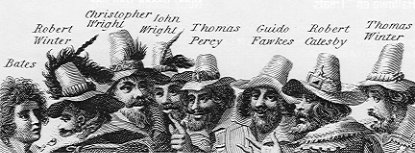
I am seven hours “behind” the land of my birth, but today would be the day on which to remember one Guy — named Guido in the image above — Fawkes, a terrorist whose religious and political sympathies were closely interwoven.

*

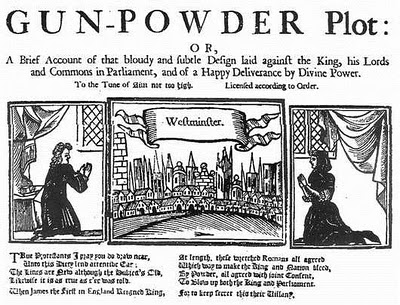
Archbishop Cranmer‘s [dare I say, Laudable?] blog today has a poetic description of the event, a fine illustration:

gunpowderplot.jpg

and some fascinating comments portraying both the event itself and religious terror more generally…

We have had four hundred years to “remember, remember” — should we remember, or should we forgive and forget?

*

The mask worn in the movie V for Vendetta is a Guy Fawkes mask, now also associated with both the Anonymous group and the Occupy movement… and it shows up in all sorts of strange places…

images1.jpg

Pharaoh? Guy Fawkes?

Clear proof that if you connect too many dots, you may go what we Brits call “dotty”…

Fouche on Potential and Probable Uses of Power

Friday, October 7th, 2011

My sometime Chicago Boyz colleague, Joseph Fouche, had an interesting if somewhat meandering post on how power is used, not used and possibly abused.

The Chains of the Improbable vs. The Chains of the Impossible

An old Vulcan proverb advises us that only Sulla could march on Rome. This proverb may contradict another ancient proverb that claims that all roads lead to Rome. This seeming contradiction is resolved when you include little used roads, off the beaten track, the roads not taken. Sherlock Holmes once chided John A. Watson, M.D., saying, “How often have I said to you that when you have eliminated the impossible, whatever remains, however improbable, must be the truth?” Some roads to Rome are impossible, leading to the insurmountable. Lucius Cornelius Sulla Felix took a road that, while thought impossible, proved to be merely improbable.

Sulla, consul of Rome for the year 88 B.C., was in camp preparing to take his army east to fight King Mithridates VI of Pontus. Two envoys arrived to tell him that his command had been taken away by the vote of one of the people’s assemblies in Rome. These envoys of the Roman people expected that Sulla would do the only thing possible: lie down there, obedient to their commands, as every Roman army commander before him had done. Unfortunately, what they thought was impossible was only improbable.

Sulla gathered his men, announced what the will of the Roman people was, and asked them what the will of the army was. Sulla’s soldiers answered by stoning the envoys of the Roman people to death, much to the surprise of the envoys of the people. Sulla’s soldiers then petitioned Sulla to take an impossible road, a road never taken, and lead them to Rome to reclaim his Mithridatic command. Sulla, much to the surprise of his own officers, who thought such a course impossible, decided to heed his men and march on Rome. His officers resigned en masse except a happy few. But the poor bloody legionaries of Sulla’s army eagerly began the march on Rome.

Envoys from Rome streamed towards Sulla’s army as it marched north.These envoys were shocked and grew increasingly shocked as they protested to Sulla that surely, surely it was impossible that he wanted to march a Roman army through the city limits and into Rome itself. The law forbade it. The unwritten constitution forbade it. The Republic forbade it. The gods forbade it.

Sulla responded to the effect of, “Go tell the Romans that I don’t lie here obedient to their commands. I’m coming to Rome and hell’s coming with me.” The tone of these envoys’ entreaties and the mood of the people of Rome grew increasingly hysterical as the improbable dawned on them: not only could a Roman army commander march an army on Rome, it was increasingly probable that Sulla would march armed Roman legionaries right into the heart of Rome itself to deal with his political enemies. Indeed, Sulla led his men across the sacred pomerium that divided the “public thing” (res publica) of sacred Roma herself from land that was merely the property of Rome. Sulla’s veteran legionaries easily dispatched the hastily gathered mob of gladiators and other ruffians that his political opponents had thrown together at the last moment in a futile attempt to stop them.

Sulla had revealed that the impossible was merely the improbable.

Sulla spent the rest of his life trying to disguise this state of improbability as a mere state of impossibility.

He failed.

That was merely Fouche’s introduction. The post is well worth reading in full.

The post caught my eye because of Sulla, a Roman who did a monstrous thing but who was himself no monster. Much like a surgeon whose patient’s body is riddled with cancer, Sulla attempted to buy the old Roman Republic time and restore a semblance of political health by ruthlessly cutting out a tumorous faction and ratcheting back a host of constitutional gimmickery that had been welded onto Roman government over the years by ambitious politicians. Older, original rules of the game, or new ones in their spirit, were restored after blood shed in the proscriptions was scrubbed from the forum. Sulla even formally stepped down from the supreme power he held, like Cincinnatus, to further drive home the point to his fellow Romans regarding the sanctity of their traditions – though reportedly Sulla remained, even in a debaucherous retirement, a terrifying figure and stringpuller.

Fouche is correct that Sulla’s extreme measures failed. The underlying structural problems of the Republic were rooted in an increasing concentration of wealth, primarily in land ownership by Patricians and politically favored trading opportunities in “the East”, held mostly by the elite of Rome’s Italian “allied” city states, that left many Roman citizens too impoverished to perform military service or to be active in politics, except as dependent members of a clientela. The Republic’s legions and it’s political virtue had been based on an economically independent smallholding class who were being despoiled by politically powerful Patricians. Sulla’s reforms may have tempred political conflict within the ruling class for a time, but they also aggravated the social grievances that provided the Populares with political support from ordinary Romans and tilted the delicate political balance in the Republic toward extreme oligarchy.

In his retirement, observing the young Julius Caesar, whom Sulla had reluctantly spared, his toga fashionably loosely belted, long sleeved and wearing boots, like the ancient kings of Alba Longa, Sulla remarked “ He contains many Mariuses“. Caesar did. And unlike Marius but like Sulla, Julius Caesar was successful, Sulla having shown him the way to cross a Rubicon.

Power is power but power coupled with legitimacy endures. Sulla to Caesar to Augustus is the continuum.

Dead Sea Scrolls & Nag Hammadi Codices online

Wednesday, September 28th, 2011

[ by Charles Cameron — archaeology, Biblical scholarship, eschatology, digital literacy ]

.

Both the Dead Sea scrolls from Qumran and the Gnostic and associated codices from Nag Hammadi are now available for study online:

quo-codices.jpg

The Nag Hammadi Archive can be explored via the Claremont Colleges Digital Library, and the Digital Dead Sea Scrolls via the Israel Museum, Jerusalem.

Here’s a description of the War Scroll from Qumran, which “is dated to the late first century BCE or early first century CE”:

Against the backdrop of a long biblical tradition concerning a final war at the End of Days (Ezekiel 38-39; Daniel 7-12), this scroll describes a seven stage, dualistic confrontation between the “Sons of Light” (the term used by Community members to refer to themselves), under the leadership of the “Prince of Light” (also called Michael, the Archangel) – and the “Sons of Darkness” (a nickname for the enemies of the Community, Jews and non-Jews alike), aided by a nation called the Kittim (Romans?), headed by Belial. The confrontation would last 49 years, terminating in the victory of the “Sons of Light” and the restoration of the Temple service and sacrifices. The War Scroll describes battle arrays, weaponry, the ages of the participants, and military maneuvers, recalling Hellenistic and Roman military manuals.

You can see why I’m interested.

The Nag Hammadi texts are a little less well known but include — along with a variety of other texts, some of them self-described as “apocalypses” — the now celebrated Gospel of Thomas, which Bart Erhman reads as continuing a “de-apocalypticizing” of Jesus’ message which he finds beginning in Luke and continuing in John:

In the Gospel of Thomas, for example, written somewhat later than John, there is a clear attack on anyone who believes in a future Kingdom here on earth. In some sayings, for example, Jesus denies that the Kingdom involves an actual place but “is within you and outside you” (saying 3); he castigates the disciples for being concerned about the end (saying 18); and he spurns their question about when the Kingdom will come, since “the Kingdom of the Father is spread out on the earth and people do not see it” (saying 113).

Again, you can see why I am delighted that these texts are becoming available to a wider scholarly audience…

In both the Nag Hammadi codices and Qumran scrolls, we have texts that were lost for almost two thousand years and discovered, somewhat haphazardly, in 1945 and 1947 respectively, providing us with rich insights into the religious ferment around a time and place that have been pivotal for western civilization.

Now, more than half a century later, the web — as it becomes our global museum and our in-house library — brings us closer to both…

Anonymous and Master Roger, a review

Tuesday, August 30th, 2011

 by J. Scott Shipman

master-roger.jpeg

Anonymous and Master Roger, Anonymous, Notary of King Béla The Deeds of the Hungarians, Master Roger’s Epistle to the Sorrowful Lament upon the Destruction of the Kingdom of Hungary by the Tartars

 Back in June Zen posted a couple of mini book reviews, and David Schuler posted this comment: 

 “For moderns inclined to romanticize war in antiquity may I recommend The Epistle to the Sorrowful Lament upon the Destruction of the Kingdom of Hungary by the Tartars?  It became available in English translation fairly recently and constitutes a first-hand account of the Mongol invasion of Hungary.  The violence, not only against persons and property, but against the land itself is notable and eye-opening.”

The title was enough to pique my interest, and since I knew very little of this period I went to Amazon UK and purchased a copy (US versions are prohibitively expensive) . That said, I didn’t expect to get around to reading for some time, but if I don’t “buy” a book while it is still on my mind, I’ll likely forget as the pile continues, “without ceasing” (to wax Biblical) to grow. For an obscure text, the introduction drew me in and I was hooked enough to read a few pages a day.

The book has ample and informative introductions to each work. The stories are presented in Latin on one page and English on the facing page.

The narratives are very different, Anonymous was a Notary to King Béla (circa 1196), and he recounts the deeds of Hungarian royalty, and the behind the scenes machinations of the royal court. Anonymous’ account was laced with both biblical and classic texts and was quite tedious, predictably obsequious but while at the same time offering up little snippets here and there—and often in the notes. A note in the section titled 40. The Victory of Prince Árpád, Anonymous wrote: “…for thirty four days and in that place the prince and his noblemen ordered all the customary laws of the realm and all its rights.” The editors included the following footnote with respect to “rights.”

 “The translation of ius (in contrast to lex, “law”) is a problem that is not only linguistic. Translators of Roman legal texts often retain ius, as it implies law, justice, rights along with all their connotations. Modern English does not distinguish lex from ius, Gesetz from Recht, or loi from droit, which may explain the generally supine Anglo-Saxon attitude towards the law and authority in general…”

Schuler was right in his description of Master Roger’s first hand account of the Tartar invasion (1241/42); horrific comes to mind. There is no romance. The brutality and ruthlessness of the Tartars is awe-inspiring and fearful 900 years removed. The tactics of the Tartars are textbook examples of psychological warfare before the term was coined—and their ability to “get inside” their adversaries decision-making loop (OODA, anyone?) was remarkable.

The ancient Sorrowful Lament story was reassuring of the power and resilience of the human spirit. The deprivations experienced by the Hungarians were not unique in human history, but serve to illustrate how resilient a people can be when things truly go to hell in a hand basket. When their leaders failed, the Hungarians found way to live in spite of their feckless unprepared leaders, and in spite of a ruthless, blood and booty thirsty enemy.

Anonymous and Master Roger is recommended to anyone wanting to understand the human condition, whether royalty, peasant, bureaucrat, or barbarian. This is an important book…for a “sorrowful lament” has much to teach us about the human condition and how little man changes. This highly eclectic little title comes highly recommended and many thanks to Dave for sharing.

Postscript: One remarkable thing about this book, printed in Hungary, is the high quality construction using good paper and string.

There are no references to share for this volume, however if this volume is indicative of their work, Central European Medieval Texts are to be commended and followed.

BTW, Joey recommended Millenium by Tom Holland and I’m about half-way through—excellent thus far!


Switch to our mobile site