zenpundit.com » government

Archive for the ‘government’ Category

Viewdle is a Two-Edged App

Sunday, February 20th, 2011

Saw this on Shlok’s site:

Viewdle – Photo and Video Face Tagging from Viewdle on Vimeo.

This kind of app is a required step for making augmented reality devices part of the social media ecology. Therefore, this tech will become a standard for all mobile devices – merchants and advertisers want us as an army of data collectors on each other.

OTOH, automatic face-recognition and social media aggregation raises serious concerns about the potential dangers of living under a panopticon state if an app is aggregating and bundling all your online data in real time, while giving out your GPS and home address. A godsend to stalkers, oppo researchers, con men, disgruntled spouses or employees, autocratic governments and other creepy malefactors. Expect businesses, which are already attempting to illegally pry and spy into all areas of employee’s lives, to make surreptitious use of apps of this nature

Puts the protests to revolution in Egypt and Tunisia in perspective, doesn’t it?

If the FCC wanted to do something useful and promoting of liberty, they might consider regs to let individuals exercise greater control the use third parties would have to their collective online IDs – then you could be “out there” or not or to the degree you liked. Some people, do want to be “out there” professional or social reasons. While you cannot control pictures of yourself in a public space, I’m not sure the Supreme Court thought that your presence in public meant that random strangers and government officials should be able to run your credit history as you sit at a table in a restaurant or bar or take in a movie or ball game by taking your photo. A similar logic underlies state laws prohibiting wiretapping or making auditory recording individuals without their knowledge and consent (Illinois being one such state where Chicago aldermen and state legislators have acquired a healthy fear of recording devices).

Speaking of government, I have been told by an authoritative source that the USG rsearch is far advanced in this area. Probably a lot further along than is Viewdle, but perhaps not.

History as a Gen Ed Credit for Engineering Students Aspiring to Naval Leadership

Tuesday, February 15th, 2011

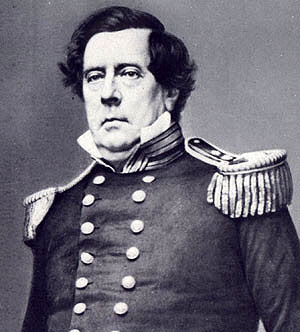
Commodore….errr….what’shisnameagain???

As a rule, I generally do not write about US Navy affairs because it is not an area of expertise for me and I think Galrahn covers that territory admirably well without my poor help. Every so often though, an item from our sea-roving friends catches my eye that I am qualified to speak about and today is one of those days.

Teaching naval history has become an inconvenience to those entrusted with training our nation’s future captains and admirals because they need to get the budgetarily “sexy” topic of “cyber warfare” into the US Naval Academy curriculum. Yes, that’s right. Because someday, in the midst of battle, the combatant commander of PACOM will be furiously barking out HTML code at the bridge of the Eisenhower, above the cries of wounded men.

Gentlemen, gentlemen….in matters of education, fundamentals come before esoterica!

I strongly recommend this post by LCDR Benjamin “BJ” Armstrong, historian, pilot and Navy officer who tackled this subject with an enviable grace and eloquence at the USNI blog:

HH104, WWATMD…

….More than policy or naval strategy, Mahan believed in teaching officers the best ways to approach the challenges of command.  He saw his job as a Naval War College plankowner in those terms, about teaching command, and to do so he turned to history.  But, it wasn’t just senior officers who needed grounding in our naval past.  He wrote in his very first published article, winning third place in “Proceedings” annual essay contest, that history was also a key foundation for learning at the Naval Academy.

When he said that history “lies at the foundation,” it wasn’t just a convenient turn of phrase.  He believed that before subjects like gunnery, engineering, or even cyber-warfare, could be taught a Midshipman needed to know why he was learning them.  Why did any of it matter?  The best way to show a student why hitting the target in gunnery class was important was to teach him the history that showed what happened when crews weren’t drilled properly.  Perhaps he would teach the Midshipman about Captain James Lawrence sailing Chesapeake out of Boston harbor with a green and undrilled crew in 1813 to face HMS Shannon, a short time later uttering his final command, “Don’t give up the ship” just before he succumbed to his wounds and the British boarding party swarmed aboard in victory.  Maybe the Midshipman would recognize the words…from the battle flag bearing the phrase in Memorial Hall that was flown at the Battle of Lake Erie.  Mahan felt that once a Midshipman understood the importance of mastering the craft, of studying their trade, a subject like weapons systems engineering would become important even to the lowly humanities major.

The second part of Mahan’s statement is also important, “all sound military conclusions and practices.”  In our age of checklist leadership and officers educated as engineers there is a desire to approach leadership challenges as equations where certain inputs are guaranteed to give you the desired results.  But Mahan doesn’t say all “correct” military conclusions and practices, he says “sound.”

Mahan recognized that both naval strategy (conclusions) and combat leadership (practices) were art, not science.  In his book “Naval Strategy: Compared and Contrasted with the Principles and Practice of Military Operations on Land,” published in 1911, Mahan compared naval officers to artists.  He wrote that artists had to learn certain techniques, mediums and certain skills, but that wasn’t what made their artwork great.  In the end “art, out of materials which it finds about, creates new forms in endless variety,” artists take those foundation basics and then mix and match them based on inspiration and experience to create a masterpiece.  History helps us understand that frequently there are no right answers to military questions of strategy or leadership.  There are only “sound conclusions,” which are drawn from understanding basics and history.  Demonstrating this great truth to Midshipman early in their education, say as a Plebe before they have taken three years worth of engineering classes that teach them there is always an equation and a correct answer, is much more valuable than having them learn it after years of service.

Bravo!

This decison is wrong on so many levels it amounts to pedagogical malpractice. It should be reversed.

What kind of mind do we want our Navy officers to have in the moment of decision?  An admiral in command of a carrier task force has more destructive power at his disposal than any man on earth except for the ruler of Russia and the President of the United States. At a crisis point, it is too late to roll back the clock to gain the benefit of a career of professional reading, discussion and reflection on the lessons of naval warfare, strategy and statesmanship. EE courses are good things, and demonstrably useful, but they do not inculcate the same habits of mind as does the learning of history.

Historically, the US Navy was the plenipotentiary service of the United States with it’s admirals and commodores assuming extremely sensitive diplomatic or even proconsular duties alongside their responsibilities of military command. The careers of Farragut, Perry, Dewey, Leahy, King, Nimitz and others of lesser rank attest to how naval command has always been deeply entwined in American history with statesmanship and keen political insight. The 21st century will be no different.

The lessons of history are a sword and shield.

Is COIN Dead?

Thursday, February 10th, 2011

slide1.JPG

By that, I mean contemporary, mid-2000’s “pop-centric” COIN theory as expressed in FM 3-24  – is it de facto dead as USG policy or is COIN theory formally evolved to officially embrace strong elements of CT, targeted assassinations, FID, “open-source counterinsurgency” and even bare-knuckled conventional warfare tactics?

Mind you, I have nothing against pragmatic flexibility and think that, for example, moves to arm more Afghan villagers for self-defense are realistic efforts to deal with the Taliban insurgency, and I prefer USG officials speaking frankly about military conditions as they actually exist. Doctrinal concepts should not be used to create a “paint-by-numbers” military strategy – it is a starting point that should be expected to evolve to fit conditions.

But having evolved operations and policy as far as the USG military and USG national security agencies have, with the current draconian budgetary restraints looming – are we still “doing COIN”? Or is it dead?

Thoughts?

NSDD-32 as Ronald Reagan’s Grand Strategy

Wednesday, February 9th, 2011


[Cross-posted to the Ronald Reagan Roundtable at Chicago Boyz]

Big Peace blogger Sun Tzu has dug into the historical archives to post NSDD-32, the cornerstone document for coordinating the Reagan administration’s foreign, defense and intelligence policies ( Hat tip to Col. Dave).

“NSDD” stands for “National Security Decision Directive”. In essence, the document is an executive order issued through the National Security Council to executive branch agencies represented or under the supervision of the NSC. A NSDD (or “PDD” in Democratic administrations) carries the force of law and is often highly classified, frequently being used for presidential “findings” for approving covert operations, as well as to set national security policy.

NSDD-32: Ronald Reagan’s Secret Grand Strategy

CLASSIFIED:  TOP SECRETTHE WHITE HOUSE
WASHINGTON

May 20, 1982

National Security Decision
Directive Number 32

U.S. NATIONAL SECURITY STRATEGY

I have carefully reviewed the NSSD 1-82 study in its component parts, considered the final recommendations of the National Security Council, and direct that the study serve as guidance for U.S. National Security Strategy.

Our national security requires development and integration of a set of strategies, including diplomatic, informational economic/political, and military components.  NSSD 1-82 begins that process. Part I of the study provides basic U.S. national objectives, both global and regional, and shall serve as the starting point for all components of our national security strategy.

The national security policy of the United States shall be guided by the following global objectives:

  • To deter military attack by the USSR and its allies against the U.S., its allies, and other important countries across the spectrum of conflict; and to defeat such attack should deterrence fail.
  • To strengthen the influence of the U.S. throughout the world by strengthening existing alliances, by improving relations with other nations, by forming and supporting coalitions of states friendly to U.S. interests, and by a full range of diplomatic, political, economic, and information efforts.
  • To contain and reverse the expansion of Soviet control and military presence throughout the world, and to increase the costs of Soviet support and the use of proxy, terrorist, and subversive forces.
  • To neutralize the efforts of the USSR to increase its influence through its use of diplomacy, arms transfers, economic pressure, political action, propaganda, and disinformation.
  • To foster, if possible in concert with our allies, restraint in Soviet military spending, discourage Soviet adventurism, and weaken the Soviet alliance system by forcing the USSR to bear the brunt of its economic shortcomings, and to encourage long-term liberalizing and nationalist tendencies within the Soviet Union and allied countries.
  • To limit Soviet military capabilities by strengthening the U.S. military, by pursuing equitable and verifiable arms control agreements, and by preventing the flow of militarily significant technologies and resources to the Soviet Union.
  • To ensure the U.S. access to foreign markets, and to ensure the U.S. and its allies and friends access to foreign energy and mineral resources.
  • To ensure U.S. access to space and the oceans.
  • To discourage further proliferation of nuclear weapons.
  • To encourage and strongly support aid, trade, and investment programs that promote economic development and the growth of humane social and political orders in the Third World.
  • To promote a well-functioning international economic system with minimal distortions to trade and investment and broadly agreed and respected rules for managing and resolving differences.

In addition to the foregoing, U.S. national security policy will be guided by the operational objectives in specific regions as identified in Parts I and III of the study.

Read the rest here.

Normally, for important NSDD, there will be several preliminary meetings of principals (the statutory members of the NSC) or their key deputies, before the text of the NSDD is prepared by the NSC adviser or executive director (sort of the chief of staff of the NSC) and the White House Counsel before it is formally approved by the NSC and signed by the President. This however, is not set in stone. Presidents are free to determine the NSC procedures of their administrations or ignore them if it suits their purpose. It is hard to imagine Richard Nixon fully briefing his SECSTATE William Rogers on anything of importance, much less doing it through Kissinger’s NSC, or JFK permitting any kind of bureaucratic structure to constrain his prerogatives.

NSDD-32 was prepared under the auspices of Reagan’s second NSC Adviser, “Judge” William P. Clark, who succeeded the hapless William V. Allen. Clark was the most conservative of Reagan’s many NSC Advisers and, as a California political crony of the president, the only Washington outsider. As a result, Clark was in tune with DCI William Casey and UN Ambassador Jeanne Kirkpatrick, hostile toward the views of State Department Soviet experts and far more interventionist than the top officials at Cap Weinberger’s OSD (Office of the Secretary of Defense). Clark had previously served at State as Deputy Secretary under Al Haig, an experience that did not leave him with a good impression of the loyalty of senior State Department officials to the administration’s foreign policy goals.


The activist “we win, they lose” strategy laid out NSDD-32 reflects Clark’s alignment with William Casey and it is very hard to credit Reagan’s national security strategy looking like NSDD-32 if it had been concocted by Colin Powell, Frank Carlucci and George Schultz, making Clarks brief tenure of critical historical importance. Powell, Carlucci and Schultz are all fine public servants but were disinclined by temperment and institutional loyalty to have articulated a strategy that “went on offense”; though, in fairness to Schultz, as SECSTATE he made very effective diplomatic use of Reagan Doctrine programs that State consistently opposed ( Contra aid, covert aid to the Afghan Mujahedin, UNITA and RENAMO) to extract concessions from the Soviets at the bargaining table.

Rumsfeld’s Rules

Tuesday, February 8th, 2011


At Best Defense, Thomas Ricks indicates that “the Rumsfeld Files” might be the new “wikileaks”, in terms of interesting data points:

Playing Rummy Bingo

Speaking of the Rumsfeld files, he has put up all sorts of stuff up there on his website. Just start typing in names and see what pops up. Put in “Chalabi” and see that he was still taking advice from Ahmed Chalabi about Iraq as late as November 2005: “Chalabi was in and he, along with everyone else who has been in during the last two months, says we ought to reduce our presence in the cities — that it is causing a problem. Is George [Casey] sensitive to that?”

Have to think that Secretary Rumsfeld selected more than one document bombshell in that mass of papers with care.

Speaking as someone trained in diplomatic history back in the day when FRUS was years behind on the usual 30 year de-classification standard, the speed with which confidential and secret information enters the public domain, by hook or crook, is amazing. As more and more docs are being overclassified by government bureaucrats, the faster the secrets are stolen, leaked or released.

Probably a correlation there.


Switch to our mobile site