“Trust, but verify” and Pakistan: II
Sunday, May 8th, 2011[ by Charles Cameron — second of three ]
*
.
Trust — or mistrust — but verify.
So: can you trust crowd-sourcing, can you trust officialdom?
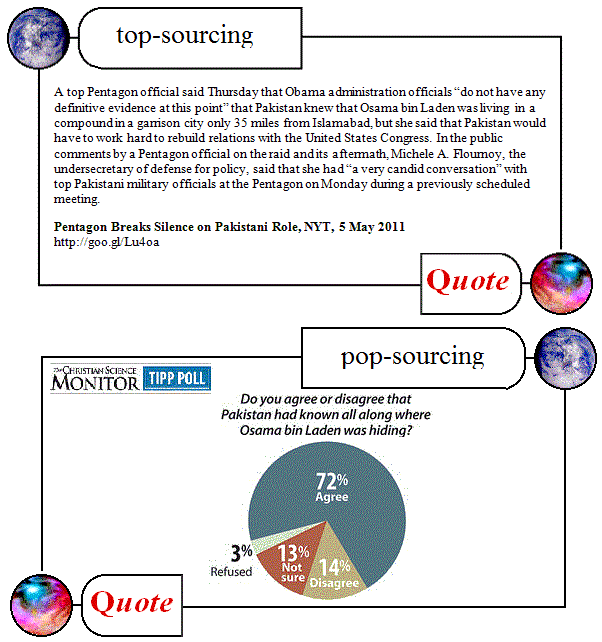
Can you trust Pakistan?
[ by Charles Cameron — second of three ]
*
.
Trust — or mistrust — but verify.
So: can you trust crowd-sourcing, can you trust officialdom?
Can you trust Pakistan?
[ by Charles Cameron ]
*
.
Ronald Reagan said “Trust, but verify.” Gorbachev said, “You repeat that at every meeting.” Reagan said, “I like it.”
*
Zen claimed a couple days ago that “Osama bin Laden was caught and killed in an ISI safe house in Abbottabad” — while over at ChicagoBoyz, Trent Telenko asserted:
We already knew Pakistan is what we feared a nuclear-armed Iran would be — a nuclear-armed, terrorist supporting, state. Just ask India about Mumbai and the Lashkar-e-Taiba. Now we know that Pakistan is attacking us too. Al Qaeda is the operational arm of Pakistani intelligence (ISI) attacking us just as Lashkar-e-Taiba is its operational arm attacking India.
Those are “strong” versions of claims that have been made in “weaker” forms for some time now.
*
Thus the NY Times refers to “the belief among administration officials that some elements of the ISI may have ties to Bin Laden and the Afghan Taliban” while according to the BBC, Adm. Mike Mullen recently claimed the ISI had a “long-standing relationship” with the Haqqani network. A Guardian report used the phrase “rogue elements” in discussing recently wikileaked documents from Guantanamo:
The documents show the varying interpretations by American officials of the apparent evidence of ISI involvement with insurgents in Afghanistan. There are repeated “analyst’s notes” in parentheses. Several in earlier documents stress that it is “rogue elements” of the ISI who actively support insurgents in Afghanistan.
So: is it “some elements of the ISI”—or “rogue elements of the ISI” — or simply “the ISI”?
*
The Pakistani Inter-Service Intelligence Directorate was included in the “list of terrorist and terrorist support entities identified as associate forces” in one of the leaked documents, the “JTF-GTMO Matrix of Threat Indicators for Enemy Combatants” with the notation:
This list is not all inclusive but provides the primary organizations encountered in the reporting from and about JTF-GTMO detainees. Through associations with these groups and organizations, a detainee may have provided support to al-Qaida or the Taliban, or engaged in hostilities against US or Coalition forces.
“Association with Pakistan ISID, especially in the late 1990s up to 2003” was listed in the same document as among the “the primary indicators for assessing a detainee’s membership or affiliation with the Taliban or ACM elements other than al-Qaida.”
BTW, what happened to the ISI in 2003?
*
And what of Pakistan itself? is it just the ISI that’s problematic, or the entire state of Pakistan? Time magazine reports:
CIA ruled out participating with its nominal South Asian ally early on because “it was decided that any effort to work with the Pakistanis could jeopardize the mission. They might alert the targets,” Panetta says.
Indeed, the problem may not be that there are rogue elements in ISI, nor that the ISI is a rogue element in Pakistan, but that Pakistan itself may be a rogue state, and a nuclear one at that.
How simple it is to write such a sentence – and how subtle the task of understanding – not leaping to conclusions but penetratingly understanding – just what the real situation is.
*
As Zen says in the same post:
It is long past time for a deep, strategic, rethink of what ends America wants to accomplish in Central Asia and some hardheaded realism about who our friends really are.
Intelligence needs to be intelligent, and to be seen to be intelligent. Whether we trust or mistrust — we need to verify.
[ first of three, at least ]
[ by Charles Cameron ]
*
.
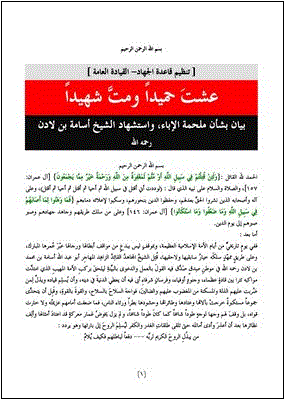
McGill grad student and blog-friend Christopher Anzalone (Ibn Siqilli) has blogged the al-Qaeda Statement on bin Laden’s Death (see above), and the International Centre for the Study of Radicalisation (ICSR) has posted an English translation.
The statement is headed “In the name of God”, declaries its authorship to be “The al-Qaeda Organisation – General Leadership”, uses the epigraph “You have lived in glory and died as a martyr” and is titled “A statement about the dignity and martyrdom of Sheikh Osama bin Laden, may Allah have mercy on him”.
A few quick notes on the ICSR text:
Bin Laden is described as:…
the mujahid leader zahid [aesthetic] muhajir [immigrant], Sheikh Abu Abdullah Osama bin Mohammed bin Laden
I am pretty sure the meaning of “zahid” is closer to “ascetic” (pious, self-denying) than “aesthetic” – a not infrequent confusion — and “mujahir” which I have seen translated both “emigrant” and “immigrant” today, means one who, like the Prophet leaving Mecca for Medina in what is known as Hijra, has left his home in service to God.
He was killed in a moment of sincerity where he combined words and actions, with dawah and proof to join the caravan of great leaders, loyal soldiers and honest knights who refused to let their religion fall to a lower status …
The phrase “honest knights” is of interest, with its suggestion of chivalry (and thus implicit link with Salah ad-Din / Saladdin).
He faced weapons with weapons, force with force, and he accepted the challenge of arrogant forces who came with machinery, weapons, aircraft, and troops to subjugate the people. He was neither weak before them, nor did he capitulate.
I take this to be a counter to American statements that he was unarmed: he may not have had a weapon to hand at the time of death, but in a longer perspective he was a fighter who “kept fighting a battle with which he was familiar, and from which he did not desist” as the next phrase has it.
Then comes an astonishing rhetorical flourish to describe the man who brought down the Twin Towers, a sort of triumphant book-ending of the two moments:
However, he challenged them face to face, like a towering building which no one can surmount.
We should compare here his own remark shortly after 9/11, “What was destroyed were not only the towers, but the towers of morale in that country” and again in 2004, “… as I looked at those demolished towers in Lebanon, it entered my mind that we should punish the oppressor in kind and that we should destroy towers in America…”
Here, from the perspective of AQ Central, is his mortality, and the form that his immortality will take:
… the life of the Sheikh of jihad of our times has ended, so that his blood, words, stances, and finality will stay as a spirit that will run through the body of Muslim generations for years to come.
See also (for what I’ll call “metaphoric immortality”) al-Awlaki’s description of a person like Qutb, who “wrote with ink and his own blood” and others like him, “and after they died it was as if Allah made their soul enter their words to make it alive; it gives their words a new life”.
I have no doubt that the symbolic tone of the piece will have powerful impact on peoples – Arab and Pashtun among others – with a keen ear for poetry:
The blood of the mujahid Sheikh Osama bin Laden is more precious to us and every Muslim than to simply be spilled in vain. We assure there will be a curse hunting the Americans and their agents, chasing them both outside and inside their countries. Soon, God willing, their joy will turn to sadness and blood will mix with their tears.
Finally and fairly ironically – it is dated 3 May 2011 but was issued on the forums today, May 6 — the piece ends with this warning:
We are warning the Americans against humiliating the corpse of the Sheikh or mistreating any of his dignified family members whether alive or dead. The corpse should be delivered to the families. Any mistreatment will only increase your hell, for which you will only have yourselves to blame.
I am sure others will view this document from different angles and provide further informative commentary – these are the pieces of the picture which drew my attention.
[ by Charles Cameron ]
*
.
I like the idea of seven generations as a timeline to work with: it’s mid-range, and it confers a sort of limited immortality on the world around me, without being too bothered about me and my personal survival. On the other hand, it’s an “over the horizon” kind of thinking, and I once heard the suggestion that when in a four-and-a-half tatami room, I should confine myself to four-and-a-half tatami thinking.
So.
An alternative approach is to leave everything else out of a given picture, and concentrate on what happens to children.
I’m not suggesting “seven generation”, “four-and-a-half tatami”, or “children only” thinking should be the only approaches we take, just that they may add valuable insight…
*
In which spirit: Forget, for a moment, enmity: here are two horrors…

*
These two things have struck me as particularly horrible in my browsing over the last few days. The first – assuming the Guardian is quoting the Pakistani intelligence official correctly, and that the official knows what he’s talking about – is the sort of thing we might not, as the saying goes, “wish on our worst enemy” – but it happened to our enemy’s child, a girl, twelve years old:
Osama bin Laden’s 12-year-old daughter watched as her father was shot dead by American special forces, a senior Pakistani intelligence official has told the Guardian.
The girl, who was found at the scene of the raid by Pakistani security services, is being cared for at a military hospital having been wounded in the attack. She has been questioned about the sequence of events during the raid on Sunday night.
No blame, as the saying goes – but for that child, it’s a double tragedy.
And the second?
I know how excited my own sons get when a new action-figure toy from the Halo line arrives in the household – so I dread to think how a toy like this might turn younger minds, as yet perhaps innocent of violence and hatred, towards the “heroism” of jihad…
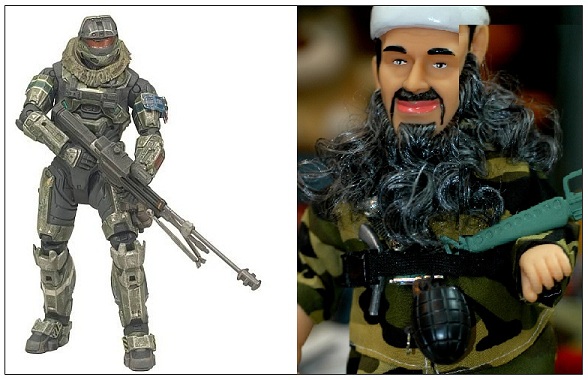
[ Jun Noble 3 action figure from Amazon – OBL action figure from Foreign Policy slideshow ]
*
It is childhood I am grieving:
Leaves, like the things of man, you
With your fresh thoughts care for, can you?
Ah! as the heart grows older
It will come to such sights colder
By & by, nor spare a sigh…— Gerard Manley Hopkins SJ, from his poem Spring and Fall, to a young child
[ by Charles Cameron ]
*
.

My friend Bryan Alexander‘s book, The New Digital Storytelling: Creating Narratives with New Media, hit the shelves a short while ago (recommended) — and this month Bryan is exploring the various forms of digital story-telling on his new digital storytelling blog.
I’m interested in narrative, too – even when it isn’t digital – because it’s the prime way in which we humans figure out what’s going on around us…
Here, then, are two “tellings and retellings” of the Abbottabad raid and the death of Osama bin Laden.
.
1. The fog of war
In his first briefing on bin Laden’s death from the White House, John Brennan, Assistant to the President for Homeland Security and Counter-Terrorism, dismissed bin Laden with the words, “I think it really just speaks to just how false his narrative has been over the years.”
Narrative is important, and the narrative John Brennan was proposing as a corrective to bin Laden’s version went as follows:
here is bin Laden, who has been calling for these attacks, living in this million dollar-plus compound, living in an area that is far removed from the front, hiding behind women who were put in front of him as a shield. I think it really just speaks to just how false his narrative has been over the years. And so, again, looking at what bin Laden was doing hiding there while he’s putting other people out there to carry out attacks again just speaks to I think the nature of the individual he was.
A writer in the Atlantic commented today:
And that’s the message our counterterrorism officials would, I expect, like the world — and especially any potential followers of al-Qaeda’s anti-American ideology — to get about our newly vanquished enemy, responsible to the single deadliest attack on American soil. The leader of the terrorist group was soft, a coward in the end who hid behind a woman’s skirts like a little girl, having grown accustomed to living in luxury in a mansion. Almost everything about this narrative seemed calculated to diminish any possible perception of strength or masculinity in bin Laden’s reaction to the raid by an elite team of U.S. Navy Seals — men who are in contrast among the most mythic and valorized in our armed forces, known for slogans like “pain is just weakness leaving the body.”
But just a day after Brennan’s briefing, the President’s Press Secretary, Jay Carney, gave a second briefing, in which he revised the official narrative, saying:
Well, what is true is that we provided a great deal of information with great haste in order to inform you and, through you, the American public about the operation and how it transpired and the events that took place there in Pakistan. And obviously some of the information was — came in piece by piece and is being reviewed and updated and elaborated on.
.
So what I can tell you, I have a narrative that I can provide to you on the raid itself, on the bin Laden compound in Pakistan.
I have a narrative…
The revised narrative featured an unarmed bin Laden in a far from palatial house with no visible air-conditioning, who didn’t in fact use a woman as a human shield… all of which “really just speaks to just how false” Brennan’s own original narrative was.
But then – you don’t believe everything you read in the press, do you? And besides, the first news reports of almost any big story are almost invariably inaccurate, it takes time for clarity to emerge… which adds up to the idea that it’s not so easy to distinguish between how the world actually spins — and how the world is spun.
So that’s a telling and retelling of the Abbottabad raid in “real life” as transmitted to us by various media and recorded on the web…
.
2: The twitter-stream and the analyst
A little earlier a more “purely” digital version of the story – no less confused by the “fog” that inevitably surrounds the reporting of highly volatile situations – had emerged quite spontaneously via Twitter, when the delightfully-named ReallyVirtual (an IT specialist who had moved to Abbottabad for some peace and quiet) was kept awake by the noise of helicopters overhead and sounds of explosions, and tweeted a couple of late-night friends… and a stream of tweets began which quickly led to an almost thousandfold spike in Yahoo searches on bin Laden, and bin Laden related searches occupying all top twenty spots on Google trends…
You might call that spontaneous, distributed story-telling – but it’s also the raw material for a collated and curated twitter narrative, using Chirpstory, a tool for curating and presenting stories from the twitter-stream:
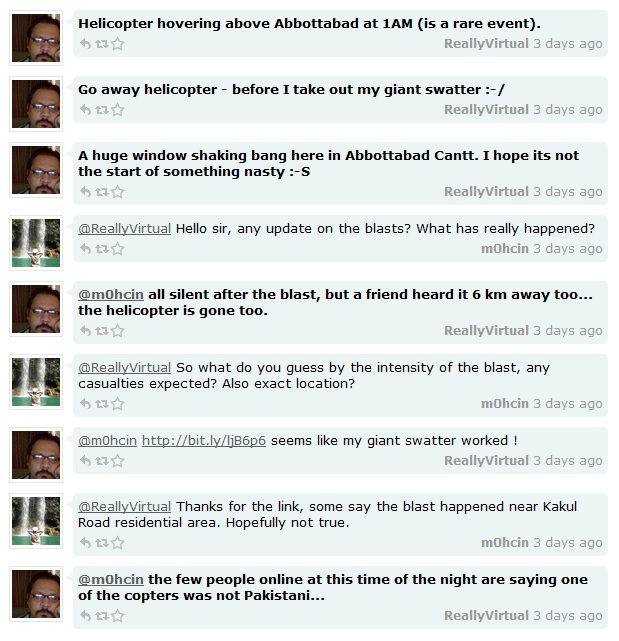
We’re not done yet…
That in turn provides grist for the analytic mill of B Raman, a highly-regarded Indian analyst, blogger, and former chief of counter-terrorism with India’s R&AW intelligence agency – who winnowed out the chaff and added in his own commentary to create a denser, tighter analytic narrative of his own:
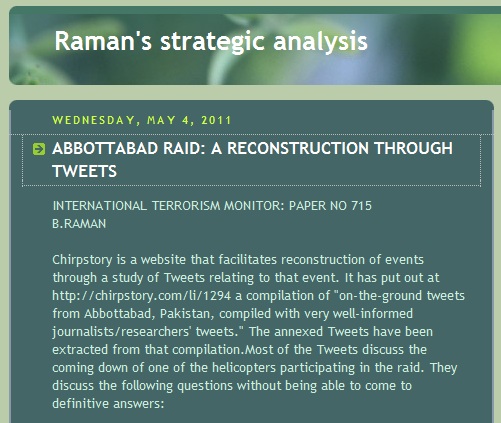
To my way of thinking, the spontaneous twitter-stream version, the Chirpstory adaptation and B. Raman’s midrash on it are at least as interesting as the successive White House narratives…
.
3. Further reading:
Also relevant to our narrative here, and your own readings on the topic of our tale:
How the Bin Laden Announcement Leaked Out
Bin Laden Reading Guide: How to Cut Through the Coverage

Zenpundit is a blog dedicated to exploring the intersections of foreign policy, history, military theory, national security,strategic thinking, futurism, cognition and a number of other esoteric pursuits.
Customized Web Site & Blog Design


