zenpundit.com » analytic

Archive for the ‘analytic’ Category

Book Review: JM Berger’s Jihad Joe

Monday, June 20th, 2011

[ by Charles Cameron — “homegrown” jihad ]

.

41nibyw1jbl_sl500_aa300_.jpg

Jihad Joe: Americans who go to war in the name of Islam

by JM Berger

Potomac Books, Inc, 2011, hard back, $29.95

*

The title by itself is striking — Jihad Joe – and captures nicely the somewhat surreal blend of the normal and the utterly strange that we encounter when we think about “Americans who go to war in the name of Islam” – the subtitle and topic of JM Berger‘s book. And think about them, know a bit about them, we should.

The big question, of course, is Why?

Berger writes early on of young men who gather “to focus their rage through a religious filter” and while noting that jihadists comes from varied backgrounds and travel for varied reasons, correctly zeroes in on the sense of obligation that a jihadist interpretation of Islam imposes:

While all major religions have rules that limit or justify war, a small but significant minority of Muslims believe that under the correct circumstances, war is a fundamental obligation for everyone who shares the religion of Islam. When war is carried out according to the rules, it is called military jihad or simply jihad. [emphasis mine]

The rage may spring from many sources, social, economic, political, but when religion is used to focus it, as Berger nicely puts it, that obligation is what provides divine legitimacy — and the promise of miracles, martydom and a paradisal afterlife – and the sense of serving a higher purpose, to otherwise quieter lives.

*

Berger starts at the beginning. After a brief mention of the presence of many Muslims under slavery, two early and distinctly American expressions of Islam (the Moorish Science Temple and the Nation of Islam), and the beginnings of Muslim Brotherhood activity as Egyptian and other Muslim immigrants brought more orthodox strands of Islam to the States, Berger alerts us to the idea that Americans leaving to fight jihad may have deeper roots than we think.

Bin Laden‘s mentor Abdullah Azzam, for instance, was in the US in the 1980s appealing for Americans to help the mujahideen in their resistance to the Soviet occupation of Afghanistan – a cause supported by President Reagan, who took tea with muj leaders for discussion and photo op, and by the wily Charlie Wilson of Charlie Wilson’s War. Azzam’s calls for volunteers were successful:

No one kept track of how many Americans answered the call, and no one in or out of the U.S. Government would venture a guess on the record. More than 30 documented cases were examined for this book. Based on court records and intelligence documents, a conservative estimate might be that a minimum of 150 American citizens and legal residents went to fight the Soviets.

Implications for today: this has been happening for a long time, it’s not something Anwar al-Awlaki invented just yesterday — and there have been times when the US was no too displeased at such activities.

Azzam’s appeal was precisely to the sense of a general, compulsory obligation for Muslims – fard ayn in Arabic – buttressed by tales of the miraculous and promises of paradise. I emphasize these points because their appeal is real. The day Al-Qaida was founded, an American was present, Mohammed Loay Bayazid, aka Abu Rida al Suri, and it was his reading of Azzam’s account of miracles among the jihadists in Afghanistan – apparent supernatural protection from and/or paralysis of superior forces, the “odor of sanctity” on martyrs’ bodies – that turned him from a not very pious Muslim into a volunteer jihadist. You can read the stories yourself — Azzam’s book is now available for download, in English, on the web.

I’m focusing in on the religious element because that’s my area, others will comment better than I on the military or historical aspects that Berger deals with. But Berger makes it clear that from its inception, Al-Qaida numbered Americans among its higher echelons, and bin Laden was “strangely enamored of Americans and people who had spent time in the United States” – if only for the very practical reason that their passports allowed them access most anywhere.

*

The first act of violence on American soil generally attributed to AQ, Berger tells us, was the 1990 killing of Rashad Khalifa in Tucson, AZ. Khalifa was the numerologically inclined leader of a Tucson mosque and translator of the Qur’an whose apocalyptic date-setting (2280 CE) I mentioned in my Zenpundit post Apocalypse Not Yet? a week ago.

Khalifa’s story leads into that of Al Fuqra, a group that Berger describes in some detail, writing of their “rural compounds and small private villages” and their “covert paramilitary training grounds” and noting that while they have been implicated in “at least thirty-four incidents … from bombings to kidnappings to murder … the government has never moved against the group in an organized manner.”

Berger turns next to the blind Sheikh Omar Abdel Rahman and his followers, soon joined by the AQ-trained bomb-maker Ramzi Yousef, and the 1993 bombing of the World Trade Center – which failed to topple the towers — leaving the task for Mohammed Atta to complete in 2001 under bin Laden’s command

1992 sees several thousand US troops in Arabia given briefings on Saudi culture – largely a matter of Wahhabist Islam – and four-day passes to visit Mecca at Saudi expense were available for converts. As the Bosnian crisis began to unfold, ex-military Muslims converted by these means formed a natural pool for recruitment as jihadists to defend their Muslim brothers against ethnic cleansing and genocide at the hands of their Serb neighbors.

With the combination of the first WTC bombing and the Bosnian jihad, the “far enemy / near enemy” combo was in place: jihad could draw on both local and global events to fuel its global plans, and find both local and targets to take down…

By the beginning of the 1990s, America was in AQ’s sights, though AQ was barely known to a handful of Americans. The 1993 Black Hawk Down incident in Mogadishu featured AQ-trained forces, and the Nairobi and Dar es Salaam embassy attacks were soon in the planning stages. In 1996, bin Laden publishes his declaration of war on America, and the CIA put together a first plan to kidnap him…

*

Anwar al-Awlaki enters the picture around this time, a complex man Berger calls “a study in contradictions” – “a gifted speaker who was capable of moving men to action”.

If the power of religion to focus rage, and the concept of jihad as a compulsory obligation, fard ayn, are two of our first take-aways from Berger’s book, here is a third: rhetoric is the tool that transforms the curious (pious or not so much) into the committed. Anwar al-Awlaki had “a powerful cocktail of skills” but they boil down to this: the ability to talks Islam casually, in the American manner, to American kids — in American English, in a way that appears pious and scholarly, presents jihad as both obligation and adventure, and moves them to action…

Three of the 9-11 hijackers were al-Awlaki contacts… Nidal Hasan, the army psychiatrist who massacred his fellow soldiers at Fort Hood… Umar Farouk Abdulmutallab, the suspected “underwear bomber”… Faizal Shazad, the Times Square bomber… the list of those who have known and been influenced by al-Awlaki goes on…

The history of AQ by now is well known, covered in such books as Lawrence Wright‘s The Looming Tower and Peter Bergen‘s The Longest War, so Berger can concentrate on the “home grown” side of things, featuring — alongside al-Awlaki — his clumsier precursor the AQ propagandist Adam Gadahn, and paying considerable attention to another less-than-widely reported aspect of the jihad – the Pakistani Lashkar-e-Taiba group and its ISI-assisted 2008 attack on Mumbai, India, for which the intelligence scouting was done by the Pakistani-American sometime DEA agent David Headley, and the subsequent planning of an attack in Denmark…Berger turns next to Somalia and al-Shabab – but you get the drift, he is offering us a thoroughgoing, fully researched tour of the various Americans and groups joined by Americans across the world, involved in waging jihad, against scattered local enemies, or against the “far enemy” – the United States.

*

Berger’s work is detail-packed and focused, and a useful resource for that reason alone. But it is also and specifically the work of someone who has read and talked with and listened to the people he is writing about, and his work carries their voices embedded in his own commentary. It thus joins such works as Jessica Stern‘s Terror in the Name of God: Why Religious Militants Kill and Mark Juergensmeyer‘s similarly named and similarly excellent Terror in the Mind of God: The Global Rise of Religious Violence.

Bringing us up to date, Berger offers an overview of jihadist use of the internet, paying special attention to English-language sites – Islamic Awakening, Revolution Muslim — emphasizing the peripheral nature of “forum” activities, but also crediting them as an active doorway to recruitment. Zach Chesser, Samir Khan, Jihad Recollections and Inspire magazine, they’re all here. Read Berger’s recent blog post on “gamification” after this chapter, follow him at @intelwire, and you’ll be ongoingly up to date on his thought…

Berger closes with a look at future prospects. The opening of this chapter – an overview of the history so far covered – speaks volumes:

The journey of the American jihadist spans continents and decades. Americans of every race and cultural background have made the decision to take up arms in the name of Islam and strike a blow for what they believed to be justice.

Many who embarked on this journey took their first steps for the noblest of reasons – to lay their lives on the line in defense of people who seemed defenseless. But some chose to act for baser reasons – anger, hatred of the “other,” desire for power, or an urge towards violence.

In the early days of the movement, it was possible to be a jihadist and still be a “good” American…

Berger neither condemns nor excuses: he sees, he asks, he researches, he reports. His observations of the current situation can thus be trusted to be driven by insight rather than ideology – not the most common of stances, but one we very much need.

He pinpoints as the first element that almost all American jihadists have in common as “an urgent feeling that Muslims are under attack”. Foreign policy implications? Yes indeed – but Berger is also looking to the Muslim community to take an approach less focused on what he terms a “litany of grievances” – valid though some of them may be – which in effect helps perpetuate a “counterproductive narrative” of how the US views and treats Muslims.

Once a narrative that America is at war with Islam is established, the argument for jihad as fard ayn can be made – and all manner of shame, frustrations, rage, violent tendencies, alienation and idealism can be unleashed under the jihadist banner.

Berger’s conclusion:

We must preserve the constitutional rights and basic human respect due to American Muslims while changing the playing field to create conditions in which extremism cannot thrive. These goals are not mutually exclusive – they are independent.

If principle and pragmatism are not enough reason to change the tone of the conversation, there isx one more thing to consider. It would be not only dangerous but shameful to prove that our enemies were right about us all along.

Berger’s is a book to read, certainly — and more significantly perhaps, a book to admire.
The Said Symphony: moves 6-9

Saturday, June 18th, 2011

[ by Charles Cameron – extended analytic game on Israeli-Palestinian conflict — continuing ]

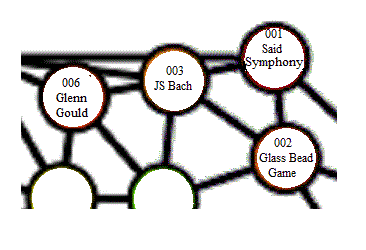
Move 6: Glenn Gould

move-006.gif

Move content:

51pewuz2vyl__sl500_aa300_.jpg

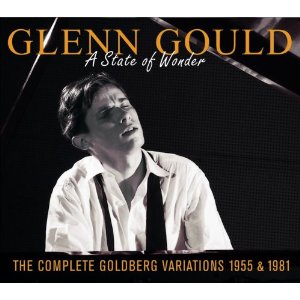
Glenn Gould was a great pianist whose two recordings of Bach‘s Goldeberg Variations alone would prove both the brilliance of his skill, which could draw forth the individual lines in Bach’s counterpoint in a way no earlier pianist had the technique to pull off, and the depth of his musical understanding.

glenn-gould-solitude-trilogy.jpg

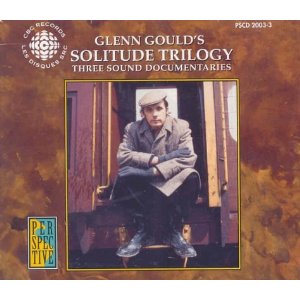
Late in life, Gould began “composing” radio works for the Canadian Broadcasting Corporation — he calls them “contrapuntal radio” — which revealed his interest in listening not just to Bach and other music but to life in general with an ear for counterpoint:

Gould set himself up to hear the world in a new way. In diners he ate his lunch alone, eaves dropping closely on the voices around him. He learned to hear conversation as music, the lilting lines, the rhythms everywhere up, down, and around, what Bach does to our sense of talk. There are two part inventions in words, themes and variations in the quarrels of couples and the tales told by friends. Gould met the world on his own terms, and he was fascinated by this way of listening to human voices as if they were a musical interplay, not participating in a conversation but taking it all in, as an audience.

It is that manner of listening which I am attempting in this game…

Links claimed:

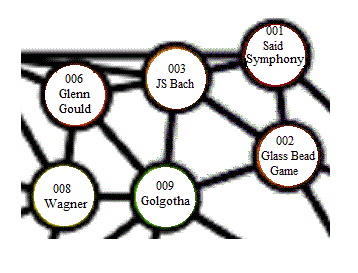
To Bach, because Gould is Bach’s great interpreter, taking his interpretation of Bach’s counterpoint not just into the deep riches of Bach’s music for keyboards, but also out into the depth and riches of the world…

Comment:

I see this move as concluding the first, quiet introductory section of the game, setting forth the mode of understanding in which it is played, and honoring those those work has preceded, comforted and confirmed my own.

We shall return to this theme of counterpoint no doubt — the whole work falls under the aegis of Bach, as all of Bach’s work falls under his familiar motto: Soli Deo Gloria.
____________________________________________________________________________________________

Move 7: Daniel Barenboim

move-007.gif

Move content:

Daniel Barenboim is another celebrated musician, a brilliant Argentinian-Israeli pianist and conductor, in whose biography we read:

In the early 1990s, a chance meeting between Mr. Barenboim and the late Palestinian-born writer and Columbia University professor Edward Said in a London hotel lobby led to an intensive friendship that has had both political and musical repercussions. These two men, who should have been poles apart politically, discovered in that first meeting, which lasted for hours, that they had similar visions of Israeli/Palestinian possible future cooperation. They decided to continue their dialogue and to collaborate on musical events to further their shared vision of peaceful co-existence in the Middle East. This led to Mr. Barenboim’s first concert on the West Bank, a piano recital at the Palestinian Birzeit University in February 1999, and to a workshop for young musicians from the Middle East that took place in Weimar, Germany, in August 1999.

The West-Eastern Divan Workshop took two years to organize and involved talented young musicians between the ages of 14 and 25 from Egypt, Syria, Lebanon, Jordan, Tunisia and Israel. The idea was that they would come together to make music on neutral ground with the guidance of some of the world’s best musicians. … There were some tense moments among the young players at first but, coached by members of the Berlin Philharmonic, the Chicago Symphony and the Staatskapelle Berlin, and following master classes with the cellist Yo-Yo Ma and nightly cultural discussions with Mr. Said and Mr. Barenboim, the young musicians worked and played in increasing harmony.

From the orchestra’s current news page:

In 2005, the orchestra realized the impossible: a concert with Israelis, Palestinians, and other Arab musicians in the Palestinian territory of Ramallah.

Links claimed:

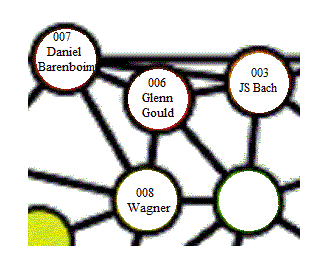
To Edward Said: because they were friends, because the West-Eastern Divan is a a human analog to Said’s view of a symphonic understanding of the Israeli-Palestinian conflict, and because he stands as an Israeli Jew in counterpoint to Said, the Palestinian.  Indeed, it is Barenboim, not Said, who is quoted here:

Drawing on the fundamentality of counterpoint in music, Barenboim describes how ‘in the act of challenging each other, the two voices fit together’ and that ‘music is always contrapuntal, in the philosophical sense of the word’ – indeed, ‘joy and sorrow can exist simultaneously in music’. He further argues that ‘acceptance of the freedom and individuality of the other is one of music’s most important lessons’. And this is the philosophy that underpins the phenomenon of the Divan orchestra: ‘You can’t make peace with an orchestra’, but one can ‘create the conditions for understanding’ and ‘awaken the curiosity of each individual to listen to the narrative of the other’.

To Bach, because as he writes:

I was reared on Bach. My father was virtually my only teacher, and he attached great importance to my growing up with Bach’s keyboard music. He considered it to be very important, not only for its musical and pianistic aspects, but also for everything else that is played on the piano. For him polyphonic music-making was simply one of the most important issues concerning everything relating to piano-playing. … The music can only be of interest if the different strands of the polyphonic texture are played so distinctly that they can all be heard and create a three-dimensional effect – just as in painting, where something is moved into the foreground and something else into the background, making one appear closer to the viewer than the other, although the painting is flat and one-dimensional.

And to Glenn Gould because —

gould-barenboim.jpg

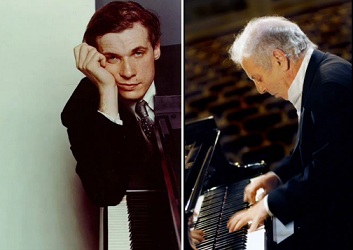
well, you may consider it a duel or a duet (a decision which shadows all differences, no?) but the two men are both celebrated for their renditions of the Bach Goldberg Variations, which are compared in excerpts back to back here on YouTube for our delight.

Comment:

I have only a couple of things to note here — the name West-Eastern Divan hearkens back to Goethe‘s poetry, and thus to the western world’s discovery of the sufic poetry of Hafez and Rumi — we find here a brief allusion to Yo-Yo Ma — and in the friendship of Said and Barenboim we see personified both the Israeli-Palestinian conflict and its transcending — in which a potential duel becomes a realized duet..

[ My thanks to Howard Rheingold for a pointer ]

____________________________________________________________________________________________

Move 8: Richard Wagner and antisemitism

move-008.gif

Move content:

barenboim-ring.jpg

With Richard Wagner, the ugly shadow of antisemitism falls across our play:

The idea of racial decline, and of German mentality being inherently superior, is integral to everything Wagner stood for. He saw himself as a redeemer, a notion his wife Cosima and her acolytes adopted as their creed. He gave the Aryan saviour-hero a dominant role in his operas. Siegfried is the incarnation of the sun-hero who would set Germany back on the true path – an idea that had existed in German mythology since the Middle Ages. Parsifal has characteristics of an Aryan Jesus.

European high culture had long had a disdain for the Jews, the merchants, the lenders — in Wagner’s writings, in his essay Judaism in Music and arguably in his operas too, he argues for the purity of the German race and the inability of the Jew, talented though he may be, to do more than ape that culture:

Our whole European art and civihisation, however, have remained to the Jew a foreign tongue; for, just as he has taken no part in the evolution of the one, so has he taken none in that of the other; but at most the homeless wight has been a cold, nay more, a hostile looker-on. In this Speech, this Art, the Jew can only afterspeak and after-patch — not truly make a poem of his words, an artwork of his doings.

It is a shadow that will touch, a virus that will infect Hitler — who will visit the Wagner family long after the Master’s death, attend and protect the Master’s playhouse in Bayreuth, cause the Master’s music to be played at the Nuremberg Rallies — and in so doing, teach European high culture itself that it is not immune to genocidal fantasies nor their execution in fact — enthrall and revolt and disgust and be deafeated — thus leading to the foundation in 1948 of the State of Israel, the Yom Ha’atzmaut of the Israelis, the Yawm an-Nakbah of the Palestinians…

Consider this press report, from which I have already quoted above:

Until the final scene, the Hamburg State Opera’s November 2002 production of Die Meistersinger von Nurnberg had proceeded without comment. Everyone was primed to applaud the hymn to “holy German art” that brings Richard Wagner’s four-hour pageant to a climax. Then came the bombshell. Midway through Hans Sachs’s monologue about honouring German masters over “foreign vanities”, the music came to an abrupt halt. Suddenly one of the mastersingers started speaking: “Have you actually thought about what you are singing?” he asked.

The virulence of antisemitism, and the shadow side of our common humanity, are not to be excluded from our game.

Links claimed:

To Daniel Barenboim, because he, a Jew and a musician, had the temerity to conduct the Berlin Staatskapelle orchestra in the Overture to Wagner’s Tristan und Isolde, in Jerusalem, in July 2001.

And to Glenn Gould, because…

gould-wagner.jpg

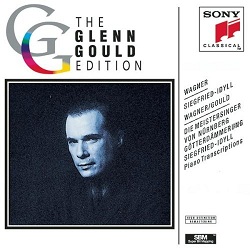
his piano transcription and performance of the Prelude to Die Meistersinger is a revelation: you might like to purchase it.

Comments:

I will confine myself to saying that Wagner’s concept of the gesamtkunstwerk or “work of total art” with its combination of poetry, drama, dance, song and even architecture is, in its own way, a precursor to many modern cross-disciplinary endeavors — the experimental works of Scriabin, whose “unrealized magnum opus Mysterium was to have been a grand week-long performance including music, scent, dance, and light in the foothills of the Himalayas” (Wikipedia), the Orphic poetry-in-film of Jean Cocteau, the crossover between poetry and the visual arts in Guillaume Apollinaire‘s Calligrammes — and not least, in Hermann Hesse‘s great Glasperlenspiel

____________________________________________________________________________________________

Move 9: Golgotha

move-09.gif

Move content:

Specifically, Golgotha refers to the small hill outside the Jerusalem city walls where Christ was crucified — our word “Calvary” is derived from the name:

And when they were come unto a place called Golgotha, that is to say, a place of a skull, They gave him vinegar to drink mingled with gall: and when he had tasted thereof, he would not drink. And they crucified him, and parted his garments, casting lots: that it might be fulfilled which was spoken by the prophet, They parted my garments among them, and upon my vesture did they cast lots. And sitting down they watched him there…

Matthew 27: 33-36

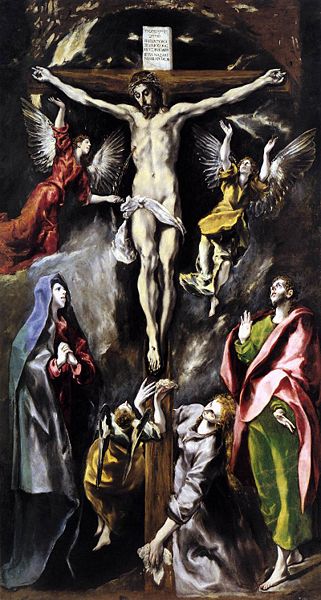
321px-crucifixion_prado.jpg
El Greco, The Crucifixion, The Prado, Madrid

Figuratively, Golgotha is the nadir, the lowest point — as in this powerful observation by the soldier-poet Capt. Wilfred Owen, describing the carnage of trench warfare in World War I in a letter to Osbert Sitwell, dated 4 July 1918.

For 14 hours yesterday, I was at work-teaching Christ to lift his cross by the numbers, and how to adjust his crown; and not to imagine he thirst until after the last halt. I attended his Supper to see that there were no complaints; and inspected his feet that they should be worthy of the nails. I see to it that he is dumb, and stands mute before his accusers. With a piece of silver I buy him every day, and with maps I make him familiar with the topography of Golgotha.


Links claimed:

To Wagner, in a manner that continues the motif of his antisemitism: Rudolf Steiner, founder of the Waldorf schools and anthroposophist, gave a lecture on the mythic underpinnings of Wagner’s Parsifal in 1906, which he said:

How was it that Wagner was able to find the right mood for his Parsifal? It is most important for us to recognize that Wagner was able to do this because he knew that what happened on Golgotha had especially to do with the blood, he knew that we had to see there not only the death of the Saviour but we had to see what took place there with the blood, how the blood was purified on Golgotha and became something quite different from ordinary blood. Wagner has spoken of the connection of the Saviour’s blood with the whole of mankind. In his book “Paganism and Christianity” we read these words: “Having found that the capacity for conscious suffering is a capacity peculiar to the blood of the so-called white race, we must now go on to recognize in the blood of the Saviour the very epitome, as it were, of voluntary conscious suffering that pours itself out as divine compassion for the whole human race.”

To Glenn Gould — introducing a contemporary instance of the nadir of human consciousness — because Hannibal Lecter, the insane psychiatrist of Thomas Harris‘ novel The Silence of the Lambs, has a copy he made from memory (“Memory, Officer Starling, is what I have for a view”) of Duccio‘s painting Golgotha after the Deposition on the walls of his cell, and listens to the Bach Goldberg Variations on his tape recorder — Glenn Gould is specified as the performer.

To the Glass Bead Game, because Hermann Hesse in what can only be an autobiographical passage in Demian writes:

The teacher had spoken of Golgotha. The Biblical account of the suffering and death of the savior had made the deepest impression upon me from my earliest childhood. Often as a small boy I had, after my father had read the story of the passion on Good Friday, lived in this painfully beautiful, pale, ghostly and still powerfully living world of Gethsemane and on Golgotha. I had experienced it listening to Bach’s St. Matthew Passion, it had flooded me with the somber, powerful tones of this mysterious world, with its mystical drama. Even today I find in this music, and in Actus Tragicus the essence of all that is poetical and of all artistic expression.

and there is no less surely an echo of that in a comment made by Joseph Knecht — the Magister Ludi of Hesse’s novel —

Nowadays, for example, we do not think much of the theology and the ecclesiastical culture of the eighteenth century, or the philosophy of the Enlightenment; but we consider the cantatas, passions, and preludes of Bach the ultimate quintessence of Christian culture.

For Hesse at least, and Knecht himself by implication, the Golgotha of Bach’s St Matthew Passion is “the essence … of all artistic expression”.

And to Bach, finally, for those sections (58-9 in Part II of the Passion) which deal with Golgotha and the crucifixion:

58a. Rezitativ (Evangelist): “Und da sie an die Stätte kamen”
58b. Chor: “Der du den Tempel Gottes zerbrichst”
58c. Rezitativ (Evangelist): “Desgleichen auch die Hohenpriester”
58d. Chor: “Andern hat er geholfen”
58e. Rezitativ (Evangelist):”Desgleichen schmäheten ihn auch die Mörder”
59. Rezitativ: “Ach Golgatha”

all of which can be heard in John Eliot Gardiner‘s performance here on YouTube, although I’d highly recommend Gardiner’s Bach: Sacred Vocal Works: the Christmas Oratorio, St. Matthew Passion, St. John Passion and Mass in B Minor as a boxed set — a stunning treasure.

Comment:

Hesse recommends the practice of meditation between moves in the Glass Bead Game, and rather than comment on this move briefly here, I shall next write a more extended meditation on the game thus far, and on this move in particular.

Here we approach the very walls of Jerusalem.
____________________________________________________________________________________________

The Said Symphony: moves 1-5

Saturday, June 18th, 2011

[ by Charles Cameron – extended analytic game on Israeli-Palestinian conflict ]

.

In two previous posts (Intro, and Board and Gameplay), I have described my forthcoming attempt to “play” a 130-plus move game, in which I will use quotations, images and anecdotes to express something of the complex weave of thoughts and emotions that govern — in tense and tenuous fashion — the “Israeli-Palestinian problem”.

Here I will commence play, making my initial “moves” in this area of the board:

said-bd-zp-start.gif

____________________________________________________________________________________________

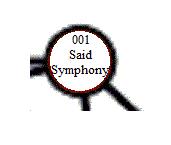
Move 1: The Said Symphony

move-001.gif

Move content:

When you think about it, when you think about Jew and Palestinian not separately, but as part of a symphony, there is something magnificently imposing about it. A very rich, also very tragic, also in many ways desperate history of extremes — opposites in the Hegelian sense — that is yet to receive its due. So what you are faced with is a kind of sublime grandeur of a series of tragedies, of losses, of sacrifices, of pain that would take the brain of a Bach to figure out. It would require the imagination of someone like Edmund Burke to fathom.

Edward W. Said, Power, Politics, and Culture, p. 447 — from the section titled “My Right of Return,” consisting of an interview with Ari Shavit from Ha’aretz Magazine, August 18, 2000.

Links claimed:

In his novel of the Glass Bead Game, Hermann Hesse writes:

Every transition from major to minor in a sonata, every transformation of a myth or a religious cult, every classical or artistic formulation was, I realized in that flashing moment, if seen with a truly meditative mind, nothing but a direct route into the interior of the cosmic mystery, where in the alternation between inhaling and exhaling, between heaven and earth, between Yin and Yang, holiness is forever being created.

It is in the links between moves, the creative leaps of the analogical mind, that the secret of the game can be found — so the “links claimed” sections of moves can be viewed as meditation points — architecturally, they are the “arches” of potential insight between the “pillars” of existing ideas. Here, no links are claimed, since this is the first move in the game.

Comment:

This is where it begins… with a vision of dissonant voices in counterpoint… ____________________________________________________________________________________________

Introductory moves

Before we get directly into the “meat” of the game, I want to explore its purpose via a few more moves that focus on what we might call the polyphony of ideas — thinking in terms of multiple voices.

Move 2: Hermann Hesse and the Glass Bead Game
Move 3: JS Bach and the Art of Fugue
Move 4: William Blake and Fourfold Vision
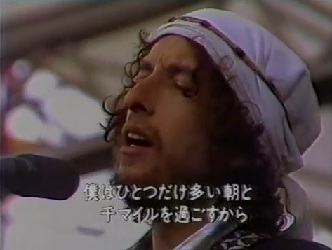
Move 5: Bob Dylan and One Too Many Mornings
Move 6: Glenn Gould

Then two moves nudging us in the direction of, then directly into — Israel:

Move 7: Daniel Barenboim
Move 8: Wagner

and specifically to the outskirts of Jerusalem / Al Quds:

Move 9: Golgotha

You might want to consider these nine moves a sort of overture.  Let’s see how that goes…

____________________________________________________________________________________________

Move 2: Move 2: Hermann Hesse and the Glass Bead Game

move-002.gif

Move content:

Hermann Hesse’s novel Das Glasperlenspiel (English title The Glass Bead Game, also published as Magister Ludi) won him the Nobel for Literature.

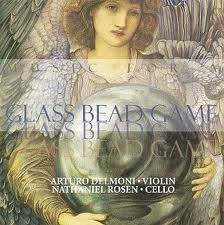
gbg-cover.jpg

The centerpiece of the novel is the Game itself. Hesse doesn’t spell out in detail how it is to be played, but his hints are enough to let us know that in play, different ideas from across world culture are combined as if in a virtual music of ideas:

The Glass Bead Game is thus a mode of playing with the total contents and values of our culture; it plays with them as, say, in the great age of the arts a painter might have played with the colors on his palette. All the insights, noble thoughts, and works of art that the human race has produced in its creative eras, all that subsequent periods of scholarly study have reduced to concepts and converted into intellectual values the Glass Bead Game player plays like the organist on an organ. And this organ has attained an almost unimaginable perfection; its manuals and pedals range over the entire intellectual cosmos; its stops are almost beyond number.

It is in an attempt to bring Hesse’s idea of a musical synthesis of ideas into practical application in helping us understand — and perhaps even, god willing, help us to resolve — the Palestinian-Israeli conflict that I am playing this game.

The idea is not to come up with a solution, but a richer sense of the interplay of motives and memories as they build the situation we all now face.

Link claimed:

To Edward Said, in that Hesse immediately precedes Said in his intuition that melodies are not the only kinds of thought that can be juxtaposed in counterpoint and thus integrated in a complex, sometimes tragic, often profound, always human music.

Comment:

The graphic I have used is from the cover of a lovely CD, featuring Arturo Delmoni and Nathaniel Rosen, Music for a Glass Bead Game. ____________________________________________________________________________________________

Move 3: Move 3: JS Bach and the Art of Fugue

move-003.gif

Move content:

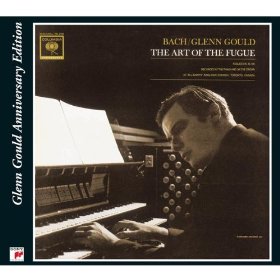
gould-art-of-fugue.jpg

Bach was my first great love in the arts, and when I applied to study at Christ Church, Oxford, it was essays on Hopkins, El Greco, and Bach — specifically the B Minor Mass — that got me in the door. Years later, when I lived in Warrenton and commuted to a think-tank job in Arlington, VA, I found myself muttering To hold the Mind of Bach over and over to myself like a mantram.

And that, I think, is the key to my games.

I want to think as Bach did, polyphonically — to see the world in terms of counterpoint, to read life musically. And my games, which involve holding related, sometimes harmonious and sometimes conflicting thoughts in the mind at the same time, invite and encourage me to do that. They also provide me with a method of notating (scoring, in the musical sense) such multi-thought patterns on the various HipBone boards.

It is Bach, therefore, who is grandfather to Said’s thought, as Hesse is its father — and Bach’s greates expressions of this approach are found in such great summary works as the B Minor Mass and the Art of Fugue.

The taste I offer here is from Contrapunctus IX, which you can hear played by Glenn Gould on the organ here (and download it for 99 cents)…

Links claimed:

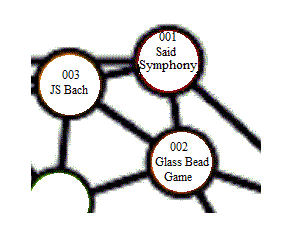
To Hesse and the Bead Game, because Bach’s presence, and that of counterpoint whose greatest exponent he was, is fundamental to Hesse’s great Game. Indeed, as he writes in the book:

The Game was at first nothing more than a witty method for developing memory and ingenuity among students and musicians. … One would call out, in the standardized abbreviations of their science, motifs or initial bars of classical compositions, whereupon the other had to respond with the continuation of the piece, or better still with a higher or lower voice, a contrasting theme, and so forth. It was an exercise in memory and improvisation quite similar to the sort of thing probably in vogue among ardent pupils of counterpoint in the days of Schütz, Pachelbel, and Bach — although it would then not have been done in theoretical formulas, but in practice on the cembalo, lute, or flute, or with the voice.

To Edward Said and his call for a symphonic reading of the Israeli-Palestinian situation: because he invokes the mind of Bach himself in the passage quoted in move 1, speaking of the

sublime grandeur of a series of tragedies, of losses, of sacrifices, of pain that would take the brain of a Bach to figure out.

Comment:

It is said that every artist teaches us to see, listen, hear, read, understand in a fresh way, so that the artist’s own work, at first well-nigh incomprehensible, may gradually find its way first into clarity, and then into ease of access, obviousness, popularity, and “classical” status — later stages of the same process will bring it first obscurity and finally oblivion.

We are not yet in a position to hold many thoughts simultaneously in the mind as Bach’s mind held many melodies, but we are opening to the possibility…

Multi-tasking… this will be an early attempt at a game of musical multi-thinking. Please think it through with me… ____________________________________________________________________________________________

Move 4: William Blake and Fourfold Vision

move-004.gif

Move content:

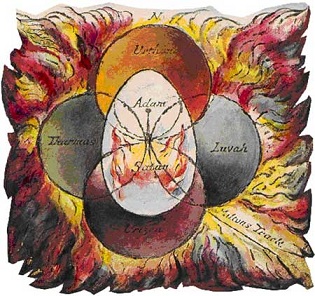
Here’s what William Blake saw:

ogormanblake.jpg

Here’s what William Blake said, in his Letter to Thomas Butts:

Now I a fourfold vision see

And a fourfold vision is given to me

Tis fourfold in my supreme delight

And three fold in soft Beulahs night

And twofold Always.

May God us keep\

From Single vision & Newtons sleep.

Here’s a commentary on Blake’s notion from a fascinating paper by Marcel O’Gorman:

Several Blake critics have attempted to unravel Blake’s use of term “fourfold vision.” Accoring to Jerome McGann, beings of single vision see the world in absolutes. Life is a prison term that ends in a final, discrete annihilation. Men of twofold vision see the world dialectically, according to contraries. Threefold vision enables one to recognize the contraries and see that they are not absolute, but that the boundaries of good and evil shift according to each individual. In Milton, Blake defines threefold vision as a peaceful state, and he associates it with Beulah:

There is a place where Contrarieties are equally True This place is called Beulah, It is a pleasant lovely Shadow Where no dispute can come. Because of those who Sleep.  (M 30:1-3)

Beulah and threefold vision are identified with sleep, restfulness. But fourfold vision involves activity, not sleep. Fourfold vision is generation and destruction, life and death, or even life in death. Evidently, Blake’s understanding of death is unconventional, to say the least. For Blake, death is considered as part of the creative process, a part of life.

Links claimed:

To the Glass Bead Game: because Hesse writes:

I suddenly realized that in the language, or at any rate in the spirit of the Glass Bead Game, everything actually was all-meaningful, that every symbol and combination of symbols led not hither and yon, not to single examples, experiments, and proofs, but into the center, the mystery and innermost heart of the world, into primal knowledge. Every transition from major to minor in a sonata, every transformation of a myth or a religious cult, every classical or artistic formulation was, I realized in that flashing moment, if seen with a truly meditative mind, nothing but a direct route into the interior of the cosmic mystery, where in the alternation between inhaling and exhaling, between heaven and earth, between Yin and Yang, holiness is forever being created.

Yin and yang are the opposites of the dialectic, but in the yin-yang symbol or tai-chih we see them alternating and interpentrating in the subtle and fluid play between them (Blake’s threefold vision) from which, in Hesse’s words, “holiness is forever being created” — Blake’s fourth.

To the Said Symphony, because precisely that kind of fluid flowing between one perspective and another is what allows empathy to triumph over opposition, and the “other” to become “brother” — the condition in which alone “the peaceable kingdom” / “peace on earth” can prevail…

Comment:

Blake was the mentor of my own poetic mentor, Kathleen Raine, and my own early published poems appeared in a Penguin volume edited by Michael Horovitz and titled Children of Albion in Blake’s honor.

I am happy to remember such friends in writing this game — and amazed to find in the Blake illustration above, which I only ran across today in O’Gorman’s article, yet another visual precursor to the boards on which my games are played. ____________________________________________________________________________________________

Move 5: Bob Dylan and One Too Many Mornings

move-005.gif

Move content:

dylan.jpg

The Bob Dylan song, One too many mornings.

You’re right from your side

I’m right from mine

We’re both just one too many mornings

An’ a thousand miles behind

Links claimed:

To Fourfold Vision and William Blake: Dylan captures the utterly wrong double-rightness of conflict that features in Blake’s vision — at an intensely personal level. And I’d argue, personally, that Dylan does in music and poetry what Blake was doing in poetry and visual art — at greater depth than his Blakean friend (and companion on parts of the Rolling Thunder tour) Allen Ginsberg.

Comment:

I believe I was at the Colorado Rolling Thunder Revue concert where Dylan sang the version which YouTube presents here from a Japanese bootleg video tape. You can purchase the Hard Rain album — or just the one track — here. ____________________________________________________________________________________________

four more moves coming up shortly in a follow-up post, and then I’ll take a break.

The Said Symphony: Board and Gameplay

Thursday, June 16th, 2011

[ by Charles Cameron – extended analytic game on Israeli-Palestinian conflict — see Said Symphony: Intro ]
.

All the games of the HipBone family use the juxtaposition of ideas on a game-board to develop a web of associations that is larger and more complexly interwoven than the same ideas gathered in a simple list, didactic argument or sequence.
.

The Said Symphony board:

.
The simplest of these games uses the DoubleQuotes format, with which regular Zenpundit readers will already be familiar (i, ii, iii, iv). More complex games have been played on the Dart and WaterBird boards among others, some light-hearted (Movie Trivia Game), some quite serious (What Sacred Games?).

For quite a while now, I have wanted to play a solo game — something more epic in scale than a two-move DoubleQuote or even a ten-move game on the WaterBird board – that “scored” the symphony that Edward Said intuited, as mentioned in my previous post.
Not so long ago, I found the perfect board…

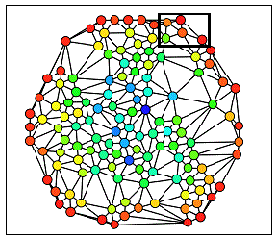
600px-graph_betweenness_svg.png

Board credit: Claudio Rocchini
.

The HipBone gameplay

.
Here’s how the gameplay works.

Slowly, I am going to “place” one quote (or image) after another on that board.

Each of these quotes or images (or equations, or sound-clips, or even blanks / silences) will be assigned a “position” (circle) on the board, a name or “move title“, some “move content” that features the quote or image and enough associated content to explain it, a series of “links claimed” in which I build bridges to directly adjacent moves already in play, and on occasion a “comment” which will allow me to weave in an overview of how the game is going, some footnotes, whatever seems helpful.

A board position, move title, move content, links claimed and comment, taken together, will comprise a single “move” on the board.

I hope to cover a wide range of issues here, political and religious, riparian and agrarian, Judaic and Christian and Muslim, secular and sacred, local, regional and international, disputed and agreed, in parallel and orthogonal and in opposition, violent and peaceable, ancient and modern and futuristic, social and individual… thesis and antithesis and synthesis, you get the drift.

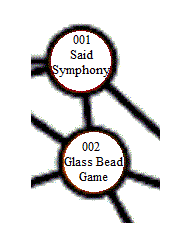
Let me be clear: wherever the board shows two circles (‘board positions”) directly linked by a line, the ideas (“moves”) assigned to those two circles should have some form of linkage – associative, analogical, metaphorical, metonymic, causal, illustrative, oppositional, paradoxical, biographical, bibliographic… and so forth.

Putting that another way, I shall try to place my moves in such a way that moves joined by lines between them will indeed provoke thought and insight — about the facts on the ground, the myths in the air, the dreams and hopes and dashed hopes, the people…

So that the whole sorry, glorious story will hover behind the board, with pinpoint quotes and details shining through the moves on the board like constellations in the night sky.

Thus it is not the ideas themselves but their relationships – their duels and duets – which form the fabric of this work of architecture, the counterpoint of its music.
.

Playing and following along:

.
I shall play my moves first, one at a time, in the forums my friend Howard Rheingold, web pioneer and author of Smart Mobs, has set up for graduates of his online classes. I may at times make two or three moves there in a day — or wait a week and ponder what my next move should be.

But I don’t want to clutter up ZP every time I made a move, so I shall wait and gather them, and post here on Zenpundit when I have a suitable cluster to offer.

It was Howard‘s gracious invitation for me to introduce my games to his alumni that first nudged me off my perch and got me started playing this game that I have been thinking about for some years now –and Zenpundit is my home on the open web – so this double presentation is natural.

You are most welcome to follow along, comment and kibitz – but let me make two things clear from the outset:

The fact that I “play” a particular person, image, work of art or headline in no way means that I endorse that person or point of view – any more than a novelist or historian quoting Hitler, Churchill, or Stalin necessarily endorses the swastika, Union Jack or hammer and sickle:

Quotation does not imply endorsement or disparagement.

And the fact that I juxtapose two situations, events, anecdotes, quotes, processes or persons in no way means that I equate them – any more than a juxtaposition between the soccer game that kicked off the Football War (El Salvador and Honduras, 1969) and the Fischer-Spassky match that was a minute but focused skirmish in the Cold War (USA vs USSR, 1972) implies that soccer is or somehow equals chess — or is its exact opposite — or provides or implies a moral equivalence between America and Russia:

Linkage does not imply equivalency, moral or otherwise.

There will be symmetries, there will be asymmetries, as you’ll see — and indeed it may well prove that the discrepancies, oppositions and imbalances between two adjacent moves will be as fruitful as any parallelisms.

What I would suggest is that every move, like it or loathe it, should be heard.
.

And briefly, the HipBone Games:

.
The project builds on my previous development of the HipBone family of games, which began as an attempt to make a playable variant of the Glass Bead Game described in Hermann Hesse‘s Nobel winning novel, Magister Ludi.

I recently posted an introductory account of the games on Bryan Alexander‘s New Digital Storytelling blog; game boards are available for download at HipBoards; and the basic games rules and invitation to play are still up at my now ancient HipBone Games website.

I’m happy to take questions in the comments section.
.

Next up:

.
In my next post, I’ll play the opening moves

Pundita on Mexican Insurgency and Hollowing Out America

Wednesday, June 15th, 2011

Blogfriend Pundita turns an eye to Mexico, which is currently entering free fall despite official US policy that the cartels are not an insurgency, and has extensive comments on how the transnationally oriented, strategically inept, elite mismanaging US foreign policy no longer think in terms of a “US foreign policy”. Or perhaps, a “US”:

“Hollowed out” Mexico and hollowed-out USA

….I hate to be the one to break this news to Mark but there can no longer be an American policy on Mexico because there is no longer a United States of America. He doesn’t know this because he doesn’t watch much television news, but a few weeks of watching CNN will clue him that the USA is no more. In its place is a country called The Whole World (aka RIC – Republic of International Community), which for reasons known only to the rascals who run CNN excludes every world region where CNN is not in hot competition with al Jazeera.I myself speak of the “country” of the USA, which I think is what seems to be a box of cookies or a milk carton in the foreground of the above satellite photo of the RIC, only as a matter of convention.

As for FNC (Fox News Channel): currently too busy taking pot-shots at other TV news outlets for initially covering up the Weiner story and otherwise too busy trying to find a Republican who can win the White House to notice that a U.S. government is a memory.

(Memo to FNC: The other TV media were initially quiet about Weiner’s texting problem not because he’s a Leftist but because his wife is Hillary Clinton’s closest aide and they didn’t want to have to tell the American public that the person closest to the U.S. Secretary of State is an American Muslim of Indian-Pakistani heritage who was raised in Saudi Arabia, you nitwits.)So before we try to upgrade U.S. policy on the hollowed-out state of Mexico, as the Narcos book terms it, I say let’s examine how the U.S. got hollowed out.

One more point before I cede the floor to Mark: His summary doesn’t indicate whether the book addresses racism and apartheid in Mexico. I know that Mark is aware of the subject so I think he would have mentioned it, if any of the monographs dealt specifically with racism; frankly I’d be surprised if any did because the topics of Mexican racism and apartheid are taboo in both the USA and Mexico.

Later this week or the next I’ll try to rip myself away from the Afghan War long enough to return to those issues, which I touched on in an earlier post. For now, I’ll just say that I think Mexico’s type of racism is the true “virus” that Dr Bunker talks about….

Good question regarding the effects of racism in Mexico on the evolution of the cartel wars. An important point. I know why employees of USG entities do not raise it; for the same reason they will not use the “i” word – Mexican officials would go ape.

Dr. Bunker reads ZP from time to time and he’s best placed to explain why none of the authors delved into that aspect of narcocultas folk religion or Mexican elite behavior. My recollection is that most of the contributors to Narcos Over the Border were security specialists rather than social historians or sociologists.  Maybe David Ronfeldt, who also has a specialty in Mexican affairs, can also weigh in on this important point.

Hollowing out of the US requires a post of it’s own to consider.


Switch to our mobile site