zenpundit.com » metacognition

Archive for the ‘metacognition’ Category

Play as if your life depends on it

Sunday, June 10th, 2012

[ by Charles Cameron — from the Glass Bead Game via the HipBone Games to Sembl ]
.

.
.

Play most assiduously is how Edgar Wind translates the motto of Marsilio Ficino — the man who more or less single-handed, built the Florentine Renaissance: studiossime ludere. Play most studiously.

Play as if your life depends on it.

*

Hermann Hesse crowned his life-work with the great, boring, utterly riveting novel Das Glasperlenspiel, The Glass Bead Game, sometimes better known in the English-speaking world by the (Latin) title, Magister Ludi — which means both school-teacher and Master of the Game.

And game there is: the Glass Bead Game itself, or GBG for short.

The book centers around a game of ideas — a game in which the most profound conceptual systems of all human cultures are brought together in a grand architecture that Hesse calls “the hundred-gated cathedral of Mind”:

A Game, for example, might start from a given astronomical configuration, or from the actual theme of a Bach fugue, or from a sentence out of Leibniz or the Upanishads, and from this theme, depending on the intentions and talents of the player, it could either further explore and elaborate the initial motif or else enrich its expressiveness by allusions to kindred concepts.

Here Hesse mentions astronomical, musical and textual concepts — the game, like the digital world of the internet, allows mathematical, textual, musical and visual elements to be juxtaposed and combined, just as Sven Birkerts described in an interview with Cliff Becker:

There are tremendous opportunities, and we are probably on the brink of the birth of whole new genres of art which will work through electronic systems. These genres will likely be multi-media in ways we can’t imagine. Digitalization, the idea that the same string of digits can bring image, music, or text, is a huge revolution in and of itself. When artists begin to grasp the creative possibilities of works that are neither literary, visual, or musical, but exist using all three forms in a synthetic collage fashion, an enormous artistic boom will occur.

Birkerts was concerned that these “tremendous opportunities” might drown out “the old quiet pastime of reading mere words” — but Hesse’s great game is a contemplative one, in which Hesse proposes:

Every transition from major to minor in a sonata, every transformation of a myth or a religious cult, every classical or artistic formulation was, I realized in that flashing moment, if seen with a truly meditative mind, nothing but a direct route into the interior of the cosmic mystery, where in the alternation between inhaling and exhaling, between heaven and earth, between Yin and Yang, holiness is forever being created.

*

Play…

We play, we play games, we play music… we play wargames… all the world’s a stage, and we are (merely) players.

Consider: Play is what children do to learn, so brilliantly, language, languages, geography, mathematics, history, chess, go, music, politeness, discipline, excess, consequences, moderation… And play is what masters do to express their mastery — Picasso plays, Casals plays, Einstein plays… And the motto of Ficino, mentor to the Florentine Renaissance, is play most assiduously.

*

The Glass Bead Game is a game, then, to compare with the greatest of games — Chess, Go, name your poison — indeed, with the greatest of intellectual endeavors — the Encyclopédie, the gesamtkunstwerk, the long-sought Theory of Everything…

All the insights, noble thoughts, and works of art that the human race has produced in its creative eras, all that subsequent periods of scholarly study have reduced to concepts and converted into intellectual values the Glass Bead Game player plays like the organist on an organ. And this organ has attained an almost unimaginable perfection; its manuals and pedals range over the entire intellectual cosmos; its stops are almost beyond number. Theoretically this instrument is capable of reproducing in the Game the entire intellectual content of the universe.

How can taking that idea and making it playable not be a worthy challenge, in this world that is daily more absorbed in digital play in its arcades and cinemas, on its consoles, tablets, phones, and computers?

*

Just reading the book made me want to play the game, but I like to keep things simple. I needed to be able to play it with a pencil and paper napkin over a cup of coffee — or on an email list or in the online forums that were beginning to spring up while I was figuring out some early boards and rules. I took Hesse’s basic concept of juxtaposing ideas and applied it on simple graph-like boards, on which each circle represents an idea, and each line a resemblance. I called my playable variants the HipBone Games.

More recently, my friend and colleague Cath Styles has been working on the development of iPad and web-playable versions of the games. We call them Sembl, because they explore the resemblances between things, ideas — and at a deeper level, the patterning of the world itself.

But the game remains the same: to juxtapose one thing — an idea, an object, a work of art, song, person or event — with another, in a way that generates the aha! of creativity. And to do that repeatedly, weaving an architecture of related ideas, on our way to weaving Hesse’s cathedral of Mind.

Our world has never been in greater need of creativity and connectivity — our future depends on them — and in the Sembl game, every move you make is a further link in the pattern that connects, every move you make is a creative leap. More on that in my follow up post, The crackling energy of a Sembl move.

Conceptual blending

Monday, May 28th, 2012

[ by Charles Cameron — cross posted from Sembl — creativity as the blending of ideas ]
.

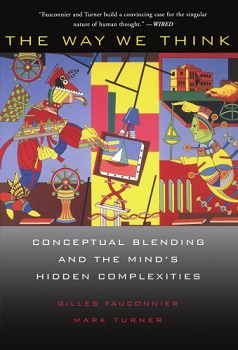
Gilles Fauconnier and Mark Turner‘s The Way We Think: Conceptual Blending and the Mind’s Hidden Complexities gives us a fascinating look at the way the human mind weaves a world out of seemingly disparate elements — in a very similar manner to that in which the creative mind weaves an aha! out of seemingly disparate ideas. The book deals with the formation of perceptions as well as ideas, but it was a specifically conceptual blend that intrigued me the other day.

First, they note that when we use expressions like “I had reached the boiling point. I was fuming. He exploded.” we are making a metaphorical mapping in which “a heated container maps to an angry individual, heat maps to anger, smoke and steam (signs of heat) map to signs of anger, explosion maps to uncontrolled rage.” Then they add in the “folk theory of physiological effects of anger” including ” increased body heat, blood pressure, agitation, redness of face” – and thus we have a threefold scheme, in which physiology, emotions and the physics of heat are intricately cross-correlated, so that we can say without much thought “He was so mad I could see smoke coming out of his ears”.

Here Fauconnier and Turner describe the mechanics of this remarkable conceptual blending process – which can yield such a seemingly unremarkable phrase:

In addition to the metaphoric mapping between Heat and Emotions and the vital-relation connection between Emotions and Body, there is a third partial mapping between Heat and Body. In this mapping, steam as vapor that comes from a container connects to perspiration as liquid that comes from a container, the heat of a physical object connects to body heat, and the shaking of the container connects to the body’s trembling.

The three partial mappings set the stage for a conventional multiple blend in which the counterparts in the inputs are fused, yielding, for example, a single element that is heat, anger, and body heat and a different single element that is exploding, reaching extreme anger, and beginning to shake. Once we have this blend, we can run it to develop further emergent structure and we can recruit other information to the inputs to facilitate its development.

*

What interests me here is the phrase:

the inputs are fused, yielding, for example, a single element that is heat, anger, and body heat

and what it reminds me of is CS Lewis writing in The Allegory of Love:

It must always be remembered … that the various senses we take out of an ancient word by analysis existed in it as a unity.

Thus the King James Version of the Bible, John 3.8, reads:

The wind bloweth where it listeth, and thou hearest the sound thereof, but canst not tell whence it cometh, and whither it goeth: so is every one that is born of the Spirit.

In the Greek, the word here translated wind is pneuma, and the sentence accordingly means “the pneuma blows where it wills, and you hear its sound but can’t tell where it comes from or is going: and so it is with all those born of pneuma“…

Recalling Lewis’ remark about the “various senses we take out of an ancient word”, this in turn means simultaneously and without separation:

the wind blows where it wills, and you hear its sound but can’t tell where it comes from or is going: and so it is with all those born of wind…

the breath blows where it wills, and you hear its sound but can’t tell where it comes from or is going: and so it is with all those born of breath…

and:

spirit blows where it wills, and you hear its sound but can’t tell where it comes from or is going: and so it is with all those born of spirit…

Take this a step further, realize that spirit can be defined as what inspires us, and we have:

inspiration blows where it wills, and you hear its sound but can’t tell where it comes from or is going: and so it is with all those born of inspiration…

Four meanings, all making good sense, and all present simultaneously and inseparably in the one gospel phrase…

*

Now consider that Fauconnier and Turner are speaking of how “three partial mappings set the stage for a conventional multiple blend in which the counterparts in the inputs are fused, yielding, for example, a single element that is heat, anger, and body heat” and compare it with Lewis’ “unity” from which we take out “the various senses” by “analysis”, as applied to the “ancient word” pneuma, with its meaning encompassing wind, breath, spirit… inspiration.

Are wind, breath and spirit or inspiration in fact three “primitives” that conceptual mapping in ancient Greek thought has brought together? What do we gain, and what do we lose if we view them this way?

And what do we lose, what do we gain if we view them as a single rich concept, now reduced to three or four separate — and separately less complexly interesting — ideas?

Boyd & Beyond 2012

Saturday, May 19th, 2012

Colonel John Boyd

This is a head’s up early warning so people can get their schedules and plans together.

From J. Scott Shipman at the Disciples of Boyd’s Strategy Group:

Greetings! A gentle reminder that Boyd & Beyond 2012 is scheduled for 12 & 13 October 2012 at Quantico, VA. 

I would encourage those interested in presenting to contact me or Colonel Stan Coerr. As far as I know, Stan doesn’t have a presenters list. As in the last couple of years, we discourage the use of PowerPoint. The last two years have been two compelling days, and I’ve no doubt this year will be no exception.

There is no charge to attend, as the Command & Staff College makes space available. So check you schedules and make plans to attend, and consider submitting an idea for a presentation.

Ullman’s Strategic Revolution?

Sunday, May 13th, 2012

Strategist Dr. Harlan K. Ullman (best known for the concept of  “Shock and Awe“) had a piece up at Atlantic Council about which I have a mix of opinions, so I am going to break it down with some excerpts and comment:

Needed Now: An Intellectual Revolution in Strategic Thinking 

Toward the end of the Cold War, Soviet military thinkers coined the phrase “Military-Technical Revolution.” Based on a combination of extraordinary advances in precision strike and in information and surveillance technologies, the MTR was successfully transformed by the Pentagon into the “Revolution in Military Affairs.”

Meant to defeat the Red Army, the RMA was a real military revolution proven in the first Iraq War in 1991 when US arms pulverized Saddam Hussein’s army; in Afghanistan quickly routing the Taliban in 2001; and again smashing Iraq two years later.

There’s more than just a semantic difference here.

A “Military Revolution” is a rare thing in history, an epochal event, like the transformation of warfare in early modern Europe , which also dovetails with the Marxist-Leninist  economic deterministic conception of what constituted a world-historical “revolutionary” event in Soviet ideology. A “Military-Technical Revolution” was a terminological effort by Soviet general officers to reduce the ideological scope of the event discussed away from a sphere predominantly governed by the supreme authority of the Party (and in practice then, by politburo ideologist, Mikhail Suslovwho was deeply suspicious of any kind of reform) to one that emphasized that radical changes in warfare originated in or would flow from purely technological innovations and could therefore be safely managed by military professionals without encroaching upon political matters.  Self-interest and institutional interest of the Red Army general staff at work.

American defense intellectuals repackaged the Red Army’s “Military-Technical Revolution” as the  “Revolution in Military Affairs” – a much narrower concept than “Military Revolution” yet broader, more flexible and open-ended than it’s Soviet parent. Eminent strategist and military historian Colin S. Gray described RMA thusly:

Military Revolutions are preceded, implemented, and succeeded by RMAs. RMA refers to a radical change in the character of war. The engines of such change include, but are by no means limited to, technological innovation. Scholars note that most historically plausible RMAs have not obviously been led by new technologies [1].

The American RMA unlike the Soviet version was more closely tied to the force-multiplying effects of the information revolution and Moore’s Law  that was to reshape the global economy, and came to be shorthanded, under Rumsfeld, as “transformation“. However, like the Soviet MTR, RMA suited the growing fascination of American military officers with operational art as the acme of professional identity and a substitute for strategy and troublesome questions of policy and politics. While “transformation” was good for making the military more efficient at applying violence, the focus on technological magic in operations tended to anesthetize senior generals from the need to attend to the vital strategic-policy dimension of war.

Back to Ullman:

….Today, American and certain allied militaries are exhausted by a decade of war. All face large and looming defense cuts meaning far less money for defense. Under these circumstances, readiness and morale become early casualties.

With the exception of North Korea (or to some states in Europe, Russia), few hostile armies are around to fight in a conventional conflict making the case for defense more diaphanous. The wars in Iraq and Afghanistan demonstrated that while military force may have been necessary, it could not make either country more governable, hardly the best argument for defense spending.

The omission of China is simply weird. I am neither a ‘Panda hugger” or a “Panda mugger” and I don’t think China should be shoehorned into the role of near-peer competitor, which it is not yet, except in the fantasies of hypernationalistic Chinese and maybe blogger/salesmen from the Lexington Institute. But how do you ignore a nation like China and the PLA in in a military-geopolitical strategic analysis?

….How can militaries deal with these facts of life? The answer is that a new revolution is desperately needed. Given the bleak funding outlook, this revolution can only be accomplished through intellect and rejuvenating strategic thinking.

British Gen. Rupert Smith’s “The Utility of Force” skillfully interpreted war in the 21st century to be about and over people — to protect and defend them or to defeat or disrupt them rather than as modern armies squaring off against one and other.

Many assumptions to unpack from few words.

I welcome Dr. Ullman’s call for an intellectual renaissance in strategic thinking which, if badly needed among the professional military class, is even more urgently required in our political class who – with some exceptions – were largely AWOL from their responsibilities of senior partnership in fashioning strategy and grand strategy with the uniformed military in the past ten years. Perhaps in a generation or two, the proliferation of grand strategy programs at elite universities that are increasingly feared by anti-American intellectual leftists, will produce a large cadre of statesman with real strategic competence.

Regarding the second paragraph, while I am sympathetic to the assumptions that 4GW environments will increase with the erosion of state sovereignty and legitimacy, the future of warfare may very well be extremely “hybridwith well-financed polities, corporations and networks fielding impressively high tech military capabilities alongside atavistic and disorganized insurgencies wallowing in blood and entrails. The latter will invite intrusion by the former and the former are sometimes going to clash with one another, as well as against postmodern warlords, superempowered individuals, urban guerrillas and networked jihadis.

….Some 15 years earlier, the concept of “shock and awe” was created in which the goal was to affect, influence and ultimately control the will and perception of an adversary (hence Smith’s “people”) with the use or threat of military force. “Shock and awe” was inspired by the Chinese philosopher Sun Tzu eons ago when he wrote that the really brilliant general wins without having to fight a battle.

Shock and awe posited four criteria: control of the environment, rapidity, (near) perfect knowledge and brilliance in execution.

The last two, combined with the realities and uncertainties of today’s international environment, form the foundations for this much needed intellectual revolution in strategic thinking.

If so, then the revolution fizzles out here.

Rapidity and brilliance in execution – or at least excellence – can be trained for, but in control of the environment, the enemy gets a vote (and so, for that matter, does the environment) and “(near) perfect knowledge” is a transient comparative advantage held (if at all) during the initial moments of a complete surprise attack. While it would be nice to have, “(near) perfect knowledge” cannot be a foundation for a strategic revolution as it is a largely unachievable standard in unhurried conditions of perfect peace, much less during the fog and friction of war.

….No one can be certain about the nature of future conflicts as the requirements for defense, once equated in largely military terms, have expanded to cover security with a far broader aperture extending well beyond armies, navies and air forces.

In future conflict, military force may or may not be necessary. But they have not been sufficient to achieve the strategic and political aims of bringing stability and security to Iraq, Afghanistan and so far Libya for example.

Further, given defense cuts, preparations for major conventional operations will be severely curtailed as both weapons and systems for those engagements as well as training will likewise be reduced, possibly dramatically. The strategic question that forms the heart of an intellectual revolution rests on how militaries can prepare for a future so filled with uncertainty while preserving traditional war fighting skills with far less money.

Ullman is correct that public expectations of “security” have expanded beyond military strength to encompass more of the DIME spectrum with, arguably, law enforcement, immigration/assimilation and cyber issues as well.

Disagree that the current political class dominated by aging Boomer fantasists will recognize that sharply curtailed military budgets mean fewer operations.It certainly has not worked that way in Britain where harshly punitive budgetary cuts to the British Army and Royal Navy have scarcely curbed Her Majesty’s government’s appetite for military intervention.  American politicians and Atrocity Boards will simply require the Pentagon eat it’s seed corn to pay for intervention piled upon intervention and when that runs dry, Congress will look at cutting veteran health benefits and pensions and hollow out the force until it breaks.

….First, militaries and strategic thinking must be oriented about obtaining (near) perfect knowledge not merely about traditional operations and employing weapons systems with far greater creativity. There must be far more learning about other, non-military tools and other regions and states round the world of import or interest to assuring national security.

The part  about creativity is spot on, but in a military where majors, colonels and brigadier generals feel they cannot sign off on something as mundane as a platoon, a company or a battalion using ATVs on patrol in Afghanistan without risking their careers, then bureaucratic micromanagement has already reached the state of military rigor mortis. Strategic thinking in the ranks cannot begin until the climate of fear is removed and the incentives for promotion changed to reward risk-taking. Just like the State Department, the Pentagon’s antiquated personnel system is out of alignment with the needs of American national security and  represents a systemic bulwark against positive change.

Pursuit of near perfect knowledge should be dropped. When Admiral Art Cebrowski helped conceive of network-centric warfare,  there was an opportunity present, through real-time sharing of  information across a military “system”, to maximize individual and unit initiative within their understanding of the commander’s intent and accelerate the operational tempo vis-a-vis the enemy. Instead, information technology, as I see it imperfectly from my far remove as a civilian kibbitzer, has empowered micromanagement with three and four star generals playing company commander, colonels playing squad leader and lawyers and powerpoint-inebriated staff officers hundreds  of miles away blocking artillery or air support requested by units under fire.

Perfect knowledge as a doctrinal benchmark encourages organizational paralysis in the face of uncertainty, rather than the fluidity, creativity and adaptiveness that Ullman seeks.

….Second, new means and methods must be created or strengthened that contribute to maintaining fighting skills that enable brilliance in operations. For example, as the British navy and air force lose both carrier and anti-submarine capacities for an interim period, units should be assigned to the US or French navies that will employ these weapons systems. The British army could deploy units to serve in Korea or Pakistan and India where conventional combat is central to those forces to maintain these skills. And new generations of war games and simulators must be invented and fielded so that many scenarios can be played out to keep skills at acceptable levels of readiness.

These are useful ideas, especially the wargames. I don’t think the British will bite though, except for “model” partnerships with the French. There’s really no good reason why there should not be an “Anglospheric” (UK, US, ANZUS, Canada) combined naval warfare planning staff and regular joint exercises.

….Third, to achieve these aims, a further revolution in military education from bottom to top is essential. Officers and troops must be prepared intellectually in order to obtain near perfect knowledge about a future that at best is opaque. And simultaneously, keeping combat skills sharp in an era of austerity when weapons and training will be in shorter supply is best done as Bobby Jones, perhaps the greatest golfer ever observed about that game — it is played in the 6-inch space between the ears!

Militaries will be reluctant to accept new or any revolutions when they are fighting for subsistence. Politicians find governing hard enough. And few are prepared to impose a revolution let alone make tough decisions.

If an intellectual revolution is to be wrought, it must come from within. But who will listen? And who will lead?

As of now, no one is leading and few understand the need to do so.

1. Colin S. Gray. Another Bloody Century. Orion Books Ltd. London. 2005.  117..

Educating Divided Minds for an Illiberal State

Friday, May 4th, 2012

Adam Elkus had well-constructed argument about the Thomas Friedman-Andrew Exum exchange:

Education and Security

Andrew Exum’s has a useful critique of Thomas Friedman’s recent piece. In a nutshell, Friedman makes the old argument that the US could buy friendship and allegiance by giving Middle Easterners more education and scholarship opportunities. To this, Exum has a rather terrific rejoinder:

“I am a proud graduate of the American University of Beirut, but do you know who else counted the AUB as their alma mater? The two most innovative terrorists in modern history, George Habbash and Imad Mughniyeh. U.S. universities and scholarship programs are nice things to do and sometimes forge important ties between peoples and future leaders, but they can also go horribly wrong and do not necessarily serve U.S. interests. There is certainly no guarantee a U.S.-style education leads to greater tolerance or gender and social equality.”

Habbash and Mughniyeh are hardly alone. Diego Gambetta and Steffen Hertog famously observed an distinct overrepresentation of scientists, engineers, and other highly educated professionals in both violent and nonviolent groups with illiberal ideologies. Gambetta and Hertog make an argument that the black-and-white mindset of certain technical groups correlate well with extremist ideologies, but I am unfamiliar with how this has been academically received so I won’t endorse their claims. To be sure, a look at 20th century history would also reveal a significant confluence of intellectuals in the humanities and social sciences being involved in either state or non-state illiberal movements. 

Indeed, the problem here may be the imbalance of educational systems that produce divided minds, where lopsided cultures of thought interact with enough disturbed individuals with a will to power. Stalin demonstrated what Communism looked like when a former Orthodox seminarian presided over a police state run by engineers; Mao one-upped him with Communism as the mystical rule of an all-powerful poet.

One of the more unfortunate trends among many bad ideas currently advertised as “education reform” is the denigration of the humanities and the reduction or elimination of the arts and history in public schools in favor of excessive standardized testing of rote skills and reasoning at the lowest levels of Bloom’s taxonomy, mostly due to Federal coercion. That this has become particularly popular with GOP politicians (though many elitist Democrats echo them) would have appalled erudite conservatives like William F. Buckley and Russell Kirk or old school libertarians who would have seen nationalization of k-12 education policy as worse than the status quo.

In an effort to appear genuinely interested in improving education, some politicians couple this position with advocacy for STEM, as the teaching of science has also been undermined by the NCLB regime and a grassroots jihad by religious rights activists against the teaching of evolution in high school biology classes. While STEM in and of itself is a good thing and better science instruction is badly needed, STEM is no more a substitute for teaching the humanities well than your left hand is a substitute for your right foot.

The modes of thinking produced by quantitative-linear- closed system-analytical reductionist reasoning and qualitative-synthesizing-alinear-imaginative -extrapolative are complementary and synergistic. Students and citizens need both. Mass education that develops one while crippling the other yields a population sharing a deeply entrenched and self-perpetuating lacunae, hostile and suspicious of ideas and concepts that challenge the veracity of their insular mental models. This is an education that tills the soil for intolerance and authoritarianism to take root and grow

Education should be for a whole mind and a free man.


Switch to our mobile site