zenpundit.com » legitimacy

Archive for the ‘legitimacy’ Category

R2P is the New COIN

Monday, September 19th, 2011

Introduction: 

The weirdly astrategic NATO campaign in Libya intervening on the side of ill-defined rebels against the tyrannical rule of Libyan strongman Colonel Moammar Gaddafi brought to general public attention the idea of “Responsibility to Protect” as a putative doctrine for US foreign policy and an alleged aspect of international law. The most vocal public face of R2P, an idea that has floated among liberal internationalist IL academics and NGO activists since the 90’s, was Anne-Marie Slaughter, former Policy Planning Director of the US State Department and an advisor to the Obama administration. Slaughter, writing in The Atlantic, was a passionate advocate of R2P as a “redefinition of sovereignty” and debated her position and underlying IR theory assumptions with critics such as Dan Drezner, Joshua Foust, and Dan Trombly.

In all candor, I found Dr. Slaughter’s thesis to be deeply troubling but the debate itself was insightful and stimulating and Slaughter is to be commended for responding at length to the arguments of her critics. Hopefully, there will be greater and wider debate in the future because, in it’s current policy trajectory, R2P is going to become “the new COIN”.

This is not to say that R2P is a military doctrine, but like the rise of pop-centric COIN, it will be an electrifying idea that has the potential fire the imagination of foreign policy intellectuals, make careers for it’s bureaucratic enthusiasts and act as a substitute for the absence of a coherent American grand strategy. The proponents of R2P (R2Peons?) appear to be in the early stages of following a policy advocacy template set down by the COINdinistas, but their ambitions appear to be far, far greater in scope.

It must be said, that unlike R2P, an abstract theory literally going abroad in search of monsters to destroy, COIN was an adaptive operational and policy response to a very real geopolitical debacle in Iraq, in which the United States was already deeply entrenched. A bevy of military officers, academics, think tank intellectuals, journalists and bloggers – some of them genuinely brilliant – including John Nagl, Kalev Sepp, Con Crane, Jack Keane, David Petraeus, Michèle Flournoy, David Kilcullen, Fred and Kim Kagan, James Mattis, Montgomery McFate, Thomas Ricks, Andrew Exum,  the Small Wars Journal and others articulated, proselytized, reported, blogged and institutionalized a version of counterinsurgency warfare now known as “Pop-centric COIN“, selling it to a very reluctant Bush administration, the US Army and USMC, moderate Congressional Democrats and ultimately to President Barack Obama.

The COIN revival and veneration of counterinsurgent icons like Templer and Galula did not really amount a “strategy”; it was an operational methodology that would reduce friction with Iraqis by co-opting local leaders and, for the Bush administration, provide an absolutely critical political “breathing space” with the American public to reinvent an occupation of Iraq that had descended into Hell. For US commanders in Iraq, adopting COIN doctrine provided “the cover” to ally with the conservative and nationalistic Sunni tribes of the “Anbar Awakening” who had turned violently against al Qaida and foreign Salafist extremists. COIN was not even a good theoretical  model for insurgency in the 21st century, never mind a strategy, but adoption of COIN doctrine as an American political process helped, along with the operational benefits, to avert an outright defeat in Iraq. COIN salvaged the American political will to prosecute the war in Iraq to a tolerable conclusion; meaning that COIN, while imperfect, was “good enough”, which in matters of warfare, suffices.

During this period of time and afterward, a fierce COINdinista vs. COINtra debate unfolded, which I will not summarize here, except to mention that one COINtra point was that COINdinistas, especially those in uniform, were engaged in making, or at least advocating policy. For the military officers among the COINdinistas, this was a charge that stung, largely because it was true. Hurt feelings or no, key COINdinistas dispersed from Leavenworth, CENTCOM and military service to occupy important posts in Washington, to write influential books, op-eds and blogs and establish a think tank “home base” in CNAS. Incidentally, I mean this descriptively and not perjoratively; it is simply what happened in the past five years. The COINDinistas are no longer “insurgents” but are the “establishment”.

R2P is following the same COIN pattern of bureaucratic-political proselytization with the accomplished academic theorist Anne-Marie Slaughter as the “Kilcullen of R2P”. As with David Kilcullen’s theory of insurgency, Slaughter’s ideas about sovereignty and R2P, which have gained traction with the Obama administration and in Europe as premises for policy, need to be taken seriously and examined in depth lest we wake up a decade hence with buyer’s remorse. R2P is not simply a cynical fig leaf for great power intervention in the affairs of failed states and mad dictatorships like Gaddafi’s Libya, R2P is also meant to transform the internal character of great powers that invoke it into something else. That may be the most important aspect and primary purpose of the doctrine and the implications are absolutely profound.

Therefore, I am going to devote a series of posts to analyzing the journal article recommended by Dr. Slaughter, “Sovereignty and Power in a Networked World Order“,  which gives a more robust and precise explanation of her ideas regarding international relations, sovereignty, legitimacy, authority and power at greater length than is possible in her op-eds or Atlantic blog. I strongly recommend that you read it and draw your own conclusions, Slaughter’s argument is, after all, about your future.

ADDENDUM – Related Posts:

Slouching Toward Columbia – Guest post: Civilian Protection Policy, R2P, and the Way Forward

Phronesisaical –Dragging History into R2P

Dart-Throwing Chimp – R2P Is Not the New COIN

Committee of Public Safety –With Outstretched Arm | The Committee of Public Safety

Elkus on Wikileaks and Sovereignty

Sunday, September 4th, 2011

Adam Elkus has a smart piece up at Rethinking Security that deserves wider readership:

WikiLeaks and Sovereignty

….WikiLeaks represents the idea that states have no inherent authority to hold onto vital national secrets. Because information is fundamentally boundless and unlimited by the “oldthink” of national borders and politics, state control over proprietary information is irrelevant. WikiLeaks and other radical transparency advocates believe that they-an unelected, transnational elite-can pick and choose which states are good and bad and whose secrets deserve exposure. And if information deserves to be free-and the only people who would keep it from being so are those with something to hide-then it is fine for non-state networks to arrogate themselves the right to receive and expose state secrets.

….While WikiLeaks is often positioned as a champion of digital democracy, it is actually wholly anti-democratic. It transfers power and security from national governments and their publics to unelected international activist organizations and bureaucrats. While this may seem like a harsh interpretation, there is no check on the likes of Julian Assange. Governments-even autocratic ones-still must contend on a day-to-day basis with the people. Even China had to face a reckoning after the Wenzhou train crash. WikiLeaks and other radical transparency organizations mean to replace one group of elites-which at least nominally can be called to court-with another who are accountable only to their own consciences.

Read the whole thing here.

Let me add a few comments to Adam’s excellent analysis.

Wikileaks and Julian Assange were not and have never been, lone wolves or information-must-be-free martyrs. They are allied with important institutions and individuals within the Western progressive elite, not least major media heavyweights like The New York Times, The Guardian and Der Spiegel, but also sympathizers within Western governments. Unless you think that Pvt. Bradley Manning was a hacker wunderkind with an intuitive grasp of which files that could be swept up to further a sophisticated political agenda, the man had some inside help from further up the food chain.

Adam is correct to describe these political factions as anti-democratic because they are and while leaking has been going on as long as there have been governments, we now have the emergence of a transnational generational clique that see themselves as entitled to rule and impose policies that comport with their social prejudices, economic self-aggrandizement and ideological fetishes, whether the people support them or not. A vanguard attitude, if not an organizational vanguard.

Wikileaks and other devices operating in shadowy undercurrents are their form of liberum veto against the rest of us in the instances where they are not completely in control, thus migrating political power from responsible state institutions to the social class that currently fills most of the offices and appointments. So far, their actions have been largely cost-free because their peers in government, however irritated they may be at the effects of Wikileaks, are loath to cross the Rubicon and hammer these influential conspirators with whom they went to school, intermarry, do business, live amongst and look out for the careers of each other’s children the way they have hammered Bradley Manning.

The same oligarchical class indulgence is seen in the financial crisis where almost none of the people responsible for massive criminal fraud in the banking and investment  sectors that melted the global economy have faced prosecution, unlike previous financial scandals like the S&L crisis or BCCI where even iconic figures faced grand juries. Instead of indictments, the new class received subsidies, bonuses and sweetheart, secret deals from their alumni chums running central banks and national governments. 

Carl Prinecommenting on a much narrower and wholly American slice of this corrupt camarilla, described this new class very well:

Let me be blunt.  A late Baby Boomer generation of politicians, bankers, reporters and generals has formed into a cancer inside this democracy, and their tumorous leadership won’t be kind to your future.

Unfortunately, this cancer is not limited to our democracy, it is the root of the decline of the West.

R2P is a Doctrine Designed to Strike Down the Hand that Wields It

Saturday, September 3rd, 2011

There has been much ado about Dr. Anne-Marie Slaughter’s ennunciation of “Responsibility to Protect” as a justification for the Obama administration’s unusually executed intervention (or assistance to primarily British and French intervention) in Libya in support of rebels seeking to oust their lunatic dictator, Colonel Moammar Gaddafi. In “R2P” the Obama administration, intentionally or not, has found it’s own Bush Doctrine, and unsurprisingly, the magnitude of such claims – essentially a declaration of jihad against what is left of the Westphalian state system by progressive elite intellectuals – are beginning to draw fire for implications that stretch far beyond Libya.

People in the strategic studies, IR and national security communities have a parlor game of wistfully reminiscing about the moral clarity of Containment and the wisdom of George Kennan. They have been issuing tendentiously self-important “Mr. Z” papers for so long that they failed to notice that if anyone has really written the 21st Century’s answer to Kennan’s X article, it was Anne-Marie Slaughter’s battle cry in the pages of The Atlantic.

George Kennan did not become the “Father of Containment” because he thought strategically about foreign policy in terms of brutal realism. Nor because he was a stern anti-Communist. Or because he had a deep and reflective understanding of Russian history and Leninism, whose nuances were the sources of Soviet conduct. No, Kennan became the Father of Containment because he encapsulated all of those things precisely at the moment when America’s key decision makers, facing the Soviet threat, were willing to embrace a persuasive explanatory narrative, a grand strategy that could harmonize policy with domestic politics.

Slaughter’s idea is not powerful because it is philosophically or legally airtight – it isn’t – but because R2P resonates deeply both with immediate state interests and emotionally with the generational worldview of what Milovan Djilas might have termed a Western “New Class”.

While it is easy to read R2P simply as a useful political cover for Obama administration policy in Libya, as it functioned as such in the short term, that is a mistaken view, and one that I think badly underestimates Anne-Marie Slaughter. Here is Slaughter’s core assertion, where she turns most of modern diplomatic history and international law as it is understood and practiced bilaterally and multilaterally by sovereign states in the real world (vice academics and IGO/NGO bureaucrats) on it’s head:

If we really do look at the world in terms of governments and societies and the relationship between them, and do recognize that both governments and their citizens have rights as subjects of international law and have agency as actors in international politics, then what exactly is the international community “intervening” in?

…For the first time, international law and the great powers of international politics have recognized both the rights of citizens and a specific relationship between the government and its citizens: a relationship of protection. The nature of sovereignty itself is thus changed: legitimate governments are defined not only by their control of a territory and a population but also by how they exercise that control. If they fail in that obligation, the international community has the responsibility to protect those citizens.

Slaughter is a revolutionary who aspires to a world that would functionally resemble the Holy Roman Empire, writ large, with a diffusion of power away from legal process of  state institutions to the networking informalities of the larger social class from whom a majority of state and IGO officials are drawn, as a global community. In terms of policy advocacy, this is a brilliantly adept move to marry state and class interests with stark moral justifications, regardless of how the argument might be nibbled to death in an arcane academic debate.

As with Kennan’s X Article, which faced a sustained critique from Walter Lippmann who realized that Containment implied irrevocable changes in the American system, R2P has attracted criticism. Some examples:

Joshua Foust –Why sovereignty matters

Much as advocates of the “Responsibility to Protect,” or R2P, like to say that sovereignty is irrelevant to the relationship of a society to its government (which Slaughter explicitly argues), it is that very sovereignty which also creates the moral and legal justification to intervene. For example, the societies of the United States and NATO did not vote to intervene in Libya – their governments did.

Foreign Affairs – The Folly of Protection

….RtoP, responding to the sense that these domestic harms warranted international response, solidified the Security Council’s claims to wider discretion. Yet it also restricted its ability to sanction intervention to the four situations listed in the RtoP document — genocide, war crimes, ethnic cleansing, and crimes against humanity — and thus precluded, for example, intervention in cases of civil disorder and coups. Although the resolution authorizing force against Libya will certainly further entrench the principle of RtoP, it will not completely resolve the tension between RtoP — in itself only a General Assembly recommendation — and the UN Charter itself, which, according to the letter of the law, limits action to “international” threats.

Dan Trombly –The upending of sovereignty and Responsibility to Protect Ya Neck

Beauchamp, along with Slaughter, have revealed R2P for what it actually is: a doctrine based on regime change and the destruction of the foundations of international order wherever practically possible. After all, are intervening powers really fulfilling their responsibility if they fail to effect regime change after intervening? This is exactly why I believe R2P is far more insidious than many of its advocates would have us believe or intend in practice. It is essentially mandating a responsibility, wherever possible, to seek the sanction, coercion, or overthrow of regimes which fail to meet a liberal conception of acceptable state behavior. Even if R2P is never applied against a major power, it is hard to see why such behavior would not be met with just as much suspicion as humanitarian intervention and previous Western regime change operations were. Indeed, a full treatment will reveal there is immense pressure for R2P to initiate the more fundamental, and more universal, impulse to revert to the potential ruthlessness inherent in international anarchy.

Understandably, such critiques of R2P are primarily concerned with sovereignty as it relates to interstate relations and the historical predisposition for great powers to meddle in the affairs of weaker countries, usually with far less forthrightness than the Athenians displayed at Melos. It must be said, that small countries often  are their own worst enemies in terms of frequently providing pretexts for foreign intervention due to epic incompetence in self-governance and a maniacal delight in atavistic bloodshed. Slaughter is not offering up a staw man in relation to democide and genocide being critical problems with which the international community is poorly equipped and politically unwilling to counter.

But R2P is a two edged sword – the sovereignty of all states diminished universally, in legal principle, to the authority of international rule-making about the domestic use of force is likewise diminished in it’s ability to legislate it’s own internal affairs, laws being  nothing but sovereign  promises of state enforcement. Once the camel’s nose is legitimated by being formally accepted as having a place in the tent, the rest of the camel is merely a question of degree.

And time.

As Containment required an NSC-68 to put policy flesh on the bones of doctrine, R2P will require the imposition of policy mechanisms that will change the political community of the United States, moving it away from democratic accountability to the electorate toward “legal”, administrative, accountability under international law; a process of harmonizing US policies to an amorphous, transnational, elite consensus, manifested in supranational and international bodies. Or decided privately and quietly, ratifying decisions later as a mere formality in a rubber-stamping process that is opaque to everyone outside of the ruling group.

Who is to say that there is not, somewhere in the intellectual ether, an R2P for the the environment, to protect the life of the unborn, to mandate strict control of small arms, or safeguard the political rights of minorities by strictly regulating speech? Or whatever might be invented to suit the needs of the moment?

When we arrest a bank robber, we do not feel a need to put law enforcement and the judiciary on a different systemic basis in order to try them. Finding legal pretexts for intervention to stop genocide does not require a substantial revision of international law, merely political will. R2P could become an excellent tool for elites to institute their policy preferences without securing democratic consent and that aspect, to oligarchical elites is a feature, not a bug.

R2P will come back to haunt us sooner than we think.

ADDENDUM:

Doug Mataconis at Outside the Beltway links here in a round-up and commentary about R2P posts popping up in the wake of the Slaughter piece:

The “Responsibility To Protect” Doctrine After Libya

….It’s understandable that the advocates of R2P don’t necessarily want to have Libya held up as an example of their doctrine in action. Leaving aside the obvious contrasts with the situation in Syria and other places in the world, it is by no means clear that post-Gaddafi Libya will be that much better than what preceded it. The rebels themselves are hardly united around anything other than wanting to get rid of Gaddafi and, now that they’ve done that, the possibility of the nation sliding into civil and tribal warfare is readily apparent. Moreover, the links between the rebels and elements of al Qaeda that originated in both Afghanistan and post-Saddam Iraq are well-known. If bringing down Gaddafi means the creation of a safe haven for al Qaeda inspired terrorism on the doorstep of Europe, then we will all surely come to regret the events of the past five months. Finally, with the rebels themselves now engaging in atrocities, one wonders what has happened to the United Nations mission to protect civilians, which didn’t distinguish between attacks by Gaddafi forces or attacks by rebels.

….Finally, there’s the danger that the doctrine poses to American domestic institutions. If Libya is any guide, then R2P interventions, of whatever kind, would likely be decided by international bodies of “experts” rather than the democratically elected representatives of the American people. American sailors and soldiers will be sent off into danger without the American people being consulted. That’s not what the Constitution contemplates, and if we allow it to happen it will be yet another nail in the coffin of liberty.

Read the rest here.

The Debate over the Influence and Extent of “Realism”

Tuesday, August 16th, 2011

 Kudos to Dan Trombly of Fear, Honor and Interest. Why?

First, for drawing attention to the debate between Dan Drezner and Anne-Marie Slaughter over, hmm, “Real-world Realism” in American foreign policy:

Dan DreznerMeet the new foreign policy frontier…. same as the old foreign policy frontier

….Well, this is… this is… I’m sorry, I got lost among the ridiculously tall strawmen populating these paragraphs.   I’ll go out on a limb and posit that not even Henry Kissinger thinks of the world the way Slaughter describes it.  Just a quick glance at, say, Hillary Clinton’s recent speech in Hong Kong suggests that actual great power foreign policies bear no resemblance whatsoever to that description of “traditional foreign policy.” 

Slaughter knows this very well, given that she was Clinton’s first director of policy planning.  She also knows this because much of her writing in international relations is about the ways in which traditional governments are becoming more networked and adaptive to emergent foreign policy concerns.  

Rebuttal time…..

Anne-Marie SlaughterThe Debate Is On! A Response to Dan Drezner

….I’ll take that bet. I think it’s exactly how Henry Kissinger still thinks of the world. Indeed, he has just published a book on China — of course, because from the traditional realist perspective China is by far the most important foreign policy issue in the 20th century, as it is the only possible military and economic competitor to the United States. Hence, as realists/traditionalists never tire of repeating, the U.S.-China relationship is the most important global relationship of the 21st century: what matters most is ensuring that as both nations pursue their power-based interests they do not collide catastrophically. Never mind that an avian flu virus that is both fatal and aerosol-borne arising anywhere in Asia could do far more damage to global security and the economy than China ever could — just see the forthcoming movie Contagion.


The second reason for giving Mr. Trombly props is that his excellent post in response to the above was a lot more interesting and substantive than their pleasantly jocular and Friedmanesque exchange:

Old School realism and the problem of society

….Waltz cares about states because states, in the time periods he examines, are the primary bearers of power. Power, not the state, is likely the more long-standing differentiation between the liberal/idealist and realist schools of international affairs. Realists generally care more about who has power, and particularly coercive power, because in the realist view, it is the power to control – not to collaborate, connect, or convince – which is the final arbiter and source of other forms of  socio-political-economic behavior.

For most of the history of thinkers identified with realism, the state did not exist, nor did the conception of the state as a unitary actor. Thucydides, long identified as one of the fathers of Western realism, was not a Waltzian structural realist in the slightest. As most early realists did, he cited the origins of political behavior in irrational and rational drives, which originate in the hearts and minds of men. There were no states in Thucydides’s day, but city-states, empires, and various other forms of political organization which did not survive to the present day. Thus one had to be quite conscious not just of particular parties and factions, but even individuals, who, in a polis such as Athens could completely upturn the designs of the Athenian state. In his description of the varying governments and systems of organization at play, Thuycdides actually shows a keen awareness of how regime types and the social composition can influence international politics, but only insofar as it involves the exercise of power. The exchange of goods, culture, and ideas matters far less to him. Slaughter does offhand mention that an Avian flu could kill far more than a war and be more likely. Interestingly enough, the plague of Athens does play an important role in Thucydides’s history

….This pessimism about the dangers of those lacking political virtue, or restraint of their passions, from acquiring power colors, in one way or another, much of the subsequent 2,500 years of realist thought. Ultimately, the interactions and aims of the various interest groups that Slaughter describes, and Drezner dismissed, are not necessarily prescriptively ignored but the subjects of active disdain, fear, and scorn

Much to like in this fairly lengthy post, which  I recommend you read in full.

Now for my two cents.

First, as a factual matter, it would not be hard to establish that Dr. Slaughter is correct and Dr. Drezner is not that Henry Kissinger does think like that. He most certainly did while he was in power, as is amply recorded in the National Archives, Kissinger’s memoirs and secondary works by historians and biographers who made Kissinger their subject. To all appearances, Brent Scowcroft, Kissinger’s protege thinks the same way, as did Kissinger’s master, Richard Nixon, whose private remarks regarding the unimportance of ephemeral actors to geopolitics were brutal. The UN, for example, Nixon dismissed as a place for “just gassing around” and Nixon was happy to use the UN (and George Bush the Elder) as unwitting props in his China Opening.

Policy makers do not think like IR academics do, even when they are IR academics like Dr. Slaughter or Dr. Kissinger. They don’t have the time or luxury of remove from events. The cool, detached, analytical, Harvard intellectual who wrote Nuclear Weapons and Foreign Policy became the emotive, egoistic, domineering, slightly hysterical, bureaucratic operator and diplomatic tactician as National Security Adviser. I suspect a six days a week, sixteen hour days of crisis management culture as Policy Planning Director at State likewise tempered Slaughter’s time for theorizing speculations.

That said, there is some room present for Dr. Drezner’s skepticism and Mr. Trombly’s “active disdain, fear and scorn”of non-state actors (which I think is a spot on gestalt of the Metternich-worshipping Henry the K).

The state as an organization of coercion and defense is unrivaled in human history by any other political form except the tribe. The state is fine-tuned to be a beast of prey and open challeges to the state, in all it’s panolpy of might, without a long preparatory period of eroding it’s legitimacy and attriting it’s will to power, seldom turn out well unless the challenger is another state. Non-state actors who challenge state authority tend to survive and thrive initially only by being elusive, deceptive, adaptive, faster and by inflicting moral defeats until they accumulate enough armed power to co-opt, thwart, deter or topple the state by force. This requires the challenger engaging the state in such a way that it habitually reacts with excessive restraint punctuated by poorly directed outbursts of morally discrediting excessive violence ( see Boyd’s OODA Loop)

When non-state actor challengers gain sufficient political momentum and break into a full-fledged armed insurgency, a dangerous tipping point has been reached because insurgencies are generally very difficult, expensive and bloody to put down, often representing a much larger pool of passive political discontent. The advantage begins to turn to the challenger because the mere existence of the insurgency is itself an indictment of the state’s competence, authority and legitimacy. Some states never manage to regain the initiative, slipping into state failure and co-existing with the insurgency for decades or being ignominously defeated.

We live in an era of state decline, or at least an era of erosion of the state’s willingness to use force in self-defense with the unconstrained savagery of a William Tecumseh Sherman or a Curtis LeMay. While overall, the zeitgeist favors the non-state actor, challenging the state a much harder trick when it is ruled by a charismatic sociopath, an authoritarian lunatic or when the machinery of security is organized on the basis of extreme and homicidal paranoia. Very little political “room” exists in such circumstances for non-state actors of any size to emerge because the state has used terror to atomize society and dissolve natural bonds of social trust; dissidents, if they are to be effective, often must rely upon external support and patronage.

This is not to say that the power Dr. Slaughter commends, to “collaborate and connect” is unimportant. Far from it, as it represents a very formidible long term threat to the omnipotence of states by permitting a highly networked and wealthy global civil society to self-organize to check their power. At the inception though, “collaboration and connection” is very fragile and vulnerable to state interdiction. Representing oneself as a political challenge to the state before power is acquired to any significant degree is unwise; if empowering civil society in tyrannies through “collaboration and connection” is the goal of the USG, it ought to be done under the radar with plausible pretexts and without an obvious affiliation to American sponsorship.

That would only be…..realistic.

Descent into Barbarism

Wednesday, August 10th, 2011

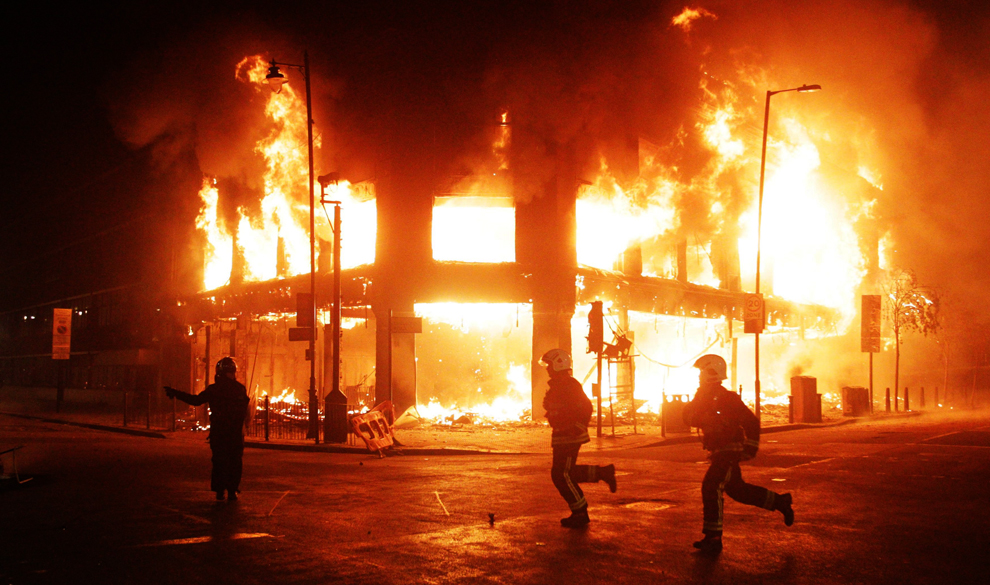
London burns for four days as UK authorities dealt timidly and uncertainly with semi-organized swarms of brazen thugs, causing rioting to spread to other cities. What have we seen so far?

* The British government and police acted with moral uncertainty in the face of violent challenge from swarming tactics by “underclass youth” rioters.  The BBC was filled with interviews of victimized citizens complaining about how police were unwilling to intervene to stop acts of looting, assault and arson. Police behavior fed the cycle of rioting and encouraged fence-sitters to join in and swell the ranks of the mob, as did early talking head comments in the British media that argued that the rioters were “justified”

* The British government was politically paralyzed by the crisis and needed three days and a Cabinet meeting to begin to organize an effective anti-riot strategy, distribute proper equipment, summon additional manpower, change police ROE and marshal a rhetorical narrative against the rioters.  All the halmarks of excessive top-down control by out of touch technocrats and politicians.

 John Robb summed up this kind of anti-leadership beautifully in his review of Rebecca Solnit’s A Paradise Built in Hell  :

…In contrast to the people on the ground, she shows that the only people that actually do panic during disasters are the elites — from those with wealth to those running the government’s response (I’m not talking about the first responders actually on the ground doing good work).  They panic over the loss of control a disaster brings.  This often results in extreme actions that only serve to make things worse: from martial law authorized to use deadly force against looters (often just people trying to survive the situation) to arbitrarily hearding people into locations that aren’t able to support large groups of people.  

What This Means

The lesson here is that during an extreme disaster, the people you may most need to fear are those in charge, particularly if their motives are focused on protecting elite interests put at risk by the disaster

* The Cameron government’s legitimacy is at risk, being currently blamed for everything connected to the riot from the underlying “root causes”, to their initial total lack of interest in defending ordinary Britons to the bad impression made of having senior ministers being on vacation while the capitol of the UK was ablaze. Earnest and repeated assertions by government officials that no political or racial motives were behind the rioting conflicted with the reality being broadcast live by the government’s own news service in the first hours and days of the riot.

Handling a riot properly is state power 101. The Prime Minister has about two days to turn this situation and the political perceptions created around or he will begin an irreversible downward spiral to an early retirement.


Switch to our mobile site