zenpundit.com » intelligence

Archive for the ‘intelligence’ Category

NSDD-32 as Ronald Reagan’s Grand Strategy

Wednesday, February 9th, 2011


[Cross-posted to the Ronald Reagan Roundtable at Chicago Boyz]

Big Peace blogger Sun Tzu has dug into the historical archives to post NSDD-32, the cornerstone document for coordinating the Reagan administration’s foreign, defense and intelligence policies ( Hat tip to Col. Dave).

“NSDD” stands for “National Security Decision Directive”. In essence, the document is an executive order issued through the National Security Council to executive branch agencies represented or under the supervision of the NSC. A NSDD (or “PDD” in Democratic administrations) carries the force of law and is often highly classified, frequently being used for presidential “findings” for approving covert operations, as well as to set national security policy.

NSDD-32: Ronald Reagan’s Secret Grand Strategy

CLASSIFIED:  TOP SECRETTHE WHITE HOUSE
WASHINGTON

May 20, 1982

National Security Decision
Directive Number 32

U.S. NATIONAL SECURITY STRATEGY

I have carefully reviewed the NSSD 1-82 study in its component parts, considered the final recommendations of the National Security Council, and direct that the study serve as guidance for U.S. National Security Strategy.

Our national security requires development and integration of a set of strategies, including diplomatic, informational economic/political, and military components.  NSSD 1-82 begins that process. Part I of the study provides basic U.S. national objectives, both global and regional, and shall serve as the starting point for all components of our national security strategy.

The national security policy of the United States shall be guided by the following global objectives:

  • To deter military attack by the USSR and its allies against the U.S., its allies, and other important countries across the spectrum of conflict; and to defeat such attack should deterrence fail.
  • To strengthen the influence of the U.S. throughout the world by strengthening existing alliances, by improving relations with other nations, by forming and supporting coalitions of states friendly to U.S. interests, and by a full range of diplomatic, political, economic, and information efforts.
  • To contain and reverse the expansion of Soviet control and military presence throughout the world, and to increase the costs of Soviet support and the use of proxy, terrorist, and subversive forces.
  • To neutralize the efforts of the USSR to increase its influence through its use of diplomacy, arms transfers, economic pressure, political action, propaganda, and disinformation.
  • To foster, if possible in concert with our allies, restraint in Soviet military spending, discourage Soviet adventurism, and weaken the Soviet alliance system by forcing the USSR to bear the brunt of its economic shortcomings, and to encourage long-term liberalizing and nationalist tendencies within the Soviet Union and allied countries.
  • To limit Soviet military capabilities by strengthening the U.S. military, by pursuing equitable and verifiable arms control agreements, and by preventing the flow of militarily significant technologies and resources to the Soviet Union.
  • To ensure the U.S. access to foreign markets, and to ensure the U.S. and its allies and friends access to foreign energy and mineral resources.
  • To ensure U.S. access to space and the oceans.
  • To discourage further proliferation of nuclear weapons.
  • To encourage and strongly support aid, trade, and investment programs that promote economic development and the growth of humane social and political orders in the Third World.
  • To promote a well-functioning international economic system with minimal distortions to trade and investment and broadly agreed and respected rules for managing and resolving differences.

In addition to the foregoing, U.S. national security policy will be guided by the operational objectives in specific regions as identified in Parts I and III of the study.

Read the rest here.

Normally, for important NSDD, there will be several preliminary meetings of principals (the statutory members of the NSC) or their key deputies, before the text of the NSDD is prepared by the NSC adviser or executive director (sort of the chief of staff of the NSC) and the White House Counsel before it is formally approved by the NSC and signed by the President. This however, is not set in stone. Presidents are free to determine the NSC procedures of their administrations or ignore them if it suits their purpose. It is hard to imagine Richard Nixon fully briefing his SECSTATE William Rogers on anything of importance, much less doing it through Kissinger’s NSC, or JFK permitting any kind of bureaucratic structure to constrain his prerogatives.

NSDD-32 was prepared under the auspices of Reagan’s second NSC Adviser, “Judge” William P. Clark, who succeeded the hapless William V. Allen. Clark was the most conservative of Reagan’s many NSC Advisers and, as a California political crony of the president, the only Washington outsider. As a result, Clark was in tune with DCI William Casey and UN Ambassador Jeanne Kirkpatrick, hostile toward the views of State Department Soviet experts and far more interventionist than the top officials at Cap Weinberger’s OSD (Office of the Secretary of Defense). Clark had previously served at State as Deputy Secretary under Al Haig, an experience that did not leave him with a good impression of the loyalty of senior State Department officials to the administration’s foreign policy goals.

The activist “we win, they lose” strategy laid out NSDD-32 reflects Clark’s alignment with William Casey and it is very hard to credit Reagan’s national security strategy looking like NSDD-32 if it had been concocted by Colin Powell, Frank Carlucci and George Schultz, making Clarks brief tenure of critical historical importance. Powell, Carlucci and Schultz are all fine public servants but were disinclined by temperment and institutional loyalty to have articulated a strategy that “went on offense”; though, in fairness to Schultz, as SECSTATE he made very effective diplomatic use of Reagan Doctrine programs that State consistently opposed ( Contra aid, covert aid to the Afghan Mujahedin, UNITA and RENAMO) to extract concessions from the Soviets at the bargaining table.

Living Intelligence System

Tuesday, February 1st, 2011

My twitteramigo @ckras has put your tax dollars to work attempting to shatter the stovepipes of analytical excellence in the IC.

And it is pretty cool…..notice how issues of lines of authority and reliability of information are facilitated and made infinitely more efficient with off the shelf Web 2.0.


The nice thing about this project of @ckras is that his model can be generalized to any large organization or system where bureaucratic complexity and the territoriality of guarding tiny empires is gumming up the timely flow of information into the right hands.

A Recommended Blog for Metacognition

Sunday, January 30th, 2011

A while back, I added Ribbonfarm to the blogroll, which is written by Dr. Venkat Rao, a corporate scientist typeafter John Hagel featured in his twitterstream an old but amusing post by Rao analyzing sociopathology in corporate life via characters from The Office. Clever. I thought I would blogroll him and check in periodically.

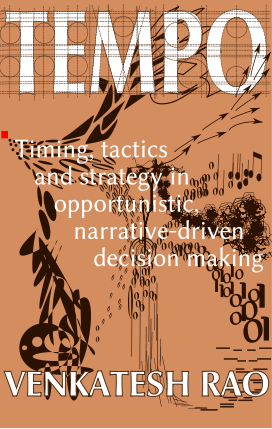
Later, I noticed that Rao makes frequent references to Clausewitz in his posts and that he is writing Tempo, a book on decision making that will be of great personal and professional interest to many readers here. At this juncture, I’m intrigued.

Then last week, Rao featured a lengthy post on metacognition where he made some excellent points. Here’s a few of them, but as I can only put up a small selection, you should go read the full post:

Boundary Condition Thinking:

 ….To build mathematical models, you start by observing and brain-dumping everything you know about the problem, including key unknowns, onto paper.  This brain-dump is basically an unstructured take on what’s going on. There’s a big word for it: phenomenology. When I do a phenomenology-dumping brainstorm, I use a mix of qualitative notes, quotes, questions, little pictures, mind maps, fragments of equations, fragments of pseudo-code, made-up graphs, and so forth.

You then sort out three types of model building blocks in the phenomenology: dynamics, constraints and boundary conditions (technically all three are varieties of constraints, but never mind that).

Dynamics refers to how things change, and the laws govern those changes. Dynamics are front and center in mathematical thought. Insights come relatively easily when you are thinking about dynamics, and sudden changes in dynamics are usually very visible.  Dynamics is about things like the swinging behavior of pendulums.

Constraints are a little harder. It takes some practice and technical peripheral vision to learn to work elegantly with constraints. When constraints are created, destroyed, loosened or tightened, the changes are usually harder to notice, and the effects are often delayed or obscured. If I were to suddenly pinch the middle of the string of a swinging string-and-weight pendulum, it would start oscillating faster. But if you are paying attention only to the swinging dynamics, you may not notice that the actual noteworthy event is the introduction of a new constraint. You might start thinking, “there must be a new force that is pushing things along faster” and go hunting for that mysterious force.

This is a trivial example, but in more complex cases, you can waste a lot of time thinking unproductively about dynamics (even building whole separate dynamic models) when you should just be watching for changes in the pattern of constraints.

….Historians are a great example. The best historians tend to have an intuitive grasp of this approach to building models using these three building blocks.  Here is how you can sort these three kinds of pieces out in your own thinking. It involves asking a set of questions when you begin to think about a complicated problem.

  1. What are the patterns of change here? What happens when I do various things? What’s the simplest explanation here? (dynamics)
  2. What can I not change, where are the limits? What can break if things get extreme? (constraints)
  3. What are the raw numbers and facts that I need to actually do some detective work to get at, and cannot simply infer from what I already know? (boundary conditions).

Besides historians, trend analysts and fashionistas also seem to think this way. Notice something? Most of the action is in the third question. That’s why historians spend so much time organizing their facts and numbers.

Nice. There’s a multitude of places here to jump off and generate further epistemic analysis, and I am sure that some of the admirers of Boyd, Polanyi, Wohlstetter, Feynman, Kahn and Clausewitz in the ZP readership might do so in the comments. Or my co-blogger Charles might weigh in from the imaginative/mythic/visual domain. We’ll see.

Regardless, I think if you are following blogs like Metamodern, Thomas P.M. Barnett,  Open the Future, Global Guerrillas, John Hagel’s Edge Perspectives, Eide Neurolearning Blog or liked the old Kent’s Imperative (suddenly live again after being dormant for 2 years), you’ll want to consider adding Ribbonfarm to your RSS feed or blogroll.

ADDENDUM:

Ed at Project White Horse, another fine site for your blogroll, is also blogging on boundary conditions:

Stall, Spin, Crash, Burn and Die – Boundary Conditions for 2011

….You can’t fix things without some understanding, real understanding of the problem – nor can there be real leadership without actionable understanding. That’s where establishing boundary conditions as a vehicle to frame the problem – and therefore garner greater insight – become important.

Drilling for oil at a depth of 5000ft and in open ocean – Deepwater Horizon – should have been/should be seen as a “crisis” in waiting no matter the historical track record. Proper understanding would have meant that the National decision making level immediately recognized the high potential for the initial crisis migrating into a severely complex catastrophe after the explosion and acted, not waiting to see if BP’s response plans would work. Activities in “Blue Water”/open ocean are not a linear extrapolation from “inshore,” nor is 5000 ft a linear extrapolation from 200ft or 500ft. depths.  BP’s plans might have been up to the problem, but the shear nature of the environment, if scrutinized in context of “unconventional” as described below, should have been a trigger to initiate intermediate action.  Rather, the declaration of an Event of National Significance was 30+ days in coming??? A significant point, I believe, is the problem generated by not recognizing the nature or even acknowledging the existence of a different kind of  problem, one potentially very complex or stochastic in nature – an “unconventional crisis.”

DoubleQuotes and Questions

Friday, January 28th, 2011

[ by Charles Cameron ]

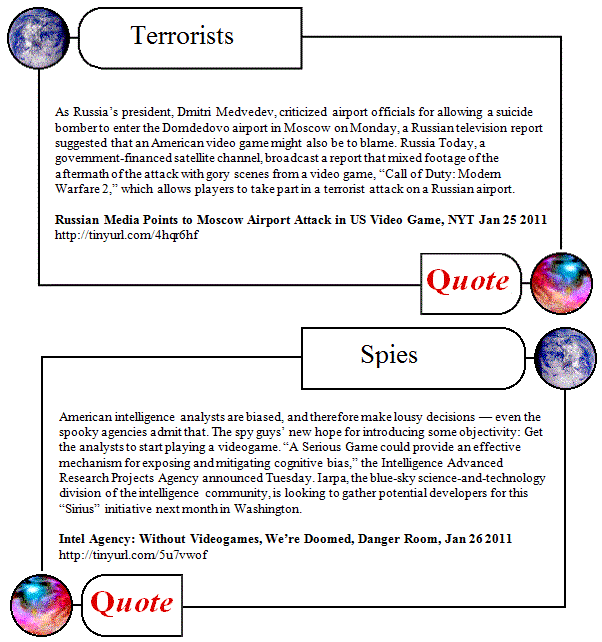
You know, I really enjoy building my DoubleQuotes. They can be entirely frivolous, as is this one, for instance:

with its touch of gothic — a taste I share with my friend Bryan Alexander.

Or they can work like a Necker cube, offering opposite framings with which to view a single topic — in this case, video games.

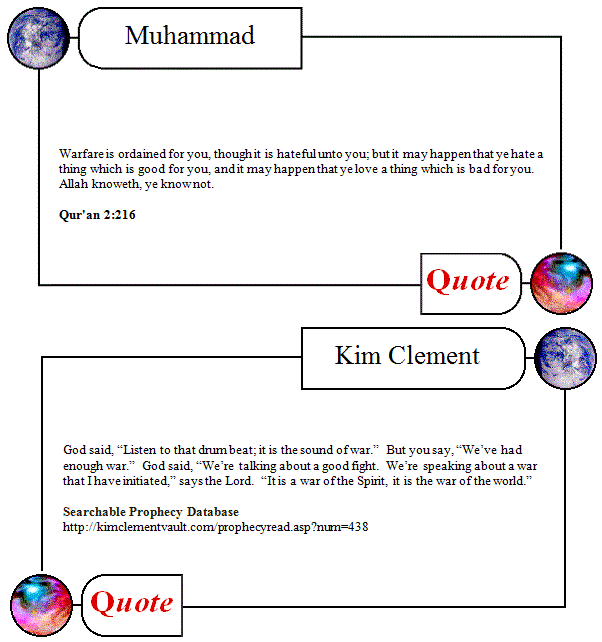
They can also work like Rorschach blots — this one compares two prophecies, one from the Quran and one from a contemporary Christian prophet (if I’m not mistaken, President Obama quoted him recently) —

— but it is left up to the reader to determine the value of each…

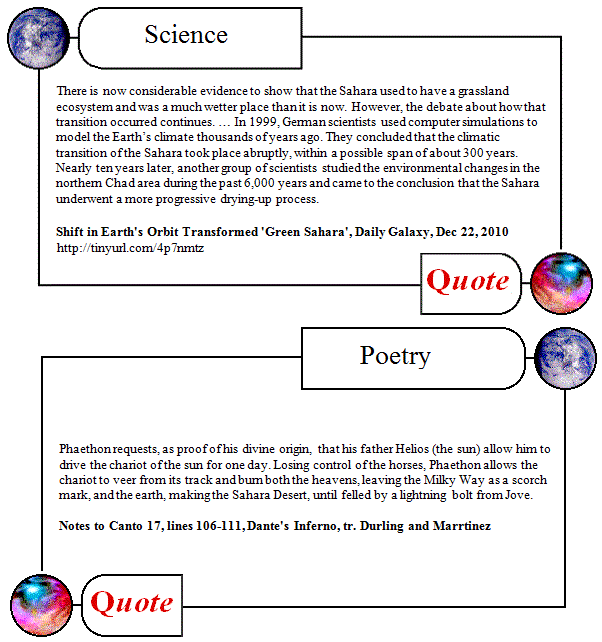
And they can also pose fundamental questions of preference:

Has science simply replaced myth, d’you think? or is science for the facts, perhaps, and the mind — while poetry and myth are for the heart, and truth?

The origami of War and Peace

Monday, January 24th, 2011

[ by Charles Cameron ]

It is brilliant. On the one hand, the folded-paper crane is a well-known symbol of peace:

On the other hand:

Even [Thai PM Shinawatra] Thaksin’s attempts at peace have been problematic. Last winter, he decided to launch a “peace bombing” to assuage the fury of the nation’s mostly Muslim southerners, who were enraged at the implementation of martial law and the growing rate of disappearances, reportedly by Thai Buddhist security forces. So Thaksin asked the Thai people to fold him an enormous flock of origami birds and then dropped more than 100 million paper cranes over the roughly 5,000 square miles along the Malay peninsula that make up Thailand’s deep south. Dropping the birds was intended to be a gesture of peace from the north to the impoverished south. But the Muslim population saw the “peace gesture” differently. “The Islamic understanding of dropping birds is battle,” Dr. Chaiwat Satha-Anand, a political science professor at Bangkok’s Thammasat University told me. He pointed to Sura 105 of the Quran, “The Elephant,” in which God sends down “birds in flocks” upon his enemies to flatten them like blades of grass.

Eliza Griswold, Dispatches From Southern Thailand: From Separatism to Global Jihad

*

It was Graeme Dobell’s fine post today, The 2010 Madeleine Awards for diplomatic symbol, stunt or gesture, that clued me into Thaksin’s one hundred million symbols of peace, plummeting like bombs from the sky…


Switch to our mobile site