zenpundit.com » cultural intelligence

Archive for the ‘cultural intelligence’ Category

“Optimizing the Potential of Special Forces”

Sunday, July 14th, 2013

[ by Mark Safranski – a.k.a “zen”]

A remarkably blunt article on SF/SOF (“special forces” is being used as an umbrella term for both) in the context of policy and strategy, from the perspective of an emerging great power by LTG Prakosh Katoch of the Indian Army. The American example of SOCOM in Afghanistan/Iraq/GWOT has obviously had an impact here, as has the negative example of Pakistani use of terrorists as proxy forces and ISI covert operatives for direct action in Indian territory and elsewhere. Quite aside from global conflicts and the bilateral rivalry with Pakistan, India also faces more than a dozen long term irregular conflicts with their own dynamics, such as the NaxaliteMaoist insurgency , which Katoch places in the context of Chinese strategic ambitions against India.

A must read.

Optimizing the Potential of Special Forces

….In India, the lack of strategic culture, more on account of keeping the military out from strategic military decision making, has led the hierarchy to believe that conventional forces coupled with nuclear clout can deter us from irregular threats. Nothing can be farther from the truth. Pakistan, though conventionally inferior, has been successfully playing her ‘thousand cuts policy’ knowing full well that India has failed to develop the required deterrent. It is our inability to find a cure to this Achilles’ heel, that has led China, which was hitherto using Pakistan as proxy to wage irregular war on India, now directly aids and supports insurgent and terrorist outfits inside India.

….Why the US has managed to secure its mainland post 9/11 is not only because of an efficient Homeland Security organisation but because the US Special Forces (USSF) are operating in 200 countries including India. Significantly, USSF have undeclared tasks such as conducting proactive, sustained ‘man-hunts’ and disrupt operations globally; building partner capacity in relevant ground, air and maritime capabilities in scores of countries on a steady – state basis; helping generate persistent ground, air and maritime surveillance and strike coverage over ‘under-governed’ areas and littoral zones and employing unconventional warfare against state-sponsored terrorism and trans-national terrorist groups globally. Before 26/11, Al-Qaeda had planned similar operations against New York but could not because the USSF had infiltrated Al-Qaeda. One cannot guard the house by simply barricading it. You must patrol the streets and the area outside.

Growing inter-dependence and interlinking of terrorist groups regionally and internationally should be a matter of serious concern. It is not the US alone that has deployed its Special Forces abroad. This is the case with most advanced countries including UK, Russia, Israel, China and even Pakistan. Pakistan’s SSG was operating with the Taliban in Afghanistan and has been active in Jammu and Kashmir, Nepal and Bangladesh, primarily training anti-India forces. There is a strong possibility of their presence in the Maldives and Sri Lanka as well, aside from presence within India. The Chinese have been smarter. For all the development projects throughout the globe, including in Myanmar, Nepal, Pakistan-POK, Sri Lanka, Bangladesh and Seychelles, contracts underway by PLA-owned/affiliated companies employ serving and veteran PLA soldiers and disguised Special Forces with assigned tasks, including evacuation of Chinese citizens from that country in case of emergencies. 

Read the rest here.
On Time and timeframes

Monday, July 1st, 2013

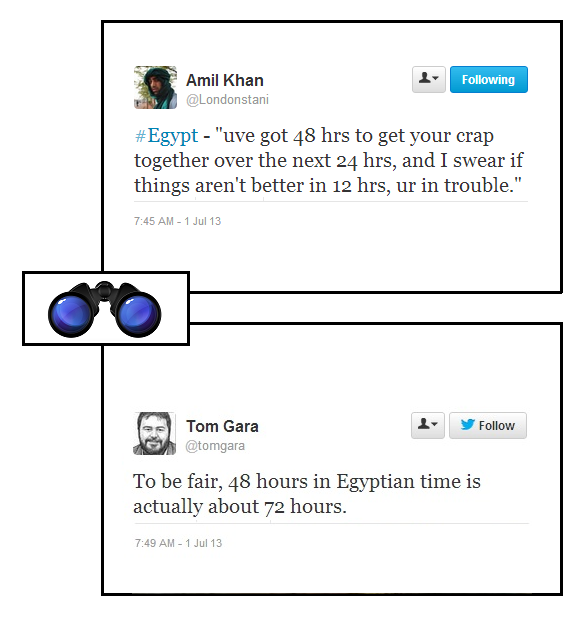
[ by Charles Cameron — 48 hours, Egyptian time, can mean many things, also DoD foresight, next 48 hrs ]
.

We seem to have at least four “times” here, ranking from 12 to 72 hours — or zero to 72 if you take the Army’s announcement itself as a sort of starting pistol — and they’re operating, obviously enough, under different frames. The army likes nicely rounded numbers like “48 hrs”, PERT chart thinking gives you the least time available in which to take the first step towards a desired aim, here “12 hours” — and “24 hours” is the latest target time for serious, visible progress to avert “worst case” response preparations. Or something along those lines.

And “72 hours”? That may be Egyptian elastic time, and thus roughly comparable to Lakota time

The Lakota view of time was simple. “Time was never a specific minute, but rather spaces of time,like early morning, just afternoon or just before midnight. The real meaning of time could be summed up by the phrase “nake nula waunyelo” loosely translated it means:

“I am ready for whatever, any place, any time, always prepared”.

When work needed to be done, people were prepared to work late inthe fields or stay up until 3 am to finish goods to be sold at market.When no work needed to be done, they didn’t work.

The irony is in the next comment:

Policy makers saw an opportunity to improve things by installing awestern time ethic and a respect for the clock.

I don’t know Egypt — but I have spent time “on Lakota time” and don’t wear a watch or carry a phone these days… The piece I drew those quotes from, Lessons from the Lakota: Time lessons for today’s managers, may or may not be useful advice for managers, but its overview-with-graphic of different time systems is worth a quick look. Anthropologists would be able to tell you more about individual cultures, but my point is that differing timeframes are among the major features of different worldviews, and we need to have a decent sense of them when we interface with them.

So “72 hours” may be an instance of relaxed but purposive time, okay? Which wouldn’t necessarily fit well with starched and pressed military time.

**

And here’s the blockbuster:

According to the Congressional Budget Office’s Analysis of DoD’s Future Years Defense Program from 2013, military foresight time runs five years ahead, while USG foresight time runs to 2030 at least:

In most years, the Department of Defense (DoD) provides a five-year plan, called the Future Years Defense Program (FYDP), associated with the budget that it submits to the Congress. Because decisions made in the near term can have consequences for the defense budget well beyond that period, the Congressional Budget Office (CBO) regularly examines DoD’s FYDP and projects its budgetary impact over several decades. For this analysis, CBO used the FYDP provided to the Congress in March 2012, which covers fiscal years 2013 to 2017; CBO’s projections span the years 2013 to 2030.

That’s confidence of a kind… but consider this:

I know, I know — whatever happens in Egypt “momentarily” may turn out to be no more than an eddy briefly interrupting a larger time-flow in the “mid-term” — a phenomenon I’d like to map nicely with some river graphics one of these days.

**

But time? What was it St Augustine said of it?

What, then, is time? If no one asks me, I know what it is. If I wish to explain it to him who asks me, I do not know.

Update on America 3.0 Book Events – Bennett and Lotus

Friday, May 31st, 2013

America 3.0 

From Chicago Boyz:

America 3.0: Mike Lotus on The Bob Dutko Show

Mike Lotus will be on the Bob Dutko radio show tomorrow, May 31, 2013 at 12:40 p.m. EST. Bob hosts Detroit’s #1 Christian Talk Radio Show on WMUZS 103.5 FM.

Please listen in if you can!

Many thanks to the Bob Dutko Show for having me on.

This weekend we will post an updated list of upcoming appearances by Jim Bennett, Mike Lotus, and occasionally both of us together, talking about America 3.0.

Thanks to The Takeaway, the The Armstrong & Getty Show, and The Janet Mefferd show for interviewing Jim Bennett — all yesterday. It was a Bennett Threefer! 

And Author Appearances:

Upcoming appearances for Jim Bennett and Mike Lotus discussing America 3.0

Tuesday, May 28, 2013
Lou Dobbs Tonight (James and Michael)
We will be on about 7:45 p.m. EST.

Wednesday, May 29, 2013
Armstrong & Getty (James)
11:15 am EST

Wednesday, May 29, 2013 
Janet Mefferd Show (James)
3:30 pm EST

Friday, May 31, 2013 
Bob Dutko Show (Michael)
1:40 pm EST

Tuesday, June 4, 2013
Talk to Adam Smith Society, Booth School of Business (Michael)
Noon

Thursday, June 6, 2013
Mornings with Nick Reed (Michael)

Saturday, June 7, 2013
Marc Bernier Show (James & Michael)
4:25 pm EST

Monday, June 17, 2013
Western Conservative Summit, “Envisioning America 3.0” (James)

And their maiden TV appearance with Lou Dobbs:

New Book: America 3.0 is Now Launched!

Tuesday, May 21st, 2013

America 3.0: Rebooting American Prosperity in the 21st Century – why America’s Best Days are Yet to Come by James C. Bennett and Michael Lotus

I am confident that this deeply researched and thoughtfully argued book  is going to make a big political splash, especially in conservative circles – and has already garnered a strong endorsement from Michael Barone, Jonah Goldberg, John O’Sullivan and this review from  Glenn Reynolds in USA Today :

Future’s so bright we have to wear shades: Column 

….But serious as these problems are, they’re all short-term things. So while at the moment a lot of our political leaders may be wearing sunglasses so as not to be recognized, there’s a pretty good argument that, over the longer time, our future’s so bright that we have to wear shades.

That’s the thesis of a new book, America 3.0: Rebooting American Prosperity In The 21st Century.The book’s authors, James Bennett and Michael Lotus, argue that things seem rough because we’re in a period of transition, like those after the Civil War and during the New Deal era. Such transitions are necessarily bumpy, but once they’re navigated the country comes back stronger than ever.

America 1.0, in their analysis, was the America of small farmers, Yankee ingenuity, and almost nonexistent national government that prevailed for the first hundred years or so of our nation’s existence. The hallmarks were self-reliance, localism, and free markets.

At the end of the 19th century and the beginning of the 20th, people were getting unhappy. The country was in its fastest-ever period of economic growth, but the wealth was unevenly distributed and the economy was volatile. This led to calls for what became America 2.0: an America based on centralization, technocratic/bureaucratic oversight, and economies of scale. This took off in the Depression and hit its peak in the 1950s and 1960s, when people saw Big Government and Big Corporations as promising safety and stability. You didn’t have to be afraid: There were Top Men on the job, and there were Big Institutions like the FHA, General Motors, and Social Security to serve as shock absorbers against the vicissitudes of fate.

It worked for a while. But in time, the Top Men looked more like those bureaucrats at the end of Raiders Of The Lost Ark, and the Big Institutions . . . well, they’re mostly bankrupt, or close to it. “Bigger is better” doesn’t seem so true anymore.

To me, the leitmotif for the current decade is supplied by Stein’s Law, coined by economist Herb Stein: “Something that can’t go on forever, won’t.” There are a lot of things that can’t go on forever, and, soon enough, they won’t. Chief among them are too-big-to-fail businesses and too-big-to-succeed government.

But as Bennett and Lotus note, the problems of America 2.0 are all soluble, and, in what they call America 3.0, they will be solved. The solutions will be as different from America 2.0 as America 2.0 was from America 1.0. We’ll see a focus on smaller government, nimbler organization, and living within our means — because, frankly, we’ll have no choice. Something that can’t go on forever, won’t. If America 2.0 was a fit for the world of giant steel mills and monolithic corporations, America 3.0 will be fit for the world of consumer choice and Internet speed.

Every so often, a “political” book comes around that has the potential to be a “game changer” in public debate. Bennett and Lotus have not limited themselves to describing or diagnosing America’s ills – instead, they present solutions in a historical framework that stresses the continuity and adaptive resilience of the American idea. If America”s “City on a Hill” today looks too much like post-industrial Detroit they point to the coming renewal; if the Hand of the State is heavy and it’s Eye lately is dangerously creepy, they point to a reinvigorated private sector and robust civil society; if the future for the young looks bleak,  Bennett and Lotus explain why this generation and the next will conquer the world.

Bennett and Lotus bring to the table something Americans have not heard nearly enough from the Right – a positive vision of an American future that works for everyone and a strategy to make it happen.

But don’t take my word for it.

The authors will be guests Tuesday evening on Lou Dobb’s Tonight and you can hear them firsthand and find out why they believe “America’s best days are yet to come

On getting it right, eh?

Thursday, April 25th, 2013

[ by Charles Cameron — with a little help from the Buddha, fake quotes, self-referential paradox, a pinch of salt, and two tbsps of anthropology ]
.

Over the last ten days we have seen a whole lot of speculation, misinformation, spin and gossip masquerading as analysis and journalism, and that was on my mind when I ran across an alleged Buddha-quote that told me to use my common sense — and since my common sense told me there probably wasn’t a phrase in Pali, the language of the earliest Buddhist texts, that would correspond too closely to the highly idiomatic English usage, common sense, I thought I should check it out with Fake Buddha Quotes, my go-to place for checking what the Buddha is supposed to have said:

I’m pretty sure the Buddha never said “Pretty sure I never said that” too, for much the same reason.

**

But what delights me most about all this is just how self-referential this all is: the Buddha allegedly warns us against trusting what we read even when it’s attributed to him, in what turns out to be a faux quote attributed to him, based on a real quote that reads (in one translation):

Any teaching should not be accepted as true for the following ten reasons: hearsay, tradition, rumor, accepted scriptures, surmise, axiom, logical reasoning, a feeling of affinity for the matter being pondered, the ability or attractiveness of the person offering the teaching, the fact that the teaching is offered by “my” teacher. Rather, the teaching should be accepted as true when one knows by direct experience that such is the case.

**

Fpr what it’s worth, the abbreviated version doesn’t mean the same as the original. From Koun Franz at Sweeping Zen:

his is a very different idea. The original says we need to verify through direct experience; the popular version says that we can stand back from the practice, at a distance, and use reason to determine its authenticity.

Or this, from Bodhipaksa, the Fake Buddha Quotes guy, :

The Buddha of course isn’t saying we should jettison reason and common sense. What he’s implying is that both those things can be misleading and what’s ultimately the arbiter of what’s true is experience. It’s when you “know for yourselves” that something is true through experience that you know it’s true.

**

Another comment on the same page led me to this first comment on cultures and languages —

which in turn reminded me of the second, a long-time favorite of mine from the time when I was some sort of Anthro professor in dreamy Oregon…

**

And, y’lnow, both those quotes in my second pair give you a visceral sense of what today’s SWJ article by Robert R. Greene Sands and Thomas J. Haines, Promoting Cross-Cultural Competence in Intelligence Professionals is very rightly on about, though it’s all phrased in a manner so abstract you might easily miss the point…

Mitigating cognitive, cultural and a host of tradecraft biases is essential for intelligence professionals to navigate through today’s culturally complex environments. Adopting the perspective of contemporary cultural groups, including nation-states, often defies understanding because the intelligence professional is challenged to both appreciate and consequently discern meaning of behavior that is predicated on vastly different beliefs and value systems. Fundamental to this dissonance is a markedly different cultural reality resulting from different histories, traditions and the stasis of culture. The professional’s western and deeply seated worldview impedes either the analysis itself, or is perjured by the cognitive restrictions imposed by the structured analytic strategies used.

The quote about the Wintu — it’s from Dorothy Lee, Linguistic Reflection of Wintu Thought, Chapter 9 in Dennis and Barbara Tedlock‘s Teachings from the American earth: Indian religion and philosophy — goes on to say:

The Wintu relationship with nature is one of intimacy and mutual courtesy. He kills a deer only when he needs it for his livelihood, and utilizes every part of it, hoofs and marrow and hide and sinew and flesh. Waste is abhorrent to him, not because he believes in the intrinsic virtue of thrift, but because the deer had died for him.

Now there‘s “a markedly different cultural reality” for you!


Switch to our mobile site