zenpundit.com » leadership

Archive for the ‘leadership’ Category

War on Speed

Monday, August 26th, 2013

[ by Mark Safranski a.k.a. “zen”]

“When a man is lying in a shell hole, if he just stays there all day, a Boche will get him eventually. The hell with that. My men don’t dig foxholes. Foxholes only slow up an offensive. Keep moving.”

                                                                                                      – General George Patton

“In large-scale strategy, when the enemy starts to collapse, you must pursue him without letting the chance go. If you fail to take advantage of your enemies’ collapse, they may recover.”

“Speed is not part of the true Way of strategy. Speed implies that things seem fast or slow, according to whether or not they are in rhythm. Whatever the Way, the master of strategy does not appear fast”

                                                                                                          – Miyamoto Musashi 

“Two basic principles . . . underlie all strategic planning. . . .The second principle is:  act with the utmost speed”

                                                                                                             – Carl von Clausewitz

Soldiers of the 1st Cavalry Division charge [ Photo credit: U.S. Army photo by Sgt. Travis Zielinski]

SWJ Blog published a link to  2013-14 Key Strategic Issues List put out by the Strategic Studies Institute to US Army War College students and researchers regarding the critical questions that the Chief of Staff believes need to be answered for the US Army to adapt to changing circumstances. It’s a good institutional practice and an interesting document to peruse. My attention was drawn to the subset entitled “Chief of Staff of the Army Special Interest Topics”. General Odierno’s second topic begins with an appropriately broad question:

                                       “How important is speed—both in terms of maneuver and information?”
We should look at the question first in a general sense and then in the light of the U.S. Army and the circumstances in which it is likely to find itself in the next few decades.

Common sense tells us that in any conflict, the ability of a single combatant, an armed group or an army corps to move and fight with speed is generally an advantage. This applies in other forms of conflict aside from warfare; for example, the boxing legend Muhammed Ali was great in his early career not merely because he was a big man and a gifted boxer but because he was also incredibly fast compared to his opponents, running rings around them in a match, taunting and humiliating them. When age removed the edge of speed, a slower Ali was forced to change his tactics and absorb a great deal of punishment that he had formerly escaped. Slow moving armies are like Muhammed Ali past his prime -they make for good targets.

In the history of warfare, many great fighting forces were also fast moving ones. Stonewall Jackson’s Confederates averaged close to fifteen miles per day in the Shenandoah Valley campaign; Roman legions frequently marched twenty miles in five hours while the armies of Alexander the Great and Napoleon Bonaparte drew closer to thirty a day. The fierce and elusive Apache topped them all, reputedly covering an astonishing seventy miles a day on foot in harsh desert terrain. Nor are the advantages of great speed limited to land armies, speed at sea and in the air is a tremendous equalizer for numerically inferior forces. It is good to move fast. The US Army, or at least parts of it, should be able to move fast, but this comes with a few caveats:

  • First, speed is always relative advantage. Being the fastest army in the world is a great thing but it is not quite so great if you are fighting the second fastest army in the world and the difference between the two is marginal.
  • .
  • Secondly, really optimizing speed for an entire army (vice specific units) is likely to come with trade-offs in terms of force structure and operational costs. Fast is fine, but fast with firepower is better, unless you think Operation Market Garden is the model to emulate.
  • .
  • Third, distance is often antagonistic to speed (i.e. imposes greater friction costs).  The ability to sustain a campaign in Afghanistan from the Western hemisphere does not mean it will be cheap to run your strykers and helicopters on imported fuel.  Zipping your panzers across France is not the same as slogging them through the vast and roadless expanse of Russia.
  • .
  • Fourth, speed and agility are not the same thing.  Maneuver in battle depends on other things aside from linear speed; the ability to execute fast transients by rapidly shifting what your force is doing on the fly is unlike simply moving them from point A to point B at a high rate of speed. 
  • .
  • Fifth, moving at one easily predictable speed and operational tempo, even at a high rate, is not as good as purposefully changing up both to throw the enemy off of their game. Sometimes employing a slow or erratic tempo is useful for imposing costs on enemy forces, deceiving them or constraining their freedom of action. 

Speed of information is not at all the same as the speed of material things, in part because the qualitative value of the information determines the utility of receiving it faster. An army that could move information and communicate more effectively – by having mastered writing, messenger systems, secret codes, the telegraph, shortwave radio or the internet – usually has a comparative advantage, but only up to a point. Much like medicine, the right dose of information can cure what ails you but too much or the wrong kind at the wrong time can kill you.

Even valuable information – much like Robert E. Lee’s battle plans for Antietam wrapped around some cigars – is simply unconnected data unless it is received by someone (Observation), who unlike General McClellan, is competent to discern the importance, put the information into context (Orientation), plan (Decide)and take appropriate action (Act).  Knowledge is contextual and actionable ( or it is a prerequisite for effective action) while information is isolated, raw and could easily be irrelevant trivia or distracting “noise”.

Quantity of information and the velocity with which it circulates through an organization can undermine the comparative advantage of having greater informational speed. Communication often expands to fill the bandwith allotted to the detriment of organizational effectiveness.  What is useful intel for a squad leader entering a seemingly abandoned village becomes a drowning sea of minutia for a battalion, brigade or theater commander who can only grasp coup d’oeil by focusing on essential components of operational or strategic problems as they are expressed on the battlefield.

Every transmitted message is a form of transaction requiring time, attention and energy from a commander and his subordinates, taxing their ability to prioritize effectively and inevitably creating “fog” by increasing the ratio of useless, incorrect or irrelevant data to crucial information. Improvement comes both from becoming increasingly effective at distilling knowledge from masses of data and from paring back the traffic in informational garbage and “busywork” and legalistic “CYA” communication. Greater informational speed shows it’s true value when an organization (military, business, political etc) can systematically move critical knowledge to the person who needs it at the moment it is required.

How Should the US Army think about Speed?

The US Army, in my view, faces some probabilities in the next few decades in terms of thinking about speed, force structure, potential conflicts and other questions:

  • Barring a resumption of conscription, austerity and domestic politics will mean a smaller active duty peacetime force that will have to formally shed some of the Cold War legacy missions it is no longer capable of executing  or willing to fund. 
  • .
  • Any major land conflict the US enters is likely to be expeditionary against a much more numerous opponent ( North Korea, Iran, Pakistan,  China or a proxy war – likely in Africa) while our technological edge over near-peer and second to third tier adversaries, while remaining, will be less than in previous decades.
  • .
  • The US may face more than one “small war” at a time with an allied or friendly state requesting FID/COIN help against an insurgency of some kind. 
  • .
  • The US may face an insurgency at home from Mexican narco-cartels that may begin as a law enforcement matter and be escalated by cartels into a serious paramilitary insurrection and terrorism problem before political authorities are willing to acknowledge the gravity of the threat (i.e. American politicians will behave much like their Mexican counterparts did in the 2000’s. Indeed they are already doing so in regard to massive cartel infiltration of American cities)
  • .
  • The US will retain sufficient nuclear deterrent, Naval and strategic air capability to make a conventional or nuclear attack on the American homeland extremely unlikely.

The US Army, even in a reduced size,  will probably retain the role of “mailed fist” land force with a core of  armor, motorized infantry, artillery units along with infantry that could conceivably be scaled up to much larger levels of personnel in a grave crisis. But the reality is the politicians will always try to fight foreign wars with peacetime forces, so to be of real use, the Army must be able to go to war “as is” and win it very quickly.  It is unlikely that a serious opponent like Iran, if it’s leaders believe the US intends regime change, will permit America a leisurely 6-12 month build-up of an invading host in a neighboring state the way that Saddam did [ can you imagine PLA generals sitting on their hands as the US Army put, say, 10-15 divisions of American and coalition troops on their border with Vietnam?]

So if the US Army is to be operationally relevant by virtue of speed, there must be a deep all-services investment in the unsexy air and sealift capacity to move a substantial amount of troops and their heavy equipment in days or weeks instead of months ( most likely combined with even greater efforts at pre-positioning ). Speed and maneuver in operations depends on getting there in the first place.

Assuming we have many divisions or brigades (if we stay “modular’) arriving somewhere, increasing operational speed is partly a work of the Army’s leaders spending years changing  the organizational culture to give subordinates real room to take initiative within their commander’s intent. This will help improve both physical maneuver as well as information flow by reducing the institutional incentives to create paralysis by micromanagement.

Accepting loose reins may mean more American casualties, far more enemy combatant casualties and consequent civilian collateral damage as field grade and junior officers take greater responsibility and the tempo of operations accelerates. ROE will have to be simpler and hew closer to what is permitted under the Laws of War vice what overly complex guidance prevailed at certain times in Afghanistan. This will require ruffling the feathers of international law professors, lefty NGO activists, anti-American journalists and some members of Congress.

On the other hand, we might start winning wars again.

Is Grand Strategy Democratic?

Friday, August 9th, 2013

[by Mark Safranski – a.k.a. “zen“]

Grand strategy in 1941

A very interesting article at Small Wars Journal by Captain Sean F.X. Barrett, USMC on the state of contemporary grand strategy. Definitely worth the time to read the whole thing:, but I am only going to make meandering comments on a few sections:

The Democratization of Grand Strategy 

Calls for a formalized strategic planning process and grand strategy have been mounting for years.  However, those sounding these calls erroneously remember a past that rarely if ever existed and overestimate the importance of a formalized process and a final product.  Most disconcertingly, they assume that government is necessarily the only supplier of grand strategy, while ignoring that those in government are not incentivized to actually produce it.  In fact, the proliferation of communications technology, which provides the means for accessing a wealth of open source intelligence and for disseminating ideas, and the plethora of academics, analysts, and other intellectuals outside of official government communities provide a more effective, democratic, and transparent substitute to the (oftentimes imagined) Project Solariums of the past.  The environment in which these intellectuals operate nurtures “real devils,” who vigorously propose policy and strategy alternatives in which they truly believe and have a stake in seeing implemented, resulting in a de facto strategic planning process, whose merits far exceed those of a de jure one. 

I think the call for a formal process, or at least an institutionalized forum for “doing grand strategy”, derives from both the lack of incentives correctly noted by Barrett and the frequently piss-poor and astrategic performance of American statesmen after the Soviet collapse. That the resulting criticism, proposals, counter-proposals, debates and domestic politics in drag relating to grand strategy are an alternative, open-source and more effective mechanism than formal planning is an intriguing idea.

Certainly, if a statesman or senior policy adviser have not done hard thinking about geopolitics and grand strategy while in the political wilderness then they won’t do it at all. Once in office, there simply is no time even if the inclination is present. Richard Nixon, who thought very seriously on these matters, as POTUS was militant about having Haldeman carve out undisturbed time for him to continue doing so in a secret “hideaway” office in the EOB. This was highly unusual and difficult even for Nixon to maintain – most presidents and senior officials faced with 18 hour days, 6-7 days a week, simply want to unwind in their off hours, see their loved ones or sleep.

….Furthermore, when formalized strategic planning processes and grand strategy have actually existed, their importance has largely been exaggerated.  For example, Richard Immerman debunks some of the myths surrounding Project Solarium, which is often referenced today as a model for grand strategy.  In referencing the intelligence that was ostensibly utilized during Project Solarium to guide the formation of grand strategy, he argues that, even though President Eisenhower—whose highest priority was to exploit the full resources of government to formulate a more effective and sustainable national strategy—was welcoming of CIA input, this input had minimal impact on President Eisenhower’s policies or grand strategy.[viii]  After such a long time serving in the Army, President Eisenhower had already developed highly formed beliefs about national security, and while intelligence has been perceived as playing a critical role by confirming his beliefs, a lack of confirmation would not have significantly impacted or altered his decisions.[ix]  Furthermore, Immerman claims that he has “never been able to locate a scintilla of evidence collected by the CIA and other agencies that changed Eisenhower’s [mind].”[x]   

While Barrett is correct that in discerning grand strategy in historical eras it is often reified and exaggerated retrospectively -that is because grand strategy, much like strategy itself, has a deeply iterative character. In facing the Soviet challenge,  Project Solarium both responded to and built upon a solid foundation laid by the post-warwise menNSC-68, Containment policy, the Marshall Plan, the National Security Act, the creation of the CIA , NSC, NATO, the Department of Defense, the Truman Doctrine, the X Article, the Long  Telegram, Bretton Woods and stretching back to WWII, the geopolitical vision of The Atlantic Charter, Potsdam and FDR’s Four Freedoms. Project Solarium was not ex nihilo but an effort to improve, shape, refine and surpass what the Eisenhower administration had inherited from it’s Democratic predecessors.

Barrett is also on target when he identifies a strong ideological-political predisposition in formulation of grand strategy. Eisenhower had not only operational/experential preferences but a worldview that he brought with him into the White House and his Secretary of State, John Foster Dulles, had even stronger convictions that, especially in regard to his fierce and almost Calvinistic anti-communism, sometimes render him a caricature today. We have to be careful though in parsing public statements and private assessments. Dulles, despite his hardline reputation, was a sophisticated and highly influential figure in American foreign policy as the senior GOP adviser through most of the 1940’s. Despite talk of “rollback”, neither Dulles nor Eisenhower had any appetite for leaping into Hungary militarily to support the anti-Soviet revolt or supporting the Franco-British-Israeli debacle in the Suez. Still less attractive was the prospect of military intervention in faraway Laos. Grand strategic ideas were applied with realism and prudence by the Eisenhower administration.

….It should come as no surprise that three of the first four members of the 2014 QDR’s “independent” panel are those that self-selected into the DOD and conformed and performed so well as to achieve flag officer rank, including retired Marine Corps Gen. James E. Cartwright, former vice chairman of the Joint Chiefs of Staff; retired Air Force Gen. Gregory S. Martin, former commander of Air Force Materiel Command; and retired Army Lt. Gen. Michael D. Maples, former Defense Intelligence Agency director.[xx]  The fourth member, Michele Flournoy, former Undersecretary of Defense for Policy, has been deemed politically palatable enough by both Congress and the Obama Administration, and one must assume the DOD well, since nominations are not made, and consent by Congress not given, without DOD’s at least tacit approval.  That we insist on calling this panel independent should be disconcerting enough in itself.  The first four members were selected by the Senate Armed Services Committee, Defense Secretary Chuck Hagel will appoint the Chairman and Vice Chairman of the panel, and the other panel appointees will be made by the chair and ranking member of the House Armed Services Committee.  This situation is not entirely dissimilar to China under the Ming emperors, wherein the emperors’ concern for stability, obedience, and conformism overlapped with the bureaucracy and their strong aversion to changing the status quo.  The imperial literary examination system of Imperial China helped breed this mutually beneficial conformism, and its effects prove quite relevant in this regard.  While the examination preserved the cultural unity and political stability of China, it also impeded originality and experimentation.[xxi]

Yes.

Arguably, the period of Ming-Q’ing decline may have been superior in the sense that the Confucian classics and the exams upon which they were based that were the gateway to the mandarinate were at least, an objective and respected yardstick, however ossified and ritualized. All we have by contrast are partisan politics, bureaucratic culture and the increasingly oligarchic client-patron networks within the Beltway and Manhattan..

….President Eisenhower commissioned Project Solarium in part to devise a strategy for coping with a lack of knowledge about the Soviets’ intentions and capabilities.  Today, however, more and more strategic intelligence is publicly available.  For example, the National Intelligence Council’s[xxiii] new Global Trends series is unclassified.  We now arguably suffer not from too little information, but from too much. This has increasingly democratized the arena of grand strategy and enabled more and more even amateur analysts to help process the wealth of information in the public domain and formulate it into alternative visions for the future.  One might argue that what these different entities focus on is simply policy or at best strategies for individual instruments of national power.  However, even individual policy or strategy analyses might instead be seen as reflections of the overarching principles that they support (and that are often enumerated in the mission statements of many of these think tanks, institutes, and analysis centers), which as Sinnreich contends, are what in fact help form the basis of an enduring grand strategy

Sort of. There are two other ways to look at this picture.

First, that we have an insufficient consensus bordering on ideological schism within the elite as to what America is and is supposed to become that executing  foreign policy, much less enunciating a grand strategy, cannot get beyond the lowest common denominators between left and right and bureaucratic autopilot. This in turn causes the cacophony of voices on grand strategy. I partially subscribe to this view.

Secondly, that our elite, whatever their divisions over political passions or personalities have a consensus grand strategy ( or at least, an ethos) for generational and class aggrandizement at the expense of the rest of us and American national interest in a way that the former 20th century governing class called the Eastern Establishment would have neither imagined nor tolerated. The resulting ferment of “bottom-up” grand strategy is a result of increasing divergence of interests between rulers and the ruled and an erosion of the former’s legitimacy as a result of their self-aggrandizing game-rigging , abandonment of the ethic of leadership as stewardship for “ubi est mea” and a deficit of competence that contrasts with their enormously inflated collective sense of self-importance.

I partially subscribe to this one as well.

How to win souls and be worthy of emulation?

Tuesday, June 4th, 2013

[ by Charles Cameron — considering a rare attribute in two religious leaders ]
.

**

Christopher Anzalone tells a story about the Grand Ayatollah Sadiq al-Sadr (above, left), Moqtada‘s father, in his highly recommended podcast on Jihad & Martyrdom in Contemporary Muslim Militants with Karl Morand.

I’m very slow at transcription, but this story hit me with its insight into an aspect of religion that — as the story itself illustrates — is not always recognized, and i was able to find the same story told elsewhere, though not with the flair Chris brings to the telling. Here it is, as recounted by Patrick Cockburn in his book, Muqtada Al-Sadr and the Battle for the Future of Iraq:

One former disciple of Mohammed Sadiq tells an anecdote illustrating his master’s pragmatism. “One day, I was sitting with Mohammed Sadiq in his office, when a man came in to ask the price of tomatoes,” he says. “The question infuriated me: I thought he had come to mock us. But al-Sadr, wiser and smarter than I am, gave him a detailed answer, giving him the price of different kinds of tomatoes. He had understood what the question was about. I caught up with the man as he left the office and asked him why he had asked the question. He replied: ‘In selecting a marji’ [a religious figure to emulate and whose rulings he would accept], I choose the one who knows my suffering, who is close to the poor and the disinherited.'”

**

Pope Francis has a similar direct and simple approach, and from the very start of his pontificate it has been winning him admirers, both religious and secular. He refuses the limo, preferring to take the bus. He pays his own bill as he checks out at the hotel front desk (above, right). He telephones the guy in Buenos Aires whose newsstand supplied his daily newspaper, to thank him and cancel his subscription…

Person to person.

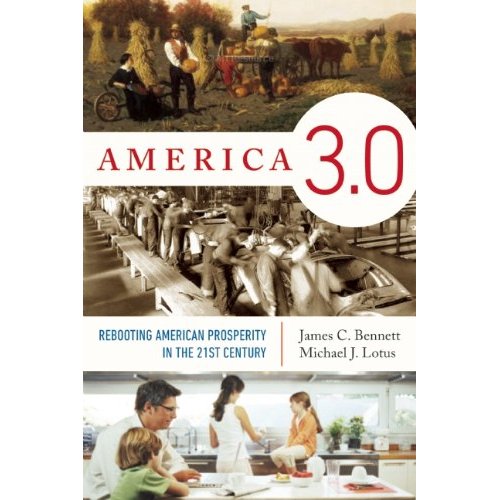
New Book: America 3.0 is Now Launched!

Tuesday, May 21st, 2013

America 3.0: Rebooting American Prosperity in the 21st Century – why America’s Best Days are Yet to Come by James C. Bennett and Michael Lotus

I am confident that this deeply researched and thoughtfully argued book  is going to make a big political splash, especially in conservative circles – and has already garnered a strong endorsement from Michael Barone, Jonah Goldberg, John O’Sullivan and this review from  Glenn Reynolds in USA Today :

Future’s so bright we have to wear shades: Column 

….But serious as these problems are, they’re all short-term things. So while at the moment a lot of our political leaders may be wearing sunglasses so as not to be recognized, there’s a pretty good argument that, over the longer time, our future’s so bright that we have to wear shades.

That’s the thesis of a new book, America 3.0: Rebooting American Prosperity In The 21st Century.The book’s authors, James Bennett and Michael Lotus, argue that things seem rough because we’re in a period of transition, like those after the Civil War and during the New Deal era. Such transitions are necessarily bumpy, but once they’re navigated the country comes back stronger than ever.

America 1.0, in their analysis, was the America of small farmers, Yankee ingenuity, and almost nonexistent national government that prevailed for the first hundred years or so of our nation’s existence. The hallmarks were self-reliance, localism, and free markets.

At the end of the 19th century and the beginning of the 20th, people were getting unhappy. The country was in its fastest-ever period of economic growth, but the wealth was unevenly distributed and the economy was volatile. This led to calls for what became America 2.0: an America based on centralization, technocratic/bureaucratic oversight, and economies of scale. This took off in the Depression and hit its peak in the 1950s and 1960s, when people saw Big Government and Big Corporations as promising safety and stability. You didn’t have to be afraid: There were Top Men on the job, and there were Big Institutions like the FHA, General Motors, and Social Security to serve as shock absorbers against the vicissitudes of fate.

It worked for a while. But in time, the Top Men looked more like those bureaucrats at the end of Raiders Of The Lost Ark, and the Big Institutions . . . well, they’re mostly bankrupt, or close to it. “Bigger is better” doesn’t seem so true anymore.

To me, the leitmotif for the current decade is supplied by Stein’s Law, coined by economist Herb Stein: “Something that can’t go on forever, won’t.” There are a lot of things that can’t go on forever, and, soon enough, they won’t. Chief among them are too-big-to-fail businesses and too-big-to-succeed government.

But as Bennett and Lotus note, the problems of America 2.0 are all soluble, and, in what they call America 3.0, they will be solved. The solutions will be as different from America 2.0 as America 2.0 was from America 1.0. We’ll see a focus on smaller government, nimbler organization, and living within our means — because, frankly, we’ll have no choice. Something that can’t go on forever, won’t. If America 2.0 was a fit for the world of giant steel mills and monolithic corporations, America 3.0 will be fit for the world of consumer choice and Internet speed.

Every so often, a “political” book comes around that has the potential to be a “game changer” in public debate. Bennett and Lotus have not limited themselves to describing or diagnosing America’s ills – instead, they present solutions in a historical framework that stresses the continuity and adaptive resilience of the American idea. If America”s “City on a Hill” today looks too much like post-industrial Detroit they point to the coming renewal; if the Hand of the State is heavy and it’s Eye lately is dangerously creepy, they point to a reinvigorated private sector and robust civil society; if the future for the young looks bleak,  Bennett and Lotus explain why this generation and the next will conquer the world.

Bennett and Lotus bring to the table something Americans have not heard nearly enough from the Right – a positive vision of an American future that works for everyone and a strategy to make it happen.

But don’t take my word for it.

The authors will be guests Tuesday evening on Lou Dobb’s Tonight and you can hear them firsthand and find out why they believe “America’s best days are yet to come

Octavian Manea interviews MIT’s Roger D. Peterson

Friday, April 19th, 2013

Another installment of Octavian Manea’s excellent COIN interview series at SWJ. This one focuses on social science and varieties of insurgency:

Breaking Down “Hearts and Minds”: The Power of Individual Causal Mechanisms in an Insurgency 

….OM: In your research you pointed out to a spectrum of conceivable individual roles in an insurgency. What is the methodology behind this typology?

RDP: This methodology comes from my 2001 book (Resistance and Rebellion: Lessons from Eastern Europe) which focused on Lithuanian resistance to Soviets in the 1940’s. Insurgency is a complex phenomenon, especially in how violent organization and networks are created and sustained, and the methodology of that book involved breaking down this complexity into component parts and then building back up into a coherent whole. At the base of this process is the way individuals position themselves relative to the dramatic and violent events of insurgency. Most people may wish to remain neutral and just take care of their families but events push significant numbers of individuals into roles of unarmed support of insurgents, or local armed position of a militia, membership in a mobile non-local organization, or equivalent positions in support of the government.  Furthermore, individuals may move back and forth along this spectrum of roles. If one is skeptical of broad and vague theories at a high level of aggregation, as I am, then you need to get down and observe dynamics at a basic level. Observing movement along this spectrum of roles is one way to do that. 

…..Is it FM 3-24 and the whole contemporary Western COIN discourse too narrow, too much focused on rational, cost/benefit models of decision-making? Is it too restrictive when making this inventory of driving motivations or causal mechanisms?

RDP: I think there is a tendency in the Western academic analysis to focus on rational theories. Those theories are straightforward.  But they also might be too straightforward, too simple.  In Iraq, the coalition did not plan on the emotion of resentment stemming from a status reversal affecting Sunni calculations in the beginning stages of the conflict. We did not understand the revenge norms that exist in some of the places. We did not fully understand the social norms that helped to produce the tribal militias in Anbar province.  We did not understand the psychological mechanisms underlying the Sunni view of the new world they were living in. 

The last part is a curious lacuna.

The incompetence of the planning for the occupation of Iraq has been amply recorded – the high level disdain of General Tommy Franks and Secretary Rumsfeld for what befell the day after victory, the keeping of professional Arabists at arms length in preference for Beltway contractors and college kids with AEI connections, the haplessness of Jay Garner and the political obtuseness of Paul Bremer ad so on. This is not what I mean about lacuna.

I mean something more fundamental, in terms of understanding human nature as the root of political behavior and therefore political violence. We are all familiar with the Clausewitzian trinity (or should be) but less attention is paid to the motivational factors that make men decide to stand, fight and die or stand aside. Thucydides also had a trinity that did not attempt to capture the nature of war but rather explain why wars happened and it seems to me to be of particular use for evaluating the decision in small wars to pick up a gun or not, to side with the government or join the rebellion:

“Surely, Lacedaemonians, neither by the patriotism that we displayed at that crisis, nor by the wisdom of our counsels, do we merit our extreme unpopularity with the Hellenes, not at least unpopularity for our empire. That empire we acquired by no violent means, but because you were unwilling to prosecute to its conclusion the war against the barbarian, and because the allies attached themselves to us and spontaneously asked us to assume the command. And the nature of the case first compelled us to advance our empire to its present height; fear being our principal motive, though honour and interest afterwards came in. And at last, when almost all hated us, when some had already revolted and had been subdued, when you had ceased to be the friends that you once were, and had become objects of suspicion and dislike, it appeared no longer safe to give up our empire; especially as all who left us would fall to you. And no one can quarrel with a people for making, in matters of tremendous risk, the best provision that it can for its interest. 

Fear, honor and interest are ever present in “calculation” both by men and by the political communities they compose and the factions that threaten to tear them apart. All the more so in a defeated and broken country divided by ethnicity and sect where all parties were uneasily eyeing the conqueror. No special knowledge of Arab culture should have been required to anticipate that Iraqi men, if made desperate by uncertainty and circumstance, might have at least seen it in their interest to achieve some measure of security with the gun and to enact policies of carrots and sticks a priori to discourage that, before the insurgency gained critical mass.

Awareness of the universality of the Thucydidean trinity would not have in itself guaranteed success in Iraq but knowing it is a rudimentary minimum of political competence upon which you can at least build.


Switch to our mobile site