zenpundit.com » islamic world

Archive for the ‘islamic world’ Category

Justice, Coercion, Legitimacy, State-Building and Afghanistan

Tuesday, January 17th, 2012

Discussion has been emerging in the foreign policy blogosphere of   late  regarding sovereignty and the other day, Afghanistan scholar Antonio Giustozzi opined on coercion, a necessary tool of a state seeking to wield a monopoly of force.

Theory is good and the discussion is an important one with implications for US foreign policy, but it helps when debate is informed by empirical examples from practitioners.  Quesopaper, a blog by  someone out in the field  in Afghanistan has been dormant for a while, but sprang alive again with a timely post:

Rule of Law, The Afghan Springer Show 

….Rule of Law is one of the key aspects to “fixing” Afghanistan. When the Taliban dominated the country, they controlled the “courts.” As Taliban influence waned, the US and partner nations have sought to create a more traditional court system. I can’t speak intelligently on why “WE” decided to create a more western form of law in Afghanistan, but I can say, it’s not the correct approach.

I work in a remote district. It’s over an hour to the main provincial (think state) government center. The difference between the two places is about as extreme as possible. The villages, even the district center (think country govt) lack ANY essential services. There are no plumbing systems, no electricity, no garbage service…nothing. Yet, the people here survive; and dare I say? Thrive.

Like most farming folks, the people here like to be left alone. The people appreciate the Govt–Government of the Islamic Republic of Afghanistan aka “GIRoA”–but they only want so much help. Rule of Law doesn’t fit into their needs.

So, how do rural locals settle disputes?

I just recently worked with a local governor as he negotiated the resolution of a 25 year dispute. Dispute doesn’t really describe what happened…feud is more appropriate. Each side had multiple murders, one family had 1300 fig trees destroyed. Decades of money in dispute. The feud was complicated enough that the Taliban failed to resolve the issue in nearly seven years of negotiations. Negotiations require buy-in from many parties…I could go on about this, but I doubt I can make it any clearer…

Land disputes are among the thorniest local civil society issues in Afghanistan, and one where the generally corrupt and inept Karzai regime draws a particularly poor comparison with the Taliban insurgency’s ability to provide “rough justice” where the richer, more influential party to the dispute does not automatically win through bribery. Land claims are blood issues in peasant-agrarian societies in general and all the worse in honor cultures that tolerate vendettas – that the brutal Taliban could not force a settlement in this case, or did not dare to try – speaks volumes.

….Finally, our district (county govt) governor is called upon to start the process of reconciliation. This BTW is MAJOR progress for the legitimacy of GIRoA. It means the people trust this man to handle this dispute. It might become national news (for Afghanistan) though you will never hear this story on any US network or .com site (except quesopaper.com). After weeks of massaging each side, pulling out their story, commitments (commitment to settle is vital in these things) and “evidence.”

An aside about evidence…in a society that is mostly verbal and illiterate, nearly anything written can become something that it is not…WTF are you talking about Pietro? What I mean is, give someone who can’t read a document. That paper is written in a foreign language, with foreign letters. Tell him its a deed to a piece of land…wait 35 years. Now, tell that man’s grandson that the land he’s been farming for 10 years; that his family has worked for generations, isn’t actually his.

Now he has nothing; he can’t provide for his family. Tell him, his paper is a receipt for a Persian rug, not a deed…explain that he owes the real land owner for the use of that property and revenues generated. Let me know how that goes…if you smell cordite it probably didn’t go to well.

For very poor people who live at the margins of subsistence, the stakes could not be higher, which can make rolling the dice on private violence attractive (this is also why land reform programs are only a short term stopgap in economic development and reform. Agrarian population almost always exceeds arable land and as the plots get smaller, they are less productive).  Dying on your feet with a weapon in hand looks a lot more honorable to a hard-pressed farmer than watching your children waste away from starvation as the other villagers gossip about your plight.

A state with legitimate authority can preempt or suppress such private violence, but is also expected to solve the problem.

….Back to our story…The governor calls in Sharia/Islamic law experts and elders from both tribes and other community elders. Mix that group into a bunch of small rooms and start shifting groups from room to room…hours of discussions (which looks like arguing to me). Don’t forget, this thing hasn’t been settled before, it’s serious business, and here serious business is settled with an AK. At anytime the whole ordeal can melt into violence.

Success is fleeting. I have a gun, no fooling…I’m armed….

Go to quesopaper to find out what happened next. 🙂

Part of the problem is, as quesopaper indicates, our Western framework. We began experimenting with rule of law to settle property claims and commons rights starting, oh, in 14th century England with land enclosures and we did not really finish for good until after Reconstruction in the very late 19th century. That’s 500 years for the “Rule of Law” as we understand it to become the standard for 100 % of the population, 100% of the time.

And along the way, there was blood. Rivers of it. From the Highlands of Scotland, to the piney woods upcountry of Appalachia to the Black Hills and the great Western Range Wars. The gavel of the judge had to be preceded by the soldier’s rifle, the settler’s six shooter, the rebel’s musket and knives used in the dead of night.

Are Afghans in far rural villages closer to a Manhattan attorney or an English tenant whose access to the pasture has been closed off by his noble lord against all custom and ancient right? What quesopaer is seeing is “state building” from scratch, from the bottom up. Slow, painful, difficult to be certain, but more likely to be durable than imported abstractions imposed from the top down.

We are leaving Afghanistan, it is clear. Any state that we leave behind that can resist the Taliban must be able to stand behind and enforce a rule of law as Afghans understand and accept it.
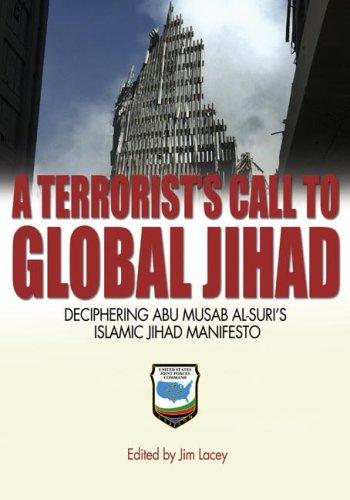


Book Review: A Terrorist’s Call to Global Jihad

Thursday, December 29th, 2011

A Terrorist’s Call to Global Jihad: Deciphering Abu Musab al-Suri’s Islamic Jihad Manifesto by Jim Lacey (Ed.)

Previously, I read and reviewed Brynjar Lia’s Architect of Global Jihad, about Islamist terrorist and strategist Abu Musab al-Suri. A sometime collaborator with Osama bin Laden and the AQ inner circle, a trainer of terrorists in military tactics in Afghanistan and an advocate of jihadi IO, al-Suri was one of the few minds produced by the radical Islamist movement who thought and wrote about conflict with the West on a strategic level. Before falling into the hands of Pakistani security and eventually, Syria, where al-Suri was wanted by the Assad regime, al-Suri produced a massive 1600 page tome on conducting a terror insurgency,  The Global Islamic Resistance Call, which al-Suri released on to the jihadi darknet.

Jim Lacey has produced an English digest version of al-Suri’s influential magnum opus comprising approximately 10 % of the original  Arabic version, by focusing on the tactical and strategic subjects and excising the rhetorical/ritualistic redundancies common to Islamist discourse and the interminable theological disputation. There are advantages and disadvantages to this approach.

First, Lacey has produced a concise and readable book from a large mass of sometimes convoluted and repetitive theorizing that al-Suri strung together piecemeal, sometimes on the run or in hiding. For those interested in getting to the heart of al-Suri’s nizam la tanzim strategic philosophy, A Terrorist’s Call to Global Jihad is an invaluable resource for strategists, counter-terrorism specialists, tactical operators,  law enforcement and laymen. Secondly, it is also a useful reference for policy people to see through al-Suri’s eyes the internal political and philosophical divisions within the radical jihadi community. al-Suri himself writes very ambivalently about 9/11 as a great blow against America and yet a complete calamity in it’s effects for the “jihadi current” that destroyed everything the Islamist revolutionaries had so painstakingly built, including the Taliban Emirate. Thus a climate was created by the American counter-attack where old methods of struggle were no longer useful and jihadis must adopt radically decentralized operations ( what John Robb terms Open-Source Warfare; indeed it is clear to an informed reader that al-Suri, a wide-ranging intellectual rather than a narrow religious ideologue, was influenced by Western literature on asymmetric warfare, 4GW, Three Block War  and COIN).

The drawback to this approach is more for scholars looking at the deeper psychological and ideological drivers of jihadi policies, strategy and movement politics. The religious questions and obscure Quranic justifications cited by Islamist extremists that are so tedious and repetitive to the Western mind are to the jihadis themselves, of paramount importance in establishing both the credentials of the person making an argument but also the moral certainty of the course of action proposed. al-Suri himself had some exasperation with the degree to which primarily armchair ideologues, by virtue of clever religious rhetoric, could have more influence over the operational decisions of fighting jihadis than men with field experience like himself. By removing these citations, an important piece of the puzzle is missing.

The Musab al-Suri whose voice appears in A Terrorist’s Call to Global Jihad is consistent with the one seen in Lia’s book, dry, sardonic, coldly hateful toward the West and highly critical of the jihadis own mistakes, laden with overtones of pessimism and gloom. al-Suri did not envision a quick victory over the West and wrote his manifesto as a legacy for future generations of Islamist radicals because the current one was nearly spent after the American onslaught and poorly educated in comparison with predecessors like the generation of Sayid Qutb.

Strongly recommended.

A “Big Dream” attributed to Osama bin Laden

Tuesday, December 13th, 2011

[ by Charles Cameron — hadith, Aden-Abyan, Abu M. al-Maqdisi, major dream of young bin Laden, role of narration 1 month after his death, any comments? ]

.

.

I was trying to follow up on a hadith which declares:

An army of twelve-thousand will come out of Aden-Abyan. They will give victory to Allah and His messenger. They are the best between myself and them.

There’s an extensive discussion of it on Somalinet offered by Sheikh Abu Muhammad al-Maqdisi [teh Sheikh Abu M al-Maqdisi?] and posted on June 4 of this year, but it doesn’t answer my question as to how this narration fits in with the various narrations about the army from Khorasan.

1.

While reading in and around this topic, however, I ran across this account of a dream on the young bin Laden, which appears on a number of sites favorable to jihad around June 4, 2011, i.e. after bin Laden’s death, and which I have not seen discussed on those analysts’ sites that I manage to follow.

It’s extremely interesting to me not only because dreams are potentially important vehicles for divine guidance in Islam, but also because it ties bin Laden specifically to the Khorasan / black banners hadith, and to the Mahdi.  In this dream, I( don’t think it’s going too far to say that bin Laden himself plays a preparatory role with regard to the Mahdi that we can perhaps understand in the west as equivalent to that of John the Baptist in preparation for Christ.

2. 

If this dream narrative has been explored in the open source analytic literature, I would be very interested to see what has been said.  In  the meantime, I will simply post the narration as I found it:

3.

This incident was narrated to me by a student of knowledge who spent more than 20 years in the company of scholars acquiring knowledge. He told me about a dream that Shaykh Osama bin Laden had when he was 9 years old, which indicated that Allah swt was preparing Shaykh Osama bin Laden, may Allah have mercy on him, since childhood, for battles against the Crusaders.

He told me that once he was sitting with a companion and discussing the deplorable condition of the Ummah but that all the incidents taking place in the Muslim Ummah are going according to Allah’s plan and that it is certain that the victory of Allah the Almighty will come. He will surely send a Leader and a Guide from amongst our Ummah who will deliver the humiliated and pitiful Ummah to the enlightened path of ascent and loftiness. We started thinking that who could be such a person!

Immediately, the thought of Shaykh Osama bin Laden came to our minds, since he has made innumerable sacrifices for the sake of the Ummah. On this, my companion smiled and said, “I will narrate to you a dream of Shaykh Osama bin Laden; you will be pleased to hear it, and your love for the mujahideen will only increase.”

He said, I was in al-Madinah al-Munawwarah at the house of a Scholar who used to lecture at the Prophet’s masjid. We had just arrived at his house when someone knocked on the door. The Shaykh returned with a person of luminous and honorable appearance who was about 80 years old.

The host welcomed him and requested the Tafsir of a few verses from the Qur’an. We quietly listened to him while the guest Shaykh recited a few verses, and then he gave the Tafsir of those verses. By Allah, I had studied a number of Tafsirs, but that Shaykh was a sea of knowledge. When he completed his lesson, the host invited him for a meal, but he declined politely, and we came to understand that he was fasting.

Eventually, the guest asked for permission to leave, but the host insisted, ‘Until you narrate to us the dream of Shaykh Osama bin Laden once more, you will not get the permission to leave.’

The Shaykh smiled and asked, ‘The dream that Shaykh Osama bin Laden had when he was 9 years old?’ The host replied in the affirmative.

This is how that Shaykh narrated the incident:

I was a close friend of Muhammed bin Laden, the father of Osama bin Laden. Many times I would be in his company. And many times, I used to visit his house regarding work related to construction. During the discussions, our talk would be disturbed by the playing of his children, and then he would ask them to go out and play.

But I was surprised to see that he would always ask one particular son to sit beside him. I asked him, “Why don’t you let this son of yours to play with his other brothers? Is he sick?”

Mohammed bin Laden smiled and said, “No, there something special about this son of mine.”’

When I asked his name, he said, “His name is Osama, and he is 9 years old. Let me share with you something strange which happened a few days ago. My son woke me up few minutes before the morning prayer and told me, ‘Dear father, I want to tell you about a dream that I had.’ I thought he must have had a nightmare. I made ablution and took him along with me to Masjid.

On the way, he told me, ‘In the dream, I saw myself in a huge, flat area. I saw an army mounted on white horses moving towards me. All of them were wearing black turbans. One of the horsemen, who had shiny eyes, came up to me and asked me, “Are you Osama bin Muhammed bin Laden?” I replied, “Yes.” He then asked me again, “Are you Osama bin Muhammed bin Laden?” I again replied, “Yes, that is me.” He again asked, “Are you Osama bin Muhammed bin Laden?” Then I said, “By Allah, I am Osama bin Laden.” He moved a flag towards me and said, “Hand this flag over to Imam Mahdi Muhammad bin Abdullah at the gates of Al-Quds.” I took the flag from him, and I saw that the army started marching behind me.’

Muhammed bin Laden said, “I was surprised at that but, due to business at work, I forgot about the dream. The next morning, he woke me up just before the morning prayer and narrated the same dream. The same thing happened on the third morning also. Now, I began to worry for my son. I decided to take him with me to a knowledgeable person who can interpret dreams.

Accordingly, I took Osama to a person of knowledge and informed him about the whole incident. He looked at us with surprise and asked, ‘Is this your same son who had the dream?’ I said, ‘Yes.’ He kept staring at Osama for some time. My concern multiplied. He comforted me and said, ‘I will ask you a few questions. I am sure that you will answer them truthfully.’

He asked Osama, ‘Son, do you remember anything about that flag which that horseman gave you?’ Osama replied, ‘Yes, I remember it.’

He asked him, ‘Can you describe it, how it was?’

Osama said, ‘It was similar to the flag of Saudi Arabia, but its color was not green but black, and there was something written on it in white color.’

He then put the next question to Osama, ‘Did you ever see yourself also fighting?’

Osama replied, ‘I commonly see such dreams.’ He then asked Osama to go out of the room and do recitation of the Qur’an.

Then that person of knowledge turned towards me and asked, ‘Where is your ancestry from?’

I replied from Hadramawt in Yemen. Then, he asked me to tell him something about my tribe. I replied that we are related to the tribe of Shanwah which is a Qahtani tribe from Yemen. He then cried out the Takbir loudly and called in Osama and kissed him while crying. He also said that the signs of the hour are near.

‘O Muhammed bin Laden, this son of yours will prepare an army for Imam Mahdi and for the sake of protecting his religion, he will migrate to the region of Khurasan. O Osama ! Blessed is he who will do Jihad by your side and undone and disappointed be he who leaves you alone and fights against you.’

4.

It is notable that this account appears to have surfaced in the English-language literature about a month after the Abbottabad raid of May 2.  At least in this English-language form, it seems to be a posthumous account, hagiographic in tone, and directly linking  bin Laden and those who fought with him to the fulfillment of Mahdist prediction.

My questions would be whether anyone knows of an earlier appearance of this narrative, perhaps in Arabic — and if it indeed is first found after bin Laden’s death, how the readers of signs, both Islamist and  Western-analytic, read this particular text.

I have seen this narrative featured on sites relating to the Netherlands, Egypt, Somalia, South Africa, Kashmir, and Pakistan — and as a text video with nasheed accompaniment on YouTube – so it seems to have spread pretty rapidly, which suggests it “fits” powerfully with the needs of the jihadizing internet shortly after bin Laden’s death.

5.

Sources include:


Lex Talionis I: the matter of Subramaniam Swamy and Harvard

Friday, December 9th, 2011

[ by Charles Cameron — Harvard controversy, free speech vs hate speech, Hindutva, moral high ground & sanctions for and against violence ]

.

I am grateful to various members of the New Religious Movements list for pointing me to the recent events in Harvard, where a group of scholars led by the formidable Diana Eck (her book on Banaras is a masterpiece and greatly treasured) have persuaded the Faculty of Arts and Sciences to omit two courses in economics usually taught by Subramaniam Swamy from their Summer School offerings next year, on the ground that an op-ed he published in Daily News and Analysis titled “How to Wipe Out Islamic Terror” fell under the category of hate-speech (as opposed to free speech).

The article in question is no longer available on the DNA site, but can be found on Pamela Geller‘s Atlas Shrugged blog.  An account of the controversy can be found on Inside Higher Ed, and Harvard Faculty’s debate was reported in the Harvard Magazine.

Subramaniam Swamy is President of what remains of the once powerful Janata Party and former Union Cabinet Minister.

With that as background, I would like to address the issue of the varying principles and rule-sets invoked as offering a moral high ground – or a necessary safeguard – in various religious and other traditions.

*

I have read Dr Subramaniam Swamy’s article, and while the various quotes in it recommending specific actions — such as “Remove the masjid in Kashi Vishwanath temple complex, and 300 others in other sites as a tit-for-tat” and “Enact a national law prohibiting conversion from Hindu religion to any other religion” – give western readers a sense of Swamy’s overall mindset and intentions, it was another quote that held my attention:

This is Kaliyug, and hence there is no room for sattvic responses to evil people. Hindu religion has a concept of apat dharma and we should invoke it. This is the moment of truth for us.

I suspect the reason this quote has not been featured in the reports I’ve read of the debate have to do with the number of words in it that are unfamiliar to the western reader.

I’m acquainted with Kaliyug (the Age of Darkness) and with the concept of the sattvic (“Sattva is a state of mind in which the mind is steady, calm and peaceful” to quote the sacred Wiki), but had to dig a bit to discover that apat dharma is essentially “righteousness in emergencies”:

There are special Dharmas during critical and dangerous circumstances. They are called Apat-Dharma.

Swami Sivananda

Apat Dharma: They are duties that come to one under extraordinary circumstances, in crisis or in emergencies (apatmulakah). In such circumstances, even that which under normal circumstance is deemed wrong becomes dharma (tatra adharmo’pi dharmah). Here the righteous motives guide our actions (bhava-suddhimattvat). Normally a doctor gives anaesthesia before operating the patient but an emergency operation performed on the battlefield to save the life or limb of a soldier on the battlefield may be done without anaesthesia and with the instruments available, be they sterilized or not. When emergency is declared in the country, the elected parliament can be dismissed, the Constitution suspended and the ruler assumes extra-ordinary powers to deal with the situation. When peace prevails, the youth of a country should get education and work, but during war, the country may call upon its youth to sacrifice their education and fight in defence of the country, sometimes with hardly any training.

Sanjeev Nayyar

So that quote – “This is Kaliyug, and hence there is no room for sattvic responses to evil people. Hindu religion has a concept of apat dharma and we should invoke it. This is the moment of truth for us” – is essentially the abstract principle on which Swamy’s various proposals are based, and thus corresponds to the principles articulated by PM Netanyahu in his recent opening of the Knesset as underlying his government’s policies with regard to national security:

Our policy is guided by two main principles: the first is “if someone comes to kill you, rise up and kill him first,” and the second is “if anyone harms us, his blood is on his own hands.”

If you want a sense of how important that quote about apat dharma is to a Hindu (and a fortiori, a Hindutva) reader, see the way it is singled out and quoted with an illustration of Krishna driving Arjuna‘s chariot into battle by “Sanchithere (I’ve used the same illustration at the head of this post):

*

What am I after here?

It seems to me that we could use a brief yet definitive scholarly account of what the guiding principles of the various religions and secular worldviews allow their adherents, in terms of justice, forgiveness, pre-emption, retribution and retaliation.

This would need to include, compare and contrast such principles as:

  • The Judaic notions of pre-emptive killing (Netanyahu’s first principle, found in the Talmud and commonly quoted as ‘ha’Ba Lehorgecha, Hashkem Lehorgo, If someone tries to kill you, rise up and kill him first) and the injunction, in fighting the Amalekites, “Now go and smite Amalek, and utterly destroy all that they have, and spare them not; but slay both man and woman, infant and suckling, ox and sheep, camel and ass” (1 Samuel 15:3).
  • Christ’s “But I say unto you which hear, Love your enemies, do good to them which hate you.” (Luke 6.27)
  • Christian “just war” theology.
  • The western / UN “norm” that some actions are simply beyond the pale, unacceptable under any circumstances (essentially the basis for war crimes tribunals)
  • Game theory’s “tit for tat” strategy in an iterated Prisoners’ Dilemma as proposed by Anatol Rapaport and articulated by Robert Axelrod in his book, The Evolution of Cooperation.
  • The Islamic tradition’s notion of response in kind (Qur’an: 2.194, “and so for all things prohibited, — there is the Law of Equality. If then anyone transgresses the prohibition against you, transgress ye likewise against him but fear Allah, and know that Allah is with those who restrain themselves”) – which would appear to imply that actions that would not normally be acceptable may be appropriate in response to an enemy that has already “transgressed” in that specific manner
  • Gandhi’s ahimsa, together with his corollaries, “An eye for an eye makes the whole world blind” (attributed) and “It is better to be violent, if there is violence in our hearts, than to put on the cloak of nonviolence to cover impotence.”
  • Swamy’s own “This is Kaliyug, and hence there is no room for sattvic responses to evil people” and “the nation must retaliate — not by measured and ‘sober’ responses but by massive retaliation.”
  • Buddha’s “Victory breeds hatred. The defeated live in pain. Happily the peaceful live giving up victory and defeat” (Dhammapada15,5)…

… and so forth.

*

I am grateful for further pointers and comments you may care to offer.

I hope to follow this post up with another, Lex Talionis II, which will address the use of private rewards for revenge killings in the Israeli / Palestinian matter.

Jihad for all Seasons: Review of Storming the World Stage (in PRAGATI)

Thursday, November 10th, 2011

Storming the World Stage: The Story of Lashkar-e-Taiba by Stephen Tankel

PRAGATI, India’s National Interest Review magazine has published my review of Dr. Stephen Tankel’s book on Lashkar-e-Taiba, titled Storming the World Stage. The article is not yet online (I will add the link when it is released) but the issue digest PDF version is below:

pragati-issue56-nov2011-communityed.pdf

“Jihad for all seasons”

….Carnegie and RAND scholar Stephen Tankel has endeavored to demystify and deconstruct LeT in his meticulously researched book, Storming The World Stage: The Story of Lashkar-e-Taiba and bring into the light the complex relationships that entwine LeT with the Pakistani state and the subterranean universe of radical jihadi politics.  Conducting extensive interviews with Islamist militants, Western and Indian intelligence officials, Pakistani politicians and ISI officers and buttressing his narrative with sixty-three pages of end-notes, Tankel has produced a portrait of Lashkar-e-Taiba that is accessible to the layman while remaining a methodical work of scholarship.

…. An organisation that, like Hezbollah, is state-sponsored but not controlled, Lashkar-e-Taiba is suited for waging what military analyst Frank Hoffman terms “Hybrid War”, but how LeT would play that role in an Indo-Pakistani War is left to the reader’s inference. LeT also demonstrated in Mumbai a fluid tactical excellence in its use of off-the-shelf technology, small arms and mobility to reap an enormous return-on-investment by attacking soft targets, much along the asymmetric lines advocated by warfare theorist John Robb. Tactics that are a critical threat to any open society by forcing it to take preventive measures which are ruinously expensive and contraindicated to keeping society free and democratic….

Will update post as matters develop.


Switch to our mobile site

