zenpundit.com » islamic world

Archive for the ‘islamic world’ Category

Book Review: Architect of Global Jihad by Brynjar Lia

Thursday, August 18th, 2011

Architect of Global Jihad by Brynjar Lia

Architect of Global Jihad: The Life of al Qaida Strategist Abu Mus’ab al-Suri is Brynjar Lia’s definitive biography of the shadowy terror theorist, Islamist intellectual and sometime jihadi, Mustafa bin Abd al Qadir Sitt Maryam.

Sitt Maryam, who went by al-Suri in jihadi circles, was a red haired, fair-skinned Syrian renegade from the Muslim Brotherhood who was trained in military tactics and explosives in Saddam Hussein’s terrorist camps, passing on his skills to fellow “Arab Afghans” during and after the Soviet War. Attracted to secular military theory, guerrilla warfare tactics and strategy rather than theological disputes, hating the West but despising Salafist radicals, Lia’s Abu al-Suri is an isolated and anomalous figure in “the jihadi current” of the 1990’s and post-9/11 era.

“A born critic” with a grim and unsmiling demeanor who entangled himself in acrimonious personal feuds with leading jihadis, including Osama bin Laden, al-Suri failed to win many adherents to his insightful “system not organization” (nizam la tanzim) theory of jihad until his arrest caused his writings, especially his magnum opus The Global Islamic Resistance Call to go viral in the Islamist darknet.

A true intellectual, widely read in western literature and military writings, al-Suri crafted a stategy of jhad that adapted arguments of 4GW, “leaderless resistance” and classical Maoist insurgency to suit Islamist purposes and conditions while rejecting secret, hierarchical, organizations and al-Qaida’s “Tora Bora mentality” as historical failures. Self-radicalization and “sudden jihad syndrome” among alienated Western Muslims was the stuff from which al-Suri hoped to build a massively decentralized, open source, self-sustaining campaign of terrorism.

A hundred and forty some pages of text in Architect of Global Jihad are devoted exclusively to excerpts from al-Suri’s 1,600 page treatise on terrorism operations and strategy. He was a serious and determined opponent of Western civilization’s core values, despite having enjoyed long stretches of reasonably comfortable Western exile in Spain and “Londonistan” to such a degree that al-Suri was in no particular hurry to rejoin the jihad and even acquired the unenviable (and inaccurate) reputation of only being a “pen jihadi”.

Musab al-Suri, who is likely dead at the hands of Baathist jailers, is best described as an Islamist parallel to Vladimir Lenin before the Bolshevik Revolution. The similarities are striking, the irascible temperment, formidible intelligence, the frustrating politics of exiled revolutionary communities, the ideological marginalization both men endured as radicals in a community of already extreme activists and the embrace of terrorism (tactically in Lenin’s case, strategically in al-Suri’s). al-Suri and Lenin, despite wide ideological differences, as revolutionaries represent the psychological type Eric Hoffer termed “true believers” – pitiless, absolutely committed, intellectually rigid on matters of principle but tactically flexible and creative in terms of method.

Such men are dangerous, to themselves as well as to society.

Strong recommendation:

ADDENDUM:

Related posts on or including Abu Musab al-Suri

Lexington GreenAbu Musab al-Suri: Theorist of Modern Jihad and The Networked Jihad: Parasitic on Developed World Technology, Information, Ideas

Charles CameronA Terrorist’s Call to Global Jihad: Deciphering Abu Musab al-Suri’s Islamic Jihad Manifesto

John RobbSURI: nizam, la Tanzim (system, not organization) – Global Guerrillas

The Jamestown FoundationThe Jamestown Foundation: Al-Suri’s Adaptation of Fourth  , The Jamestown Foundation: Al-Suri’s Doctrines for Decentralized  and The Jamestown Foundation: Abu Mus’ab al-Suri and the Third

Jihadica Abu Mus`ab Suri: Architect of Global Jihad Neglected? and Training for the Lone Jihadi

The Hoover InstitutionThe Terror Fringe

New Book: Storming the World Stage by Stephen Tankel

Monday, August 15th, 2011

Storming the World Stage: The Story of Lashkar-e-Taiba by Stephen Tankel

I returned from Texas yesterday to find on my doorstep, a review copy of Storming the World Stage: The Story of Lashkar-e-Taiba by Carnegie scholar Stephen Tankel.  Mirv Irvine of CNAS describes it thusly:

…one of the definitive accounts of Lashkar’s rise as well as the 2008 Mumbai attacks, and his book should be the go-to-guide for those looking to understand Pakistan’s reliance on proxies against India and its attached baggage

Moreover, my co-blogger and expert on esoteric religious militancy, Charles Cameron has already expressed book envy of this review copy and covets it. Heh. With such strong endorsements, I am moving it to the top of the pile for immediate reading.

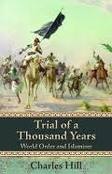
Trial of a Thousand Years, by Charles Hill—a review

Thursday, August 11th, 2011

 trial of thousand years

by J. Scott Shipman 

Trial of a Thousand Years, World Order and Islamism, by Charles Hill

Ambassador Charles Hill’s Grand Strategies, Literature, Statecraft, and World Order was the best book I read in 2010, so I had high expectations for this volume and was not disappointed. Ambassador Hill provides a 35,000-foot view of the relationships between the West and Islam in history focusing on the subtitle of his earlier work in the form of “world order.”

Unsurprisingly, as in Grand Strategies Hill goes back to the roots of modern order in the Treaty of Westphalia (1648). He provides a brief review of the world ushered in by the men who negotiated, and quotes another historian who said, “men who were laboring, each in his own way, for the termination of a terrible war. They had no idea of progress. The word “innovation” was anathema to them. The last thing on their minds was the creation of a new system of sovereign states…” Here we are 363 years later and “from the seeds sown at Westphalia” the system they set in place is has grown, but has been under siege many times from many fronts.

Westphalia was distinctive because it was “procedural, not substantive” and required a minimum number of procedures/practices to which to adhere and allowed disparate parties with different, “even mutually antagonistic, substantive doctrines and objectives” to work together. Hill points out four distinctions:

  • Religious arguments were not allowed in diplomacy.
  • The State was the fundamental entity.
  • Interstate/international norms and laws were encouraged, absent “divine sources” but based on mutually beneficial/positive agreements.
  • Use of professional military and diplomats with “its own set of protcols.” [Personal note: In another life, I was an arms control inspector enforcing the START I and INF Treaties—protocol was very serious and the true measure of the actual treaty language. There was also a strong and consistent application of reciprocity that made each party think before stretching protocol—this happened to my teams more than once.]

For Hill a central mission of the United States is the defense of the Westphalian world order. In less than 165 pages and six chapters, he outlines the origins of modern Western order and correspondingly covers Islamic order. From the beginning to the end Hill provides ample evidence of challenges to Westphalia, often from indigenous Western sources, but focusing mostly on our trials with Islam.

Hill sets the sources from whence the Western and Islamic world orders arose, where the West was grounded in Christianity, and the Islamic in the Caliphate. For two religions claiming Abrahamic roots, their worldviews were, and in many instances remain diametrically opposed. Central was the question of duality or unity. For the West, the State and religion were two complementary systems/powers—following the teaching of Christ ““Render unto Caesar the things which are Caesar’s, and unto God the things that are God’s” (St Matthew’s Gospel 22:21) For Islam there was no distinction, and the very thought was hateful to Islamists. Islam’s “unswerving devotion to monotheism” continues to this day among those groups and states using terror to upend existing world order.

I am sympathetic to Hill’s ideas; however recognize with globalization and the internet tweaks may be required. And I’ll take this segue to introduce an idea for consideration.

Westphalia’s removal of religion made trade possible among former religious enemies. Unambiguous rules for contracts and dispute resolution evolved. What if we could bridge the gap between Western jurisprudence and tribal, or non-Western legal systems? What if, instead of insisting our way or the highway we design a solution that would allow both sides to keep their respective legal processes and procedures, thereby opening untapped markets?

At least one person has already considered these alternatives. Michael Van Notten (1933-2002) was a practicing lawyer in the Netherlands and married into a Somali tribe. Van Notten used his legal training and insights gained as a member of his new family to design a method of contracting where tribal law and Western jurisprudence could peacefully and prosperously coexist. Van Notten recorded his ideas in a book called The Law of Somalis, A Stable Foundation for Economic Development in the Horn of Africa. I’ll not review this book, but wanted offer this as a teaser alternative.

After reviewing the history of the West and Islam, Hill identifies seven Clausewitzian centers of gravity for both: legal, military, the State, women, democracy, nuclear weapons, and values. Hill makes the distinction between the use of diplomacy by Islam and the Islamist (the fundamental variety). No surprises, to the Islamist a secular State is an “apostasy,” as is international law (Sharia being the single source), democracy and the rights of women.

Hill concludes, “Islamic civilization entered the international system under duress,” which he believes has contributed to the current situation of failing states and lagging economies that establish conditions where radicalized Islam can flourish. The radicalized elements reject the secular Westphalian world order, however Hill points out that some in Islam insist that sharia imposed by the state “cannot be the true law of Islam. It is not possible to apply sharia through the state; it can only be applied through acceptance by human beings (An-Na’im).” Another alternative is the Medina polity established by the Prophet (“later called the Pact—kitab—of Medina) “guaranteeing each tribe the right to follow its own religion and customs, imposing on all citizens rules designed to keep the overall peace, establishing a legal process by which the tribes settled purely internal matters themselves and ceded to Muhammad the authority to settle intertribal disputes…Although this document has been called the first written constitution, it was really more of a multiparty treaty” (Ansary).

Hill convincingly demonstrates that more often than not, rulers have co-opted Islam as a way to dominate the people (Iran comes to mind.). He quotes Professor L. Carl Brown of Princeton, “nothing exclusively “Islamic” about this Muslim attitude towards politics, any more than the politics of feudalism or of imperial Russia was distinctly “Christian.” It is the political legacy of Muslims, not the theology of Islam…”

For the Islamist, secularism is the booger man, but secularism in the Westphalian order has its own set of problems. Hill writes, “A new phenomena arose: wars motivated by religious convictions were replaced by wars driven by ideologies—surrogates for religion—each aimed to oppose, undermine, destroy and replace the Westphalian system. The greatest of these was international communism, the latest is international Islamism.”

In many respects, Trials is as good as Grand Strategies. Ambassador Hill is to be commended for his insight, courage, and conviction—this little book packs a big, enlightening punch. Strongest recommendation.

References you may find of interest (links to quoted authors above are links to the respective reference):

The Incoherence of the Philosophers, Abu Hamid Muhammed Al-Ghazali

The Crisis of Islamic Civilization, Ali A. Allawi

The Caliphate, Thomas W. Arnold

Sayyid Qutb and the Origins of Radical Islamism, John Calvert

Crimea: The Last Crusade, Orlando Figes —Figes’ The Whisperers was very good.

The Morality of Law, Lon L. Fuller

The Muqaddimah, Ibn Khaldun (Translated Franz Rosenthal)

The Clash of Empires: The Invention of China in Modern World Making, Lydia H. Liu

The Government of the Ottoman Empire in the time of Suleiman the Magnificent, Albert Lyber

Byzantine Civilization and The Fall of Constantinople, both by Steven Runciman

The First World War, Hew Strachan

Mozart and the Enlightenment; Truth, Virtue and Beauty in Mozart’s Operas Nicholas Till

Muslim Intellectual: A Study of Al-Ghazadi, W. Montgomery Watt

Dialectic of Enlightenment, Max Horkheimer and Theodor W. Adorno 


Johnston, Gorka and the need for specialist knowledges

Wednesday, August 10th, 2011

[ by Charles Cameron — religious knowledge, foreign policy, military ]

.

Dr. Douglas M. Johnston just posted a piece titled Religion a crucial tool in U.S. foreign policy in the Washington Post’s On Faith blog, and in it he quoted Dr. Sebastian Gorka‘s recent testimony to the HASC Subcommittee on Emerging Threats and Capabilities:

It is very difficult, if not impossible, to provide the contextual knowledge we need to understand and defeat our enemy if we rely solely upon anthropologists and social scientists…. Today our multi-disciplinary analysis of the enemy and his doctrine just as much requires — if not more so — the expertise of the regional historian and theologian, the specialist who knows when and how Sunni Islam split from Shia Islam and what the difference is between the Meccan and Medinan verses of the Koran. We should ask ourselves honestly, how many national security practitioners know the answers to these questions, or at least have somewhere to turn to within government to provide them such essential expertise.

I do appreciate that this was written by Dr Gorka for an audience that needs to keep up to speed on many, many topics.  What dismays me here isn’t the idea that “national security practitioners” should know these things — they should indeed, and should certainly also know specialists who know a great deal more — but that the bar is set so low, “a specialist” being, for that audience, someone “who knows when and how Sunni Islam split from Shia Islam and what the difference is between the Meccan and Medinan verses of the Koran”.

Let’s back up a bit.  Here’s a report on the Senate hearing on the appointment of GEN. Dempsey as Chief of Staff of the U.S. Army.

Gen. Martin Dempsey, tapped by the White House to be the next top military officer, acknowledged Tuesday that he and other senior officers failed to grasp the power dynamics among Islamic-based groups in Iraq.

After the U.S. military toppled the Saddam Hussein-led regime there in 2003, a powder keg erupted that was driven, in large part, by centuries-old power struggles and distrust among Iraq’s various Islamic sects.

It took American civilian and military leaders years to adapt and understand these dynamics, which experts say played a major role in both the length and violent nature of the Iraq war.

Driving the lack of understanding was a tendency of the military to “take five minutes to understand” an issue while immediately spending the next “55 minutes trying to solve it,” Dempsey said during his confirmation hearing before the Senate Armed Services Committee.

Those “five minutes to understand” might get you the basic difference between the Meccan and Medinan suras — but a specialist knows a little more than that, as one can gather from comments Dr Timothy Furnish posted just the other day on his MahdiWatch blog, commenting on Dempsey’s remarks:

One might reasonably wonder whether the US military and intelligence community (not to mention the State Department) truly does, finally, realize the importance of sectarian differences in the Islamic world. For example, the Syrian case pitting the pseudo-Shi`i Alawi rulers against the country’s Sunni majority only recently came to Washington’s attention; neither Libya’s history of Sanusiyah Sufi jihad against occupation, nor Mua`amar al-Qadhafi’s heretical Islamic teachings and rule, has been fully considered or acknowledged by the American government; and there are still commanders deploying to and from Afghanistan who seem blissfully ignorant of the fact that that country is 19% Shi`i (and that a substantial subset of that is not Twelver but Sevener, or Isma’ili, Shi`i).

But that’s one paragraph from a single blog post, and Furnish has written a book — has written, as they say, “the book” on Mahdism.  And that’s just one book, you don’t suppose Furnish’s knowledge is limited to what he managed to compress into a few hundred pages, do you?

Furnish is a specialist — that’s why I read and correspond with him.  I’m a generalist with, I hope, some decent insights into what to watch for and who to read for background — but Furnish is a specialist.

And the solution isn’t to add “specialist” to a checklist, find one on LinkedIn and check it off — the solution is widespread, ongoing conversation among specialists, with the help of generalists, across all silos and disciplinary boundaries, of the sort we try to promote here from time to time… until there are enough people, with enough parts of the puzzle, that we don’t get blindsided by our ignorances.

Ignorances, plural.  Knowledges, plural.

*

This just in…  Dr Furnish’s second book — The Caliphate: Threat or Opportunity? — is now available for pre-order. I hope to review it at some point here on ZP.

Booksbooksbooksbooks….

Monday, August 1st, 2011

Two more for the pile….


Another Bloody Century by Colin Gray

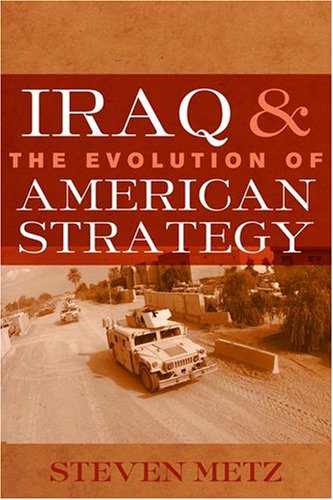
Iraq & the Evolution of American Strategy by Steven Metz

Comments or opinions?


Switch to our mobile site