zenpundit.com » history

Archive for the ‘history’ Category

R2P is the New COIN: Slaughter’s Premises

Wednesday, September 21st, 2011

Part I. 

As I mentioned in my last post, I will be analyzing Anne-Marie Slaughter’s ideas about “Responsibility to Protect“doctrine, based on her Stanford Journal of International Law article, “Sovereignty and Power in a Networked World Order” in a series of posts order to better understand and critique the assumptions on which R2P rests. Before I begin, some caveats:

Reading these posts is no substitute for reading the article yourself and drawing your own conclusions. A truly remarkable paper of some 44 pages of academic prose, a blog review of Dr. Slaughter’s thesis, even in a series, will only be able to focus on her operative premises and not delve into every shade or nuance. Limitation of the medium, but readers are free to disagree or agree in the comments.

Dr. Slaughter is an IR theorist and international lawyer of eminent stature and her style of argumentation reflects both the strengths and the weaknesses of those fields.

On the empirical issue of general, trends in international affairs and conflict, I do not take issue with Dr. Slaughter’s assumptions about the rise of networked non-state actors, greater degrees of uncertainty, complexity and multipolarity among and within states and the systemic erosion of state legitimacy. Indeed, in a broad and fundamental sense, I share them as I think do most people studying irregular conflict, counterinsurgency, 4GW and hybrid wars. I take exception though to the truly radical legal and policy conclusions Slaughter draws from these trends, as well as her normative delight in their trajectory. It as if we both agree that the Westphalian house is on fire, but she is reaching for a jerrycan of gasoline in order to speed the process along.

Finally, in this series I intend to tackle her argument from a thematic perspective, addressing how Slaughter views core philosophical questions of authority, international law, sovereignty, legitimacy and power in inventing a “responsibility to protect” doctrine and what the logical extrapolation of her ideas entails. Slaughter structured her article differently, with these concepts interwoven as she made her case in five sections, with sovereignty being a dominant concept.

The first post will concentrate on Slaughter’s premises regarding the problem facing the international community and her proposed solution:

An excerpt from Dr. Slaughter summarizing her thesis in her introduction:

….Westphalian sovereignty faces two fundamental challenges in contemporary international relations….First, the ineffectiveness challenge….A State’s ability to control its own territory without external interference is no longer sufficient to allow it to govern its people effectively – to provide security, economic stability and a measure of prosperity, clean air and water, and even minimum health standards.

Second, is the interference challenge. The letter of Article 2(7) remain; the spirit is violated repeatedly and increasingly routinely. All of human rights law deliberately infringes on the domestic jurisdiction of every state, denying governments the freedom to torture, murder, “disappear”, or systematically discriminate against their own citizens. Moreover, throughout the the 1990’s the Security Council repeatedly found that the conditions prevailing within a state, from starvation in Somalia to political intimidation and massacre in East Timor, constituted a threat to international peace and security sufficient to require collective armed intervention, and should have made such a determination regarding the genocide in Rwanda. States can no longer assume that if they refrain from interfering in the affairs of other states they will remain free from interference themselves.

….In short, states can no longer govern effectively by being left alone. The converse proposition is equally true, although perhaps more startling: States can only govern effectively by actively cooperating with other states and by collectively reserving their power to intervene in other states’ affairs. The world has indeed turned upside down: small wonder that the concept of sovereignty needs to be redefined!

Startling, is a good description.

Slaughter’s first “fundamental challenge” pivots on an odd usage of the word “effective”. “Effective governance” here is defined by Slaughter as something other than a state’s actual physical control over the territory and population over which it asserts sovereignty. Explicitly, “effective governance” is then defined as the provision of modern public goods, presumably without resort to autarkic policies, as interdependence is one of her themes. 

To be fair to , there’s some merit to Slaughter’s consideration of the provision of public goods. States that face non-state actor challengers like Hezbollah who do fill social needs are thwarting their state opponents at the moral as well as the material level of conflict, winning over their loyalty and eroding the legitimacy of the state. So, if Dr. Slaughter was writing a manual on, say, psychological warfare or insurgency, she would have me on board here.

But, unfortunately, she isn’t. Slaughter is writing an article, ostensibly on international law, and a vague laundry list of economic items, a transient de facto state of public policy, strikes me as a poor foundation for a universal principle of law. By Slaughter’s standard, Mexico which provides public services, is democratically governed and economically  interdependent despite being strangled by a narco-insurgency of atavistic brutality, is “effectively governed”. Lebanon, whose government in is under the hegemony of Hezbollah is “effectively governed”. There’s a subsumed “correct” political economy embedded in the argument here by Slaughter; if a first world state decides to reject carbon footprint taxes, nationalized health care or privatizes it’s mail delivery, is it “ineffectively governed”?

At least the first challenge is relatively straightforward. Slaughter’s second “fundamental challenge” is an exercise in logical acrobatics.

Slaughter is correct that the spirit and at times the letter of international law (actual, real world, international law that has a chance of being followed, not R2P theory) is stretched to justify military intervention. She is also right that Rwanda’s genocide by the then radical Hutu regime constituted a threat to international peace and cried out for intervention, and the failure to do so resulted in not just genocide of the Tutsi people but ultimately an African WWI in the Congo basin. These two factually accurate examples are diametrically opposed to one another, yet somehow, they combine to arrive at the solution of institutionalizing military intervention in international law as a rule and not an exception. They are juxtaposed with the cases of Somalia, where no state, legitimate or otherwise, existed and East Timor, which was a case of de jure military aggression and annexation by Indonesia. The only thread tying all of these disparate examples together is a large pile of dead bodies.

Charnel house examples make for bad law, unless you have to govern a society of cannibals.

Finally, while boldly rejecting international law’s long established definition of sovereignty, Slaughter offers two easily falsifiable assertions, that states can no longer govern effectively by governing alone and that the ever present danger of arbitrary meddling by foreigners is a prerequisite for good governance. If so, Switzerland would be a Hobbesian hellhole today and Central America and the Caribbean islands would resemble tropical Singapores . The omnipresent threat of foreign meddling on religious grounds is what states ran away from screaming after the Thirty Year’s War, which may have killed up to a third of all the people in the Germanies.

Anne-Marie Slaughter proposes to restore that state of affairs on more secular grounds.

Next post – Slaughter on Authority and International Law.

ADDENDUM – Related posts:

Inkspots –R2P is NOT the new COIN, but Ulfelder is just as wrong as Safranski about why*

Fear, Honor and Interest –Geopolitics, Networks, and Complex Friction
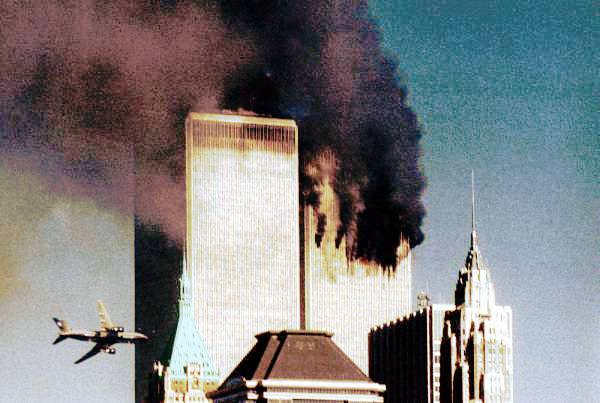
The Nine Eleven Century?

Sunday, September 11th, 2011

nineleven2.jpg

Ten years ago to this day, almost to the hour of which I am writing, commercial jetliners were highjacked by al Qaida teams armed with boxcutters, under the direction of Mohammed Atta, were flown into the towers of the World Trade Center and the Pentagon. A fourth plane, United Airlines Flight 93, believed to be headed to the US Capitol building, crashed in Pennsylvania when passengers led by Todd Beamer heroically attempted to stop the highjackers. The whole world watched – most with horror but some with public glee – on live television as people jumped out of smoke-engulfed windows, holding hands, to their deaths. Then, the towers fell.

From this day flowed terrible consequences that are still unfolding like the rippling shockwave of a bomb.

We look back, sometimes on the History Channel or some other educational program, at the grainy, too fast moving, sepia motion pictures of the start of World War I. The crowds wildly cheered troops with strangely antiquarian uniforms that looked reminiscent of Napoleon’s day, march proudly off to the war that gave Europe the Somme, Gallipoli, Passchendaele and Verdun. And the Russian Revolution.

After the armistice, the victors had a brief chance to reset the geopolitical, strategic and economic patterns the war had wrought and in which they were enmeshed. The statesmen could not rise to that occasion, failing so badly that it was understood even at the time, by John Maynard Keynes and many others, that things were being made worse. World War I. became the historical template for the short but infinitely bloody 20th century of 1914-1991, which historians in future centuries may simply describe as “the long war” or a “civil war of western civilization”.

There is a serious danger, in my view, of September 11 becoming such a template for the 21st century and for the United States.

On the tenth anniversary of 9/11, as we remember the fallen and the many members of the armed services of the United States who have served for ten years of war, heroically, at great sacrifice and seldom with complaint, we also need to recall that we should not move through history as sleepwalkers. We owe it to our veterans and to ourselves not to continue to blindly walk the path of the trajectory of 9/11, but to pause and reflect on what changes in the last ten years have been for the good and which require reassessment. Or repeal. To reassert ourselves, as Americans, as masters of our own destiny rather than reacting blindly to events while carelessly ceding more and more control over our lives and our livelihoods to the whims of others and a theatric quest for perfect security. America needs to regain the initiative, remember our strengths and do a much better job of minding the store at home.

The next ninety years being molded by the last ten is not a future I care to leave to my children. I can think of no better way to honor the dead and refute the current sense of decline than for America to collectively step back from immersion in moment by moment events and start to chart a course for the long term.

Anonymous and Master Roger, a review

Tuesday, August 30th, 2011

 by J. Scott Shipman

master-roger.jpeg

Anonymous and Master Roger, Anonymous, Notary of King Béla The Deeds of the Hungarians, Master Roger’s Epistle to the Sorrowful Lament upon the Destruction of the Kingdom of Hungary by the Tartars

 Back in June Zen posted a couple of mini book reviews, and David Schuler posted this comment: 

 “For moderns inclined to romanticize war in antiquity may I recommend The Epistle to the Sorrowful Lament upon the Destruction of the Kingdom of Hungary by the Tartars?  It became available in English translation fairly recently and constitutes a first-hand account of the Mongol invasion of Hungary.  The violence, not only against persons and property, but against the land itself is notable and eye-opening.”

The title was enough to pique my interest, and since I knew very little of this period I went to Amazon UK and purchased a copy (US versions are prohibitively expensive) . That said, I didn’t expect to get around to reading for some time, but if I don’t “buy” a book while it is still on my mind, I’ll likely forget as the pile continues, “without ceasing” (to wax Biblical) to grow. For an obscure text, the introduction drew me in and I was hooked enough to read a few pages a day.

The book has ample and informative introductions to each work. The stories are presented in Latin on one page and English on the facing page.

The narratives are very different, Anonymous was a Notary to King Béla (circa 1196), and he recounts the deeds of Hungarian royalty, and the behind the scenes machinations of the royal court. Anonymous’ account was laced with both biblical and classic texts and was quite tedious, predictably obsequious but while at the same time offering up little snippets here and there—and often in the notes. A note in the section titled 40. The Victory of Prince Árpád, Anonymous wrote: “…for thirty four days and in that place the prince and his noblemen ordered all the customary laws of the realm and all its rights.” The editors included the following footnote with respect to “rights.”

 “The translation of ius (in contrast to lex, “law”) is a problem that is not only linguistic. Translators of Roman legal texts often retain ius, as it implies law, justice, rights along with all their connotations. Modern English does not distinguish lex from ius, Gesetz from Recht, or loi from droit, which may explain the generally supine Anglo-Saxon attitude towards the law and authority in general…”

Schuler was right in his description of Master Roger’s first hand account of the Tartar invasion (1241/42); horrific comes to mind. There is no romance. The brutality and ruthlessness of the Tartars is awe-inspiring and fearful 900 years removed. The tactics of the Tartars are textbook examples of psychological warfare before the term was coined—and their ability to “get inside” their adversaries decision-making loop (OODA, anyone?) was remarkable.

The ancient Sorrowful Lament story was reassuring of the power and resilience of the human spirit. The deprivations experienced by the Hungarians were not unique in human history, but serve to illustrate how resilient a people can be when things truly go to hell in a hand basket. When their leaders failed, the Hungarians found way to live in spite of their feckless unprepared leaders, and in spite of a ruthless, blood and booty thirsty enemy.

Anonymous and Master Roger is recommended to anyone wanting to understand the human condition, whether royalty, peasant, bureaucrat, or barbarian. This is an important book…for a “sorrowful lament” has much to teach us about the human condition and how little man changes. This highly eclectic little title comes highly recommended and many thanks to Dave for sharing.

Postscript: One remarkable thing about this book, printed in Hungary, is the high quality construction using good paper and string.

There are no references to share for this volume, however if this volume is indicative of their work, Central European Medieval Texts are to be commended and followed.

BTW, Joey recommended Millenium by Tom Holland and I’m about half-way through—excellent thus far!

Historical footnotes to game theory

Sunday, August 21st, 2011

[ by Charles Cameron — philosophy, psychology, history, game theory, dilemma, commons cooperation, analogy, 9/11 ]

.

I have an interest in game theory that is much like my interest in music: I can’t play, but I can whistle. And so it is that I’ve substituted curiosity about the history of the thing, and whatever analogical patterns I can discern there, for any actual ability at the thing itself.

Somewhere in my analogy-collector’s mind, then, I have these two quotes, cut from the living tissue of their writer’s thoughts, and prepped fpor contemplation. I find them, in retrospect, quite remarkable.

Jean-Jacques Rousseau, in On the Inequality among Mankind, wrote:

Such was the manner in which men might have insensibly acquired some gross idea of their mutual engagements and the advantage of fulfilling them, but this only as far as their present and sensible interest required; for as to foresight they were utter strangers to it, and far from troubling their heads about a distant futurity, they scarce thought of the day following. Was a deer to be taken? Every one saw that to succeed he must faithfully stand to his post; but suppose a hare to have slipped by within reach of any one of them, it is not to be doubted but he pursued it without scruple, and when he had seized his prey never reproached himself with having made his companions miss theirs.

And David Hume, in A Treatise of Human Nature:

Your corn is ripe today; mine will be so tomorrow. ‘Tis profitable for us both that I shou’d labour with you today, and that you shou’d aid me tomorrow. I have no kindness for you, and know that you have as little for me. I will not, therefore, take any pains on your account; and should I labour with you on my account, I know I shou’d be disappointed, and that I shou’d in vain depend upon your gratitude. Here then I leave you to labour alone: You treat me in the same manner. The seasons change; and both of us lose our harvests for want of mutual confidence and security.

*

Those two, I believe, are fairly well known – I was delighted the other day to run across a third sample for my collection. William James, in The Will to Believe, writes:

Wherever a desired result is achieved by the co-operation of many independent persons, its existence as a fact is a pure consequence of the precursive faith in one another of those immediately concerned. A government, an army, a commercial system, a ship, a college, an athletic team, all exist on this condition, without which not only is nothing achieved, but nothing is even attempted. A whole train of passengers (individually brave enough) will be looted by a few highwaymen, simply because the latter can count on one another, while each passenger fears that if he makes a movement of resistance, he will be shot before any one else backs him up. If we believed that the whole car-full would rise at once with us, we should each severally rise, and train-robbing would never even be attempted.

*

The first two quotes are of interest as showing the forms that an idea which will later be mathematized can take.  They are, if you like, precursors of game theoretic constructs, although neither Hume nor Rousseau appears to be mentioned in von Neumann and Morgenstern‘s Theory of Games and Economic Behavior.

The third, I think, is even more interesting..  Consider the eerie and heroic “fulfillment” of that third paragraph if read “as prophecy” – in this account from the 9/11 Commission Report of the events on United Flight 93:

During at least five of the passengers’ phone calls, information was shared about the attacks that had occurred earlier that morning at the World Trade Center. Five calls described the intent of passengers and surviving crew members to revolt against the hijackers. According to one call, they voted on whether to rush the terrorists in an attempt to retake the plane. They decided, and acted. At 9:57, the passenger assault began. Several passengers had terminated phone calls with loved ones in order to join the revolt. One of the callers ended her message as follows:

“Everyone’s running up to first class. I’ve got to go. Bye.” The cockpit voice recorder captured the sounds of the passenger assault muffled by the intervening cockpit door.

Yesterday’s highwayman is today’s hijacker, yesterday’s train is today’s plane…

*

If there’s anything to be learned here, it’s not a novel way of protecting trains or aircraft from passengers of malicious intent —

It’s that there’s a subtle thread running from something akin to instinct that’s also close to unspoken common sense, surfacing for a moment in the writings of thoughtful individuals, leading on occasion to the formulation of exact mathematical principles — but also (i) available, (ii) in the human repertoire, (iii) to be acted upon, (iv) cooperatively, (v) as required, (vi) via the medium of human common interest, (vii) which provides the resultant trust.

Which may in turn offer some reason for hope — for a humanity in various forms of communal distress…

On the Road: Genghis Khan Exhibition

Saturday, August 13th, 2011


A brief note. I am on the road in Texas, and spent the afternoon yesteady at the Genghis Khan Exhibition, which will be coming to the Field Museum in Chicago, circa 2012. The exhibit is heavy on the military artifacts of the Mongols, including real and reproduced weapons, armor, cavalry gear, siege engines, burial objects and clothing. Highly recommended!


Switch to our mobile site

