zenpundit.com » Questions

Archive for the ‘Questions’ Category

Is COIN Dead?

Thursday, February 10th, 2011

slide1.JPG

By that, I mean contemporary, mid-2000’s “pop-centric” COIN theory as expressed in FM 3-24  – is it de facto dead as USG policy or is COIN theory formally evolved to officially embrace strong elements of CT, targeted assassinations, FID, “open-source counterinsurgency” and even bare-knuckled conventional warfare tactics?

Mind you, I have nothing against pragmatic flexibility and think that, for example, moves to arm more Afghan villagers for self-defense are realistic efforts to deal with the Taliban insurgency, and I prefer USG officials speaking frankly about military conditions as they actually exist. Doctrinal concepts should not be used to create a “paint-by-numbers” military strategy – it is a starting point that should be expected to evolve to fit conditions.

But having evolved operations and policy as far as the USG military and USG national security agencies have, with the current draconian budgetary restraints looming – are we still “doing COIN”? Or is it dead?

Thoughts?

DoubleQuotes and Questions

Friday, January 28th, 2011

[ by Charles Cameron ]

You know, I really enjoy building my DoubleQuotes. They can be entirely frivolous, as is this one, for instance:

with its touch of gothic — a taste I share with my friend Bryan Alexander.

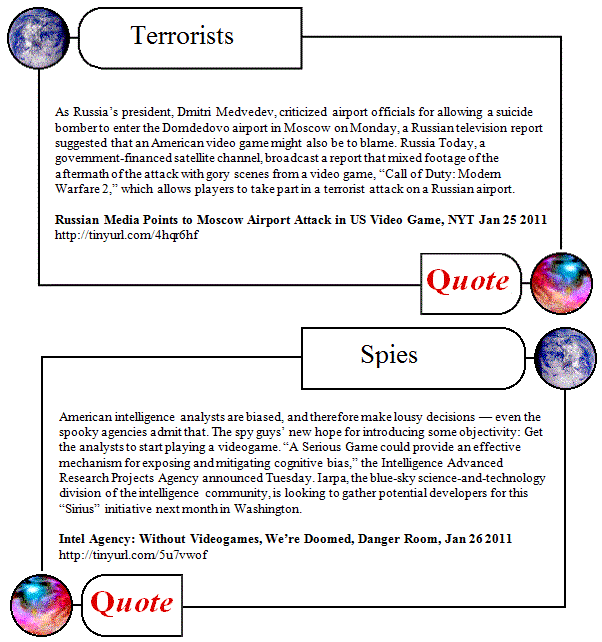
Or they can work like a Necker cube, offering opposite framings with which to view a single topic — in this case, video games.

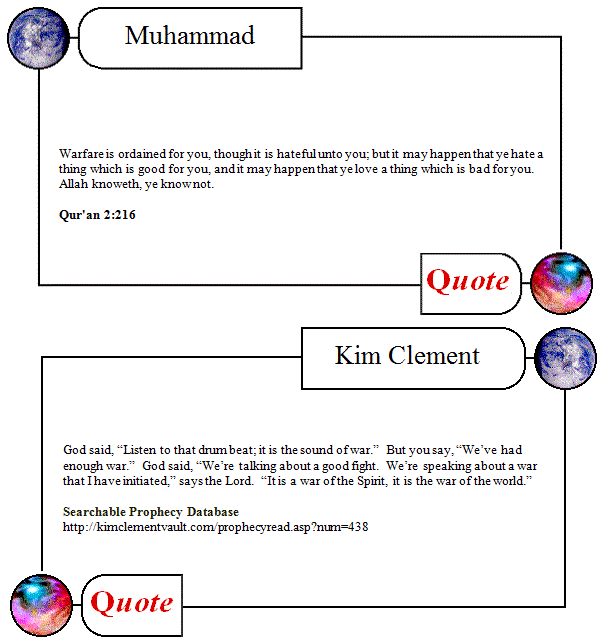
They can also work like Rorschach blots — this one compares two prophecies, one from the Quran and one from a contemporary Christian prophet (if I’m not mistaken, President Obama quoted him recently) —

— but it is left up to the reader to determine the value of each…

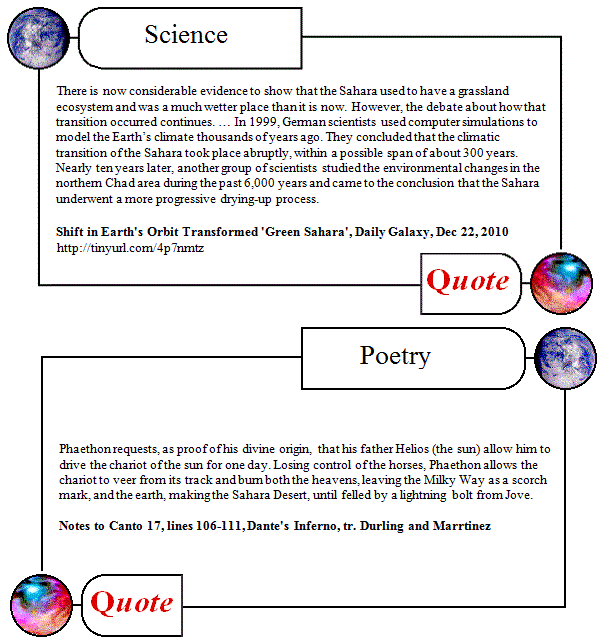
And they can also pose fundamental questions of preference:

Has science simply replaced myth, d’you think? or is science for the facts, perhaps, and the mind — while poetry and myth are for the heart, and truth?

Simplification for Strategic Leverage

Sunday, December 5th, 2010

Remember this much ridiculed visual monstrosity?:

Excessively complex representations, much less the bureaucratic systems in practice, are poor vehicles for efficient communication of strategic conceptualizations to the uninformed – such as those downstream who must labor to execute such designs. Or those targeted by them for help or harm.  In addition to the difficulty in ascertaining prioritization, the unnaturally rigid complexity of the bureaucracy generally prevents an efficient focus of the system’s resources and latent power. The system gets in it’s own way while eating ever growing amounts of resources to produce less and less, leading to paralysis and collapse.

Does it have to?

Here’s an interesting, very brief take on analytical simplification from a natural scientist and network theorist Dr. Eric Berlow on how to cull simplification – and thus an advantage – out of complex systems by applying an ecological paradigm.

Cognitive simplification will be a critical strategic tool in the 21st century.

“The Enemy of my Enemy is…?”

Thursday, July 22nd, 2010

This is interesting. Age-old, conventional strategic wisdom is supported by social network mapping research involving 300,000 ppl:

‘The Friend of My Enemy Is My Enemy’: Virtual Universe Study Proves 80-Year-Old Theory on How Humans Interact

ScienceDaily (July 20, 2010) – A new study analysing interactions between players in a virtual universe game has for the first time provided large-scale evidence to prove an 80 year old psychological theory called Structural Balance Theory. The research, published in the Proceedings of the National Academy of Sciences, shows that individuals tend to avoid stress-causing relationships when they develop a society, resulting in more stable social networks.

The study, carried out at Imperial College London, the Medical University of Vienna and the Santa Fe Institute, analyses relationships between 300,000 players in an online game called Pardus (http://www.pardus.at/). In this open-ended game, players act as spacecraft exploring a virtual universe, where they can make friends and enemies, and communicate, trade and fight with one another.

Structural Balance Theory is an 80 year old psychological theory that suggests some networks of relationships are more stable than others in a society. Specifically, the theory deals with positive and negative links between three individuals, where ‘the friend of my enemy is my enemy’ is more stable (and therefore more common) than ‘the friend of my friend is my enemy’.

….The authors found that in positive relationships, players are more likely to reciprocate actions and sentiments than in negative ones. For example, if player A declares player B to be their friend, player B is likely to do the same. If player A declares player B to be their enemy, however, player B is not likely to reciprocate.

The research also revealed strong interactions between different types of links, with some networks overlapping extensively, as players are likely to engage in similar interactions, and others tending to exclude each other. For example, friendship and communication networks overlap: as we would expect, friends tend to talk to each other. However, trade and hostility did not overlap at all, showing that enemies tend not to trade with one another.

Dr Renaud Lambiotte said: “This may seem like an obvious finding, as we would all prefer to communicate more with people we like. However, nobody has shown the evidence for this theory on such a large scale before.”

Read the rest here.

First, I wonder what Valdis Krebs thinks of this study?

Second, does this bear out on larger scale entities that cultivate primary loyalties?

Reality, Strategy and Afghanistan: Some Questions

Tuesday, July 6th, 2010

Are all the strategic objectives in Afghanistan clearly defined and acheivable by military force?

Of the operational activities that might support our strategic objectives that require civilian expertise, why in nine years have we not sent adequate civilian agency representation and funding?

If military operations in Afghanistan require a single commander, why does the civilian side of the COIN campaign have authority divided between at least a half-dozen senior officials without anyone having a deliverable “final say” reporting to the President?

If Pakistan’s “partnership” is officially a requirement for strategic success (and it is), why would Pakistan be a “partner” in helping stabilize an independent regime in Afghanistan that would terminate Pakistan’s ability to use Afghanistan as “strategic depth”?

Is the Taliban more important to our national security than is al Qaida?

If we can’t get at al Qaida after nine long years to finish them off, why is that?

If Pakistan’s ISI is sponsoring the Haqqani Network, the Quetta Shura Afghan Taliban and other extremist jihadi groups, doesn’t that make the ISI as a critical component – the strategic “brains” – of the Enemy’s center of gravity?

Shouldn’t we be targeting the Enemy center of gravity if we are to acheive our strategic objectives? (If we are going to be squeamish and pants-wetting about that, how about the retired and bearded “plausibly deniable” ex-ISI guys running around FATA as “advisers” and fixers to jihadi and tribal factions?)

Should we be sending the Enemy’s strategic brains billions of dollars annually?

For that matter, is the size of our own logistical tail effectively funding the guys in black turbans shooting at American soldiers and burying IEDs? Would less be more?

Can we ever gain the initiative if the Enemy has safe sanctuaries – oh, has anyone noticed that Pakistan has twice as many Pushtuns as Afghanistan and how does that affect the odds for winning a purist COIN campaign….in 18 months?

Are COIN warfare and proxy warfare the same thing to be treated with the same policy?

If we assume the Enemy has read FM 3-24, shouldn’t we make certain that a considerable percentage of our tactical moves in AfPak are not coming out of a “cookbook”? Is the element of surprise something we can use, or is it considered unsporting these days in warfighting doctrine?

Given that most of Afghanistan’s GDP is derived from US military spending, how is the Karzai regime going to afford an ANA of the requisite size that COIN theory requires for an operational handoff at our arbitrary political deadline of 18 months?

And on a related note, if the Karzai regime in it’s entirety was suddenly frozen in carbonite like Han Solo in The Empire Strikes Back, how much more efficient and popular would the Afghan government instantly become with ordinary Afghans compared to how it is now?

If we can’t work with Karzai why can’t we work with somebody else? It’s not like he was, you know, actually elected 😉

If political authorities are not effectively linking  Ends, Ways and Means – some old-fashioned gadflys call this state of affairs “not having a strategy” – and are unlikely to acheive our objectives and said political authorities will not consider changing the objectives, what practical actions can we take in the next 18 months to seize the initiative,  maximize the harm inflicted on our enemies, ensure help for our friends and the furtherance of our own interests?


Switch to our mobile site