zenpundit.com » Afghanistan

Archive for the ‘Afghanistan’ Category

Doc Madhu on “Sweet Strategery of Strategic Depth”

Thursday, January 6th, 2011

Onparkstreet, a.k.a. Dr. Madhu has a post I rather liked on Pakistan’s maniacal quest for “strategic depth” in Afghanistan, over at Chicago Boyz:

The Super Sweet Strategery of Strategic Depth

Pakistan’s beliefs in the value of seeking strategic depth in Afghanistan were influenced by two factors. The support it received from the U.S. in waging an armed response against the Soviet occupation triggered the belief. The success of that endeavour with no apparent costs to itself, gave Islamabad the illusion of being able to play a major role in the geo-politics of Central Asia. This more than anything else led to the belief that Afghanistan provided the strategic leverage Pakistan had long been seeking. The energy-rich Muslim states of Central Asia beckoned both Pakistan and the energy-seeking multi-nationals. Iran’s standing up to western pressures was proving an obstacle to long-term plans for energy extraction from the region. Afghanistan offered both shorter energy routing and political control through Pakistan.

V. R. Raghavan (The Hindu, 2001)

Pakistan’s intelligence agency, the ISI, “wants a reliable proxy that has territorial control of the P2K area,” Mr. Dressler adds. This desire is the result of Pakistan’s historic conflict with India. “If India comes across the border, Pakistan can fall back into Afghanistan and drive them out. It’s about strategic depth vis-à-vis India. As long as that continues to be a driving concern, Pakistan’s support for the Haqqani network will continue.”

The Christian Science Monitor (via Small Wars Journal)

A highly plausible future scenario indeed (regarding the second quoted item). In the event that the Indians decide on a massive ground invasion into Pakistan and march sturdily through the landscape of jihadi-networks and scattering Pakistani troops – with nary a nuke in sight and the US sitting idly by – it sounds like a winner of strategy. The supply lines to the Indians will, of course, be Bollywood unicorns pooping ammunition and some sort of MREs.

On the other hand, serious people seem to take Pakistani strategic depth worries seriously. The Indians are forever being told that they must take Pakistani fears of regional encroachment into account so that the United States (ISAF) may have a negotiated settlement in Afghanistan that is stable. Although….

Read the rest here.

The key to understanding Pakistan is that it does not really function like a state in the Westphalian sense, nor do it’s rulers want it to do so, the state merely being a vehicle for their own personal and class aggrandizement. Nor are the official borders of Pakistan the same as the borders that exist in elite Pakistani imaginations. Nor is Pakistan an ally of the United States in any sense that most normal people would use the term “alliance”, as allies are rarely the epicenter of one’s enemies in a shooting war. It is as if in 1944, as we jointly prepared for Operation Overlord, the British were raising volunteer Scottish Waffen SS divisions to kill American troops on the beaches of Normandy.

Strategy works within the confines of reality, strategy does not confine reality. We give Pakistan billions of dollars in military aid annually, and they use some of it to fund and train Taliban who have killed Americans, every year, for the last ten years, and continue to do so while their leadership is safely ensconced in Peshwar, Quetta and Rawalpindi.

Every year.

Think about that as you sign your 1040.

If we our leaders can’t recognize admit in public who America’s enemies really are, how can we win a war?

Our relationship with Pakistan is strategically toxic.
Ark attack

Tuesday, January 4th, 2011

[ by Charles Cameron ]

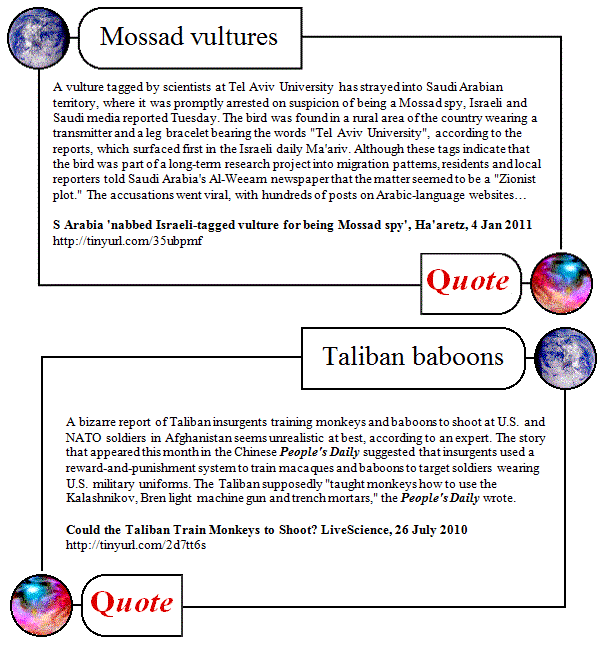
Every article I’ve read about the Mossad vulture makes some mention of another recent story, that of the Shark ‘sent to Egypt by Mossad’ of December — hence my choice to link instead to the Chinese allegation of Taliban-trained baboon platoons…

Links for this piece: vulturesbaboons

For your further edification, here’s LiveScience’s delightful illustrated compendium of the Top 10 Animal Recruits in War.

Clausewitz vs. Sun Tzu

Monday, December 13th, 2010


This article at SWJ blog has stirred a lively debate in the comments section with some very able practitioner-scholars weighing in.

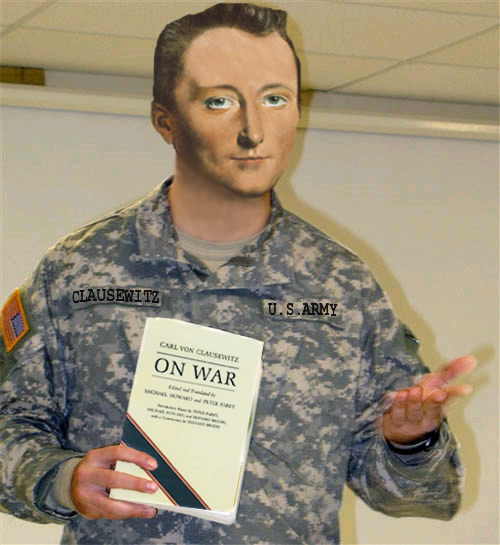
….Sun Tzu?s ancient military philosophy of indirectness and gradualism runs counter-culture with much of mainstream western military strategy. Western reliance on superior technology and firepower shaped American counterinsurgency doctrine to be largely lethal in nature and enemy focused. Clausewitz instructed generations of military officers that the destruction of the enemy?s army is the primary goal in all combat1; therefore, all political-military conflict results in offensive action where attrition of the enemy force becomes a universal requirement. Clausewitzian war theory „worked? in both world wars in that the Allies did accomplish their desired goals; however critics such as Israeli strategist Shimon Naveh raise valid questions on whether Clausewitz?s fixation on offensive action and attrition warfare helped or hindered the Allied causes2. Despite Clausewitzian strategy?s seemingly illogical structure, application of his theories in the major 20th century conflicts created an enduring military school of war strategy with „On War? taking a sacred position.

In fairness to Clausewitz, this is over the top.

The US military could use more Sun Tzu; it is far more Clausewitzian in the perspective of the officer corps than it is “Sun Tzuite”, but the armed services are not the Children of Clausewitz. Not even the US Army. We’d probably be better off if the American military was more thoroughly one or the other in terms of strategic culture than the industrial age, bureaucratic, ad hoc, legacy thinking non-strategic hodgepode that currently prevails.

I do not expect that to change. American military organizational culture is driven more by appropriations than by ideas.

Some Related Links:

Sonishi.com Interview with Martin van Creveld on Sun Tzu

Sonishi.com Interview with Chet Richards on Sun Tzu and Boyd

Christopher Bassford on Sun Tzu, Jomini and Clausewitz

Colin Gray on Clausewitz and the Modern Strategic World

The Clausewitz Roundtable

Strategy of the Headless Chicken

Simplification for Strategic Leverage

Sunday, December 5th, 2010

Remember this much ridiculed visual monstrosity?:

Excessively complex representations, much less the bureaucratic systems in practice, are poor vehicles for efficient communication of strategic conceptualizations to the uninformed – such as those downstream who must labor to execute such designs. Or those targeted by them for help or harm.  In addition to the difficulty in ascertaining prioritization, the unnaturally rigid complexity of the bureaucracy generally prevents an efficient focus of the system’s resources and latent power. The system gets in it’s own way while eating ever growing amounts of resources to produce less and less, leading to paralysis and collapse.

Does it have to?

Here’s an interesting, very brief take on analytical simplification from a natural scientist and network theorist Dr. Eric Berlow on how to cull simplification – and thus an advantage – out of complex systems by applying an ecological paradigm.

Cognitive simplification will be a critical strategic tool in the 21st century.

RESTREPO on Television this Monday

Monday, November 29th, 2010

An important announcement from my colleague, Lexington Green:

Lexington Green – (1) RESTREPO Monday, 11/29/10 at 9PM ET/PT; (2) Maj.Gen. Scales on Small Unit Dominance

This is the television premier of this extraordinarily film. I wrote about seeing this film here.

Restrepo chronicles the deployment of a platoon of U.S. soldiers in Afghanistan’s Korengal Valley. The movie focuses on a remote 15-man outpost, Restrepo, named after a platoon medic who was killed in action. It was considered one of the most dangerous postings in the U.S. military. This is an entirely experiential film: The cameras never leave the valley; there are no interviews with generals or diplomats. The only goal is to make viewers feel as if they have just been through a 94-minute deployment. This is war, full stop. The conclusions are up to you.

I highly recommend this film to all of our readers.

An information page for Restrepo is here, including video.

RESTREPO, an award winning documentary, was based on (or more precisely, closely related to) the book WAR by Sebastian Junger, which told the story of the war against the Taliban in the Korengal Valley, waged by the soldiers of the 2nd Platoon of Battle Company.

I previously reviewed WAR here and the movie RESTREPO here.


Switch to our mobile site