zenpundit.com » games

Archive for the ‘games’ Category

On the felicities of graph-based game-board design: five

Tuesday, October 20th, 2015

[ by Charles Cameron — Hofstadter Langdon Kim — for Gabi Nasemann, & in recognition of Gödel Escher Bach ]
.

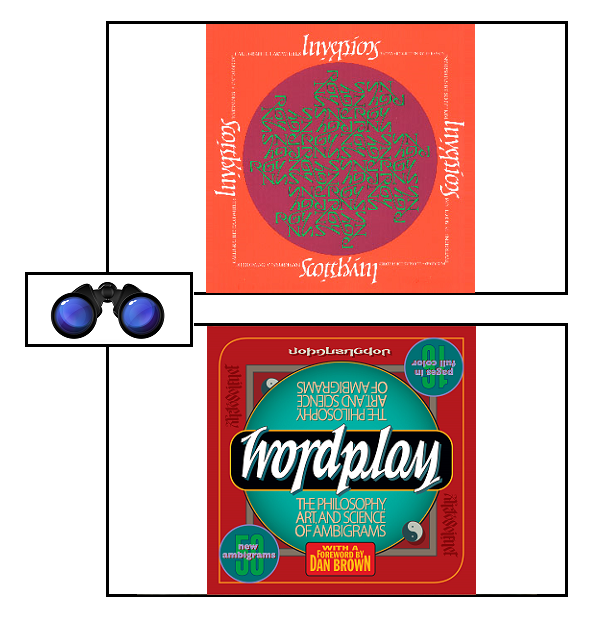
My friend the photographer Gabi Nasemann recently inquired whether I knew John Langdon‘s book, Wordplay, and I responded, DoubleQuote-style, with Scott Kim‘s Inversions:

SPEC kim langdon

I had the pleasure of meeting Scott Kim lo these many years past at the Computer Game Developers Conference, and he was kind enough to say of my HipBone Games:

Your game does seem to really call to mind the Bead Game. Almost a divination system, much more metaphorical than most games.

**

Scott Kim and his friend Doug Hofstadter both have a keen interest in Bach, so I thought it might be neat to see Scott’s treatment of the name — an ambigram, lower panel below — and how John Langdon might treat it — upper panel:

SPEC bach

Langdon’s Bach I assembled from his own typeface, Biform, which apparently seeped from his grasp into the wider world under the entirely irrelevant name Lampoon.

**

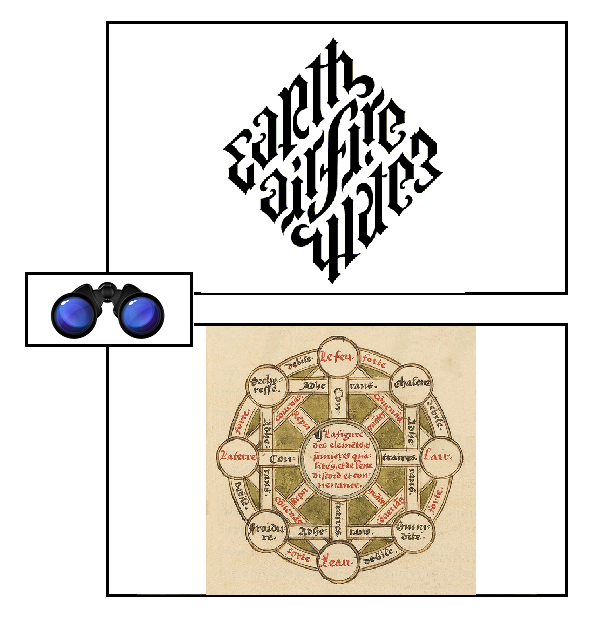
Of all Langdon’s ambigrams, the one that’s no doubt best known — since Dan Brown used it in one of his execrable books — is his square of the four elements, upper panel, below:

SPEC langdon oronce

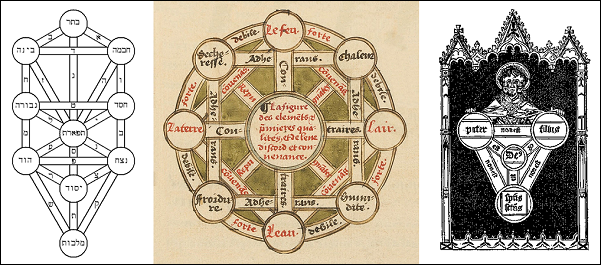
It was a nice touch, though, that Brown offered Langdon an hommage by naming his professor of symbiology after him. No doubt the fictional Robert Langdon would be familiar with the glorious diagram of the elements created by Oronce Fine, which he’d have run across in a 1549 Harvard Houghton Library volume, Le Sphere du Monde, and which I have elsewhere compared with Jewish and Christian diagrams:

Sembl and HipBone gameboards are in the same genre.. being games of linkage that you play with your mind:

games you play in your mind

**

Sources and further readings:

  • John Langdon, Ambigrams
  • Scott Kim, Ambigrams on Google Search
  • Scientific American, Remembering Martin Gardner, with Douglas Hofstadter
  • Slate, Can You Really Be a Professor of Symbology?
  • The New Yorker, Harvard_ No Symbology Here
  • Wikipedia, Robert Langdon
  • Random House, The Official Website of Harvard Symbologist Robert Langdon
  • John Langdon, Biform
  • John Langdon, Lampoon
  • Triple Canopy, This is your brain on paper
  • Military Reform through Education

    Tuesday, October 20th, 2015

    [by Mark Safranski, a.k.a. “zen“]
    Photo of Don Vandergriff instructing with a map

    Don Vandergriff facilitating Adaptive Soldier/Leader exercises at Fort Benning

    Fred Leland at LESC Blog recently had a guest post up by Dan Grazier from the Project on Government Oversight regarding the important work Don Vandergriff is doing to reform professional military education and training:

    Military Reform Through Education: From The Straus Military Reform Project, Something We In Policing Can Learn From

    ….I had the privilege of experiencing this process with a group of 30 soldiers and Department of Defense (DoD) civilians learning about adaptive leadership and mission command. All were teachers from various courses at Fort Benning sent by their senior leaders seeking to infuse new ideas into their organizations. They spent a week learning how to incorporate adaptability into their courses during a seminar taught by CDI military advisor Don Vandergriff and his colleagues with Yorktown Systems Group.

    The Adaptive Soldier/Leader Training & Education (ASLTE) seminar aims to move the Army away from outdated assembly-line training methods that teach soldiers to mindlessly execute checklists. Instead, the seminar shows soldiers how to incorporate creative and interactive methods that challenge both students and teachers. This results in empowered soldiers at all levels able to adapt to any situation. [….]

    ….Don Vandergriff, a retired Army major, has been on the front lines of personnel reform for many years. While he is most noted for his work at the service level, these seminars seek to transform the Army from the bottom up.

    Approximately 20 soldiers and 10 civilian educators spent the week learning various teaching methods through experiential learning, which flips the traditional method military students are used to. Most training today follows the “crawl, walk, run” theory all service members are familiar with. Students are generally expected to complete reading assignments, sit through a PowerPoint lecture, and then finally conduct field training to reinforce what they have learned.

    The seminar exposed students to new methods by putting the practical exercises first. For example, the seminar uses several Tactical Decision Games (TDGs) to encourage students to rapidly develop a plan for a military problem presented by the facilitators. TDGs can be created for nearly any kind of a situation, but this course mostly used actual battlefield problems like how to capture a bridge or defeat an enemy force entrenched on a hilltop. While working through these problems, the students are exposed to such concepts as Mission Command and the Observe, Orient, Decide, and Act decision cycle, commonly called the OODA Loop or Boyd Cycle.
    It is only after the practical exercises that they receive reading assignments about those concepts. Because they’ve encountered them during the exercises, the concepts become more tangible. The OODA Loop, for instance, explains an individual’s or an organization’s decision-making process. It is a difficult concept to truly understand, but it becomes easier when one first sees how it works and then reads about it. The idea is to give them a moment of discovery, that “Ah ha!” moment. Success using such methods is to have a student say, “So, that’s what you call that,” while reading.

    Don is making use of several powerful learning methodologies in his Adaptive Leadership philosophy – and I saying “learning” and not “teaching” because Don has properly put the emphasis on the student actively thinking and doing rather than on passively listening to a lecture or discussion. Lecture has a place in education, to explain or to set the student up for new learning experiences, but it should be used sparingly and in short bursts of time when the instructor has carefully set up a “teachable moment”. By having the students doing active problem solving first, they come to Vandergriff armed with their own questions, eager to have feedback.

    The use of games are also a very powerful learning tool, perhaps one of the most effective because the situational learning. tends to be transferrable rather than be compartmentalized and isolated information. The right kind of decision games are serious practice for life. This was noted by RAND social scientists way back during the early days of the Cold War:

    “The gamers argued that insights arose from immersion in play. In 1956 Joseph Goldstein noted that the war game demonstrated ‘ the organic nature of complex relationships’ that daily transactions obscured.War-gaming gripped its participants, whipping up the convulsions of diplomacy ‘ more forcefully…than could be experienced through lectures or books’.”

    ” A team from the Social Science Division [ at RAND ] posed a number of questions which they hoped the unfoldig month of gaming would resolve. Chief among them was whether gaming could be used as a forecasting technique ‘ for sharpening our estimates of the probable consequences of policies pursued by various governments’. Would gaming spark “political inventiveness“, and more importantly, how did it compare to conventional policy analysis? Did gaming uncover problems that might otherwise be neglected? And invoking the emerging touchstone of intuition, did the experience impart to policy analysts and researchers “ a heightened sensitivity to problems of political strategy and policy consequences?”

      Sharon Ghamari- Tabrizi, The Worlds of Herman Kahn

    Back to the article:

    ….Vandergriff’s teaching method incorporates recent research into adult learning, designed “to engage students in direct experiences which are tied to real world problems and situations in which the instructor facilitates rather than directs student progress.” This creates a situation where the students learn from one another. Unlike most other military classes, the ASLTE teachers use very few PowerPoint presentations. They also end up speaking far less than the students themselves.

    Vandergriff ran the class through the first TDG and led the discussion afterward. From that point forward, students took turns leading the class through After Action Reviews. Students gained confidence in leading such an exercise while the rest of the class bounced ideas off each other. The interactive nature of this kept the entire class engaged and gave all of them ownership of their own learning.

    The concept of ownership was a consistent theme throughout the seminar. According to Vandergriff, a good teacher “works to make his students better than himself and encourages them to take ownership of their development, to make them life-long learners.”

    Here Don is making use of the social pressure and reinforcement of a Peer to Peer (P2P) dynamic to maintain maximum student engagement while having them practice critical intellectual reflection, something that is a vital constituent of a professional culture of learning. A true professional embraces an honest discussion of ideas and both accepts and gives critical feedback on performance in hopes of learning and improving.

    Read more regarding Don Vandergriff’s adaptive leadership methods here and here.
    DoubleQuotes — origins

    Sunday, October 11th, 2015

    [ by Charles Cameron — IMO a really neat Zork-ish visualization game in one “passage”, albeit not in the least “twisty” ]
    .

    My first glimpse of the power of DoubleQuotes came to me after a visit to the Archives theological bookstore in Pasadena, where I had picked up a book by Haniel Long. I was reading it waiting for a bus to take me home, and ran across a paragraph that reminded me vividly of something else I had read. I had to get back to my bookshelves and find it. But which book?

    It turned out to be a book by Annie Dillard — like Haniel Long, a fine and under-appreciated American stylist — and she wasn’t quoting Long, she had a styory of her own to tell..

    **

    Not long afterwards, I made a “visualization game” out of the two paragraphs, which I posted to a hermetic studies mailing-list on November 14, 1994:

    Simply imagine this…

    You walk along a white corridor. There are two framed texts, one on each side of the corridor, at eye level.

    You stop and look at one of them, perhaps the one on the left, and read this quotation:

    My friend Jens Jensen, who is an ornithologist, tells me that when he was a boy in Denmark he caught a big carp embedded in which, across the spinal vertebrae, were the talons of an osprey. Apparently years before, the fish hawk had dived for its prey, but had misjudged its size. The carp was too heavy for it to lift up out of the water, and so after a struggle the bird of prey was pulled under and drowned. The fish then lived as best it could with the great bird clamped to it, till time disintegrated the carcass, and freed it, all but the bony structure of the talon.

    A note says this comes from the American writer Haniel Long’s book, Letter to Saint Augustine.

    What does the citation say to you? Do you like the sense that hawk and carp are gripped in a mutual embrace, like the two hands drawing each other in an M.C. Escher print?

    While you are reading this quote, your back is turned to the other. Do you turn round and read the second text?

    If so, you find a second quote, this time from Annie Dillard’s book, Teaching a Stone to Talk:

    And once, says Ernest Seton Thompson — once, a man shot an eagle out of the sky. He examined the eagle and found the dry skull of a weasel fixed by the jaws to his throat. The supposition is that the eagle had pounced on the weasel and the weasel swiveled and bit as instinct taught him, tooth to neck, and nearly won. I would like to have seen that eagle from the air a few weeks or months before he was shot: was the whole weasel still attached to his feathered throat, a fur pendant? Or did the eagle eat what he could reach, gutting the living weasel with his talons before his breast, bending his beak, cleaning the beautiful airborne bones?

    The two texts have the same weight: their images (osprey, carp, weasel, eagle) mirror one another, their language is similar, the quotes are roughly the same length, there is even a parallel between the framing of the first story in terms of Jens Jensen and the second in terms of Ernest Seton Thompson. They are twins.

    Standing between them can be like wearing stereophonic headphones.

    You walk on towards the open doorway at the end of the corridor, on the right…

    That post, with that pair of quotes from Long and Dillard, was the immediate precursor to my HipBone Games, providing me with an insight into what a single “move” in a Hesse-style Glass Bead Game might look like.

    Trump as Cinderella’s Fairy Godmother

    Monday, September 28th, 2015

    [ by Charles Cameron — on finger-based decision theory ]
    .

    Surely this is the answer to Decision Theory and Human Behavior — don’t we all do it this way?

    Image via Elkus

    Saturday, September 19th, 2015

    [ by Charles Cameron — a comparative mapping of time and eternity? ]
    .

    From my POV, this image is superb:

    Adam Elkus Chess image

    It demonstrates both the experience of the human chess player, who cannot in general play by a “brute force” method since the tree of choices exceeds his neuronal capacity, and the rational experience of the brute force method, illuminated in the case of a problem small enough in scale for artful representation.

    And part of what’s interesting — wonderful — here is the fact that the chess board is graphically far less beautiful, I dare to say, than the representation of the corresponding tree of choices.

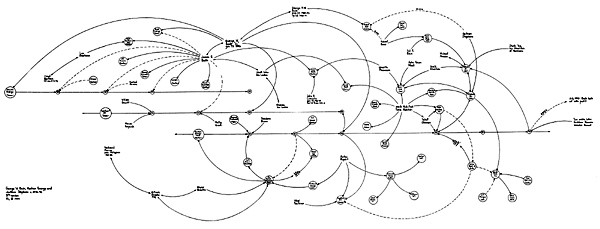
    And it reminds me of nothing so much as Mark Lombardi‘s fine art “conspiracy” graphs, like this one:

    lombardi graph

    — taken from Lombardi’s book, Global Networks, in which the artist draws the networks of influence surrounding eg oil and war in the Middle East — and which I’m sure can be found with a little effort for less than the $234.63 atvwhich Amazon currently offers a used paperback copy.

    **

    With thanks to Adam Elkus for pointing me to this concise icon of the Garden of Forking Paths.


    Switch to our mobile site