zenpundit.com » britain

Archive for the ‘britain’ Category

Descent into Barbarism

Wednesday, August 10th, 2011

London burns for four days as UK authorities dealt timidly and uncertainly with semi-organized swarms of brazen thugs, causing rioting to spread to other cities. What have we seen so far?

* The British government and police acted with moral uncertainty in the face of violent challenge from swarming tactics by “underclass youth” rioters.  The BBC was filled with interviews of victimized citizens complaining about how police were unwilling to intervene to stop acts of looting, assault and arson. Police behavior fed the cycle of rioting and encouraged fence-sitters to join in and swell the ranks of the mob, as did early talking head comments in the British media that argued that the rioters were “justified”

* The British government was politically paralyzed by the crisis and needed three days and a Cabinet meeting to begin to organize an effective anti-riot strategy, distribute proper equipment, summon additional manpower, change police ROE and marshal a rhetorical narrative against the rioters.  All the halmarks of excessive top-down control by out of touch technocrats and politicians.

 John Robb summed up this kind of anti-leadership beautifully in his review of Rebecca Solnit’s A Paradise Built in Hell  :

…In contrast to the people on the ground, she shows that the only people that actually do panic during disasters are the elites — from those with wealth to those running the government’s response (I’m not talking about the first responders actually on the ground doing good work).  They panic over the loss of control a disaster brings.  This often results in extreme actions that only serve to make things worse: from martial law authorized to use deadly force against looters (often just people trying to survive the situation) to arbitrarily hearding people into locations that aren’t able to support large groups of people.  

What This Means

The lesson here is that during an extreme disaster, the people you may most need to fear are those in charge, particularly if their motives are focused on protecting elite interests put at risk by the disaster

* The Cameron government’s legitimacy is at risk, being currently blamed for everything connected to the riot from the underlying “root causes”, to their initial total lack of interest in defending ordinary Britons to the bad impression made of having senior ministers being on vacation while the capitol of the UK was ablaze. Earnest and repeated assertions by government officials that no political or racial motives were behind the rioting conflicted with the reality being broadcast live by the government’s own news service in the first hours and days of the riot.

Handling a riot properly is state power 101. The Prime Minister has about two days to turn this situation and the political perceptions created around or he will begin an irreversible downward spiral to an early retirement.
2083 Graphics — a first look

Sunday, July 24th, 2011

[ by Charles Cameron — index of graphics, first 800 or so pages of the “2083 European Declaration of Independence”, with some analysis ]

.

A great deal of work needs to be done on the 2083 European Declaration of Independence, and I thought a useful place to start would be a catalog of images.

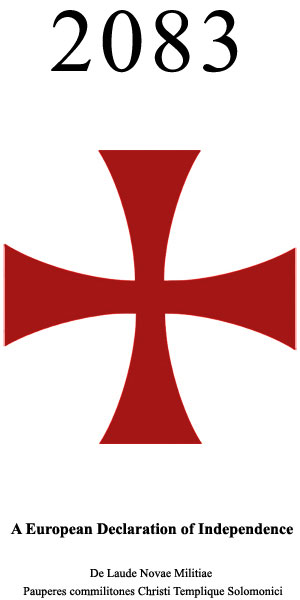
The document opens with a graphical title:

000-2083-cross-tp.jpg — title page —

That’s probably the largest single graphic in the entire work, and it puts the work squarely in the context of the Knights Templar — with e Templar cross and the full name of the order, “Pauperes commilitones Christi Templique Solomonic” or Poor Fellow-Soldiers of Christ and of the Temple of Solomon.  The Templars were a Western Christian chivalric order strongly associated with the Crusades — and the topic more recently of much historical, occult and fictional speculation.

The date 2083 is a date SFE (in the Science Fictional Era) as was 1984 before it — but it was almost certainly chosen for its echo of the 1683 Battle of Vienna, which is commonly taken to represent the turning back of the Ottomans by the Habsburgs, and thus the victory of Christendom over Islam.  Two maps show the Umayyad Conquests:

umayyad-conquests-p-228.jpg — p 228 —

and the Second Islamic Wave, turned back in Spain and at the gates of Vienna:

243-1683-second-islamic-wave-p-243.jpg — p 243 —

These can fruitfully be contrasted with a map of “tomorrow”:

demain-p-487.jpg — p 487 —

it being the author’s contention that France will be the first European country to fall to Islamic dhimmitude.  I suspect much the same is implied in this version of the French tricolore:

flag-face-p-781.jpg — p 781 —

There are some pointed attacks on leftist intellectuals:

033-academic-reform-p-33.jpg — p 33 —

and on media perceived as left-leaning, notably the BBC:

bbc-flag-w-crescent-p-384.jpg  — p 384

— that’s the Saudi flag mashed up with the BBC logo and star and crescent — and:

804-bbc-02-p-804.jpg  — p 804 —

giving both “ancient” and “modern” variants on the theme…

There are some strange items which I’ll drop in here for a breath of fresh air…

free-pluto-equal-gravity-for-all-planets-p-381.jpg  — p 381 —

which appears to be a commentary on the respective attractions of Venus and Mars, since it’s situated in a commentary on Feminism…

this really is a strangely mythic document… and…

global-warming-voidka-p-657.jpg

with its reference to “mind control agents” — and those whose minds have been controlled are clearly sheep:

wake-up-p-803.jpg — p 803 —

which may be the right moment to mention that the British, too, come in for a measure of contempt, via a quotation from none other than Osama bin Laden:

when-people-see-a-strong-horse-p-707.jpg  — p 707 —

“When people see a strong horse and a weak horse, by nature they will like the strong horse”.  Perhaps its unsurprising that the author is something of an admirer of bin Laden’s means, if not his ends.

Of course, that’s largely the fault of the Labour party:

labour-declares-multiculturalism-is-a-blessing-p-373.jpg

But that’s probably enough for one post — in my next, I’ll consider how weak we are, what the jihadist strategy against us is, and how the new Templars hope to turn the tide

against:

worst-threats-to-mankind-p-674.jpg — p 674 —

the worst threats to mankind.

Outrage Over News Corp: A Tale of Two Standards

Monday, July 18th, 2011

As a rule, I eschew political news here but I think this one merits an exception.

The big story of the moment for political junkies is the illegal hacking of cell phones allegedly carried out by employees of one of Rupert Murdoch’s British tabloid newspapers. Not just any phones either, the cell phones of British VIPs, political bigwigs, celebrities and perhaps, some 9/11 victims. All of the details have not been revealed, but there are police investigations, one of News Corp’s top employees has been arrested, parliamentary inquiries and demands by Murdochs political enemies there to have the British government “dismantle his empire“.

Rupert Murdoch is not, it must be said, a cuddly public figure. He is a press baron throwback to the era of Joseph Pulitizer and William Randolph Hearst and has a reputation for ruthlessness in business and overweening ambition in politics to gain personal influence for promoting his conservative views. He is a hate figure to Democratic and liberal partisans of the intolerant kind who see political disagreement as evidence of evil and would like FOXnews, one of Murdoch’s most influential and profitable properties, to be suppressed by the FCC (though Murdoch’s right-wing views did not preclude him from trying to cozy up to China’s communist leadership). These folks are naturally celebrating Murdoch’s dilemma and hoping for a collapse – and Murdoch and his son James are in genuine jeopardy, possibly legal, certainly political and commercial.

Much indignant outrage is being heaped on Murdoch’s head now by the enlightened; I have no love for phone hacking and I definitely agree that and violating people’s privacy is a crime that ought to be punished by sending those responsible to prison. I am curious though, how this position is squared morally with the fact that the two liberal news outlets most triumphant about the News Corp scandal, The New York Times and The Guardian, themselves recently were knowing accessories to the much more serious crime of espionage.

Actually calling these papers criminal accessories is not a full picture of their behavior during the Wikileaks document dump; it is more accurate to say that they reaped corporate financial benefit from facilitating espionage, grand theft and treason, for which their editors have not faced any legal consequences. 

Yes, treason. Look up the definition.

Much unlike the nobody Army private and patsy, Bradley Manning, who is likely to face a sentence of life in prison. Good thing for  Manning that he only outed a vast array of US intelligence and diplomatic secrets and exposed ordinary, unimportant, unprotected Afghans and Iraqis to murderous retribution by Islamist degenerates. If Manning had phonehacked a Labor MP or a wealthy, airhead celebrity – you know, really important and beautiful people – the NYT and the Guardian would be calling for a death sentence. It is a most curious scale of values.

Go back and look at which partisan blowhards with columns and bylines and talking head opinion shapers thought Wikileaks was just great and defended Julian Assange and what their opinion is on phonehacking today and see if any – any at all – evidence some consistency. Or awareness of the relative magnitude of each crime – and crime is the right word, neither of these scandals are mere pranks, but one is important to national security and the other, so far, is only interesting.

There’s something amiss here in the way that partisan politics and a seamy, not too subtle, undercurrent of class entitlement have warped the perspective and sense of proportion of some people who are smart enough to know better.

A Library vs. a Collection

Thursday, June 30th, 2011

Recall the “antilibrary ” discussion some years back, prompted by Nassim Nicholas Taleb?

The other day, I was having a conversation in the comments section regarding ancient Chinese philosophers with my learned friend Lexington Green, when I had cause to quote Nassim Nicholas Taleb, from his most recent book The Black Swan: The Impact of the Highly Improbable:

The writer Umberto Eco belongs to that small class of scholars who are encyclopedic, insightful, and nondull. he is the owner of a large personal library ( containing thirty thousand books), and separates vistors into two categories: those who react with ‘Wow! Signore professore dottore Eco, what a library you have! How many of these books have you read?’ and others – a very small minority- who get the point that a private library is not an ego boosting appendage but a research tool. Read books are far less valuable than unread ones. The library should contain as much of what you do not know as your financial means, mortgage rates, and the currently tight real estate market allow you to put there. You wil accumulate more knowledge and more books as you grow older, and the growig number of unread books on the shelves will look at you menacingly. Indeed, the more you know, the larger the rows of unread books. Let us call the collection of unread books an antilibrary.

A passage that immediately made me feel better about having resigned myself to falling further and further behind in reading the books that I keep purchasing ( I’m now also periodically finding myself going to IKEA to buy shelf extensions. I’ve resigned myself to that too).

Taleb was advocating building a library – an organized assemblage of books on a wide range of topics, of which the unread portion was your antilibrary. Libraries, private or public, are wonderful things, functioning in an earlier time as the poor man’s university. Andrew Carnegie endowed public libraries for that purpose and in past ages, wealthy patrons opened the doors of their private libraries to their favored scholars, like King George III did for Samuel Johnson.

My library is sizable but disorderly and eclectic. There are books on Turkic kingdoms and network theory, art history and classical economics, political memoirs and diplomatic papers, the “great books” and sci fi. And of course a great deal of books on strategy and history. My friends Lexington Green and Dave Schuler have far larger personal libraries and Lex’s, I can say firsthand, seems to be much better organized than mine ( though, admittedly, that would not be hard).

Recently, one of my uncles, an academic, decided he wanted to make me the eventual recipient of a major portion of his library, along with the funds to transport and shelve the books. This generous offer came with a proviso – that his collection is to be kept intact and passeed on only to someone else who would agree to keep it so. And it is really a collection and not a library. Naturally, I agreed

The difference between a library and a collection is puposeful focus and quality. My uncle decided on the advice of one of his mentors to really become a collector and decided to target the Hanoverian period of British history and only read and collect books that related directly in some way to the book previously read. He also specifically wanted to acquire rare editions and copies with the marginalia of important people from the period for purchase. My uncle also made a habit of going to the best rare and used bookstores (when he visits Illinois, Bookman’s Alley is his faviorite) wherever he happened to be. The uncle has been doing this for at least thirty+ years and has read his way forward to the early 20th century and in recent years, developed an extensive sub-collection dedicated to T.E. Lawrence.

Interestingly enough, none of this has anything remotely to do with his area of academic expertise (he has two doctorates; in a hard science and another in a medical specialty) but he’s made himself into more of an expert on the historiography of this period of British history than are most professional historians.The reason is a tunnel-like focus, which is the primary distinguishing characteristic between a building a general library and building a collection. There’s a comprehensiveness to a collection that becomes an end in itself.

books.jpg

Anglosphere Rising? The New Joint National Security Strategy Board

Tuesday, May 24th, 2011

Aaron Ellis of Egremont alerted me to this story today in The Guardian:

Barack Obama agrees to form joint national security body with UK

Barack Obama will announce during his first state visit to Britain this week that the White House is to open up its highly secretive national security council to Downing Street in a move that appears to show the US still values the transatlantic “special relationship”.

A joint National Security Strategy Board will be established to ensure that senior officials on both sides of the Atlantic confront long-term challenges rather than just hold emergency talks from the “situation room” in the White House and the Cobra room in the Cabinet Office.

….Britain believes that co-operation between the British and US national security councils marks a significant step. One British government source said: “The US and UK already work closely together on many national security issues. The new board will allow us to look ahead and develop a shared view of emerging challenges, how we should deal with them, and how our current policy can adapt to longer-term developments.”

The new board is a rare step by the White House, which guards the secrecy of the national security council. Founded in 1947 by Harry Truman, the NSC was in 1949 placed in the executive office of the president, who chairs its meetings.

Cameron tried to replicate the council when he established a body with the same name on his first full day as prime minister. It is chaired by the prime minister and designed to co-ordinate the work of the three Whitehall departments responsible for foreign affairs – the Foreign Office, the Ministry of Defence and the Department for International Development.

One government source said that Ricketts and Donilon would have to tread with care. “There is a little bit of disconnect between the two. The US national security adviser is a political appointment, whereas Sir Peter Ricketts is a civil servant. But this does make sense. We have a highly developed relationship with the USA where our military and intelligence officials work closely together. This is a useful move…

It is a start and I am heartened by the decision to formally include “strategy” as the body’s brief, that and the transatlantic nature coupled with bureaucratic differences may lead the new board to concentrate to a greater degree on looking at isues a strategic perspective rather than the S.O.P of wading into granular bureaucratic minutia. Given that I recently floated the idea of a Grand Strategy Board here ( along with Aaron), I can only be pleased to see a trend in that general direction from the Obama administration and our British allies.

Aaron was first on this story at Egremont, but he expresses some deep skepticism:

The Special Relationship lacks a purpose for the 21st century

….What immediately came to mind was the Combined Chiefs of Staff which, had it continued, might have become such a board. The engine to drive the Special Relationship forward. However, unless the UK is willing to throw away 40 years of foreign policy, the National Security Board (NSB) could be nothing more than a fair weather institution. The shared strategic interests that kept the alliance alive in the 20th century disappeared at the end of the Cold War. Other countries may prove more useful partners this century.

The given rationale for a NSB is to keep senior officials in touch with the broader challenges that face the two countries. Unfortunately, there are reasons why it might not succeed.

As global power shifts eastwards and emerging Asian states challenge US hegemony, Washington will be increasingly concerned with security and stability in the western Pacific. This is their broader challenge and President Obama is pursuing the correct policies in that region. The UK does not have a similar strategic clarity. If we want to enjoy the kind of relationship we enjoyed last century then our defence and foreign policies must expand east of Suez. Professor Michael Clarke, the head of the RUSI, has written that such a radical move “would represent the most judicious, and audacious, use of the hard/soft power combination yet seen in contemporary politics”. So far, however, the Government has shown no sign that it plans to make as big a shift as this in its ‘Big Picture’ thinking. Yet without it the NSB may prove fit only for fair weather.

….Nor do I see how the NSB can solve the institutional problems that I outlined last month. The board is supposed to move beyond crisis management, with senior officials from each side of the Atlantic focusing on the bigger picture. Given both countries’ bureaucracies have been promoting problem solvers at the expense of strategists, it isn’t evident that thinking will suddenly become more long-term. The same people will be shaping things, just this time sharing hats with Anglo-Saxon cousins. As with the Grand Strategy Board, the NSB’s utility also depends on the extent to which it taken seriously by our leaders. “You can organise government all you like, but strategy is an essentially political process that comes from the top,” Julian Lindley-French told MPs last September.

I think Aaron is spot on with the last paragraph.

Strategy is the crystallization of a kind of thinking process that needs to be present in the room or what you will have in the NSSB is a “coordination council” rearranging the deck chairs instead of charting the course. The British Cabinet and the Obama administration should strongly consider adding a few mutually acceptable wise men who do not have to juggle the supremely hectic schedules of a Foreign Secretary or a National Security Adviser, or at least some executive staffers recommended for the excellence of their strategic thinking.  It will help lean against the relentless and universal gravitational pull of bureaucratic and political culture toward the short term time horizon and the tactical details.


Switch to our mobile site