Archive for the ‘Perception’ Category
Sunday, February 6th, 2011
[ by Charles Cameron — cross-posted from Brainstormers on the Web ]

There are so many possible lessons to take here:
That a single image speaks louder than dozens of words. That we are more easily persuaded by images than by words. That FB and Twitter are clearly important to Egyptian youth. That dozens of words can convey nuances that a single image misses. That FB and Twitter were at best among the vehicles, rather than the drivers, of the events of January 25th.
That we’d do well to bear the Aristotelian distinction between material, formal, efficient and final causes in mind when talking about what “caused” or “becaused” those events – and elsewhere.
That the simple juxtaposition of two closely similar ideas can illuminate both, and perhaps create a spectral “third thing” which possesses the full detail of both with greater depth than either one in a single understanding, by a sort of stereo process not too different from stereoscopic vision or stereophonic sound.
That we live in exciting times…
Posted in analogy, analytic, arab world, Charles Cameron, cognition, complexity, computers, connectivity, culture, democracy, dictator, Epistemology, framing, free speech, freedom, innovation, insight, insurgency, islamic world, logic, media, meme, metacognition, Perception, propaganda, psychology, revolution, social science, symmetry, synthesis, Viral, wired | 2 Comments »
Sunday, February 6th, 2011
[ by Charles Cameron ]
Okay, the Reagan Roundtable is happening, and I hope to contribute to it later. In the meantime, I don’t want to disrupt the flow at ChicagoBoyz, so I’ll continue posting my non-Reagan material here — since here at ZP we’re excerpting and hollering and supporting but not actually hosting the Roundtable, and since Egypt, after all, is not waiting for the Roundtable to be over before continuing on its path of discovery…
Having said which:
*
I’m not the only one who’s eye is caught by DoubleQuotes, I see.
I ran across this one at the top of a piece by Esam al-Amin on CounterPunch entitled Mubarak’s Last Gasps, where al-Amin had made it his double epigraph — and even though I’m almost totally ignorant of the writings of Vladimir Ilyich and hope to keep things that way, I do think Quote #1 is quite a fine aphorism.
And having recently posted One for Zen and the Boydz here (remember that?), I really couldn’t resist this follow-up!
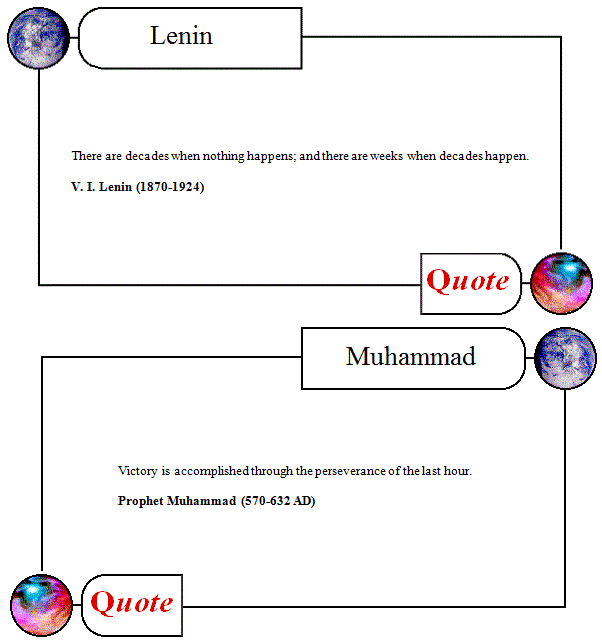
Very apt for the last few weeks.
Mind you, I think there’s an apocalyptic hint to Quote #2, which bears an interesting resemblance to Matthew 24:13:
But he that shall endure unto the end, the same shall be saved.
Posted in analogy, arab world, Charles Cameron, christianity, Communism, framing, islamic world, Perception, psychology, reform, revolution, symmetry | Comments Off on Another one for Zen and the Boydz
Thursday, February 3rd, 2011

My amigo Sean Meade ponders:
Notes: The Problem with Sparta
So here are some of the ideas and notes, for posterity.The Problem with Sparta (and Greece)
References
300 (original graphic novel by Frank Miller and better-known movie)
Gates of Fire, Steven Pressfield
The Peloponnesian War, Thucydides
A War Like No Other, Victor Davis Hanson
Sailing the Wine-Dark Sea, Thomas Cahill
The fiction glorifies Sparta while the non-fiction is more critical than laudatory. I was struck by how much the fictional Sparta, in three stories I really love, did not match the history I’d been studying.
Did Pressfield make his story more palatable to his readership by soft-pedaling Helot slavery, radical conservatism and aristocracy, oligarchy and homosexuality and pederasty?
We moderns are very critical of the real, historical Sparta. Insofar as it stands in for Greece in the fiction above, it’s an inaccurate portrayal. To say nothing of all the problems with our view of the Golden Age of Athens…
Ah, the tension between history and myth.
Admiration for ancient Sparta was imprinted into Western culture because Sparta’s Athenian apologists, including Xenophon but above all Plato, left behind a deep intellectual legacy that includes a romantic idealization of Sparta that contrasts sharply with the criticisms leveled by Thucydides against Athens in The Peloponnesian War. The Melian Dialogue remains a searing indictment against Athens 2,500 years later but no equivalent vignette tells the tale of the Helots living under the reign of terror of the Spartan Krypteia. Plato’s Republic upholds oligarchic authoritarianism inspired by Sparta as utopia while Athenian democracy is remembered partly for the political murder of Socrates and the folly of the expedition to Syracuse. Somehow, ancient Athens lost the historical P.R. war to a rival whose xenophobic, cruel, anti-intellectual and at times, genuinely creepy polis struck other Greeks as alien and disturbing, no matter how much Sparta’s superb prowess at arms might be applauded.
The fact that the vast majority of the ancient classic texts were lost, or as Dave Schuler likes to note, very selectively preserved and edited – at times, invented – by later peoples with agendas, may account for some of the discrepancy.
Posted in 300, academia, ancient history, authors, book, classics, culture, democracy, dystopia, fiction, frank miller, historians, historiography, history, ideas, intellectuals, interact, meme, movies, myth, Oligarchy, Perception, philosophy, propaganda, reading, Republic, sean meade, social science, spartans | 5 Comments »
Tuesday, February 1st, 2011
[ by Charles Cameron ]
Posted in analogy, analytic, Charles Cameron, humor, john boyd, movies, Perception, rule-sets, symmetry | 3 Comments »
Monday, January 31st, 2011
[ by Charles Cameron, cross-posted from Brainstormers on the Web ]
Here are two data-points to drop into the mind-pool as we think about current events in Egypt, the Middle East in general, and the way the world turns.

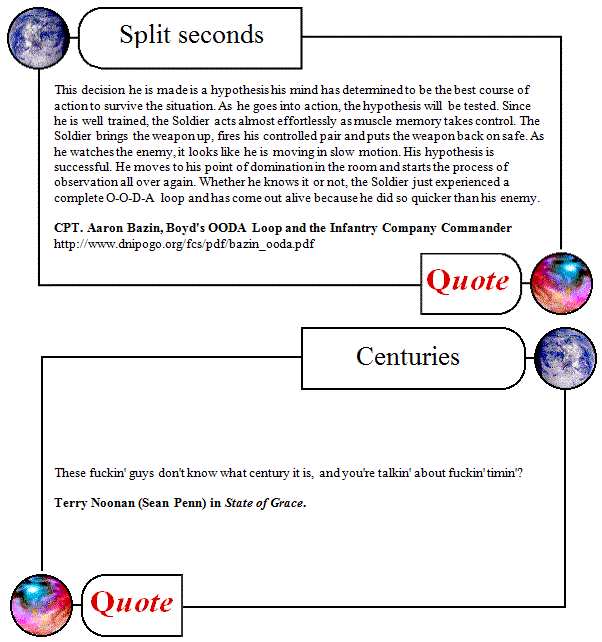
DoubleQuotes is my name for the format I’m using here, which I came up with a few years back on Brainstorms. The idea is simply to generate fresh insights by juxtaposing two thoughts – be they images, quotes, or even equations (I don’t have the technical chops for music or film clips yet) — in condensed, haiku-like form.
Think of them as pebbles dropped in a pond, watch the ripples…
[ note to Zenpundit readers: I’ll say more about Brainstorms and Brainstormers on the Web in a week or two, once the “on the Web” blog gets under way ]
Posted in America, arab world, Charles Cameron, culture, diplomacy, framing, geopolitics, insight, mideast, national security, Perception, psychology, public diplomacy, symmetry | Comments Off on Egypt: tear-gas and hotels


