zenpundit.com » Perception

Archive for the ‘Perception’ Category

How to Run a War Room

Sunday, October 31st, 2010

Hint: You need to know your Boyd.

British political consultant James Frayne at Campaign War Room explains:

Creating an effective war room

….War rooms are therefore places which can pull in relevant information, which can process it effectively by working out what is most important at a given moment, and which can make timely decisions as a result of processing this information. They must become expert in Boyd’s OODA loop – Observe, Orient, Decide, Act (although I appreciate some prefer to think of this the other way round – you inevitably act first, and observe after).

War rooms should have the following characteristics:

  • They must have clear objectives. In electoral politics, the objective is clear: win the election. In permanent campaigns or in business, objectives are usually less clear. Is the war room there to act as a rapid rebuttal machine, for example, to defend a business’ reputation (Wal-Mart set one of these up back in 2005)? Or is it to help re-organise a business? War room staff must know exactly why they are there.
  • They should have a small staff and clear lines of authority. War rooms are often created because prior decision-making structures failed, perhaps because there were too many people involved in discussions, or because no one knew where authority lay. These were reasons why the most famous political war room of all – Clinton’s in 1992 – was created. They need be tight so that people don’t get bogged down by endless people given their opinions, and they need to have clear lines of authority so that everyone knows who can make what decision.
  • They must have executive authority. It sounds like an obvious point and in many ways it is, but I remember one campaign where we worked in the campaign office but ultimate authority for decisions lay off-site. It was a debacle as you can imagine. War rooms must contain those people who can actually make decisions.

Read the rest here.

Guest Post:A Hipbone Approach to Analysis III.

Saturday, October 30th, 2010


Charles Cameron is the regular guest-blogger at Zenpundit, and has also posted at Small Wars Journal, All Things Counterterrorism, for the Chicago Boyz Afghanistan 2050 roundtable and elsewhere.  Charles read Theology at Christ Church, Oxford, under AE Harvey, and was at one time a Principal Researcher with Boston University’s Center for Millennial Studies and the Senior Analyst with the Arlington Institute:

A Hipbone Approach to Analysis III.

by Charles Cameron

I’ve been slowly prepping this series of pieces about my analytic approach — and the mysterious business of “connecting the dots” — for a while, but.. Jeff Jonas, whose work I only recently ran across, has given me “another piece of the puzzle” and a slew of new dots to connect, so here’s a quick impression of some new (for me) terrain that connects with other areas I have long been familiar with.

1

What it comes down to in my post today is this: I would like to reconcile “connecting the dots” with “putting together the pieces of the puzzle”.

Both metaphors have to do with “seeing the big picture”, and one of them (“connecting the dots”) has to do directly with nodes and edges, i.e. with those systems we call graphs and networks, while the other suggests a far subtler set of connections.

Consider this: n+1 is the next dot in the series of integers after n, with “+1” being the only link necessary — you can represent that on a graph with two nodes and an edge. But if you had the sky of the northern hemisphere in one hand (hey, this is a thought experiment) and five square miles of landscape around Winchester Cathedral in the other, finding just where to fit the cathedral (and the surrounding, branching, leafy trees nearby) snugly into the sky would be a far trickier business, and the links between air and leaf and stone molecules would be very many — we should be grateful for the ease with which the sky accommodates itself in reality to the cathedral and the trees (and the cathedral and the trees to the sky) — and for the ease with which a painter like Turner can capture the effect…
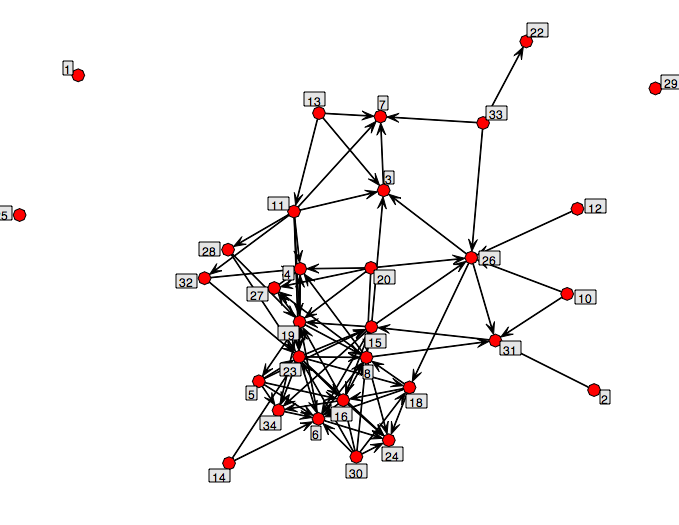
Two puzzle pieces, I mean, may have to fit along many aspects of their intersection, while dots can be connected by a single common thread.

2

I’ve only recently “met” the mind of Jeff Jonas, but he has some remarkable things to say about puzzles — for one thing, he writes about the levels of, well, computation involved in solving a jigsaw puzzle:

The first piece you take out of the box and place on the work surface requires very little computational effort. The second and third pieces require almost equally insignificant mental effort. Then as the number of pieces on the table grows the effort to determine where the next piece goes increases as well. But there is a tipping point where the effort to determine where to place the next piece gets easier and easier … despite the fact the number of puzzle pieces on the table continues to grow.

That in itself is a fascinating thought to dwell on, in fact it’s the sort of piece of the puzzle that gives me an epiphany — Jonas talks about puzzle pieces that provoke epiphanies, too:

Some pieces produce remarkable epiphanies. You grab the next piece, which appears to be just some chunk of grass – obviously no big deal. But wait … you discover this innocuous piece connects the windmill scene to the alligator scene! This innocent little new piece turned out to be the glue.

I’m processing this as a theologian / philosopher / poet, and Jonas has just given me a new angle on the theme of the intersection of frames of reference that Arthur Koestler in The Act of Creation takes to be the fundamental element in insights ranging all the way from casual jokes about rabbis to — let me give you a more powerful example — the Taniyama-Shimura Conjecture which, if I’ve understood the layman’s version correctly, began as a hunch that the otherwise entirely distinct mathematical zones known as “elliptic curves” and “modular forms” could be mapped onto each other – and wound up once proven, successfully bridging algebra with analysis.

Now, I am no no no no mathematician — but I am a student of conceptual bridges, so if I’ve phrased myself poorly here, please bear with me. The point is to think freshly about how one idea connects with another.

Koestler’s insight at the intersection between two fields (for this is essentially a matter of multiple-frame, and thus cross-disciplinary, thinking) is, I’d suggest, Jonas’ epiphanic piece of the puzzle.

Awesome.

3

But as we are trying to figure out the puzzle pieces — and this applies to “what is the meaning of life?” as much as to “what threat should be uppermost in our concern?” — Jonas has more to throw at us:

There may be more than one puzzle in the box, some puzzles having nothing to do with others. There may be duplicate pieces, pieces that disagree with each other, and missing pieces. Some pieces may have been shredded and are now unusable. Other pieces are mislabeled and/or are exceptionally well crafted lies.

I would like to add that puzzles may not be the only thing in the (universal) box. There’s a quote that originates somewhere in Heidegger, to the effect that “A puzzle is the unknown, to be solved, while a mystery is the unknowable, to be entered into and dwelt within.” As I say, I’ve only just run into Jonas’ thoughts, but I’d like to integrate that piece of the puzzle in with the ideas he’s providing – why not have a go at the mystery too while we’re about it?

4

So what happens with ideas? How do they connect?

Hermann Hesse, the Nobel laureate in literature who gave us Siddhartha and Steppenwolf and The Journey to the East, won his Nobel for his most ambitious novel, The Glass Bead Game (Das Glasperlenspiel, also known in English as Magister Ludi). It is an amazing piece of work that inspired at least one other book by another Nobel laureate — Manfred Eigen’s Laws of the Game: How the Principles of Nature Govern Chance — gave John Holland (he of genetic algorithms) the ruling metaphor for his life’s work, was an early and profound influence on Christopher Alexander’s thinking about pattern languages, and in general serves as a catalyst for grand scale creativity among a disparate crowd of very bright minds.

It is about a game — a game on the order of the complete works of JS Bach. And the essence of the game is the juxtaposition of thoughts.

It is about “connecting the dots” and “putting together the pieces of the puzzle” on the grand scale, to create not a single link between ideas, not a small “bigger picture” deploying a half-dozen or so insights, but a vast architecture of ideas that encompasses all “deep” human thought and connects all “beautiful” cognizable patterns. Hesse uses the image of an organist playing an organ to describe the play of ideas that composes his Game, writing:

All the insights, noble thoughts, and works of art that the human race has produced in its creative eras, all that subsequent periods of scholarly study have reduced to concepts and converted into intellectual values the Glass Bead Game player plays like the organist on an organ. And this organ has attained an almost unimaginable perfection; its manuals and pedals range over the entire intellectual cosmos; its stops are almost beyond number.

And in Hesse’s central, musical metaphor, the myriad thoughts that comprise what he terms the “hundred-gated cathedral of Mind” are linked one with another by likeness — by identity, isomorphism, homology, symmetry, parallelism, opposition, analogy, metaphor…

5

I’ll have to move us deep into the territory of the arts and humanities here, because Hesse himself was supremely versed in those areas, but in doing so I would remind you that John Holland wrote of his life’s work, “If I could get at all close to producing something like the glass bead game I can’t think of anything that would delight me more.”

Here’s Hesse on the analogical / isomorphic nature of the moves that connect ideas — “only connect!” said EM Forster — in his great Game:

Throughout its history the Game was closely allied with music, and usually proceeded according to musical or mathematical rules. One theme, two themes, or three themes were stated, elaborated, varied, and underwent a development quite similar to that of the theme in a Bach fugue or a concerto movement. A Game, for example, might start from a given astronomical configuration, or from the actual theme of a Bach fugue, or from a sentence out of Leibniz or the Upanishads, and from this theme, depending on the intentions and talents of the player, it could either further explore and elaborate the initial motif or else enrich its expressiveness by allusions to kindred concepts. Beginners learned how to establish parallels, by means of the Game’s symbols, between a piece of classical music and the formula for some law of nature. Experts and Masters of the Game freely wove the initial theme into unlimited combinations. For a long time one school of players favored the technique of stating side by side, developing in counterpoint, and finally harmoniously combining two hostile themes or ideas, such as law and freedom, individual and community. In such a Game the goal was to develop both themes or theses with complete equality and impartiality, to evolve out of thesis and antithesis the purest possible synthesis.

It is Bach, it is Hegel, it is the very essence of creativity, it is the associative, metaphoric nature of mind and brain (and I won’t get more than toe-deep in the “deep problem” of consciousness here).

6

And it does involve combining the understanding of both puzzle and mystery, to return to that distinction from Heidegger:

I suddenly realized that in the language, or at any rate in the spirit of the Glass Bead Game, everything actually was all-meaningful, that every symbol and combination of symbols led not hither and yon, not to single examples, experiments, and proofs, but into the center, the mystery and innermost heart of the world, into primal knowledge. Every transition from major to minor in a sonata, every transformation of a myth or a religious cult, every classical or artistic formulation was, I realized in that flashing moment, if seen with a truly meditative mind, nothing but a direct route into the interior of the cosmic mystery, where in the alternation between inhaling and exhaling, between heaven and earth, between Yin and Yang, holiness is forever being created.

Hesse is proposing his intuition that the world of ideas is a mandala-form array of symmetries with a “vanishing point” in the center.

Well, I have leapt far from my original topic, Jeff Jonas’ comments on piecing together a puzzle, but I hope the bungee-cord I’ve been depending on has held your attention, and now as always, at the far end of the extension there’s a bouncing-back.

7

The human mind “connects the dots” and “pieces together the puzzle” by recognizing likenesses — pattern recognition, if you like.

But just how human analogical thinking functions is not exactly an easy question…

Guest post: A Hipbone Approach to Analysis II.

Friday, October 29th, 2010

 Charles Cameron is the regular guest-blogger at Zenpundit, and has also posted at Small Wars Journal, All Things Counterterrorism, for the Chicago Boyz Afghanistan 2050 roundtable and elsewhere.  Charles read Theology at Christ Church, Oxford, under AE Harvey, and was at one time a Principal Researcher with Boston University’s Center for Millennial Studies and the Senior Analyst with the Arlington Institute:

A Hipbone Approach to Analysis II.

by Charles Cameron

Let’s call this one Hopscotch across the disciplines.

…our intelligence community failed to connect those dots…
        –  President Obama, Remarks on Security Reviews, Jan 05, 2010

I’ve been giving quite some thought over the past fifteen years to this issue of connecting dots.

My internet handle, hipbone, does double duty for me, since it refers to Ezekiel’s apocalyptic prophecy as featured in the lyric, “hip bone connected to you back bone”, in the old spiritual, Dem Bones, Dem Dry Bones. On the one hand it points to apocalyptic, by which I mean the soon expectation of a sudden and complete transformation in world affairs, very possibly accompanied, triggered or accomplished by extreme violence, with the end result being a highly favored “new heaven and new earth” or “new world order” depending on who is doing the expectation. On the other hand, it points directly to the idea of “connecting the dots” itself, since the entire song is about connections. I have been working on both fronts at least since 1995.

1

Connecting the dots is a matter of thinking, and there are two basic strategies of thought available to the human mind: linear thinking, which proceeds via cause and effect along a single track, and which is the major style of thought used within disciplinary silos, and lateral thinking, which skips sideways across silos and disciplines on wings of metaphor and analogy. Machines can crunch numbers and do some of our linear thinking for us: but it’s up to the analysts to cover the lateral front.

2

Let’s go aphoristic:

Expectation is algorithm: there are no algorithms for the unexpected.

I’d like to connect the dots … to blind spots.

Blinds spots are the spots we can’t, or won’t, and in any case don’t see. They fall into the category of the invisible. Visionaries are those who can see the invisible, who peer into our blind spots, into those places where we can’t see the connections between the dots, and can therefore easily be blind-sided. There’s an almost Borgesian thickness to the way things tie into one another here: the unexpected is by definition what we can’t predict, what blunt force thinking can’t predict — but it’s not invisible to those whose practice is to peer into the invisible, to aficionados of the subtler associative / metaphorical strategy…

3

Let’s go mythic.

There are two major strategies in life, two main ways of tackling problems, just as there are two heroes in the ‘Spider Woman” myth, which Joseph Campbell said was the central myth of the Americas. In Navajo terms, these twin heroes are called Monster Slayer and Child Born of Water, and their names may already give us the sense that one represents a brute force approach while the other is cannier, subtler — and able to achieve things his twin could barely imagine.

The Massive Ordnance Penetrator may be able to penetrate 60 feet of concrete, but the Grand Canyon was created by the natural flow of water — and as Lao Tzu said, “Nothing under Heaven is more soft and yielding than water, yet for eroding the hard and strong, nothing can surpass it.”

You can pitch this one-two punch at a variety of levels. The military can be seen as the nation’s Monster Slayer, its intelligence community as the Child Born of Water. You could see Thomas Barnett’s Leviathan as Monster Slayer, his SysAdmin as Child Born of Water. Or within the IC, you could say that software that can “crunch mega amounts of data” takes the Monster Slayer approach — but it requires cognitive skills and insight of a Child Born of Water sort to know when a student’s slightly eccentric interest represents a threat to the lives of three thousand office workers…

4

Let’s go analogic.

I’m thinking of the flight school students who “focused on learning to control the aircraft in flight, but took no interest in takeoffs or landings” — who asked one instructor where they could take lessons on jets without learning to fly smaller planes first, a request he concluded indicated they were “either joking or dreaming”.

In the not-so-terror-conscious atmosphere pre-9/11, a lack of interest in takeoffs and landings might have seemed quirky — but the “connections” weren’t obvious enough for the info to travel all the way up the FBI food-chain to the very top, as it would today. In post-9/11 retrospect, such things look a bit different – but I presume it still took reasoning by analogy for an instructor in a SE Asian diving school to recognize that a student who appeared less interested in the business of avoiding the bends and surfacing safely than in learning underwater swimming might pose a similar threat.

With 20/20 hindsight, this sort of thing seems glaringly obvious: even Monster Slayer could see it.

5

Let’s think about ignorance for a moment.

There’s Rumsfeld’s famous quip about known unknowns and unknown knowns, there are the genres of black swans and unintended consequences, there is what’s obvious and non-obvious, there are blind spots and hidden assumptions — and it’s the non-obvious that blindsides us, right?

We could rephrase the Spider Woman idea to state that Monster Slayer proceeds in terms of the obvious, while Child Born of Water works with the non-obvious. Jami Miscik, at that time Deputy Director for Intelligence at CIA, once remarked, “To truly nurture creativity, you have to cherish your contrarians and give them opportunities to run free”.

Child Born of Water is the contrarian, the maverick, the one whose oblique angle on things provides insight by… making non-obvious connections between the non-visible dots.

Guest Post: Mexico, Africa, Zarqawi?

Thursday, October 28th, 2010

Charles Cameron is the regular guest-blogger at Zenpundit, and has also posted at Small Wars Journal, All Things Counterterrorism, for the Chicago Boyz Afghanistan 2050 roundtable and elsewhere.  Charles read Theology at Christ Church, Oxford, under AE Harvey, and was at one time a Principal Researcher with Boston University’s Center for Millennial Studies and the Senior Analyst with the Arlington Institute:

Zen here – I think Charles has hit upon a primal psychological mechanism that comes into full flower as societies break down and war begins to shade into warlordism. We have seen this repeatedly in history from Tamerlane’s mounds of skulls to Khmer Rouge killing fields. Mad Barons, Dogmeat Generals, Friekorps kapteins and butchers long since forgotten by history- there’s a gravitational pull toward atavistic, symbolic, destruction as social norms erode under the corrosive effects of escalating violence.

Mexico, Africa, Zarqawi?

by Charles Cameron

I’ve been struck by a couple of passages I’ve run across in my reading recently that remind me of what I can only call “brutality with religious overtones”.
1. Mexico

There have been a fair number of articles about the various Mexican cartels, but the excerpt from Ed Vulliamy’s book, Amexica: War Along the Borderline that’s now online at Vanity Fair is the one that caught my eye yesterday.

Here’s Vulliamy’s account of a conversation with Dr. Hiram Muñoz of Tijuana:

He explained his work to me during the first of several visits I have made to his mortuary. “Each different mutilation leaves a message,” he said. “The mutilations have become a kind of folk tradition. If the tongue is cut out, it means the person talked too much—a snitch, or chupro. A man who has informed on the clan has his finger cut off and maybe put in his mouth.” This makes sense: a traitor to a narco-cartel is known as a dedo — a finger. “If you are castrated,” Muñoz continued, “you may have slept with or looked at the woman of another man in the business. Severed arms could mean that you stole from your consignment, severed legs that you tried to walk away from the cartel.”<¶>Earlier this year, 36-year-old Hugo Hernandez was abducted in Sonora; his body turned up a week later in Los Mochis, Sinaloa, but not in a single piece. His torso was in one location, his severed arms and legs (boxed) in another. The face had been cut off. It was found near city hall, sewn to a soccer ball.

That’s the brutality — I haven’t see the book itself yet, but I gather it also gets into the narco-corrida music and the “quasi-Catholic cult of Santíssima Muerte” — which brings me to the second part of my interest – the religious aspect.

As Vulliamy mentions, there’s the cult of Holy Death, to be sure, a sort of shadow or inverse of the Blessed Virgin — a Dark Mother for dark times, or perhaps a revival of the ancient Mictlancihuatl, lady of the Dead? — with her own liturgy, too:

Almighty God: in the name of the Father and of the Son and of the Holy Spirit, we ask for your permission to summon Saint Death. Welcome, White Sister: we find ourselves gathered here at this altar of the Romero Romero family and of each one of us, to offer you a Mass that we hope you will like…

Which brings us to the Robin-Hood-like bandit and folk-saint, Jesus Malverde, to whom prayers such as the following [FBI .pdf, see p. 20] are offered:

Lord Malverde, give your voluntary help to my people in the name of God. Defend me from justice and the jails of those powerful ones. Listen to my prayer and fill my heart with happiness. For you shall make me fortunate.

There are even miracles attributed to him:

Oh Malverde! The Vatican did not believe you to be holy and would not canonize you, but when they brought the Caterpillars to tear down your hood, you broke one machine and nobody could move you away, you broke another, leaving those who disrespect you speechless — and when the third one broke, they said, “Let Malverde’s chapel alone.”

Right beside the syncretistic quasi-Catholicism, there’s also a Protestant angle: La Familia is the group that, in Vulliamy’s words, “made its ‘coming out’ known in a famous episode: bowling five severed heads across the floor of a discotheque.” Time magazine reported on what it termed Mexico’s Evangelical Narcos:

Federal agents seized one copy of La Familia’s Bible in a raid last year. Quoted in local newspapers, the scripture paints an ideology that mixes Evangelical-style self-help with insurgent peasant slogans reminiscent of the Mexican Revolution. “I ask God for strength and he gives me challenges that make me strong; I ask him for wisdom and he gives me problems to resolve; I ask him for prosperity and he gives me brain and muscles to work,” Moreno writes, using terms that could be found in many Christian sermons preached from Mississippi to Brazil. But on the next page, there’s a switch to phrases strikingly similar to those coined by revolutionary Emiliano Zapata. “It is better to be a master of one peso than a slave of two; it is better to die fighting head on than on your knees and humiliated; it is better to be a living dog than a dead lion.”

As I commented on Zenpundit a while back,

What’s troubling here is that there is only one undoubtedly “evangelical” phrase in all those that Time quotes, and it is one of then ones said to resemble the aphorisms of Emilio Zapata. “It is better to be a living dog than a dead lion” is a pretty direct borrowing from Ecclesiastes 9.4 in the King James Version: “To him that is joined to all the living, there is hope: for a living dog is better than a dead lion.”

But that’s not actually all. I didn’t mention it at the time, but “I ask God for strength and he gives me challenges that make me strong; I ask him for wisdom and he gives me problems to resolve; I ask him for prosperity and he gives me brain and muscles to work” is almost word-for-word the same as a poem attributed to Islam — or Judaism for that matter. Indeed, it can be hard to tell who is borrowing from whom – but one final source for the La Familia bible is known – it’s the book Wild at Heart by John Eldredge, the pastor of a ministry in Colorado Springs, who must have been surprised at the uses to which his writings were being put.

In any case, as I said on Zenpundit: These people have a theology, and we should be studying it.
2. Africa

My thoughts turned to Africa when I read another paragraph recently, this one from Johann Hari’s review, The Valley of Taboos, of V.S. Naipaul’s new book, The Masque of Africa: Glimpses of African Belief:

I have stood in a blood-splattered house in Tanzania where an old woman had just been beaten to death for being a “witch” who cast spells on her neighbors. I have stood in battlefields in the Congo where the troops insist with absolute certainty they cannot be killed because they have carried out a magical spell that guarantees, if they are shot, they will turn briefly into a tree, then charge on unharmed. I have been cursed in Ethiopia by a witch-doctor with “impotence, obesity, and then leprosy” for asking insistently why he charged so much to “cure” his patients. (I’m still waiting for the leprosy.) Where do these beliefs come from? What do so many Africans get out of them? Can they be changed? These are questions that are asked in Africa all the time, but we are deaf to the conversation.

That sent me in search of some early military anthropology related to guerrilla warfare I’d come across in earlier readings.

James R Price and Paul Jureidini’s 1964 Witchcraft, Sorcery, Magic, and Other Psychological Phenomena and their Implications on Military and Paramilitary Operations in the Congo, and Roger D Hughes’s 1984 Emergency in Kenya: Kikuyu and the Mau Mau Insurrection are both of considerable interest here — but it is LSB Leakey, the world-class British archaeologist initiated as a boy into the Kikuyu ways, who has written the most provocative summary of the relationship between political and religious violence and ritual that I’m interested in tracking.

I’m quoting here from the chapter on “The Mau Mau Religion” in Maj. Hughes paper:

Leakey’s original hypothesis in Mau Mau and the Kikuyu: “Mau Mau was nothing more than a new expression of the old KCA … a political body that was banned … because it had become wholly subversive.” Furthermore, “Mau Mau was synomomous with the new body called the in school, Kenya African Union…” However, Leakey admits to a reversal of his original hypothesis in Defeating Mau Mau, and goes on to say, “Mau Mau, while to some extent synonymous with these political organizations, was in fact a religion and owed its success to this fact more than to anything else at all.”<¶>He then proceeds to attribute the origin of Mau Mau to an “ideology transfer,” wherein the religious beliefs of the Kikuyu transitioned from their ancient tribal religion to Euro-Christianity to Mau Mau. The first transition took place artificially, as the missionaries stripped away the traditional beliefs and supplanted them with “20th Century Europe’s concept of Christianity.” The second transition was more natural and evolutionary than the first. A reactionary hybrid of the old and the new developed, because the supplanted concepts would not hold up in their society. There were too many contradictions between the old and the new, mainly due to the 20th Century European “add-ons.”

Most of us have a pretty fixed view of what religion is, should be, or isn’t. Some of my readers no doubt hold to a evangelical Christian position, some are Catholic, some perhaps Buddhist, agnostic or atheist, and some perhaps Muslim. Each of us tends to take our own view of a particular religion as normative, but the reality is that the history of each of the great world religions contains sanctions for both peace-making and warfare — and human nature itself encompasses a range of behaviors that run from the kind of atavistic violence described above to the forgiving and compassionate impulse behind the Beatitudes…

And while economic pressures and political frustrations may be enough to power great struggles, when religious rituals, beliefs and feelings are added into the mix, it can quickly become even more lethal.
3. And Zarqawi?

All of which leaves me wondering how close the parallels are between the Mau Mau in LSB Leakey’s account, La Familia and the other Mexican cartels — and the brutalities of jihadists such as Abu Musab al-Zarqawi.

Guest Post: Of Weaponry and Flags II.

Wednesday, October 27th, 2010

Charles Cameron is the regular guest-blogger at Zenpundit, and has also posted at Small Wars Journal, All Things Counterterrorism, for the Chicago Boyz Afghanistan 2050 roundtable and elsewhere.  Charles read Theology at Christ Church, Oxford, under AE Harvey, and was at one time a Principal Researcher with Boston University’s Center for Millennial Studies and the Senior Analyst with the Arlington Institute:

[Originally cross-posted at Chicago Boyz]

Of Weaponry and Flags II.

by Charles Cameron

YT in a comment on Zenpundit just pointed me to a quote from Virilio’s War and Cinema, Scott meanwhile suggested I might be interested in Meaning by Michael Polanyi – and between the two of them, I find myself wanting to make a trilogy of quotes that present the symbolic impact of flags from philosophical, psychological and neurological perspectives, thus (I hope) braiding together from somewhat disparate sources a simple, non-dualistic insight. From Michael Polanyi and Harry Prosch, Meaning, pp. 72-73:

The focal object in symbolization, in contrast to the focal object in identification, is of interest to us only because of its symbolic connection with the subsidiary clues through which it became a focal object. What bears upon the flag, as a word bears upon its meaning, is the integration of our whole existence as lived in our country. But this means that the meaning of the flag (the object of our focal attention) is what it is because we have put our whole existence into it. We have surrendered ourselves to that “piece of cloth” (which would be all the flag could be perceived to be were we to try to view it in the indication way of recognizing meaning). It is only by virtue of our surrender to it that this piece of cloth becomes a flag and therefore becomes a symbol of our country. Some of the subsidiaries, then, that bear upon the flag and give it meaning are our nation’s existence and our diffuse and boundless memories of our life in it. These, however, not only bear upon the flag as other subsidiary clues bear upon their focal objects, but they also, in our surrender to the flag, become embodied in it. The flag thus reflects back upon its subsidiaries, fusing our diffuse memories. We cannot use a straight arrow to express this feature in our diagram, since such an arrow pictures only a straight, one-directional bearing-upon. We must make the arrow loop, in symbolization, in order to express the way our perception of the focal object also carries us back toward (and so provides us with a perceptual embodiment of) those diffuse memories of our own lives (i.e., of ourselves) which bore upon the focal object to begin with. This is how the symbol can be said to “carry us away.” In surrendering ourselves, we, as selves, are picked up into the meaning of the symbol.

From Murray Stein, Jung’s map of the soul: an introduction, p 100:

Life itself may be sacrificed for images such as the flag or the cross and for ideas like nationalism, patriotism, and loyalty to one’s religion or country. Crusades and countless other irrational or impractical endeavors have been engaged in because the participants felt, “This makes my life meaningful! This is the most important thing I’ve ever done.” Images and ideas powerfully motivate the ego and generate values and meanings. Cognitions frequently override and dominate instincts. In contrast to the impact of the instincts on the psyche — when one feels driven by a physical need or y — the influence of archetypes leads to being caught up in big ideas and visions. Both affect the ego in a similar way dynamically, in that the ego is taken over, possessed, and driven.

And from Paul Virilio, War and cinema: the logistics of perception, pp. 5-6:

War can never break free from the magical spectacle because its very purpose is to produce that spectacle: to fell the enemy is not so much to capture as to ‘captivate’ him, to instil the fear of death before he actually dies. From Machiavelli to Vauban, from von Moltke to Churchill, at every decisive episode in the history of war, military theorists have underlined this truth: ‘The force of arms is not brute force but spiritual force.’ There is no war, then, without representation, no sophisticated weaponry without psychological mystification. Weapons are tools not just of destruction but also of perception – that is to say, stimulants that make themselves felt through chemical, neurological processes in the sense organs and central nervous system, affecting human reactions and even the perceptual identification and differentiation of objects

Might one identify the “stimulant” aspect (Virilio) as the one that drives those in the battlefield under fire, and thus also their memories and reflections, while strategists, as thinkers, will be more inclined to see the significance of the “archetypal” aspect (Murray, Jung)? Virilio (like Boyd) is concerned with speed — and it seems plausible to me that we have three “speeds of thought” – instinctive, considered and contemplative – corresponding in rough outline to Maslow’s hierarchy, the instinctive being bodily and immediate, the considered being logical and rapid, and the contemplative being symbolic and gradual. But there’s a curious loop at work here, because the symbolic / archetypal may take its time to work its way into conscious awareness – in some cases we refer to the end result as “maturity” or “wisdom” – but it’s also somehow very close to instinct, as Jung suggests in “On the Nature of the Psyche”, Collected Works VIII, para. 415:

Psychologically … the archetype as an image of instinct is a spiritual goal toward which the whole nature of man strives; it is the sea to which all rivers wend their way, the prize which the hero wrests from the fight with the dragon.

If anyone wants to follow up this particular line of thought, I’d recommend Jolande Jacobi’s Complex / Archetype / Symbol in the psychology of C. G. Jung, and for the interweaving of image, archetype and instinct, Andrew Samuels, Jung and the Post-Jungians Chapter 2, pp. 19 ff.


Switch to our mobile site

