zenpundit.com » Patterns

Archive for the ‘Patterns’ Category

Update on America 3.0 Book Events – Bennett and Lotus

Friday, May 31st, 2013

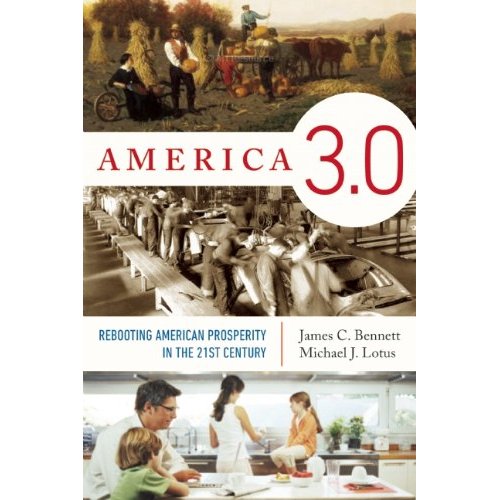
America 3.0 

From Chicago Boyz:

America 3.0: Mike Lotus on The Bob Dutko Show

Mike Lotus will be on the Bob Dutko radio show tomorrow, May 31, 2013 at 12:40 p.m. EST. Bob hosts Detroit’s #1 Christian Talk Radio Show on WMUZS 103.5 FM.

Please listen in if you can!

Many thanks to the Bob Dutko Show for having me on.

This weekend we will post an updated list of upcoming appearances by Jim Bennett, Mike Lotus, and occasionally both of us together, talking about America 3.0.

Thanks to The Takeaway, the The Armstrong & Getty Show, and The Janet Mefferd show for interviewing Jim Bennett — all yesterday. It was a Bennett Threefer! 

And Author Appearances:

Upcoming appearances for Jim Bennett and Mike Lotus discussing America 3.0

Tuesday, May 28, 2013
Lou Dobbs Tonight (James and Michael)
We will be on about 7:45 p.m. EST.

Wednesday, May 29, 2013
Armstrong & Getty (James)
11:15 am EST

Wednesday, May 29, 2013 
Janet Mefferd Show (James)
3:30 pm EST

Friday, May 31, 2013 
Bob Dutko Show (Michael)
1:40 pm EST

Tuesday, June 4, 2013
Talk to Adam Smith Society, Booth School of Business (Michael)
Noon

Thursday, June 6, 2013
Mornings with Nick Reed (Michael)

Saturday, June 7, 2013
Marc Bernier Show (James & Michael)
4:25 pm EST

Monday, June 17, 2013
Western Conservative Summit, “Envisioning America 3.0” (James)

And their maiden TV appearance with Lou Dobbs:

Glass Beads and Complexity

Monday, May 27th, 2013

[ by Charles Cameron — achieving something like closure on a post I started for Adam Elkus here, with a side dish along the way here ]
.

.

It’s astonishing to me how closely complexity science is related to Hermann Hesse‘s Glass Bead Game.

Adam Elkus recently pointed those who follow him to Cosma Rohilla Shalizi, Methods and Techniques of Complex Systems Science: an Overview, and just a quick dip there gave me the graphic I’ve put at the head of this post, together with this quote about “patterns” as Shalizi understands that term:

I mean more or less what people in software engineering do: a pattern is a recurring theme in the analysis of many different systems, a cross-systemic regularity. For instance: bacterial chemotaxis can be thought of as a way of resolving the tension between the exploitation of known resources, and costly exploration for new, potentially more valuable, resources (Figure 1.2). This same tension is present in a vast range of adaptive systems. Whether the exploration-exploitation trade-off arises among artifcial agents, human decision-makers or colonial organisms, many of the issues are the same as in chemotaxis, and solutions and methods of investigation that apply in one case can profitably be tried in another. The pattern “trade-off between exploitation and exploration” thus serves to orient us to broad features of novel situations. There are many other such patterns in complex systems science: “stability through hierarchically structured interactions”, “positive feedback leading to highly skewed outcomes”, “local inhibition and long-rate activation create spatial patterns”, and so forth.

**

Let’s start with patterns. The “people in software engineering” Shalizi mentions gleaned their use of the term “pattern” from the architect Christopher Alexander, author of the extraordinary, seminal book A Pattern Language, which in turn has hugely influenced computer science. Alexander distilled the essence of his thinking in his “Bead Game Conjecture”:

That it is possible to invent a unifying concept of structure within which all the various concepts of structure now current in different fields of art and science, can be seen from a single point of view. This conjecture is not new. In one form or another people have been wondering about it, as long as they have been wondering about structure itself; but in our world, confused and fragmented by specialisation, the conjecture takes on special significance. If our grasp of the world is to remain coherent, we need a bead game; and it is therefore vital for us to ask ourselves whether or not a bead game can be invented.

Manfred Eigen, Nobel laureate in Chemistry, called his book with Ruth Winkler-Oswatitsch Laws of the Game — and it deals with molecular biology, cellular automata, game theory, and games. But not just that — it is specifically written with Hesse’s concept in mind:

We hope to translate Hermann Hesse’s symbol of the glass bead game back into reality.

While we’re on about cellular automata, what about Stephen Wolfram? I don’t know that he talks about the Glass Bead Game himself, but at least three people talk about Wolfram’s book, A New Kind of Science, and/or his search engine, Wolfram Alpha as being strongly analogous to Hesse’s game — Jason Dyer, Graeme Philipson, and most recently, Mohammed AlQuraishi. Here’s a key para from Quraishi’s piece:

I think the Game is an intriguing concept, and I think it may one day be realized. In fact I think we are already on our way toward realizing it. In the simplest and most general sense, mathematics and programming languages allow us to formalize all knowledge. Contenders for the language of the Game already exist, at least in principle. But we are further along than that. Search engines like Wolfram Alpha have already begun the process of formalizing diverse pieces of knowledge, unifying them in a single medium, and providing the means to connect and reason about them. A repeated example in the book, the mapping of musical compositions to mathematical formulas or even historical events, is eminently doable within Wolfram Alpha. Much remains to be done of course, and there is no “game” yet that can be played across the vast sea of all human knowledge, but some enterprising individuals have already gotten started on creating it.

And then there’s John Holland, the “father of genetic algorithms”. Holland told an interviewer:

I’ve been working toward it all my life, this Das Glasperlenspiel. It was a very scholarly game, starting with an abacus, where people set up musical themes, then do variations on it, like a fugue. Then they’d expand it to where it could include other artistic forms, and eventually cultural symbols. It became a very sophisticated game for setting up themes, almost as a poet would, and building variations as a composer. It was a way of symbolizing music and of building broad insights into the world.

If I could get at all close to producing something like the glass bead game I can’t think of anything that would delight me more.

**

I’ve been working on a playable variant on the Glass Bead Game too, for twenty years quite consciously, and more if you count subterranean stirrings. And I don’t think glass beads, or stones, or chess or go pieces, or beads on an abacus, or strings of ones and zeros, or cells in an agent-based model for that matter, are the way to go. Which is not to say those approaches shouldn’t be tried, or don’t have remarkable things to teach us. I just don’t believe they give us quite what Hesse envisioned:

a direct route into the interior of the cosmic mystery, where in the alternation between inhaling and exhaling, between heaven and earth, between Yin and Yang, holiness is forever being created.

I think what’s important in Hesse’s game is that concepts that humans can grasp should reveal their stunning interrelations to heart and mind. And for that reason, the “moves” in my games [Hipbone, and more recently Sembl] consist of concepts — musical, verbal, visual, mathematical — and the links, the analogies, the “semblances” between them.

**

And thus the game is a search for analogies.

The human mind must inevitably perform what Shalizi calls the “trade-off between exploitation and exploration”. Some thoughts are proximate to others, they can be developed without any special insight by regular “linear” thinking. We do this every day, every minute — but it is not particularly revelatory. It doesn’t solve thorny problems, much less create beauty. There is another mode of thinking, however, that leaps between thoughts that are not so “close” but are nevertheless deeply related. To leap the apparent distance between such deeply related thoughts, we deploy analogy and creative thinking, and that is where the aha! of revelation occurs.

So I would suggest there is a close analogy here with the point Shalizi is making with the diagram atop this post. The human mind, to slightly paraphrase Shalizi’s caption, will “exploit the currently-available patch of food” for thought by linear, inside-the-patch thinking, but at full stretch it will also “explore, in hopes of ?nding richer patches elsewhere” — the “elsewhere” being attained precisely by “creative leaps” — by seeing semblances, patterns, analogies.

And to return to my earlier post, Thinking outside the cocoon, of which this post is a continuation, and perhaps the completion….

Shalizi’s “random walk” is thus also the archangel’s “zig-zag wantonness” in that great poem, Tom O’Roughley — when William Butler Yeats asks, “how but in zig-zag wantonness / could trumpeter Michael be so brave?” and writes, “wisdom is a butterfly / and not a gloomy bird of prey”…
GMTA: Temple Grandin

Friday, May 24th, 2013

[ by Charles Cameron — here’s today’s windfall apple from the tree of creative delight ]
.

On March 31st, 2012 (or very likely the evening of the day before, because the clock this blog runs on is always way ahead of me) I posted a graphic here:

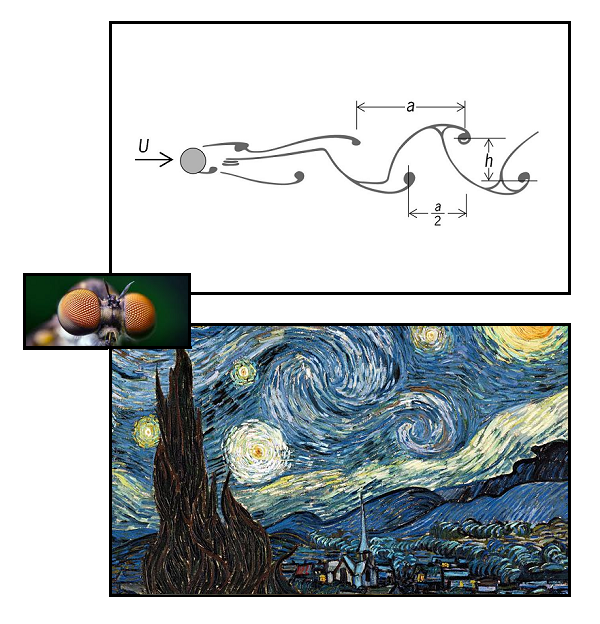
The upper image illustrates Theodore von Kármán‘s mathematics of turbulent flow, the lower image Vincent van Gogh‘s view of the night sky, and I juxtaposed them using my “DoubleQuotes” format to illustrate the underlying unity of the arts and sciences, and the breathtaking beauty and insight we can derive when we recognize a “semblance” — a rich commonality that transcends our usual division of concepts into separate and un-mutually-communicative “disciplines” and “silos”.

Apparently, this kind of cognition — the basis of every DoubleQuote, and of every move in one of the Hipbone / Sembl games — has now been termed “pattern thinking”.

**

According to Amazon, Temple Grandin and Richard Panek‘s book The Autistic Brain: Thinking Across the Spectrum was released April 30, 2013 although books are often available a couple of weeks ahead of release date, and galleys and proofs earlier still).

I read about it for the first time today, in Grandin & Panek’s piece, How an Entirely New, Autistic Way of Thinking Powers Silicon Valley in Wired. That article begins with a pull-quote from Grandin’s book:

I’ve given a great deal of thought to the topic of different ways of thinking. In fact, my pursuit of this topic has led me to propose a new category of thinker in addition to the traditional visual and verbal: pattern thinkers.

Obviously, that’s something i’d want to find out more about, so I read on into the article, expecting good things. Imagine my surprise when I read this paragraph, though:

Vincent van Gogh’s later paintings had all sorts of swirling, churning patterns in the sky — clouds and stars that he painted as if they were whirlpools of air and light. And, it turns out, that’s what they were! In 2006, physicists compared van Gogh’s patterns of turbulence with the mathematical formula for turbulence in liquids. The paintings date to the 1880s. The mathematical formula dates to the 1930s. Yet van Gogh’s turbulence in the sky provided an almost identical match for turbulence in liquid.

Boom!

**

Okay, I just received my review copy of Hofstadter and Sander, Surfaces and Essences: Analogy as the Fuel and Fire of Thinking — I guess I’ll have to review Grandin and Panke here, too.

Hermit Kingdom of Darkness

Sunday, April 7th, 2013

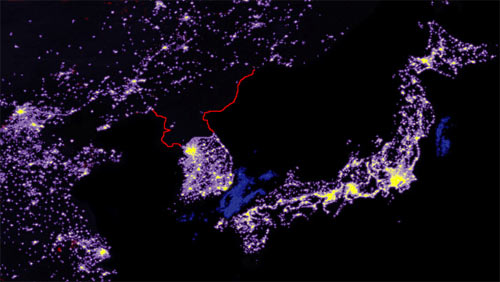
North Korea’s shopworn game of bluster, threaten, bully, violate international norms and eventually be rewarded with concessions and bribes has stopped working, which is why there now is a crisis. With the suckers (ROK, USA and Japan) refusing to play three card monty and with even  Pyongyang’s confederate China wearying of the scam when they have their own fish to fry, Kim Jong Eunhas few options to save face except to double down on painting himself into a smaller and tighter corner. There are some who would like to play the game of appeasement for a temporary respite but both Seoul and Washington are taking a harder line on North Korean antics.

One gets the impression that -unofficially, mind you – Beijing would not mind “Fatty the Third” getting a comeuppance that could push him from power and lead to the ascension of a more mature, more reasonable, more seasoned and more Sinicized leader of the Kim dynasty.

Here is a round up of more intelligently thought out (or at least interesting) articles and posts about the Nut of the North and possible war with North Korea:

Colonel Dave Maxwell– north Korean Leadership Assessment and The Realist Prism: North Korea Gambles on Strategic Assumptions and U.S. would seek regime change in North Korea if attack occurs

Colonel Maxwell is an area specialist on the DPRK, these are the “must read” pieces

Robert Baer –Viewpoint: North Korea’s Gaddafi Nightmare 

Gordon Chang –Is Kim Jong Un’s Bluster Really a Prelude to Reform?

Thomas PM Barnett –The Tricky Thing about Kim Jon Eun 

Patrick Cronin – Tell me How this Starts

IHT –Detecting Shift, U.S. Makes Case to China on North Korea 

Let me try my hand at reading the tea leaves. I don’t know that much, relatively speaking, about the “sovietology” of analyzing North Korean nuances which I will leave for experts like Colonel Maxwell to concentrate on other angles. Some points i no particular order:

  • First, any hope of an internal coup against Eun is probably nonexistent. Not only for the the consistent ruthlessness and lavish bribery which the Kim Family regime has treated it’s military, but the fact that coups of this nature have a poor track record in Communist states, even weird ones like the DPRK. From the inception of Communist power in the USSR, Soviet leaders fretted about “Bonapartism” by counterrevolutionary generals on white horses from Kornilov to Tukhachevskii to Zhukov. That these plots were mostly imaginary did not matter and Communist rulers neutralized this threat by binding the military leadership into the Party leadership at a level subordinate to the Politburo and periodically shooting likely upstarts. The political space for successful military coups do not exist in Communist regimes even for the key insiders, just ask Lin Bao. The North Korean military does not have the will to do this except in conjunction with massive Chinese intervention. Perhaps not even then.
  • For all the talk of irrationality, North Korea has been been playing this game as a survival strategy for sixty years and only miscalculated once, with the original invasion of South Korea in 1950 – which only happened, after Kim Il-Sung received the blessing of Stalin and promise of massive support from Mao ZeDong – and it was an unmitigated disaster for North Korea and China. Pointedly, the North has not initiated a war since and their subsequent violent provocations, while infuriating, have been quixotic and weird rather than existential threats that would guarantee a crushing military response.
  • The “win” for the US and ROK here is in frustrating the regime’s grasp for status, however self-deluded, in extorting more material concessions by acting like the international community’s equivalent of a crazy, menacing, homeless person ranting on a street corner. We need to make this charade appear to be a diplomatic sure-fire loser this time in the eyes of Pyongyang’s elite with an endgame where the North emerges empty handed and Eun feels that pressing further risks a greater loss of face. We do this by making moves where the spillover costs of North Korean intransigence and public lunacy drift in China’s direction; a tightly constrained North Korea out of diplomatic and economic options is really Beijing’s problem.
  • The strategic equation for “victory” from the North’s perspective depends heavily upon the reaction of the US and ROK governments to get drawn into tiresome negotiations before the North ceases it’s behavior, something they ultimately cannot control. Washington and Seoul cold hold firm or even (conceivably) take a harder line. If frustrated in their quest for concessions, the regime could exercise several options a) shift gears to a different propaganda campaign to distract internal audience b) engage in an act of terrorism elsewhere in the world, such as against a ROK embassy c) engage in a military demonstration that while provocative, like ballistic missile test, is not a casus belli d) all of the above e) undertake a military strike under the mistaken impression the ROK will not retaliate.

Comments welcomed.

E.O. Wilson on the Evolutionary Origin of Creativity and Art

Thursday, April 4th, 2013

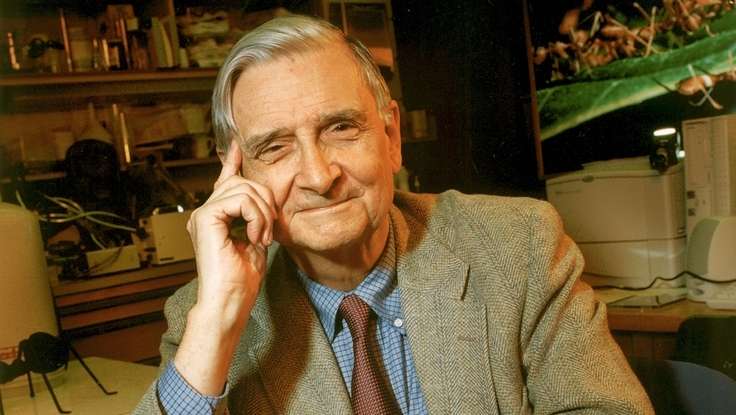
E.O. Wilson 

Last summer, eminent sociobiologist E.O. Wilson published an article in Harvard Magazine:

On the Origins of the Arts 

….By using this power in addition to examine human history, we can gain insights into the origin and nature of aesthetic judgment. For example, neurobiological monitoring, in particular measurements of the damping of alpha waves during perceptions of abstract designs, have shown that the brain is most aroused by patterns in which there is about a 20 percent redundancy of elements or, put roughly, the amount of complexity found in a simple maze, or two turns of a logarithmic spiral, or an asymmetric cross. It may be coincidence (although I think not) that about the same degree of complexity is shared by a great deal of the art in friezes, grillwork, colophons, logographs, and flag designs. It crops up again in the glyphs of the ancient Middle East and Mesoamerica, as well in the pictographs and letters of modern Asian languages. The same level of complexity characterizes part of what is considered attractive in primitive art and modern abstract art and design. The source of the principle may be that this amount of complexity is the most that the brain can process in a single glance, in the same way that seven is the highest number of objects that can be counted at a single glance. When a picture is more complex, the eye grasps its content by the eye’s saccade or consciously reflective travel from one sector to the next. A quality of great art is its ability to guide attention from one of its parts to another in a manner that pleases, informs, and provokes

This is fascinating.  My first question would be how we could determine if the pattern of degree of complexity is the result of cognitive structural limits (a cap on our thinking) or if it represents a sufficient visual sensory catalyst in terms of numbers of elements to cause an excitory response (neurons firing, release of dopamine, acetylcholine etc. ) and a subsequent feedback loop. Great art, or just sometimes interesting designs exhibiting novelty can hold us with a mysterious, absorbing fascination

Later, Wilson writes:

….If ever there was a reason for bringing the humanities and science closer together, it is the need to understand the true nature of the human sensory world, as contrasted with that seen by the rest of life. But there is another, even more important reason to move toward consilience among the great branches of learning. Substantial evidence now exists that human social behavior arose genetically by multilevel evolution. If this interpretation is correct, and a growing number of evolutionary biologists and anthropologists believe it is, we can expect a continuing conflict between components of behavior favored by individual selection and those favored by group selection. Selection at the individual level tends to create competitiveness and selfish behavior among group members—in status, mating, and the securing of resources. In opposition, selection between groups tends to create selfless behavior, expressed in
greater generosity and altruism, which in turn promote stronger cohesion and strength of the group as a whole 

Very interesting.

First, while I am in no way qualified to argue evolution with E.O. Wilson, I am dimly aware that some biological scientists might be apt to take issue with Wilson’s primacy of multilevel evolution. As a matter of common sense, it seems likely to me that biological systems might have a point where they experience emergent evolutionary effects – the system itself has to be able to adapt to the larger environmental context – how do we know what level of “multilevel” will be the significant driver of natural selection and under what conditions? Or does one level have a rough sort of “hegemony” over the evolutionary process with the rest as “tweaking” influences? Or is there more randomness here than process?

That part is way beyond my ken and readers are welcome to weigh in here.

The second part, given Wilson’s assumptions are more graspable. Creativity often is a matter of individual insights becoming elaborated and exploited, but also has strong collaborative and social aspects. That kind of cooperation may not even be purposeful or ends-driven by both parties, it may simply be behaviors that incidentally  help create an environment or social space where creative innovation becomes more likely to flourish – such as the advent of writing and the spread of literacy giving birth to a literary cultural explosion of ideas and invention – and battles over credit and more tangible rewards.

Need to ponder this some more.


Switch to our mobile site