zenpundit.com » counterpoint

Archive for the ‘counterpoint’ Category

Two for the Dalai Lama, and one more

Thursday, April 5th, 2012

[ by Charles Cameron – the UN panel of happiness experts, human nature on and off the freeway, and royal rainmaking in Thailand and Tanzania ]
.

Seeings as how the Kingdom of Bhutan just convened a UN forum on the topic of Happiness and Well-being: Defining a New Economic Paradigm, I thought it might be interesting to compare the faces in reports of a recent, controversial congressional panel on contraceptive issues with those of the folks on the happiness panel:

And to be frank, neither panel looked particularly cheerful. I thought it might be nice to get away from all that seriousness, so I featured the Dalai Lama’s often playful eyes as an inset…

Seriously: is happiness something we should figure out in committee?

To be fair, though, they did have some decent guest speakers — Joan Halifax for one. My guess is, some people just bring their happiness with them.

*

And while I have the Dalai Lama in mind and in a conveniently copiable graphic, I thought I’d post a second, quick item — this one also having to do with happiness, I suppose, and raising the question of what human nature is.

When you’re stuck on the San Diego Freeway on the way back from work, you may not feel as “one with nature” as you do when you’re out for an evening walk on the beach in Malibu. But are the ribbons of the Interstate system really that different from the veining of a leaf?

I suspect that question might bring some quiet laughter to the Dalai Lama’s eyes…

Hat-tip: I have Andrea Lobel of Concordia U to thank for this second pair of images, which she very kindly sent me knowing of my delight in such pairings.

*

Time for one more?

Given my strong interest in ritual, you won’t be surprised to learn that royal rainmaking is of interest to me.

The insignia on the left is that of the Thai Bureau of Royal Rainmaking and Agricultural Aviation, founded by Thailand’s King Bhumibol Adulyadej, who holds European patents on several of his methods:

According to the notes attached to this video:

Among the best-known and most successful of His Majesty’s water provision projects has been the Royal Rainmaking programme. He began to study how clouds might be seeded to produce rain. In 1969 he carried out preliminary tests at Khao Yai National Park using a Cessna 180 and dry ice. In August 1969, he moved to Hua Hin and used two aircraft in a variety of weather conditions to determine what worked best. Initially, he financed the research with his own funds but in 1970, he sought temporary funding for a “Rainmaking Project” from the government. With it, he established the Royal Rainmaking Research and Development Institute. Based on it, he has spent succeeding years refining his techniques to accord with varying cloud conditions and to suit differing climatological and geographic areas, enjoying considerable success throughout Thailand.

On the right is the encampment for the mapolyo a mbula or ancestral offerings for rain of the Ihanzu of Tanzania.

Todd Sanders, in his book Beyond Bodies: Rainmaking and Sense Making in Tanzania, writes:

Because the Ihanzu have long depended on the rain for their very existence, it is not surprising that rainmaking is central, both conceptually and practically, to their everyday lives. They have two royal rainmakers – one male, the other female – whose job it is to ensure the rains arrive on time and fall properly each year. … Through varied rain rites carried out each year in the village of Kirumi, royal rainmakers regulate the annual movement from the dry ‘male’ season (kipasu) to the wet ‘female’ one (kitiku) and back again. These rites take various forms, as we shall see…

For a detailed account of the mapolyo a mbula rites and the legend that accompanies and explains the diagram above, see Sanders’ Reflections on Two Sticks: Gender, Sexuality and Rainmaking in Cahiers d’Etudes Africaines:

These rites take place only when the rains have utterly failed and it has been divined that the royal Anyampanda clan spirits have demanded such an offering. Offerings take place over two days, but the entire ritual sequence often lasts a month, sometimes longer. It is only the two Anyampanda royal leaders, and no one else, who can bring such rain offerings to fruition.

*

Enough, I’m done for now — I’m happy.

Nancy Fouts and the heart of the matter

Thursday, March 22nd, 2012

[ by Charles Cameron — Nancy Fouts, sculpture, juxtaposition, essence of creativity, pocket universes, Arthur Koestler, Mark Turner ]
.

Nancy Fouts is an American artist based in London. I ran across her work a while ago thanks to Michael Weaver on Google+, and was immediately struck by the intensity of her images, each one of which seemed like a landmark from a larger geography, more precisely focused and dense with meaning than our own world usually appears to be.

First impression:

.
The first image I saw was of a snail on the straight edge of a razor blade (above, left) — an image out of the script of Apocalypse Now to be sure, but presented by Fouts in sharp detail and unadorned by any other context, visually, direct from eye to mind and heart.

This may be the image many people first see of her work — very, very striking, exquisite, terrifying if you allow it to be so, and yet as clear and simple, almost, as a single drop of water on a leaf.

Singer and song:

.
But it was this next image that conquered me:

The juxtaposition is impeccable: sewing machine, record on turntable – and the overlap between the two, the link, the vesica piscis between them, is the needle.

The music of Bach, Handel, and Vivaldi — particularly on harpsichord — has been disparagingly called “sewing-machine music”. If that phrase gave rise to this marvelous image, perhaps the slight can be forgiven.

The sewing-machine? It’s a Singer. And in what must surely be an ironic, gender-influenced choice coming to us from an artist so assured and exacting — the music that the needle draws from the groove of the record is, as you can tell from the record label, the music of His Master’s Voice.

Philosophical aside:

.
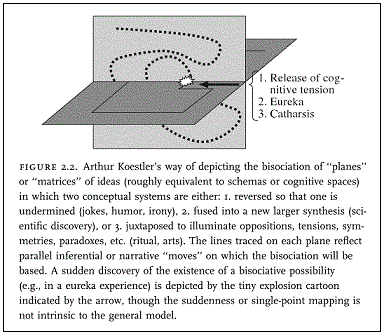
I have pointed before to this diagram from Mark Turner‘s The artful mind: cognitive science and the riddle of human creativity, based on those in Arthur Koestler‘s The Act of Creation (eg those on pp 35 and 37):

koestler-model.gif

It shows the essence of the creative act — the “release of cognitive tension” that occurs when some form of analogy, similitude, overlap allows the mind to join conceptual clusters from two fields in a “creative leap”.

Nancy Fouts’ work doesn’t merely make use of such twinned field overlaps, it makes twinned fields with overlap the defining quality of her works.

She is aiming right at the heart of the creative process. And it shows.

Moving further afield:

.
In that earlier post of mine, I talked about Ada, Countess of Lovelace, and noted that her analogy between Charles Babbage‘s Analytical Engine and Jacquard‘s mechanical loom, famously expressed by her thus:

The Analytical Engine … weaves algebraic patterns, just as the Jacquard-loom weaves flowers and leaves.

was precisely the creative leap that led to the us of punched card systems in computation from Babbage to Watson…

I could give other examples. The Taniyama-Shimura conjecture which formed the basis of Andrew Wiles‘ proof of Fermat‘s Last Theorem, bridges two previously distinct branches of mathematics precisely by showing that for every elliptic curve, there is a related modular form

And no, I don’t understand the mathematics. But I understand the concept of twinned fields, and the power of their overlap.

Some favorite tropes:

.
Back, then, to Nancy Fouts:

One thing that interests me about her work is that she has a few simple “essences” that she returns to time and again: in this case, bees, forms that resemble honeycombs, and by implication, honey.

In my own work, making similar connections between what we might paradoxically call “kindred ideas in unrelated fields” — I might set Nancy’s honeybees across from the verse from the Upanishads [Brihadaranyaka, fifth Brahmana, 14] which says:

This Self is the honey of all beings, and all beings are the honey of this Self.

Another of Nancy’s tropes connects nature and music…

The piercing:

.
And thimbles, those miniature emblems of armor and protection, are another recurring theme:

Let’s take a look at that last image, of the thimble transpierced by a needle.

I believe it has a history — again, accessible via an associative leap. Here are three images of the “wounded healer” motif, two of them specifically images of the Inuit shaman who has harpooned himself — a motif which the anthropologist and zen roshi Joan Halifax writes “captures the essence of the shaman’s submission to a higher order of knowing”:

Armor, the defenses we have in place to protect our selves, and vulnerability, the ability to to allow our selves to be wounded, so that the “self” which is “the honey of all beings” may shine through us. The paradox of Selflessness and Self.

Koan and sacrament:

.
Among wounded healers, we might count the crucified Christ, his side pierced by the spear of a Roman soldier — and here I might suggest that Fouts contrasts (image below, left) the self-sacrifice at the heart of Christianity with the pugilistic approaches of some proponents of his message:

And the image of Christ (right) balancing on a high wire?

Again I’m reminded of the language of shamanism. The anthropologist Barbara Myerhoff studied the religious beliefs and practices of the Huichol or Wixaritari of the Mexican Sierra Madre Occidental, with Ramon Medina Silva, a mara’akame or shaman of the tribe.

In her book, Peyote Hunt: The Sacred Journey of the Huichol Indians, she describes a feat of balance that Ramon performed, which appeared to serve a “sacramental” function for his people – providing them with what Cranmer‘s Book of Common Prayer calls “an outward and visible sign of an inward and spiritual grace”:

One afternoon Ramon led us to a steep barranca, cut by a rapid waterfall cascading perhaps a thousand feet over jagged, slippery rocks. At the edge of the fall Ramon removed his sandals and told us that this was a special place for shamans. We watched in astonishment as he proceeded to leap across the waterfall, from rock to rock, pausing frequently, his body bent forward, his arms spread out, his head thrown back, entirely birdlike, poised motionlessly on one foot. He disappeared, reemerged, leaped about, and finally achieved the other side. We outsiders were terrified and puzzled but none of the Huichols seemed at all worried. The wife of one of the older Huichol men indicated that her husband had started to become a mara’akame but had failed because he lacked balance.

It’s easy to read the description — but by no means as easy to keep one’s balance — something that Fouts’ image perhaps suggests more vividly than words easily can.

Richard de Mille describes the mara’akame‘s function in Huichol society as to “cross the great chasm separating the ordinary world from the otherworld beyond,” and suggests that Medina Silva’s feat of acrobatics on the barranca that day is to be understood as offering “a concrete demonstration in this world standing for spiritual balance in that world.”

Myerhoff herself was never entirely sure whether Medina Silva was “rehearsing his equilibrium,” or giving it “public ceremonial expression” that afternoon: it is clear, however, that for the Huichols, such feats of balance possess a resonance and meaning that extends beyond the “merely” physical.

Bringing the viewer into the picture

.
I may of course be projecting some of my own ideas onto Nancy Fouts’ work — and indeed, perhaps that’s the point.

She has some pretty fierce observations to make concerning matters religious — Christian, Buddhist and other — and I’ll leave those who are interested to make their own discoveries on her website. I don’t doubt there are places where her sympathies and my own overlap, and others where we differ.

Fouts speaks a direct and visceral language of images — and her juxtapositions, carefully chosen and choreographed as they are, provoke us to feel and think.

Thank you, Nancy.

No need to reach for the gun, fellas — but that’s art.

_________________________________________________________________________________________

credits for images of Harpooned Shaman: Charlie Ugyuk (left); David Ruben (right).

The Said Symphony: move 19

Sunday, March 18th, 2012

[ by Charles Cameron – extended analytic game on Israeli-Palestinian conflict — for those who wish to catch up, our game thus far consists of an intro to the game and game board, followed by moves 1-5, 6-9, then moves 10-11 which together constitute a meditation, moves 12, 13-15, 16-17, and most recently before this, move 18 with cadenza ]

Move 19: The view from above

Move content:

Discussing strategy, the very canny LTG (USMC, Ret’d.) Paul Van Riper had this to say:

What we tend to do is look toward the enemy. We’re only looking one way: from us to them. But the good commanders take two other views. They mentally move forward and look back to themselves. They look from the enemy back to the friendly, and they try to imagine how the enemy might attack them. The third is to get a bird’s-eye view, a top-down view, where you take the whole scene in. The amateur looks one way; the professional looks at least three different ways.

A bird’s-eye view, a hawk’s eye view, a top-down view, an overview, a view from 30,000 feet, a God’s eye view, a view from above, a zoom…

If move 18 and its cadenza gave us a view of the depth of vision or insight that is necessary for a full and rich understanding of the world we live in — its qualitative or spiritual scope, if you like — this next move, with its picnic and drone-sight, addresses its breadth in space and time — materially and quantitatively speaking.

The classic expression of the sheer material scope of the universe was put together by Charles and Ray Eames in their justly celebrated film, Powers of Ten, from which the lower of these two images is drawn:

Here are some other relevant scans of the scope of things, in terms of time and space:

The Scale of the Universe 2
A Brief History of The Universe
The Known Universe
A Time-Lapse Map of Every Nuclear Explosion Since 1945

These are impressive videos to be sure, but as an aside I’ll invite you to ask yourselves how well they compare with this zoom in words, a poem by the zennist, ecologist, essayist and poet Gary Snyder, from his book, Axe Handles: Poems:

Such breadth of vision, such craft.

*

If this “material scope of things” too has a cadenza, it would be that all of this is shot through with some primary oppositions, dappled as the poet Gerard Manley Hopkins would have it, with swift, slow; sweet, sour; adazzle, dim — as indicated in the drone-sight and picnic double image at the head of this move.

This dappling, this constant flux of opposites, takes many forms — day and night lead to the more abstract light and dark, which can then be interpreted morally as good and evil, to which we respond with repulsion and attraction as the case may be, building our worldviews from love or fear…

At different scales the opposites that matter most to us may have different names and shadings, but here I’d just like to draw attention to the dappling of our world with:

competition and cooperation
Darwin‘s natural selection and Kropotkin‘s mutual aid
duel and duet (ah! — a favorite phrasing of mine)
war and peace

Provocatively, we find this dappling in scriptures, too, wherein the ripples of such verses as “The LORD is a man of war: the LORD is his name” (Exodus 15.3) dropped like a stone into the pond of the human mind, meet with the ripples of other verses such as “God is love; and he that dwelleth in love dwelleth in God, and God in him” (I John 4.16).

There are times when we take such oppositions literally, perhaps too literally, and times when we begin to see oppositions as abstract and theoretical end-points to what is in fact a yin-yang process continually unfolding…

Which brings me by a commodius vicus of recirculation to this image of the great opposition between war and peace, its dappling, its unfolding:

Links claimed:

To the Lamb, move 18: this move presents the material scope of the universe in counterpoint to its visionary scope as laid out in move 18 with its cadenza.

To Revelation, move 17 — the word revelation means unveiling, as we have seen, and our sciences and technologies, with their spectra of telescopes, microscopes, cameras and zooms, are unveiling and revealing to us much about the physicality of the world we live in — much that was accounted for in other times and places through intuition, vision and poetry.

This scientific and technical revelation of material existence, for many of us moderns, has largely eclipsed the mode of visionary revelation of move 17 — yet it cannot eradicate it. Implicit in this move, then, is the sense that we carry with us both subjective and objective, inner and outer, qualitative and quantitative understandings — though the data that “sight” and “insight” provide us with may be different in kind, and resolving them may be something of a koan to us, the deep problem in consciousness as philosophers of science have named it — and that we can discount neither one if we are to have and maintain a rich sense of our situation.

Comment:

If the two previous moves have shown us the scope of the universe we co-inhabit, perhaps we should now make our own zoom in, much as James Joyce did when he had the schoolboy Stephen inscribe his name and address in his geography book as Stephen Dedalus, Class of Elements, Clongowes Wood College, Sallins, County Kildare, Ireland, Europe, The World, Universe – an address that Stephen then read both forwards and backwards, finding himself in one direction, and finding in the other that he had no means of knowing what might lie beyond the universe…

Imagine then, skipping rapidly from (unimaginable) cosmos via such things as the intriguingly named End of Greatness to galaxy or nebula…

…solar system and planet — whence we can slow down and zero gently in on the Middle (or as my friend Ralph Birnbaum would call it, the Muddle) East, Israel / Palestine, Jerusalem / Al Quds / the Temple Mount / Noble Sanctuary – and to such matters of contemplative vision and tribal passion as the first, second and projected third Temples, the al-Aqsa mosque.

Our increasing focus will bring us, then, to that the rock which Jews believe marks the place where Abraham bound his son Isaac (the Akedah), and which Muslims believe to be the place of ascent of the Prophet to the celestial realms (the Mi’raj) on his Night Journey (Qur’an, Al-Isra).

Here again myth and history collide, and both visionary and material considerations merge in the heart of the what my friend the Israeli journalist Gershom Gorenberg has justly called “the most contested piece of real estate on earth”.

Of railroad tracks and polyphonic thinking

Thursday, February 23rd, 2012

[ by Charles Cameron — more on the graphical mapping of heresy, radicalization, decision points, multiple ideas and complex issues, and some illustrations from railroad land ]

.
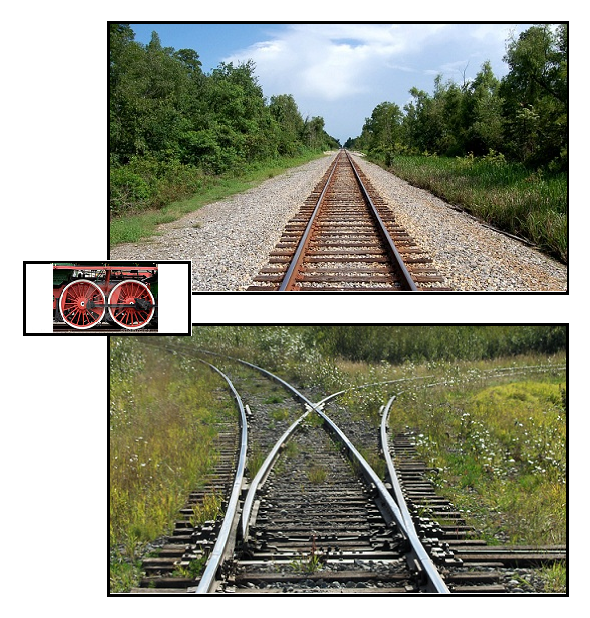
Here’s a railway track illustration of, say, the difference between true Islam (the straight track) and bida (the introduction of new ideas into the religion, deviation, heresy).

This graphic could equally represent the radicalization process, with the “point switching” occurring when the decision is made to switch from sympathizing to active participation, or from participation in the virtual dimension (say by posting on the forums) to the preparation and execution of acts of violence.

Locating the “switching points” would then be a significant part of a successful de-radicalization program, and I’d suggest that the concept of jihad as a matter of obligation (fard ‘ayn) would be one such.

*

What follows is essentially a quick-and-dirty pattern language of train tracks, switching points, marshaling yards, etc — I’ve even included one water-slide — to stir creative insights about linear thinking, multiple voices, multiple lines of thought, elegance and the polyphony of ideas

I’m posting this because any strategic and / or creative thinking that includes the perspectives and voices of multiple stakeholders will require polyphony, as will any approach to the complex dynamics in play in wicked problems…

And much else besides.

*

First, we have linear thinking — and a dilemma:

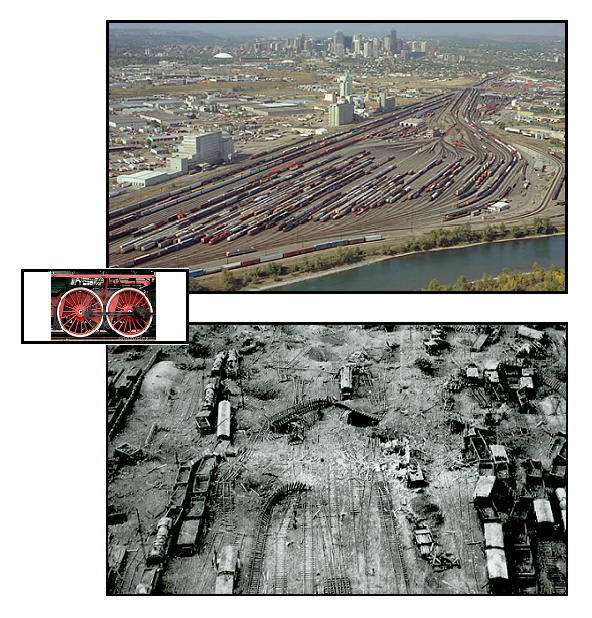
Then, there’s complication — not the same as complexity, and not nearly so hard to figure out —

— and a wicked problem, where the issues are indeed complex, and the problem itself may shift unexpectedly if, for instance, there’s another bombing run just as you are fixing things up after the last one…

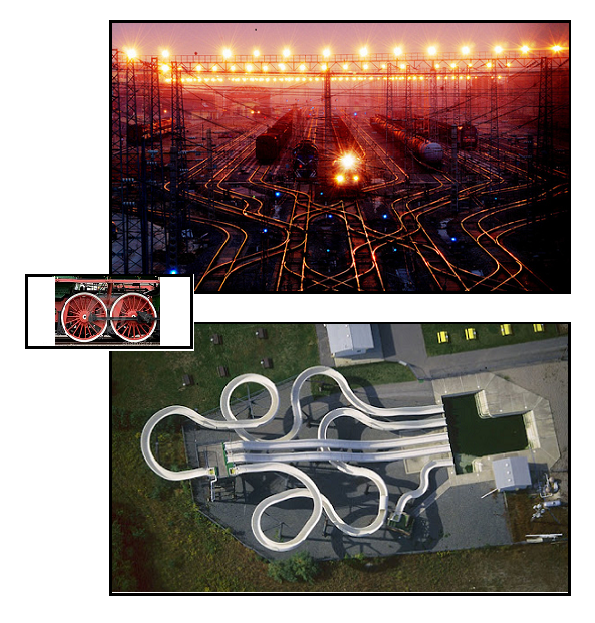
And finally, by way of inspiration, there is always the possibility of elegance —

— and (here’s where I switch to the water-slide) — there’s always the possibility of playfulness…

*

Finding ways to think graphically, elegantly and a bit playfully about wicked problems is what I’m after here…
.

*******************************************************************************

Addendum

Friend JM Berger aka @intelwire sent me a link to this image:

and commented, “I think it’s more like this, no single point of departure, no single destination, loopbacks, dead ends” — nice one, JM!

4GW and Legitimacy at SWJ

Thursday, February 23rd, 2012

Fourth Generation Warfare and William Lind was the topic of a critical essay by Major Lincoln Farish at Small Wars Journal. The article was interesting, despite my disagreement with the author on most points, because he was wrestling with important questions related to insurgency and COIN at a time when FM 3-24 is undergoing revision and the role of COIN itself in US Army operational culture is being questioned. Tight defense budgets= Musical chairs at the Pentagon. 🙂

Unfortunately, the article contained, in my view, significant problems in terms of understanding 4GW or strategy in general.Here is the article. It isn’t overly long. I am going to be commenting on passages that caught my attention and I invite readers to do the same and check out those made by Ken White and Slapout in the comments section at SWJ:

The Quest for Legitimacy 

According to The U.S. Army Marine Corps Counterinsurgency Field Manual an insurgency is “an organized movement aimed at the overthrow of a constituted government.” FM 3-24 continues with, “political power is the central issue in insurgencies and counterinsurgencies: each side aims to get the people to accept its governance or authority as legitimate.” Fourth Generation Warfare (4GW) advocates propose fighting insurgents with small cadres of highly-trained infantry, avoiding the large footprint of earlier generations of war created by command and control echelons above the company. Even if the 4GW proponents are correct on the tactical level, their proposed methods will not be successful in defeating an insurgency strategically as 4GW does not offer a legitimate alternative to the insurgents at the strategic or national level.

Premises here are incorrect.

First, while I do not speak for Mr. Lind, any fair reading of his many columns, articles and posts of the past decade (!) would demonstrate that he was, as Ken White and Slapout indicated, strongly opposed to expeditionary COIN adventures unless they were absolutely unavoidable.  His 4GW grand strategy was for the US to scrupulously avoid “centers of disorder” and view all states, even ideologically hateful misfits, as potential allies against 4GW forces. Where required, the US would instead rely on “punitive raiding” against such 4GW entities but not hunker down in the mud with them on a permanent basis.

William S. Lind, the architect of the 4GW concept, argues for units to become “true light infantry.”  He writes, “virtually all Fourth Generation forces are free of the First Generation culture of order; they focus outward, they prize initiative and, because they are highly decentralized, they rely on self-discipline.” Discipline is a key issue here; a company commander only has the authority to punish soldiers up to the (U. S. Army) rank of Sergeant (E-5). This is to protect not only the soldiers, but to give the commander the ability to maintain order and discipline commensurate with his position and abilities. A company is usually composed of only three to four officers, and they have little ability to conduct an investigation without disrupting combat operations….

…. Clear, codified, equitable discipline is one of the features that separate a military from a street gang or an insurgent movement…..

….It [4GW forces] should be trained and equipped to use cash to draw on the local infrastructure for most of its needs.”  Lind expects a company to handle most of its logistical needs with a minimum of support from a higher echelon, in other words, Lind is advocating an autonomous company.

One of the assertions of 4GW theory is that a large military with a  2GW culture organization based on hierarchy, micromanagement. limited or no autonomy of subordinates will go down to defeat ( or at least protracted stalemate) with a smaller, but more agile, adaptive 4GW force. Secondly, that counter-4GW units should be retooled to “mirror” these advantages in initiative and flexibility because the disciplined firepower of conventional military trumps those of irregulars (who of course, lack tanks, attack helicopters, cruise missiles, FOBs with food courts that include Pizza Hut and other hyperexpensive brontosaurian logistical tails). This combat advantage of light infantry over guerrillas is the reason for Lind’s advocacy of “Jaegers“.

H. John Poole, another disciple of 4GW, goes even further. Poole advocates using fire teams (a 3-4 man team) to perform deep interdiction to deny an enemy maneuver room, destroy minor camps, supply areas, and staying in place for up to three months at a time. In this scenario, how is it possible that the team effects the capture of prisoners? Would the team have to allow surrendering personnel to escape? How would enemy causalities be treated? Would the team leave enemy wounded, and how would that be portrayed to the media and world-wide? Whatever flaws there may be with 4GW, the biggest one is with legitimacy.

Poole is a tactical expert, which I certainly am not, even in terms of historical study. As I am not qualified to debate the utility of fire-teams vs. platoons or companies, I will simply note that in a different strategic context, both the Soviets and NATO contemplated and prepared for very deep, behind the lines, operations, by small, pre-positioned, sleeper cells. We also have scouts and a variety of special forces units and CIA clandestine operatives running around AfPak and the Horn of Africa – how do they currently handle these problems? Does SEAL Team 6 usually return home from a raid with 50+ prisoners?

A Western democratic government is considered legitimate if its rule is primarily derived from the consent of the populace. An illegitimate government would be one that ruled by coercion. Legitimate governments are inherently stable. They engender the popular support required to manage internal problems, change, and conflict. A lack of legitimacy in a constituted government results in a lack of popular support, and an end to the government’s actions.

Well, while I understand the point of contrast the author is making, and I’m deeply in sympathy with the inherent Lockeanism, the idea that liberal governments who have the consent of the governed do not regularly exercise coercion is fundamentally and empirically incorrect. This is easily demonstrated by refusing to pay one’s taxes, or attempting to sell unpasteurized milk, engage in sedition, build a house at variance with local zoning or in a myriad of ways. States enforce law where they do not have voluntary compliance and that enforcement, or threat thereof, constitutes coercion in a very real sense. If a state cannot make use of coercion in time of need, then it has failed as a state.

What states with consent of the governed have is a comparative advantage. Their greater legitimacy permits their actions of coercion- unlike that of a a hated, mad, tyrant – to take place less frequently and then with with less friction when they do. Enjoying greater voluntary compliance, more legitimate states have moral leeway and the political benefit of the doubt of the populace, when confronting lawbreakers and applying coercion to other challengers to the state’s authority. It is this very moral authority possessed by the state that 4GW forces seek to erode.

 Conrad Crane proposes six possible indicators of legitimacy:

– The ability to provide security for the populace.

– Selection of leaders at a frequency and in a manner considered just and fair by a substantial majority of the populace.

– A high level of popular participation in or support for political processes.

– A culturally acceptable level of corruption.

– A culturally acceptable level and rate of political, economic, and social development.

– A high level of regime acceptance by major social institutions.

While this is a good guide from a western view of what constitutes a “legitimate” government, not every group in the world would agree, and legitimacy is in the eyes of the beholder. What was legitimate in earlier times may now be unacceptable, what is legitimate in one area of the world is not in another.

Crane’s indicators are usefully pragmatic in a heuristic sense, but probably not sufficient in themselves – “legitimacy” is a huge subject and has many aspects or facets in terms of internal politics, external diplomacy, cultural identity and both positive and international law.  While “legitimacy” is difficult to define to the mutual satisfaction of military leaders, lawyers, statesmen or academics, populations seem to “know it when they see it” (and more importantly, when they don’t). The rub with pop-centric COIN theory, from a 4GW perspective, is that it is extremely difficult (though not always impossible) for armed outsiders to bestow or shore up legitimacy of a state.

I suspect that gambit works most effectively with new or emergent states also seeking acceptance or peace with neighboring states and aid from the international community and less well in cases of purely civil strife.

Insurgencies that are trying to develop legitimacy have integrated themselves locally into the social and political fabric of societies worldwide. They establish a “shadow government,” first addressing the needs of the local populace. Insurgents establish themselves as organizations capable of addressing the everyday problems of the local population. Insurgent groups have set up schools, medical clinics, sports clubs, and programs for free meals. Hamas and Hezbollah have also become powerful political parties within their respective governments. The key difference is that to be seen as legitimate, the insurgent only needs to appear legitimate in the area they are operating in and in accordance with the mores of the local populace.

Much of this passage is actually in concordance with classic 4GW thinking. I would hedge in that many 4GW entities, for example, criminal-insurgencies or loyalist paramilitaries (4GW entities acting in support of the state) have no interest in becoming a “shadow government”. Some, like Hezbollah and HAMAS do, but an across the board assumption is an effort to intellectually shoehorn all insurgencies everywhere into the Maoist model – that they seek to replace regime as the state’s new rulers- and that is one of the major flaws of pop-centric COIN assumptions.

Atrocities committed by insurgents, even if they were reported could be easily ignored.  International opinion matters little to an insurgent organization that is local, and is not subject to, or concerned with, international laws.

No.

Atrocities by irregulars may or may not be ignored. Largely that is the fault of policy, our elite’s decided lack of will in consistently pursuing their publicity, condemnation and where possible, exemplary punishment. That said, whether atrocities by irregulars are ignored or not and whether leaders of non-state forces hold international opinion in contempt, as parties to an armed conflict they are indeed subject to the laws of war and international law. Breaking laws does not mean that therefore, you are somehow above them.

The national government, on the other hand, has to appear legitimate at the international level, the national level, and at the local level. At each level there may be different beliefs as to what does or does not constitute “legitimate” governance. The counter insurgent has an even more difficult time, as they must be seen as “legitimate” in their home country, the host country, internationally, and at the local level. There is a difference in what actions and processes are seen as legitimate by these successive levels and the counter insurgent must not only be cognizant of these expectations and restrictions, but abide by them as well.

Generally correct, but all levels of legitimacy are not equally important all of the time.

The context of situations matter a great deal – first of all, the shooting part of war does count even in 4GW or COIN. It does not help to be scrupulously legitimate in all OF your actions if you lose the war to insurgents and are captured, tortured lavishly and displayed in a cage before being executed on live television.  Appealing to the sense of legitimacy of generally adversarial and distantly located foreign elites may or may not matter vs. appealing to the primary loyalty of villagers in guerrilla country. Or it might.

It is important to remember that in terms of legitimacy, the counterinsurgent  has an audience of overlapping political communities, but communities of unequal importance to the outcome. All actions in counterinsurgency warfare have political trade-offs. The bias is to ruthlessly accept those trade-offs that methodically and irrevocably advance the COIN side to victory and eschew ones where the costs greatly exceed any potential gain. To quote John Boyd, when considering conflict and threatswe should only undertake operations and policies that:

  • Support our national goal, which at the highest level involves improving our fitness, as an organic whole, to shape and cope with an ever-changing environment
  • Pump-up our resolve, drain-away our adversary’s resolve, and attract the uncommitted
  • End the conflict on favorable terms
  • Ensure that the conflict and peace terms do not provide seeds for (unfavorable) future conflict.

To continue:

The 4GW method of COIN does not properly account for legitimacy. Following the 4GW method, insurgent groups will be able to use the need for legitimacy by the counter insurgents to disrupt operations. If a charge is made that the 4GW forces have committed an atrocity, there will be a lot of interest in that story by outside groups. The media will want information, and human rights groups will bring political pressure for a full and complete investigation to be conducted, something a company commander will not have the resources to do.

I find this passage to simply be strange, given the emphasis that various writers of the 4GW school placed upon the mental and moral levels of war. Whether you agree with 4GW and William Lind or think that both = horseshit, it remains a fact that concern with legitimacy is one of 4GW’s central tenets as a theory or school of strategic thought. See, there’s this guy, an Israeli military historian, named Martin van Creveld and……

The problem, I suspect, is with how the author approaches legitimacy and the division of responsibility for questions of tactics, operations, strategy and policy. Bill Lind’s advocacy of of jaegers never seemed to me to imply that a master sergeant or captain out in the backcountry would be running an international level IO on his own. In his area of responsibility, with locals, sure – just not when Lara Logan or Dr. Jakob Kellenberger of the Red Cross shows up.

If the alleged atrocity is not investigated properly, regardless of the veracity, legitimacy for the operation and popular support at all levels will be at risk. The insurgents will be able to use the incident as a rallying cry against the counter insurgent forces. The lack of a full and complete investigation will give credence to their claims, and there will be allegations of “cover ups” and “obfuscation,” by those sympathetic to the insurgent cause. Outside neutral groups, like NGOs and the media, will not be able to quickly and easily refute these allegations, further reinforcing the insurgent’s claims. These claims harm the legitimacy of the counter insurgent operations and degrade popular support. Without popular support the U.S. Army would be forced to leave, allowing the insurgents to reoccupy the area. Tactically the insurgents may have been beaten at every turn, but strategically they have won. Given the proposed structure of 4GW forces, small 3-4 man teams, out of direct contact with higher headquarters for extended periods of time, with a minimum of command oversight- how would an investigation occur? How would media requests be handled, or investigations by human rights NGOs? How would the team or the company even be able to demonstrate that they were not responsible for the alleged crime? Do 4GW adherents believe that the US Army would be given the benefit of the doubt by the international press?

Wow.

First of all, all of what the passage describes occurs now, under the present system, beloved by Big Army, of top down micromanagement of company and platoon leaders by senior field grade or, remarkably, general officers. Any incarnation of 4GW COIN operations have not failed in the way Farish described but every major media failure that has happened in the war can be attributed in part, to the current institutional culture, climate and structure that produced such slick American IO moments as Abu Ghraib and “the Runaway General“.

Admittedly, as it is untried, a 4GW style COIN operation might not do any better than this, but really, it could hardly do worse.

The current mass of command and control, while cumbersome and at times inefficient, exists to protect the soldier and to allow him to conduct his mission with minimal disruption. To try and strip that away to a “lean fighting force” is to invite tactical success, but strategic failure. 

Top-heavy, slow moving, risk-averse, military bureaucracies ensure strategic victory?  Administrative process defines or formulates strategy? WTF?

With the loss of a robust command structure and the protection it brings from outside agencies, it will be easy for the insurgents to portray soldiers as cold-blooded killers, rampaging throughout the land with no oversight and no regard for international law, the UCMJ, or legitimacy. Without the appearance of legitimacy popular support will erode, without popular support counter- insurgent forces will be forced to cede the battlefield to the insurgents.

Move….out…of….your….comfort zone.

In general, military history and strategic thinking need to be taught earlier in the career arc of professional officers than the War College level as a counter to the habits of mind inculcated by organizational culture. The relationship between tactics, strategy and policy is always holistic, not distributed between “tactical leaders”, “operational planners” and civilian “policy wonks”. Strategy does not live way up at HQ or in the White House but should be a ladder or chain of implications that reach down to guide tactical decisions and upwards to a national or grand strategy.


Switch to our mobile site