zenpundit.com » debate

Archive for the ‘debate’ Category

A Wound That Does Not Cease to Bleed: The War in Vietnam

Wednesday, February 29th, 2012

Amigo of ZP blog, West Point military historian Colonel Gian Gentile, throws down the gauntlet in his review of Lewis Sorley’s new biography, Westmoreland: The General Who Lost Vietnam, in The National Interest:

The Better War That Never Was

DID GENERAL Westmoreland lose Vietnam? The answer is no. But he did lose the war over the memory of the Vietnam War. He lost it to military historian Lewis Sorley, among others. In his recent biography of William C. Westmoreland, Sorley posits what might be called “the better-war thesis”—that a better war leading to American victory was available to the United States if only the right general had been in charge. The problem, however, is that this so-called better war exists mostly in the minds of misguided historians and agenda-driven pundits.

In the battle over the memory of the Vietnam War, Sorley annihilates Westmoreland and leaves his character and reputation in smoldering ruins. Yet Sorley’s victory in the fight for the memory of Vietnam has not brought us a balanced historical biography of Westmoreland.  

 ….The better-war thesis argues that if only the U.S. Army had concentrated from the start on building up the South Vietnamese armed forces and winning the hearts and minds of the South Vietnamese people through limited applications of military force, we would have won the war. But the question remains: Precisely how could tactical adjustments early in the war have overpowered the political constraints placed on the army by the Johnson administration, which kept it from taking the fight to the North Vietnamese? Or the dysfunctional nature of the South Vietnamese government and military that precluded them from standing on their own? Or the declining popular support and political will in the United States as the war dragged on without a decent end in sight? Or, perhaps most importantly, how could tactical adjustments toward better methods of counterinsurgency have overpowered a communist enemy that fought the war totally while the United States fought it with limited means? In his Westmoreland biography, Sorley essentially ignores these questions.

Could the United States have prevailed in Vietnam? Yes, but it would have had to commit to staying there for generations, not a mere handful of years. The Vietnam War was an attempt at armed nation building for South Vietnam. Nations and their societies, however, are not built overnight, especially when they are violently contested by internal and external enemies. Thus, to prevail in Vietnam, the United States would have needed the collective will that it mustered to win World War II and would have had to be able to maintain it for generations. That kind of will—or staying power—was never a real possibility.

In war, political and societal will are calculations of strategy, and strategists in Vietnam should have discerned early on that the war was simply unwinnable based on what the American people were willing to pay. Once the war started and it became clear that to prevail meant staying for an unacceptable amount of time, American strategy should have moved to withdraw much earlier than it did. Ending wars fought under botched strategy and policy can be every bit as damaging as the wars themselves.

Well worth the read, not least for Gian’s model of how one historian carefully dismantles the thesis of another.

We are a mere three years from the fiftieth anniversary of Lyndon Johnson’s escalation of the Vietnam War, less than two years from the fiftieth anniversary of the assassination of John F. Kennedy that brought LBJ into power and a year from the fiftieth anniversary of the infamous coup d’etat against American client, President Ngo Dinh Diem, that JFK had approved. Finally,  fifty years ago, Kennedy drastically increased the American military advisory mission to South Vietnam to just under 10,000 men and signed off on clandestine operations against North Vietnam.

All those fiftieth anniversaries amount to a golden jubilee of rancor.

The bitterness sown by the lost war in Vietnam still burns in American politics like red hot coals. Less bright perhaps than the open flame of 1968, but if you scratch the surface, you will find with no less heat. The war spawned division and polarization that twisted our politics and poisoned public debate to this day, echoing now as farce as much as tragedy.

During the 1980’s, Vietnam historiography was virtually a cottage industry. It was the subject that ate the profession as a generation of academics who cut their academic teeth during the era of antiwar protest on campus acquired tenure, middle-aged paunches and lost hair while nursing their political grievances in their scholarship. I personally recall, as an  undergraduate, the war being referenced (usually along with vitriolic abuse of Ronald Reagan) in every humanities class, no matter how remote the course, with some professors being known for the quality of their off-topic rants.

While Westmoreland bears heavy responsibility for his part in a losing a war, even as theater commander in Saigon he was only an executor, not a maker, of strategy, much less national policy. Westmoreland did not lose Vietnam in a stunning battlefield capitulation, so Gentile is right to defend “Westy” from being scapegoated for the poor strategic reasoning hatched in the Oval Office. Where Westmoreland was at fault was in his inability to either intellectually comprehend the bigger strategic picture in which he found himself struggling (most likely) or if he did, to effectively articulate the strategic environment in Southeast Asia to a domineering President who was stubbornly determined to brook no contrary advice (possible). Had Westmoreland tried, he likely would have failed (Brute Krulak’s effort in this regard got him physically ejected from the Oval Office by the seat of his pants by Johnson himself. I am dubious that LBJ would have been any happier with contradiction of policy from Westmoreland).

Gentile, much like my professors of yore, is deeply interested in the congruence between events in his own time with those of the Vietnam era., in particular, the salience of counterinsurgency doctrine in the wars of Iraq and Afghanistan. There is, of course, some continuity between the Vietnam era and today present, a historical thread seized by the COINdinistas themselves in their veneration of Galula and slurping knife-blade portions of soup, but the continuity has limits. I suspect a Millennial generation vet of Kandahar or Fallujah, should they venture to become a historian, will frame and seek to explain their wars without much reference to the societal touchstone that is Vietnam.

Perhaps by then, for American society, Vietnam will have finally ceased to bleed.
A Convo on Monopolies and Public Education

Tuesday, February 7th, 2012

Dr. Dan Abbott a.k.a TDAXP, PhD. is one of the oldest of the ZP blogfriends, perhaps one of my earliest readers. At TDAXP, Dan’s highly creative intellect roams widely, and while he delights in playing devil’s advocate and skewering sacred cows, his colorful observations are frequently ingenious. Even when I think Dr. Abbott is wrong, he is moving issues outside their tired, old, boxes and challenging conventional authorities to provide better answers.

On and off, for the past year, Dan and I have been discussing and debating public education and corporate ed reform on several social media platforms, including Twitter. It has been an interesting conversation, partly because conversations with Dan are always stimulating and partly because we draw different normative conclusions while agreeing on most points of fact, second order effects and political dynamics. Twitter’s 140 character limit and Facebook threads sometimes truncate arguments to caricature or one-liners, so recently Dan responded to one of my tweets with a post.

I suggest you read TDAXP, PhD. in full before reading my rebuttal so that you get a fair and coherent impression of his argument:

Monopoly! 

My friend Mark Safranski leads a dual life online, running the fantastic honest-broker site Zenpundit that focuses on military-security issues, and critiquing education reform on twitter from the perspective of a labor activist. Recently on twitter Mark made thefollowing comment [edited to account for twitter’s telegraphic character limit):

There will be no evaluation of test quality, barring a PR disaster. Education publishers are dividing the market – i.e. forming a cartel – not competing.

I think the general principle behind this comment is that any organization in a monopoly position is unconcerned with quality. This viewpoint is generally held, and wrong.

Monopolies differ from other competitors in three primary ways:

1. They are able to exploit massive economies of scale
2. They are able to extract an “economic profit” from their business
3. They are regulated by the political-economic system, rather than just by its subset, the economic system

“Economy of scale” refers to the decreasing per-unit costs experienced when a given fixed cost is split over a larger production run. This is a well known concept, and I won’t talk more about it here….

Read the rest here.

I do treat posting and moderating at ZP differently than commenting elsewhere or, especially, on a site like Twitter which is better suited for demonstrations of wit or making quick connections than depth. ZP is deliberately open to different POV by design, so a Clausewitzian is as welcome to guest post here as a Boydian, left of center commenters can talk with conservatives. Generally, the comment section here is remarkably intelligent, civil and positive, even when people disagree sharply.

Insofar as I tweet on education reform, I am far less evenhanded primarily because  a) Twitter is not a forum for which I have any moderating responsibility, and b) Many of the best known proponents of corporate Ed Reform, such as Mayor Mike Bloomberg,  Jonathan Alter,  Secretary of Education Arne Duncan, Governor ChristieGovernor Snyder, Governor Walker and various itinerant billionaires, are engaged in a well-funded, well-orchestrated IO to demonize public education, teachers and their unions. Intellectual honesty has not been a hallmark of their political campaign against public education or of the self-dealing nature of their reforms,  or of  their results.

When I get a more substantive critique of public education or ed reform, like Dan’s post, I treat that with greater seriousness than pronunciamentos from oligarchic charlatans. Let’s dig into TDAXP!:

I think the general principle behind this comment is that any organization in a monopoly position is unconcerned with quality. This viewpoint is generally held, and wrong.

Actually, I had not thought that far down the road as modulating quality levels because a monopoly has not yet been established. Pearson, in alliance with the Gates Foundation, the National Governor’s Conference, many smaller Ed Reform players and the Obama administration, is *aspiring* to monopoly status in the ed publishing industry by becoming the official “go-to” publisher for school districts with material and standardized tests that meet the Common Core Standards.

[ The Gates Foundation, BTW,  is in this for the long haul, they started down this road with Acheive, Inc. in the mid 1990’s. This has been a far more strategic campaign in terms of planning than, say, US foreign policy in Afpak. Maybe we should put Bill Gates on the NSC or JCS]

The current state of the ed publishing industry after years of corporate mergers, is  technically one of oligopoly. How likely is Pearson to succeed in this gambit of acquiring monopoly status?  They are in different stages with the fifty states, but my advice is: buy lots of Pearson stock. There will be other publishers meeting niche needs (special ed, ELL etc.), or specific ed standards set by quirky, ideological, states like Texas and California, but Pearson will be the 800 lb gorilla. Regular publishers have no interest in entering the complex (in terms of non-market barriers to entry) textbook business and psychometric testing is even further afield for them.

Pearson is well placed to acquire the monopoly advantages discussed at TDAXP.

Dan’s post becomes very interesting here:

The third point is the most important here. All firms can fail by lack of understanding — that is, thru the economic system — whether they are monopolies or not. Both GM (a monopoly) and Wang Laboratories (not a monopoly) saw their position decline because of terrible product and marketing decisions. While monopolies have a greater buffer and farther to fall (because of their economies of scale and economic profits), sustained stupidity can still do the monopoly in.

Monopolies, however face an additional risk. They can fail by lack of empathy. A monopoly that fails to flatter sources of political power can be broken through political means, regardless of economic realities. The Bell Systems, for example, flouted the ideal of unregulated competition (thus alienating a radicalized political right) at the same time they were a major supporter of hard sciences research and engineering (thus alienating a radicalized political left). Even though AT&T consistently understood the market’s desire for a reliable, predictable, and always-on communication layer undergirding business, AT&T’s monopoly was destroyed due to their lack of empathy.

While “empathy” is an odd term in an economic discussions, it is particularly relevant concept to monopolies that are not natural -ie – ones established and maintained at least in part through favorable governmental regulation or subsidies and relationships with powerful politicians. So while I disagree on some technicalities (neither GM nor teacher’s unions are formally monopolies), that is unimportant in relation to Dan’s larger point – sensitivity to and accurate orientation of the political environment is critical where the free market is not in play and the government is determining market entry and other “rules of the game”.

By being obtuse, the leadership of the NEA and the AFT were largely asleep at the wheel as an elite nexus of billionaires, corporate interests, hedge fund managers, Harvard University’s College of Education and various ideologues quietly isolated them from their traditional power base in the Democratic Party, cultivated influential supporters in the major media and crafted a powerful ed reform narrative (that this narrative is exaggerated or at times false is irrelevant to whether or not it succeeds in becoming conventional wisdom). When the attack on public ed was launched in earnest after 2008, union leaders were paralyzed as ed reformers had gotten into their OODA Loop. 

Teacher’s unions  have recovered their footing at the state level, primarily because state level politicians through whom the ed reformers work are now aware that ed reformers have a pile of money but bring very few votes to the table on election day. By contrast,  “reforms” rammed through state legislatures that threaten widespread disruption of family life (such was where one’s children go to school), seem designed to benefit elite corporate interests and are nakedly hostile to teachers create a voter backlash.  At the national level, the teacher’s unions still seem to believe that the Obama administration is their ally. Legacy thinking  they will come to rue.

In the education sector, the monopoly held by teachers front organizations. By failing to provide the services they were supposed to provide — educating the young  — the teachers drove parents into debt, employers into the immigration debate, and States into powerlessness over education policy, teachers displayed a lack of empathy. This unconcern for the well-being of other stakeholders has consequences.

Here, TDAXP operates from the premise that all public school systems are failing and the primary or sole cause is incompetent teaching and that teacher’s unions have a monopoly control over the labor pool. All of these claims are false due to their sweeping nature. Some schools and districts are excellent, some are average and some are failing. The failing schools have more than their share of ineffective teachers but ineffective teachers are not the only cause of school failure – a bankrupt district without a tax base and a student population in poverty won’t be able to hire enough teachers, much less attract the best candidates.

That the NEA and AFT have not done enough to change failing schools is true, but where corporate ed reform holds sway, these vulnerable but difficult to educate students are being abandoned by charter operators whose corporate existence is predicated on serving those very children, while subsidizing  the wealthiest.

Publishers are as self-interested and greedy as teachers. They also, like teachers, aspire to monopoly bargaining power. But this does not mean that publishers won’t create tests, evaluate tests, or even improve tests.

Publishers will create materials that will satisfy statutory bidding and educational regulatory requirements when selling to public education entities. Tests are only as useful as their validity, reliability and the competence of their administration. Selling an invalid state test eventually costs a vendor a contract, as it did in Illinois ( though it took years and much wasted taxpayer dollars to do so). The highest quality tests, in psychometric terms, are fairly expensive products and usually are not sold on a mass-market basis to public schools, though they buy some of them, mainly IQ tests, for one-on-one student testing. The best business strategy for a publisher is to create tests slightly above regulatory requirements in psychometric quality and slightly below their leading competitor’s test in terms of price.

The perfect task for a monopoly.


Debating a Failure of Generalship and Leadership

Tuesday, October 18th, 2011

A fascinating online discussion between US Army intellectuals Colonel Gian Gentile, Colonel Paul Yingling and journalist and Iraq War veteran Carl Prine:

Paul Yingling  A Failure in Generalship  –AFJ

….Having spent a decade preparing to fight the wrong war, America’s generals then miscalculated both the means and ways necessary to succeed in Iraq. The most fundamental military miscalculation in Iraq has been the failure to commit sufficient forces to provide security to Iraq’s population. U.S. Central Command (CENTCOM) estimated in its 1998 war plan that 380,000 troops would be necessary for an invasion of Iraq. Using operations in Bosnia and Kosovo as a model for predicting troop requirements, one Army study estimated a need for 470,000 troops. Alone among America’s generals, Army Chief of Staff General Eric Shinseki publicly stated that “several hundred thousand soldiers” would be necessary to stabilize post-Saddam Iraq. Prior to the war, President Bush promised to give field commanders everything necessary for victory. Privately, many senior general officers both active and retired expressed serious misgivings about the insufficiency of forces for Iraq. These leaders would later express their concerns in tell-all books such as “Fiasco” and “Cobra II.” However, when the U.S. went to war in Iraq with less than half the strength required to win, these leaders did not make their objections public.

Gian Gentile A Few Questions for Colonel Paul Yingling on Failures in GeneralshipSmall Wars Journal

….Perhaps you see it differently, but the failure that I see in American generalship in both wars in Iraq and Afghanistan (with precedence in Vietnam) is the idea that tactical and operational excellence through a certain brand of counterinsurgency (or any other form of tactical innovation) can rescue wars that ultimately are failures of strategy, or as Schlesinger more harshly puts it “national stupidity.”

In light of how you respond to these questions might you consider writing “A Failure of Generalship, Version 2” for Afghanistan?

If not, might you spell out the differences between what you saw as the failure of American generalship in Iraq from 2003-2006 with the past two years plus in Afghanistan.  In other words, how has American generalship been a failure in Iraq and not in Afghanistan?

Paul Yingling The Gentile-Yingling Dialogue: ISAF Exit Strategy – Neither International nor an Exit nor a Strategy – Small Wars Journal

….Those of us charged with strategic thinking ought to heed this example.  Imagine a failed Pakistan that results in a terrorist organization acquiring one or more nuclear weapons.  What would our response be in the aftermath of such a crisis?  What intelligence capabilities do we need to locate compromised nuclear materials?  What civil security and law enforcement measures might disrupt or minimize the impacts of such a threat?  What counter-proliferation capabilities are required to seize and render safe compromised nuclear weapons or materials?  Imagine further the capabilities required to avoid such a crisis.  What diplomatic measures might change the Pakistani strategic calculus that lends support to extremism?  What broader engagement with Pakistani civil society might render this troubled country less amenable to radical ideology?  Now imagine still further back to the institutional arrangements that generate national security capabilities.  Do we have the right priorities?  Are we buying the right equipment?  Are we selecting the right leaders?  Are we making the best use of increasingly scarce tax payer dollars?

Too often, what passes for strategic thought in the United States is actually a struggle among self-interested elites seeking political, commercial or bureaucratic advantage.  Such behavior is the privilege of a country that is both rich and safe.  However, a pattern of such behavior is self-correcting: no country that behaves this way will stay rich or safe for long.

Carl Prine A Colonel of Truth – Line of Departure

….Gentile and I agreed nevertheless that Yingling failed to seal the deal by naming names, something that would’ve allowed readers the chance to test empirically whether the LTC’s overall thesis had merit.  Here’s Yingling’s nutgraf, words scribbled during the worst days in Iraq when Gentile commanded a cavalry squadron in Baghdad and I was stuck in Anbar as a lowly infantry SPC:

These debacles are not attributable to individual failures, but rather to a crisis in an entire institution: America’s general officer corps. America’s generals have failed to prepare our armed forces for war and advise civilian authorities on the application of force to achieve the aims of policy. The argument that follows consists of three elements. First, generals have a responsibility to society to provide policymakers with a correct estimate of strategic probabilities. Second, America’s generals in Vietnam and Iraq failed to perform this responsibility. Third, remedying the crisis in American generalship requires the intervention of Congress.

….Perhaps because it was so brief, Yingling’s essay lacked subtlety.  It’s not true that America’s generals in Vietnam saw the conflict merely in terms of conventional warfare, although some surely did.  He spun a dubious bit of scholarship on Malaya by John Nagl into a larger argument about Cold War generals choosing to orient American arms toward highly kinetic campaigns – as if the threat of Soviet arms in Europe had nothing to do with that.  And he peppered his analysis with bromides that remain unproven, perhaps my favorite being the chestnut that “?opulation security is the most important measure of effectiveness in counterinsurgency.”

That read better in 2007 than it does today. But Yingling’s larger point held true:  America’s generals failed to adapt our shrinking forces to how policymakers might direct their use, even if there was a re-emphasis on operations other than conventional war both in practice (Kurdistan, Bangladesh, Haiti, Somalia, Kovoso, Bosnia, Timor, Cambodia) and theory.

This is an important discussion because the failure of generalship is merely part of a larger paradigm of leadership by abdication and moral evasion that is corroding the fabric of American society to a degree not seen since the 1970’s. Or perhaps since the 1870’s. Colonel John Boyd once chided his brother officers for being willing to take a bullet for their country but not willing to risk their careers for their country. How much worse then is an elite civilian political class that grabs the largesse of government contracts with great gusto but is chronically unable to do the hard work of providing strategic leadership when in office?

Truman’s famous desk sign that indicated the buck stopped at his desk. To update the sign to fit the spirit of the times would require replacing it with a dead fish rotting from the head.

More on R2P, Second Thoughts by Slaughter? Plus, Drezner on Networks

Friday, September 30th, 2011

R2P is in the news while I slowly and laboriously wind my way through writing the next edition of the R2P is the New COIN series.

LATimes R2P and the Libya mission:When does ‘responsibility to protect’ grant countries the right to intervene?

The Palestinian bid for statehood and traffic congestion weren’t the only things going on in New York last week as the 66th U.N. General Assembly convened. One of the issues privately discussed by foreign ministers at the United Nations was the “responsibility to protect,” or R2P. This concept was central to the U.N. mandate to protect civilians in Libya, which led to NATO‘s aerial involvement there. As the dust settles in Tripoli, it has become necessary to refute a powerful myth that has developed among some pundits and politicians. That myth is that R2P bestows “the right to intervene” in Libya.Even though R2P features in just two paragraphs of the 40-page “outcome document” of the 2005 U.N. World Summit, historian Martin Gilbert has suggested that it constituted “the most significant adjustment to national sovereignty in 360 years.”R2P’s core idea is that all governments have an obligation to protect their citizens from genocide, war crimes, ethnic cleansing and crimes against humanity. It is primarily a preventive doctrine. However, R2P also acknowledges that we live in an imperfect world and if a state is “manifestly failing” to meet its responsibilities, the international community is obligated to act. It is not a right to intervene but a responsibility to protect.

The distinction is not diplomatic artifice. After the 1994 Rwandan genocide and the 1995 massacre in the Bosnian town of Srebrenica, the international community resolved to never again be a passive spectator to mass murder. Still, it would not have been surprising if R2P had quietly expired after 2005. The United Nations, after all, can be a place where “good ideas go to die.” Instead, within the U.N. the debate now is about how R2P should be meaningfully implemented, rather than whether such a responsibility exists….

If I were the House Chairman of the Foreign Affairs Committee or the Senate Armed Services Committee, I sure would like to know what those foreign ministers and especially our SECSTATE or UN Ambassador were saying about R2P! I might even suggest that,  in televised hearings, that before the US endorse or adhere to any newly fashionable concepts of sovereignty, the elected representatives of the people of the United States should be informed and consulted.

Simon Adams, like most commenters in the R2P debate, is focused on the impact an R2P doctrine as part of international law would have on military intervention, especially the frequency of American military intervention. This is reasonable because, logically, R2P implies much larger burdens and more frequent interventions overseas. But the flip side, if you look at the implication of “new sovereignty” as articulated by Dr. Slaughter, are changes to how we as Americans govern ourselves, transfers of power and authority to unelected officials, private interests and even foreigners, as well as  limitations on democratic consent.

[Limitations on the democratic consent of the unwashed masses seems to be popular lately with the political elite]

Speaking of Anne Marie Slaughter, she recently penned a curious op-ed about Afghanistan that is not a retreat from R2P, but comes across as at least a step back from seeking maximalist policy objectives with military force, in the face of messy realities:

Where the Afghanistan effort broke down

….For a long time I was convinced that the NATO intervention in Afghanistan could be successful at building a functioning Afghan government that would provide basic services to its citizens. My views were largely shaped by my regular conversations with my long-time friend Sarah Chayes, who lived in Kandahar for much of past decade running first a dairy cooperative and then a soap and fragrance business with Afghans. We were failing, in her view, because of the high NATO tolerance for the cancerous corruption that was sucking the life out of the country, starting at the top. Her book Punishment of Virtue tells the tale, describing how Afghans genuinely committed to rebuilding their country have been systematically driven out or killed by their compatriots who are profiting from the enormous in-flux of money and opportunity that inevitably accompanies large-scale Western intervention in a poor country. She thought, and I agreed, that the U.S. had had an opportunity to help rebuild a very different Afghanistan immediately after the invasion, and that it was still possible to empower the good guys if we were really willing to take on the bad guys profiting at the local, regional, and national level.

Over the past two years, I have reluctantly changed my mind. I have come to believe that where the problem is a predatory state, which the very presence of massive Western resources tends to fuel, it is essentially impossible for outsiders to spur or even effectively support a process of reform from within when we are a big part of the problem by being there in the first place. Stewart makes the argument succinctly and effectively: “the international community necessarily [lacks] the knowledge, the power, and the legitimacy to engage with politics at a local provincial level.”

I would add a much more personal dimension, one that is consistent with a 21st century focus on social actors and social relations as well as on governments and inter-governmental relations. The “international community” does not engage with Afghans. Individual men and women (mostly men) do. Those individuals – diplomats, soldiers, development professionals – develop personal relationships with Afghan officials at the national, provincial, and local level. They have to work together on common programs; moreover, the Americans or Europeans are doing their best to cultivate personal relationship in part to garner exactly the knowledge they know they lack. But once those relationships are established, how exactly is a general or a captain, an ambassador or a political counselor, a USAID Mission Director or a field development expert supposed to turn to his or her Afghan counterparts and interlocutors and explain that they should really stop taking bribes and looting the funds intended for their fellow Afghans? And once the denial is issued, as of course it must be, then what?  Accuse him or her of lying? The problems that are most central cannot even be talked about honestly. They are always someone else’s fault. But if they cannot be acknowledged, they cannot be resolved.

It is at this micro-level that policies must actually be implemented. And it is at this level that I conclude state-building military interventions are much more likely to fail than to succeed.

Slaughter, in my view, is more insightful with her empirical analysis of the granular mechanics of international relations than the theoretical and especially legal constructs she builds from them. Military force is a blunt instrument; whether you approach it from a Clausewitzian perspective or one partial to Sun Tzu, the ability to extract desired political concessions with violence – to compel the enemy to do your will – becomes more difficult and costly as your ends are at once both expansive and “fine-tuned”. We transformed and fine-tuned the societies of defeated Nazi Germany, Fascist Italy and Imperial Japan, but only after waging the greatest  total war since the Mongols sacked Persia. Bismarckian strategic talent to accomplish major ( but not maximalist) strategic goals at reasonably affordable ( but not cheap) costs is an extreme historical rarity.

Finally, Dan Drezner has re-engaged Slaughter on the point of networks in international relations and politics:

Do networks transform the democratic political process?

….As a social scientist, I must acknowledge that this is a powerful prima facie data point in favor of Slaughter.

And yet, it’s worth pushing the NYT thesis a bit. What happens when the coalition of like-minded individuals stop being of like mind? These sorts of protests can be very powerful on single-issue questions where a single policy change is desired. Maintaining this level of activism to affect the ongoing quotidian grubbiness of politics, however, is a far more difficult undertaking. Even if people can be mobilized behind the concept of “Policy X is Stupid!” getting the same consensus on “Policy Y is the Answer!” is harder. Over time, these kind of mass movements have an excellent chance of withering away or fracturing from within. See, for example, the Tahrir Square movement in Egypt.

Another thing, and this is important: unless the people in these movements actually vote in elections, then their agenda will be thwarted in the long run. Even if these kinds of networked movements are new, the political imperative to get elected and re-elected is not. If they don’t vote, then officials have a pretty powerful incentive to curry favor with the people who do vote, don’t take to the streets and don’t like these young whippersnappers with their interwebs have different policy preferences.

On the transformative nature of networks, I think Slaughter is, in the big picture, correct that scale free networks are different from hierarchies in important behavioral and structural ways. RAND scholar David Ronfeldt, a friend of this blog, has a paper that I would strongly recommend that looks at the sociopolitical nature of  tribes, hierarchies, markets and networks that has great relevance to this discussion. Drezner’s counter-point to Slaughter has traction because although networks are powerful, it is a matter of comparative advantage over other social forms in certain environments, but not all environments.

Moreover, a lot of what Slaughter is calling “networks” – especially the “governmental networks” that occur in and within IGOs are really organizations with the characteristic of modularity and are not naturally emergent scale free social networks like your twitter follower list. Secondly, networks have weaknesses as well as strengths and history is replete with networks – like political and social protest movements, peasant rebellions and revolutionary conspiracies – that were unceremoniously and thoroughly crushed by the power of ruling hierarchies. Third, and most important, the de facto existence of  tacit, dynamically evolving, social networks as political movers to be taken seriously is not itself a good reason to grant them de jure status in international law as legitimate, authority-wielding, actors.

In fact, I can think of many good reasons not to do so.

[Belated hat tips to Cheryl Rofer, Bruce Kesler, David Ronfeldt]

Formats for civil online debate II — inspired by Hesse’s Bead Game

Tuesday, August 16th, 2011

[ by Charles Cameron — hypertext, rhetoric, glass bead games, civility ]

.

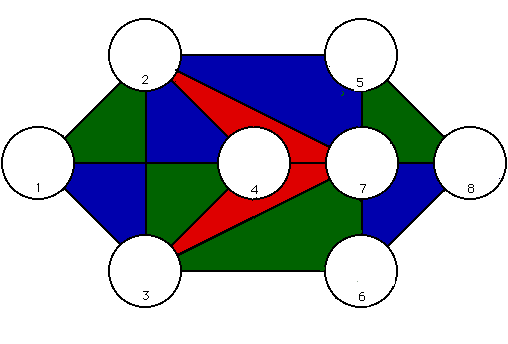
My second attempt at a format for online debate is, as I said, a variant on the “Dart Board” sometimes used for playing my HipBone Games (see, for instance, my solo game War is Sexy, says Dawn).

*

The idea here would be to format a blog post and series of 7 comments by a Querent (the one with the Question) who may also be the Umpire — both roles would be issue-neutral — a Proponent who would propose and support a thesis, and an Antagonist who would oppose it.And I should add, right at the outset, that this is a formal process for the named participants — as a white tie debate at the Oxford Union is a formal process — no matter how raucus the kibitzers may get, and accordingly requires a day or two between moves to allow for consideration, research and preparation.
dartbdwhitedebatesetup.png

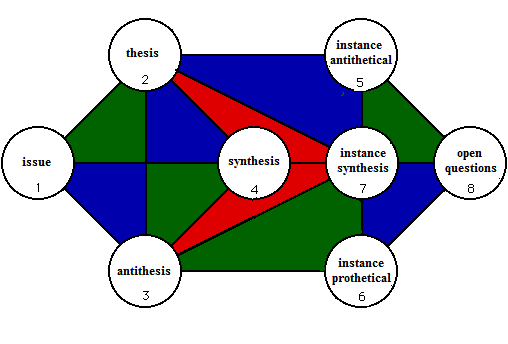
The Querent makes the first move in the first position on the board, giving it short move title (short enough to be typed on the board graphic in the space currently occupied by the word “issue‘) and a paragraph or so of move content setting forth concisely the issue to be discussed — ideally via an issue neutral anecdote or quote. After each move, the Querent (or a graphically inclined observer) would ideally update and post the game board after inserting the relevant move title.

[ Those who are not among the named participants may of course kibitz at any time… ]

The Proponent next carefully chooses a pithy quote or anecdote, gives it a move title (as above), and posts the move title, the chosen move content (the anecdote or quote selected), the link claimed (setting forth concisely the nature of his or her argument as it relates to the move content of the Querent‘s issue), and if she or he so chooses, a comment (the comments in a HipBone Game are intended for meta-conversations among the various players).

The Antagonist then similarly chooses an anecdote or quote, and posts move title, move content, links claimed — in this case, showing the links with both the issue as stated at position 1 in the Querent’s move, and the thesis as stated in position 2 in the Proponent’s move — and a comment if so desired.

Okay, that’s thesis and antithesis, the Umpire then posts a move title, some move content and links claimed to all three positions in play, with a comment if so desired, in the fourth position (labeled synthesis).

The rule is that whenever playing in a position which links via a board line to one or more previous moves, the links claimed must include explanations of how the move relates to those previous moves.

The Antagonist plays next in position 5 — playing move title, move content, links claimed, comment — providing an instance with which to dispute the thesis, and linking as per the rule just stated to the thesis proposed at position 2 — only!

Since position 5 is only connected to position 2 of those positions in play, no other links should be claimed.

Similarly, the protagonist then plays in position 6, a move which I’ve called the “prothetical” instance without a clue as to whether prothetical is a real word — tho’ I like it — linking only to the antithesis in position 2, which it seeks to refute.

Move 7 is by far the trickiest of the game, and is made by the Umpire, who now has to provide move content that synthesizes the game thus far, explaining links claimed to positions 2, 3, 4, 5 and 6 (ie to the original thesis, antithesis and synthesis, but moving the synthesis to encompass also the two instances)…

But the Umpire can take consolation in the fact that in the final move 8, the Querent gets to raise afresh those questions which remain — now that both sides have had their say, and the Umpire has attempted reconcile them.

*

Three quotes, the first one on debate:

Harmony among conflicting viewpoints, not the victory of one of them, should be the ultimate goal…

— from Bizell & Herzberg, The Rhetorical Tradition, as quoted here

The second moving from debate to dialog:

One way of helping to free these serious blocks in communication would be to carry out discussions in a spirit of free dialogue. Key features of such a dialogue is for each person to be able to hold several points of view, in a sort of active suspension, while treating the ideas of others with something of the care and attention that are given to his or her own. Each participant is not called on to accept or reject particular points of view; rather he or she should attempt to come to understanding of what they mean.

David Bohm, Science Order and Creativity, p 86

And the third, from Buddhist Madhyamika philosophy, moving into the contemplative realm where all answers are seen as the stepping off points for open questions:

I wanted to use one word in Tibetan that I’ve found very useful for myself… and this is the word zöpa.. this translates usually as patience or endurance or tolerance, but there’s this very subtle translation of zöpa, which is the ability to tolerate emptiness basically, which is another ways of saying the ability to tolerate that things don’t exist in one way, that things are so full and infinite and leave you so speechless, and so undefinably grand – and these are just descriptive words, but you have to use some words to communicate, I guess — the ability bear that, that fullness, like we’ve been talking about, not turning away, not turning away.

Elizabeth Mattis-Namgyel, in (if I recall) a Shambhala-sponsored retreat video

*

A blank Dart board, downloadable for your convenience:

dartbdwhitedebateblank.png


Switch to our mobile site