zenpundit.com » primary loyalties

Archive for the ‘primary loyalties’ Category

Martin van Creveld on The Lebanon War

Monday, June 27th, 2011


Eminent and controversial military historian, Martin van Creveld, analyzes the 2006 Israeli-Hezbollah War in the latest issue of Infinity Journal. Some Excerpts:

The Second Lebanon War: A Re-assessment

….Though the decision to retaliate in force was inevitable, it also meant that the Israel Defense Force (IDF) was taken by surprise and did not have time to prepare properly. Of the entire vast order of battle, only five regular brigades were immediately available. Moreover, these brigades had spent years doing little but carrying out counter-insurgency operations in the Occupied Territories. As a result, they had almost forgotten how to fight a real enemy; he who fights the weak will end up by becoming weak. Some of the burden fell on the Israeli Navy which shelled Lebanon’s coast, imposed a blockade, and cut the country off from the world. In doing so, one of its modern ships was hit by an Iranian-built surface to sea missile, suffering damage and taking some casualties. Since this was the first time in thirty-nine years anything of the kind had happened, it was a considerable propaganda victory for Hezbollah. At the same time it proved how much the crew had underestimated the enemy, since they (perhaps acting on their superiors’ orders) had not even switched on the vessel’s electronic defenses.

….”Stark raving mad” (majnun, in Arabic) was, in fact, the way many people in Lebanon and the rest of the Arab world reacted to the Israeli attack. As the statements of several of Hezbollah’s top leaders indicated, they too were surprised by the strength of the Israeli reaction. None of the organization’s original objectives were achieved. Its fighters remain in prison; the Israeli “occupation” of Shaba Farm continues; and Jerusalem, which it set itself as its ultimate objective to liberate, remains as firmly in Israeli hands as it has been during the last forty-four years. What the war did do was to show that, in case of war, neither Syria nor Iran would necessarily come to Lebanon’s rescue. The country’s infrastructure was left in ruins. Thirty thousand dwellings were destroyed or damaged, and dozens of bridges, underpasses, and gas stations demolished. Hundred of thousands of people were forced to flee, and as many as 2,000 killed.

Free registration required to read the article.

This piece is heavily IDF-centric in the analysis, perhaps reflecting van Creveld’s established authority on command and logistics and his recent work on air power, but I was surprised by the lack of space devoted to Hezbollah’s operations, given the author’s deep influence on 4GW theory and the study of postmodern irregular and asymmetric warfare. That may reflect, in part, the thrust of Infinity as a publication or the need for brevity but there’s an almost Clausewitzian subtext in the conclusion.

Guest Post: Shipman Reviews Dancing in the Glory of Monsters by Jason K. Stearns

Wednesday, May 18th, 2011

J. Scott Shipman, the owner of a boutique consulting firm in the Metro DC area that is putting Col. John Boyd’s ideas into action, is a longtime friend of this blog and an occasional guest-poster.

Book Review:Dancing In The Glory of Monsters, The Collapse of the Congo and the Great War of Africa, Jason K. Stearns

by J. Scott Shipman

Several thoughts come to mind when reflecting on Jason K. Stearns’ epic Dancing In The Glory of Monsters, The Collapse of the Congo and the Great War of Africa, but “dancing” doesn’t figure into any of those thoughts, and monsters are writ large, center stage. And make no mistake; we’re talking fiendishly horrific monsters, almost inhuman, as if drawn from a dictionary definition: “Anything horrible from…wickedness, cruelty or commission of extraordinary or horrible crimes; a vile creature…” So the reader should be advised, some of the stories are very disturbing.

Indeed, Mr. Stearns paints a gut-wrenching portrait of a nation and region ravaged by colonial meddling, venal and brutish politician/military leaders, and centuries old ethic strife all culminating in “many wars in one” beginning in 1996 in Congo (the former Zaire) and including active participation of neighbors Rwanda and Uganda just to name a couple.  In terms of geography, Congo straddles the equator and is the size of Western Europe, or slightly less than one fourth the size of the United States. According to the CIA World Fact Book, the literacy rate is 67% and the mortality rate a surprisingly “high” 54 years for men, and 57 for women; given the slaughter since 1996, my guess would have been a much lower number.

The Congo Wars were largely a by-product of the epic 1994 genocide in Rwanda where in the space of 100 days an estimated 800,000 Rwandans (primarily Tutsis and moderate Hutus) were killed. The killing was “organized by the elite but executed by people.” Stearns says, “…between 175,000 and 210,000 people took part in the butchery, using machetes, nail-studded clubs, hoes, and axes.” The killing was done in public and almost no one was untouched either as “a perpetrator, a victim or witness.” For internal political reasons, this resulted in over one million Hutu refugees/rebels fleeing over the border from Rwanda to Zaire. A massive tug-of-war across the border began with the ailing Zairian president Mobutu Sese Seku providing support to the rebels, and eventually a ten-year struggle within Zaire proper of both the Rwandan civil war and wars to control what became in 1997, Congo.

Dancing With Monsters is divided into three parts. Part 1 ended with the collapse of Mobutu’s government in May 1997. Following a brief respite in the fighting, Congo’s new president Laurent Kabila “fell out with his Rwanda and Ugandan allies” resulting in the second Congo war in August 1998 which “lasted until a peace deal reunified the country in 2003.” But the fighting in the eastern part of the country continues to this day and is considered the third Congo war.

Stearns tells the Congo story based on first person interviews with both perpetrators and victims of extraordinary atrocities, although he focuses more on the perpetrators who “oscillate between these categories.” A perpetrator one day becomes tomorrows victim and vice versa. Stearns has worked the better part of 10 years in the Congo, and is to be commended for the raw physical courage necessary to live, much less interview many of the “monsters” in his revealing book.

Interestingly, Stearns chose to focus on a system “that brought the principal actors to power, limited the choices they could make, and produced chaos and suffering.” That “system” is in a word, a mess. The chaos and suffering are of a kind with no contextual parallel in the modern Western experience. Stearns attempts to provide a context in an excellent introduction that offers insight into the violence, which more often than not, appears maddeningly senseless and consistently brutal. The culture of the region appears to be one where everyone is on the take, where everyone is corrupt simply to survive. To quote one of Stearns’ sources: “”If you don’t bribe a bit and play to people’s prejudices, someone else who does will replace you.” He winked and added, “Even you, if you were thrown into this system you would do the same. Or sink.”” This tone of resignation and an “ends justifies the means” justification permeates the attitudes of the political/military types Stearns interviews; in fact this philosophy colors a good portion of the book, and therein points to a large part of the systemic problem. A quote attributed to another monster, Stalin kept coming to mind: “You can’t make an omelet, without breaking a few eggs.”

From this attitude of resignation, my guess is that perhaps the “system” Stearns has documented is the extreme end result of Che Guevara-style of Soviet Marxist totalitarianism. Guevara himself spent 1965 fighting in the Congo but concluded, “they weren’t ready for revolution.” The Congolese may not have been ready for revolution, but it appears they bought the philosophy hook, line and sinker. This mentality reminded me of a passage from another book of horrors, The Whisperers, by Orlando Figes, where he writes: “she had subordinated her own personality and powers of reason to the collective.” The subordination of reason is pandemic in Congo; a place where mostly ethnically based discrimination and killing is conducted without so much as an apology. Many of Stearns’ political/military leaders spoke of “democracy,” but in my reading I did not get the sense this was anything more than a rhetorical fig leaf to remain in the good graces of the UN and the West, for there has been little in the behaviors of these leaders to suggest a level of seriousness and understanding as to what democracy means; political accountability comes to mind. Meanwhile, the killing continues.

Speaking of democracy, a good portion of the West was and continues to be indifferent to the Congo and the wars. Stearns points out, “the response, as so often in the region, was to throw money at the humanitarian crisis but not to address the political causes.” This sounds accurate. Stearns believes the West should do more, comparing the response to Kosovo in 1999, where “NATO sent 50,000 troops…to Kosovo, a country one-fifth the size of South Kivu“(part of Congo). Many of those interviewed by Stearns agree, but with a twist. In the concluding chapter, Stearns quotes a Rwandan political advisor offering what he called a “typical view” of the US from the region:

“When the United States was attacked on September 11, 2001, you decided to strike back against Afghanistan for harboring the people who carried out the attack. Many innocent civilians died as a result of U.S. military operations. Is that unfortunate? Of course. But how many Americans regret invading Afghanistan? Very few.”

Many Americans regret the extent of our operations in Afghanistan, more with each passing day. In my opinion, this seems to be offering an all-too-typical moral equivalence argument; since innocents die in American wars, our slaughter of innocents is justified. Stearns correctly follows this quote with extension of the Rwandan official’s line of thought:

“This point of view does not allow for moral nuance. Once we have established that the genocidaires are in the Congo, any means will justify the ends of getting rid of them, even if those means are not strictly related to getting rid of genocidaires.”

This official’s argument is as dangerous as the wars he and his neighbors have endured. In delegitimizing any moral nuance his prescription is amoral, or worse, claims an exclusive role defining morality thereby justifying a continuation of the slaughter. I don’t have a solution, but this prescription will yield only more of the same. Political accountability doesn’t pass the buck, or hide behind a general truth that tragedies occur, but rather learns from mistakes made and steadfastly strives to avoid further bloodshed.

In conclusion, I would offer one bit of advice to those who read this important book: use Google Earth or a good atlas; the book has maps, but the maps aren’t sufficient to the level of detail provided in the book. This is a minor nit, but one that can be enhanced through an external source.

Stearns concluded on a note of optimism and confidence in the Congolese people, whom he calls extremely resilient and energetic peoples. One could conclude nothing less from this excellent and truly frightening recounting of their story. Highly recommended.

Walter Russell Mead on our Oligarchical and Technocratic Elite

Saturday, May 14th, 2011

I am still busy with several posts and a couple of book reviews, none of which are finished and some offline activities. In the interim, Lexington Green sent me this post by Walter Russell Mead. It is long but brilliant, spot on and thoroughly devastating:

Establishment Blues

….By contrast, we have never had an Establishment that was so ill-equipped to lead.  It is the Establishment, not the people, that is falling down on the job.Here in the early years of the twenty-first century, the American elite is a walking disaster and is in every way less capable than its predecessors.  It is less in touch with American history and culture, less personally honest, less productive, less forward looking, less effective at and less committed to child rearing, less freedom loving, less sacrificially patriotic and less entrepreneurial than predecessor generations. 

 Its sense of entitlement and snobbery is greater than at any time since the American Revolution; its addiction to privilege is greater than during the Gilded Age and its ability to raise its young to be productive and courageous leaders of society has largely collapsed.

…We have had financial scandals before and we have had waves of corporate crime.  We have had pirates and robber barons.  But we have never seen a collapse of ordinary morality in the corporate suites on the scale of the last twenty years.  We have never seen naked money grubbing among our politicians akin to the way some recent figures in both parties have cashed in.  Human nature hasn’t changed, but a kind of moral grade inflation has set in and key segments of the American Establishment are increasingly accepting the unacceptable as OK.  Investment banks betray their clients; robo-signers essentially forge mortgage documents day after day and month after month; insider traders are lionized.   Free markets actually require a certain basic level of honesty to work; if we can’t be more honest than this neither our markets nor we ourselves will remain free for very long.

Many problems troubling America today are rooted in the poor performance of our elite educational institutions, the moral and social collapse of our ‘best’ families and the culture of narcissism and entitlement that has transformed the American elite into a flabby minded, strategically inept and morally confused parody of itself….

[ Emphasis mine]

….A leadership class is responsible for, among other things, giving a voice to the feelings of the nation and doing so in a way that enables the nation to advance and to change.  Most of the American establishment today is too ignorant of and too squeamish about the history and language of American patriotism to do that job.  In the worst case, significant chunks of the elite have convinced themselves that patriotism is in itself a bad and a dangerous thing, and have set about to smother it under blankets of politically correct disdain.

This will not end well.

Read the rest here.

I have written about the deficiencies of the elite before, mostly in their inability to think strategically and create a coherent foreign and national security policies but their increasingly oligarchical attitudes of favoring self-dealing fiscal, regulatory and social policies, at the expense of their fellow citizens or the national interest is cause for great alarm.For example a legion of recent national security officials from the current and previous administration, a few barely out of office, have just accepted large wads of lightly laundered Saudi cash to lobby on behalf of the Mujahedeen-e Khalq, a nutty, cultish, Marxist terrorist group that formerly worked for Saddam Hussein. This with no sense of embarrassment or shame that they are putting a dingy cast on their prior public service or awareness that doing so conflicts with solemn oaths some of them have made to the Constitution of the United States. 

How many are also taking Chinese money, I wonder?

We need a new elite

A two part meditation, part i: scenario planning the end times

Wednesday, April 13th, 2011

[ by Charles Cameron ]
.

Some people like banking, I prefer religion.

I’m perennially fascinated by the way myths and rituals, meditations and sacraments can not just motivate and move people but change them. That’s just the way I am. I spent ten minutes this morning listening to a zen nun explaining on YouTube how to strike a bell (she preferred to think of it as “inviting” the bell), how to listen to it, how to wake up.

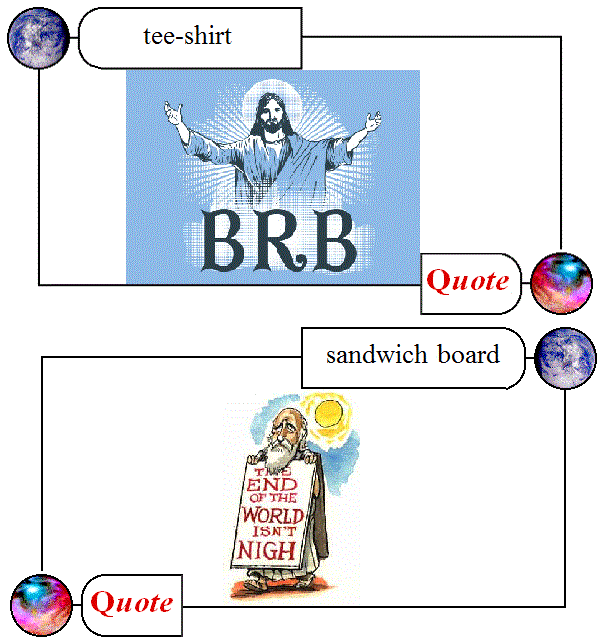
So when it comes time for scenario planning, I find the logistical and economic side of things less interesting than the tada! End of the World! excitement that seems to pop up all over the place from time to time. On billboards here in California (with a date certain: May 21st, 2011), for instance. In videos from Iran (coming soon to a theater of war near Jerusalem). And on Glenn Beck (ditto).

It seems to be a meme that cartoonists and satirists enjoy, too…

.

quo-end-times.gif

*

The thing is, there are two worldviews here, which we could conveniently label sacred and secular – though there’s no reason why one can’t hold a “sacred” view of the world (as I do) and not expect it to end any time soon (I don’t), or a “secular” view, and expect a new ice age or terminal global warming around the next bend in the road…

Two worldviews. And here’s where we get a “clash of cultures”.

Either there exists a definitive blueprint for the future of geopolitics – in Daniel, Ezekiel, and Revelation — or the future of geopolitics is something we’ll have to wrangle ourselves, using our best intelligence, wisdom and material resources.

On Sunday, you can go learn about the blueprint in an evangelical church – or you can kick back with the Sunday supplements and “Meet the Press”. And nobody much minds if you do one thing, and your neighbors do the other.

Things get interesting, however, when geopolitical decision times come around, and a great nation must decide what to do about the Palestinians, say, or Iran.

*

Okay.

Joel Rosenberg is a writer of popular, well-crafted thrillers – a Tom Clancy for the end times set.

Since his books are engaging, and since Glenn Beck frequently features Rosenberg on his show, his most recent novel, The Twelfth Imam, has been enjoying pretty decent sales, making it to #8 on the NYT best-seller list, #8 on Publisher’s Weekly and #10 on the WSJ hard-cover fiction lists in one week, not so long ago. And since I’m a student of comparative eschatology, I read his work with considerable interest, and follow his blog.

Today, he wrote:

As international support builds for the Palestinians to unilaterally declare their own state at the U.N. General Assembly opening session in September, I am growing increasingly concerned the President Obama is preparing to endorse such a move and even push for it. This would be a terrible mistake.Bible prophecy makes it clear that in the last days the nations of the world will divide up the land of Israel. But the Scriptures are also crystal clear that the nations will face the judgment of Almighty God for doing so. “For behold, in those days and at that time, when I restore the fortunes of Judah and Jerusalem, I will gather all the nations and bring them to the Valley of Jehoshaphat [“the Lord judges”]. Then I will enter into judgment with them there on behalf of My people and My inheritance, Israel, whom they have scattered among the nations; and they have divided up My land.” (Book of Joel 3:1-2).

Let the nations be warned by the God of Israel: they are on a dangerous and disastrous road. Let us pray they turn around before it is too late.

*

That’s actually a pitch for geopolitics by Biblical fiat — as Rosenberg explicitly points out:

One could wish the clear warning of the Bible would be enough to dissuade the President from dividing the land of Israel. I am not sure it will. Perhaps sheer politics will help.

If you believe in the sacred “Biblical blueprint” theory, and believe that the end times are very rapidly approaching, this should encourage you. If you believe in the secular “let’s hope our politicians don’t fubar this one” it might worry you – because you don’t trust some writers a couple of millennia ago to have an accurate appraisal of today’s Middle East, when even our intelligence services don’t claim to be able to predict the outcomes of various interventions in a complex situation, with unknown unknowns to boot.

And of course you might also be Israeli (and hold a sacred or secular viewpoint), Iranian (secular or sacred), or just not interested in geopolitics.

In Iran, the holders of a sacred, end times tradition are in power. In the US, the holders of a sacred, end times tradition exert some political influence. If you’re in Israel, you may hope and / or pray the Iranian end timers don’t visit their scenario on your head. If you’re a Palestinian, you may hope and / or pray the American end timers don’t visit theirs on yours.

I think it’s good to be aware of these things, but not get too excited.

*

More to follow in A two part meditation, part ii: of monks and maniacs.

Book Review: Narcos Over the Border by Robert J. Bunker (Ed.)

Tuesday, April 5th, 2011

Narcos Over the Border: Gangs, Cartels and Mercenaries by Dr. Robert J. Bunker (Ed.)I just finished my review copy of Narcos Over the Border. It is one of the more disturbing academic works recently published in the national security field, not excluding even those monographs dealing with Islamist terrorism and Pakistan. If the authors of this granular examination of Mexico’s immense problems with warring narco-cartels, mercenary assassins, systemic corruption, 3rd generation gangs and emerging “Narcocultas”of Santa Muerte are correct – and I suspect they are – Mexico’s creeping path toward state failure reprsents a threat to American national security of the first order.

The 237 page, heavily footnoted, book is organized into three sections: Organization and Technology Use by the narcos networks, Silver or Lead on their carrot and stick infiltration/intimidation of civil society and the state apparatus, and Response Strategies for the opponents of the cartels. Bunker’s co-authors Matt Begert, Pamela Bunker, Lisa Campbell, Paul Kan, Alberto Melis, Luz Nagle, John Sullivan, Graham Turbiville, Jr., Phil Wiliams and Sarah Womer bring an array of critical perspectives to the table from academia, law enforcement, intelligence, defense and security fields as researchers and practitioners. The effort to blend disciplinary approaches in Narcos Over the Border is both an intentional and commendable effort to break down academic and policy silos and bureaucratic “turf” perspectives that prevent analyzing Mexico’s security dilemmas as an interrelated threat increasingly resembling a full-fledged insurgency (albeit not on the classic Maoist Model).Some impressions I gained from reading Narcos Over the Border include:

  • The Narco-Cartels and the Zetas, which fight each other as well as Mexico’s military ( Mexican police generally are infiltrated, intimidated, outgunned and seriously outclassed by the Cartel gunmen, Zetas and Guatemalan Kaibiles) are better armed and better trained than are the Taliban. The deadly and efficient Zetas and Kaibiles are superior to regular Mexican military forces and have established safe haven training camps in Central America.
  • Narco-cartels are properly speaking, no longer narco-cartels but transnational criminal syndicates involved in a wider array of revenue generating activities, but with professional intelligence and military capabilities, and increasingly, political, social and religious agendas that are functionally reminiscient of Hezbollah and HAMAS.
  • The Mexican state is severely hampered in it’s response to the threat presented by the cartels by it’s own strategic use of corruption as a cost saving measure and a tool for sustaining elite control of Mexican politics, as well as a method of personal enrichment by members of Mexico’s ruling class.
  • The eschewing of the extreme violence by the cartels North of the border appears to be more of a sign of a strategic policy by cartel and Zeta bosses than a lack of capacity or evidence of a lack of infiltration into American society. To the contrary, Mexican cartel links to acutely dangerous American prison and street gangs such as the Mexican Mafia and MS-13 are significant and well documented.
  • The cartels are global, not regional or local operators.
  • The culture of the Narco-cartels, which draws on some romantic Mexican social and religious underground traditions, particularly the hybrid cartel La Familia , is morphing into a very dangerous “Narcocultas”, a neo-pagan, folk religion featuring ritualistic violence, beheadings and torture-murders carried out for reasons other than economic competition.
  • Mexico has departed the realm of having a serious law enforcement problem and has graduated to a significant counterinsurgency war against the cartels in which the Mexican state is treading water or making progress against some cartels (possibly displacing their activities to weaker states in Central America).

The authors do not assume the worst case scenario, state collapse, for Mexico but rather an insidious “hollowing out” of the state by the cartels and a mutation of Mexico’s native culture to host a 4GW nightmare. As Robert Bunker writes:

What is proposed here is that Mexico is not on it’s way to becoming a “rotting corpse” but potentially something far worse – akin to a body infected by a malicious virus. Already, wide swaths of Mexico have been lost to the corrupting forces and violence generated by local gangs, cartels and mercenaries. Such narco-corruption faced few bariers given the fertile ground already existing in Mexico derived from endemic governmental corruption at all levels of society and in some ways, it even further aided the ‘virus’ spreading through Mexican society from this new infection. Among it’s other symptoms, it spreads values at variance with traditional society, including those:

….conceivably derived from norms based on slaveholding, illicit drug use, sexual activity with minors and their exploitation in prostitution, torture and beheadings, the farming of humans for body parts, the killing of innocents for political gain and personal gratification and the desecration of the dead.

While meticulous, Narcos Over the Border is not all-encompassing in scope.  A fundamentally Mexico-centric collection of scholarly articles, it does not deal extensively with American policy makers involved in Mexico’s narco-insurgency, the intricacies of cartel financial operations or undertake case studies of narco activities in Mexican-American communities, though the authors do track narco-cartel and gang presence in cyberspace. Narcos Over the Borders represents a starting point for deeper investigation of narco-insurgency and for a national security comunity that has thus far treated Mexico as a third tier problem, a policy call to arms.Strongly recommended.


Switch to our mobile site