zenpundit.com » peace

Archive for the ‘peace’ Category

When Does Conflict Become “War”?

Tuesday, May 22nd, 2012

When does mere conflict end and war begin?

Great philosophers of strategy and statecraft did not treat all conflict as war but regarded war as a discernably distinct phenomenon, different from both peace and other kinds of conflict. War had a special status and unique character, glorious and terrible:

“Hence to fight and conquer in all your battles is not supreme excellence; supreme excellence consists in breaking the enemy’s resistance without fighting. “

    -Sun Tzu

“When the Corcyraeans heard of their preparations they came to Corinth with envoys from Lacedaemon and Sicyon, whom they persuaded to accompany them, and bade her recall the garrison and settlers, as she had nothing to do with Epidamnus. If, however, she had any claims to make, they were willing to submit the matter to the arbitration of such of the cities in Peloponnese as should be chosen by mutual agreement, and that the colony should remain with the city to whom the arbitrators might assign it. They were also willing to refer the matter to the oracle at Delphi. If, in defiance of their protestations, war was appealed to, they should be themselves compelled by this violence to seek friends in quarters where they had no desire to seek them, and to make even old ties give way to the necessity of assistance. The answer they got from Corinth was that, if they would withdraw their fleet and the barbarians from Epidamnus, negotiation might be possible; but, while the town was still being besieged, going before arbitrators was out of the question. The Corcyraeans retorted that if Corinth would withdraw her troops from Epidamnus they would withdraw theirs, or they were ready to let both parties remain in statu quo, an armistice being concluded till judgment could be given. “

-Thucydides 

“Thus, therefore, the political object, as the original motive of the war, will be the standard for determining both the aim of the military force, and also the amount of effort to be made. This it cannot be in itself; but it is so in relation to both the belligerent states, because we are concerned with realities, not with mere abstractions. One and the same political object may produce totally different effects upon different people, or even upon the same people at different times; we can, therefore, only admit the political object as the measure, by considering it in its effects upon those masses which it is to move, and consequently the nature of those masses also comes into consideration. It is easy to see that thus the result may be very different according as these masses are animated with a spirit which will infuse vigour into the action or otherwise.”

– Carl von Clausewitz 

We see from the above that war was not regarded as the same as either the political conflict which precipitated it or even, in the case of the Corcyraeans, the violence done against their interests in Epidamnus by the Corinthians, which did not yet rise to be considered war in the eyes of either Corcyra or Corinth. Instead the occupation of Epidamnus was something we would recognize today as coercion.  Like war itself, coercion operates by a calculus that is only partially rational; not only is the psychological pressure of coercion subject to passions of the moment, our reactions to the threat of violence -and willingness to engage in it – may be rooted in evolutionary adaptations going back to the dawn of mankind. Coercion, or resistance to it, usually is the midwife of war.

Prehistoric man lived a life that archaeology increasingly indicates, contrary to philosophical myth-making, was endemic in it’s violent brutality. Whether the violence between or within tiny paleolithic hunter-gatherer bands constituted private murder or warfare is a matter of debate, but the existence of the violence itself is not. Earliest firm evidence of a possible large skirmish or massacre dates back to 14,000 BC and definitive evidence for large-scale, organized battle dates to the end of the Neolithic period and dawn of the Bronze Age in 3500 BC.  Lawrence Keeley, in War Before Civilization, describes primitive man as being hyperviolent in comparison with those noted pacifists, the ancient Romans:

….For example, during a five and a half month period, the Dugum Dani tribesmen of New Guinea were observed to participate in seven full battles and nine raids. One Yanomamo village in South America was raided twenty-five times over a fifteen month period…. 

The high frequencies of prestate warfare contrast with those of even the most aggressive ancient and modern civilized states. The early Roman Republic (510-121 BC) initiated war or was attacked only about once every twenty years. During the late Republic and early Empire (118 BC -211 AD), wars started about once every six or seven years, most being civil wars and provincial revolts. Only a few of these later Roman wars involved any general mobilization of resources, and all were fought by the state’s small (relative to the size of the population) long-service, professional forces supported by normal taxation, localized food levies and plunder. In other words, most inhabitants of the Roman Empire were rarely directly involved in warfare and most experienced the Pax Romana unmolested over many generations. [Keeley,33] 

Simple, prestate societies probably waged “war” – a violent and deliberate conflict with rival groups and in alliance with rival groups against more distant interlopers – but the degree to which archaic and prehistoric humans culturally differentiated between this and their everyday, casual, homicidal violence remains unknown. Moreover, many academics would not accept the thesis of neolithic societies being “warlike”, much less, waging “war” as we understand the term until they rose to levels of social and political complexity generally denoted as chiefdoms, kingdoms and empires (“political” societies).

There’s something to that argument; a certain element of cultural identity is required to see the world in distinctly  “us vs. them” terms instead of an atomized Hobbesian “all vs. all” but I suspect it is far more basic a level of communal identification than the level of cultural identity typical of sophisticated chiefdoms like Cahokia or ancient Hawaii. Cultural and communal identity would tend to focus violence toward outsiders while increasingly complex political and social organization could “shape” how violence took place, molding it into recognizable patterns by regulation, ritual, taboo and command of authority. Once there is enough societal complexity for a leadership to organize and direct mass violence with some crude degree of rational choice and control, not only is war possible but strategy is as well.

Once a society is sophisticated enough to employ violence or the threat of violence purposefully for diplomacy or warfare, it is making a political decision to separate mundane and nearly chronic “conflict” and “war” into different categories. This would appear to be a primitive form of economic calculation distinguishing between conflict that generates acceptable costs and manageable risks and those conflicts that pose unacceptable costs or existential risks. This would give the relationship between primitive tribes the character of bargaining, an ongoing negotiation where the common currencies were violence and propitiation, until one party vacated the area or ceased to exist, most wars then having an innate tendency to escalate toward genocide (our current limitations on warfare, such as they are, derive from greater social complexity and political control over the use of violence).

If an economic calculus is indeed the root of the political decision to recognize some conflicts as “war”, that raises some interesting questions about modernity and advanced  states. What happens  when a conflict occurs with a state sufficiently complex that the ruling elite see their class interests as distinct and superceding those of the state? The calculus and what is considered “acceptable” costs or risks in a conflict vice those mandating “war” shift dramatically away from what might be considered “rational” state interest.

In a society at such an end-state, seemingly intolerable conflict might be tolerated indefinitely while full-fledged wars could be waged over what would appear to be mere trivialities to the national interest.

ADDENDUM:

In addition to some already excellent and extensive comments in the thread, I would like to turn your attention to an interview post at The Last Word on Nothing recommended byZack Beauchamp:

Horgan, Hayden, and the Last Word on Warfare 

Ann:  I understand both of you have written authoritative and charming books on war — John’s, just out, is called The End of War; and Tom’s is Sex and War — and that you’vediscussed these matters before.  I also understand you disagree about war.  How could you not agree?   I mean, war is just nasty stuff and we shouldn’t do it, right?

Tom: Ann, you’re poking the hornet’s nest right off the bat! I don’t think John and I disagree about war, but rather about peace. Don’t get me wrong: we both prefer the latter to the former, by a wide margin. And there are many things we do agree on, I think, such as the substantial observed decrease in the frequency and lethality of war over the past several centuries, and the idea that culture is an important part of the balance between war and peace. But I think we do have a difference of opinion about the attainability of peace (John) versus the inevitability of war (me). I think this makes John a better person than me, and certainly a more optimistic one. And I really, really hope he’s right. In my mind it comes down to an argument about human nature, and whether the impulses and behaviors of war are inborn or acquired. Or at least, that’s my take. John, what’s yours? [….]

The Strategic Dilemma of Bitter-Enders

Sunday, April 8th, 2012

Berlin 1945

I have been reading The End by Ian Kershaw and it struck me that the story therein of Hitler’s Reich going down to total destruction is really a recurrent phenomena.

It is interesting that Kershaw, who began his earlier 2 volume biography of Adolf Hitler with the hypothesis that the Fuhrer was more the opportunistic vehicle of grand historical forces, in this study of the Nazi Gotterdammerung has accepted that the pull of Hitler’s inexorable authority over  Nazi and traditional German elites was charismatic, personalized and beyond challenge, even when Hitler was encircled by Soviet forces in his subterranean bunker and hours from suicide. Kershaw details how Hitler and his die-hard Gauleiter apparatchiks repeatedly demanded not only the militarily impossible, but the nonsensically insane, from the Wehrmacht, the Waffen-SS and the German people themselves. Virtually everyone struggled to comply.

This story is far from unique.

The Imperial Japanese, it must be said, surpassed even their Nazi allies in stubborn refusal to accept empirical reality and determination to fight to uttermost ruin. After the destruction of their Navy, loss of 100,000 men in Okinawa (their entire army there, minus a handful, fought to the death), the ruin of their cities, approaching famine, exhaustion of aviation fuel and gasoline stocks, the declaration of war on Japan by the Soviet Union and the atomic bombing of Hiroshima – Imperial Japan’s war cabinet deadlocked on a vote to surrender. The Kamikaze enthusiasts among the flag officers proposed a battle plan for their home islands to the war cabinet picturesquely titled “Honorable Death of 100 Million”, with gruesome implications for Japan’s civilian population.

Emperor Hirohito inspects Hiroshima after the atomic bombing

Many years later, Prime Minister Nakasone, who had been conscripted as a mere boy to meet invading American soldiers and Marines on the beach with a sharpened bamboo stake, credited the two atomic bombs with having saved his life. Without them, Japan’s warlords, with the tacit approval of their Emperor, would have coerced the Japanese nation into a gloriously genocidal defeat. A policy that while irrational,  faithfully followed the cultural spirit of Bushido and Japan’s mythic 47 Ronin.

Then there was the ancient example of Masada, the defiance of Titus by the Jewish Sicarii in 73 AD, as described by Josephus:

…. Miserable men indeed were they, whose distress forced them to slay their own wives and children with their own hands, as the lightest of those evils that were before them.  So they being not able to bear the grief they were under for what they had done any longer, and esteeming it an injury to those they had slain to live even the shortest space of time after them,-they presently laid all they had in a heap, and set fire to it.  They then chose ten men by lot out of them, to slay all the rest; every one of whom laid himself down by his wife and children on the ground, and threw his arms about them, and they offered their necks to the stroke of those who by lot executed that melancholy office;  and when these ten had, without fear, slain them all, they made the same rule for casting lots for themselves, that he whose lot it was should first kill the other nine, and after all, should kill himself. Accordingly, all these had courage sufficient to be no way behind one another in doing or suffering;  so, for a conclusion, the nine offered their necks to the executioner, and he who was the last of all took a view of all the other bodies, lest perchance some or other among so many that were slain should want his assistance to be quite dispatched; and when he perceived that they were all slain, he set fire to the palace, and with the great force of his hands ran his sword entirely through himself, and fell down dead near to his own relations. So these people died with this intention, that they would leave not so much as one soul among them all alive to be subject to the Romans.

….Now for the Romans, they expected that they should be fought in the morning, when accordingly they put on their armor, and laid bridges of planks upon their ladders from their banks, to make an assault upon the fortress, which they did,  but saw nobody as an enemy, but a terrible solitude on every side, with a fire within the place as well as a perfect silence So they were at a loss to guess at what had happened. At length they made a shout, as if it had been at a blow given by the battering-ram, to try whether they could bring anyone out that was within;  the women heard this noise, and came out of their underground cavern, and informed the Romans what had been done, as it was done, and the second of them clearly described all both what was said and what was done, and the manner of it:  yet they did not easily give their attention to such a desperate undertaking, and did not believe it could be as they said; they also attempted to put the fire out, and quickly cutting themselves a way through it, they came within the palace,  and so met with the multitude of the slain, but could take no pleasure in the fact, though it were done to their enemies. Nor could they do other than wonder at the courage of their resolution and the immovable contempt of death, which so great a number of them had shown, when they went through with such an action as that was.

What does the phenomenon of bitter-end political leadership mean in terms of strategy?

To the extent that war is a contest of wills or a form of bargaining between two political communities, the fanaticism of bitter-enders simplifies strategy while often complicating the warfare necessary to execute it.  Strategy is simplified because, to borrow a term from labor relations, the “last, best offer” has been refused. No bargaining is taking place – one or more sides refuses peace at any price short of total victory (“unconditional surrender”) or complete defeat. This represents movement away from a limited war for limited ends closer toward Clausewitz ‘s theoretical “Absolute War” by becoming, for the losing party, an existential conflict. The implicit threat to fight to the bitter end in any war – assuming the resources and will to make good on the threat exist – is really a primitive form of psychological deterrence; most states seeking limited objectives will avoid getting trapped in this dynamic.

This means the strategic calculus is altered by such a stance. The war itself and the driving need to wage it to it’s ultimate conclusion may have come to outweigh the value of the original “End” over which the conflict began; perhaps a policy concession or bit of territory or admission by a state’s rulers of a subordinate place in the diplomatic pecking order. While adopting a “bitter-end” position logically seems disadvantageous to the weaker party, it presents the enemy with a new set of problems. The “Means” or costs required to wage a war of conquest and lengthy occupation may be economically or attritionally prohibitive, or even physically impossible. Israel has a fine military and nuclear weapons but the Jewish state is too small to subdue and rule over the Arab states; Imperial Japan, for all it’s martial ferocity and cruelty, could not swallow the vastness of China, divided by civil war and fighting without allies, even before Pearl Harbor. Reach can exceed grasp.

Likewise, the moral burden and diplomatic friction of waging war not only against the opposing army, but the enemy population as well – of bombing or blockading into starvation women, children and the elderly – may be more than a political community or it’s leadership are able to bear and remain unified. As callous and narcissistic leaders of great countries usually are, few of them (fortunately) aspire to follow in the footsteps of Hitler, Stalin or Mao and openly spill an ocean of blood.  The impressive firepower of the bombing campaigns of Lyndon Johnson and Richard Nixon did not break Hanoi’s will to fight the Vietnam War, they broke the Eastern Establishment’s will to pursue anticommunist Containment by force in Vietnam or elsewhere. The brutal counterinsurgency tactics of the French Army in the Algerian War destroyed the Algerian rebels militarily, but it shattered the Fourth Republic politically.

Insurgency, the “war of the weak”, is powerful because it inherently contains elements of bitter-endism. To rise up against one’s own society usually is an act of politically burning your boats and wearing, so far as the state is concerned, the mantle of treason and all that it entails. A desperate act by desperate men and conversely,  many of the leaders of states, being tyrants, are in no better position. Tyrants are widely despised; the Gaddafis or Mussolinis know that their power is their only guarantee of safety and their fate, if they fall into the hands of their people, would be terrible, so any rebellion must be crushed immediately, lest it gain traction. The Shah by contrast, was a congenital coward but a realist. He knew what might happen if he and his family fell into the hands of his political opponents, so the Pahlavi dynasty preemptively fled at the first sign of trouble (twice).

Finally, a word must be said about the position of a people under the leadership of  bitter-ender rulers in a war. Caught between a rock and a hard place, they essentially have three choices, none of them attractive:

1. Make a supreme effort to win the war.

2. Make a supreme effort to overthrow the government and sue for peace.

3.  Desert the cause as quietly as they can on an individual basis and hope for the best.

The best almost never happens. Kershaw’s history of the fate of the Germans in 1945 would have been well understood by Thucydides, even if the Melians were as blameless as the Germans were deserving of their fate:

….About the same time the Melians again took another part of the Athenian lines which were but feebly garrisoned. Reinforcements afterwards arriving from Athens in consequence, under the command of Philocrates, son of Demeas, the siege was now pressed vigorously; and some treachery taking place inside, the Melians surrendered at discretion to the Athenians, who put to death all the grown men whom they took, and sold the women and children for slaves, and subsequently sent out five hundred colonists and inhabited the place themselves.

If you want the bitter end, be prepared to drink the last drop.

The Said Symphony: move 19

Sunday, March 18th, 2012

[ by Charles Cameron – extended analytic game on Israeli-Palestinian conflict — for those who wish to catch up, our game thus far consists of an intro to the game and game board, followed by moves 1-5, 6-9, then moves 10-11 which together constitute a meditation, moves 12, 13-15, 16-17, and most recently before this, move 18 with cadenza ]

Move 19: The view from above

Move content:

Discussing strategy, the very canny LTG (USMC, Ret’d.) Paul Van Riper had this to say:

What we tend to do is look toward the enemy. We’re only looking one way: from us to them. But the good commanders take two other views. They mentally move forward and look back to themselves. They look from the enemy back to the friendly, and they try to imagine how the enemy might attack them. The third is to get a bird’s-eye view, a top-down view, where you take the whole scene in. The amateur looks one way; the professional looks at least three different ways.

A bird’s-eye view, a hawk’s eye view, a top-down view, an overview, a view from 30,000 feet, a God’s eye view, a view from above, a zoom…

If move 18 and its cadenza gave us a view of the depth of vision or insight that is necessary for a full and rich understanding of the world we live in — its qualitative or spiritual scope, if you like — this next move, with its picnic and drone-sight, addresses its breadth in space and time — materially and quantitatively speaking.

The classic expression of the sheer material scope of the universe was put together by Charles and Ray Eames in their justly celebrated film, Powers of Ten, from which the lower of these two images is drawn:

Here are some other relevant scans of the scope of things, in terms of time and space:

The Scale of the Universe 2
A Brief History of The Universe
The Known Universe
A Time-Lapse Map of Every Nuclear Explosion Since 1945

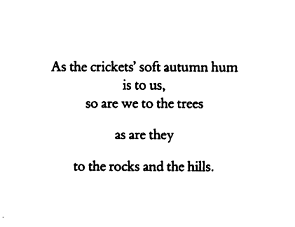
These are impressive videos to be sure, but as an aside I’ll invite you to ask yourselves how well they compare with this zoom in words, a poem by the zennist, ecologist, essayist and poet Gary Snyder, from his book, Axe Handles: Poems:

Such breadth of vision, such craft.

*

If this “material scope of things” too has a cadenza, it would be that all of this is shot through with some primary oppositions, dappled as the poet Gerard Manley Hopkins would have it, with swift, slow; sweet, sour; adazzle, dim — as indicated in the drone-sight and picnic double image at the head of this move.

This dappling, this constant flux of opposites, takes many forms — day and night lead to the more abstract light and dark, which can then be interpreted morally as good and evil, to which we respond with repulsion and attraction as the case may be, building our worldviews from love or fear…

At different scales the opposites that matter most to us may have different names and shadings, but here I’d just like to draw attention to the dappling of our world with:

competition and cooperation
Darwin‘s natural selection and Kropotkin‘s mutual aid
duel and duet (ah! — a favorite phrasing of mine)
war and peace

Provocatively, we find this dappling in scriptures, too, wherein the ripples of such verses as “The LORD is a man of war: the LORD is his name” (Exodus 15.3) dropped like a stone into the pond of the human mind, meet with the ripples of other verses such as “God is love; and he that dwelleth in love dwelleth in God, and God in him” (I John 4.16).

There are times when we take such oppositions literally, perhaps too literally, and times when we begin to see oppositions as abstract and theoretical end-points to what is in fact a yin-yang process continually unfolding…

Which brings me by a commodius vicus of recirculation to this image of the great opposition between war and peace, its dappling, its unfolding:

Links claimed:

To the Lamb, move 18: this move presents the material scope of the universe in counterpoint to its visionary scope as laid out in move 18 with its cadenza.

To Revelation, move 17 — the word revelation means unveiling, as we have seen, and our sciences and technologies, with their spectra of telescopes, microscopes, cameras and zooms, are unveiling and revealing to us much about the physicality of the world we live in — much that was accounted for in other times and places through intuition, vision and poetry.

This scientific and technical revelation of material existence, for many of us moderns, has largely eclipsed the mode of visionary revelation of move 17 — yet it cannot eradicate it. Implicit in this move, then, is the sense that we carry with us both subjective and objective, inner and outer, qualitative and quantitative understandings — though the data that “sight” and “insight” provide us with may be different in kind, and resolving them may be something of a koan to us, the deep problem in consciousness as philosophers of science have named it — and that we can discount neither one if we are to have and maintain a rich sense of our situation.

Comment:

If the two previous moves have shown us the scope of the universe we co-inhabit, perhaps we should now make our own zoom in, much as James Joyce did when he had the schoolboy Stephen inscribe his name and address in his geography book as Stephen Dedalus, Class of Elements, Clongowes Wood College, Sallins, County Kildare, Ireland, Europe, The World, Universe – an address that Stephen then read both forwards and backwards, finding himself in one direction, and finding in the other that he had no means of knowing what might lie beyond the universe…

Imagine then, skipping rapidly from (unimaginable) cosmos via such things as the intriguingly named End of Greatness to galaxy or nebula…

…solar system and planet — whence we can slow down and zero gently in on the Middle (or as my friend Ralph Birnbaum would call it, the Muddle) East, Israel / Palestine, Jerusalem / Al Quds / the Temple Mount / Noble Sanctuary – and to such matters of contemplative vision and tribal passion as the first, second and projected third Temples, the al-Aqsa mosque.

Our increasing focus will bring us, then, to that the rock which Jews believe marks the place where Abraham bound his son Isaac (the Akedah), and which Muslims believe to be the place of ascent of the Prophet to the celestial realms (the Mi’raj) on his Night Journey (Qur’an, Al-Isra).

Here again myth and history collide, and both visionary and material considerations merge in the heart of the what my friend the Israeli journalist Gershom Gorenberg has justly called “the most contested piece of real estate on earth”.

Of diversity in Islam

Wednesday, March 7th, 2012

[ by Charles Cameron — against either / or thinking — a graphic reminder? ]
.

Islam is “a mosaic, not a monolith”.

Vartan Gregorian, president of the Carnegie Corporation, offered us a 177-page exposition of that theme in a book of that title published by the Brookings Institution (2003), expanding on an earlier and shorter essay of the same title. Of the book-length version, he writes:

Presenting such a wide-angle view in a relatively small space requires the free use of generalizations, summaries, and categorizations that must leave out many nuances of history.

1.

There’s no doubt that some currents within Islam preach a continuing war against “Crusaders and Zionists” — and make no mistake about it, this is a religious movement, claiming its sanction in scripture and its path as submission to the will of God, as indicated by David Martin Jones and MLR Smith in Whose Hearts and Whose Minds? The Curious Case of Global Counter-Insurgency [see Zen’s comments here]:

The process of radicalisation is obviously a complex one. Certainly, the passage to the act of terrorism cannot be reduced solely to religion. Nevertheless, it is somewhat naive, if not perverse, to dismiss it completely. The bombings of the Madrid and London transport systems in March 2004 and July 2005 respectively, and even the 9/11 assaults, are, whatever else, Islamist acts in a Western setting. The view that religion is at best a secondary motive defies the evidence. All the groups that have undertaken high-profile terrorist acts dating from 9/11 and stretching from Bali to Madrid, London and Mumbai have acted in the name of a militant understanding of Islam. Such a pattern of worldwide attacks, exhibiting a profound devotion to a politically religious cause intimates, if nothing else, a religious dimension to jihadism. In fact, to reduce jihadism to individual social pathology attempts to explain away political religion as a social fact. Rather worryingly, it assumes that when a highly motivated jihadist claims to undertake an operation to advance a doctrine, he does not really mean it.

This might seem so obvious as to require no comment — yet Jones and Smith follow this paragraph with a question:

we need to resolve this paradox: why do counterinsurgency theorists exhibit this reluctance to confront the ideological or politically religious dimension of modern insurgency?

— and there are no doubt other segments of the media, intelligence and policy communities of which the same question might be asked.

One aspect of the answer, I believe, lies in the general tendency of post-enlightenment thinkers to “push religion into the background of their story” (Richard Landes‘ words, which I quoted here in a different context a week ago).

2.

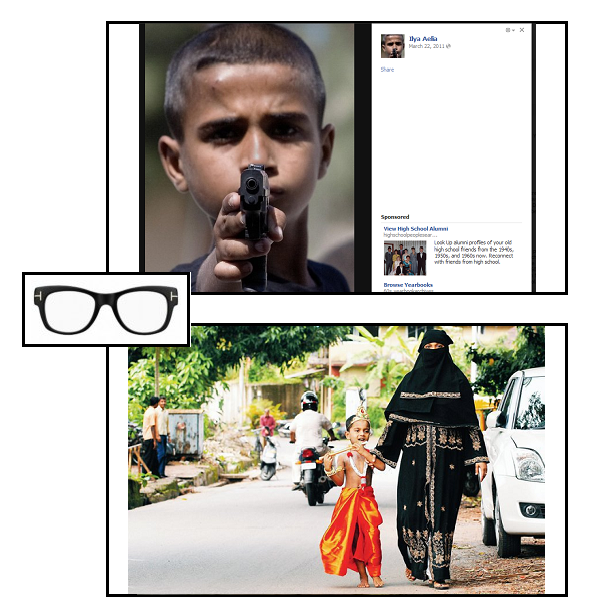
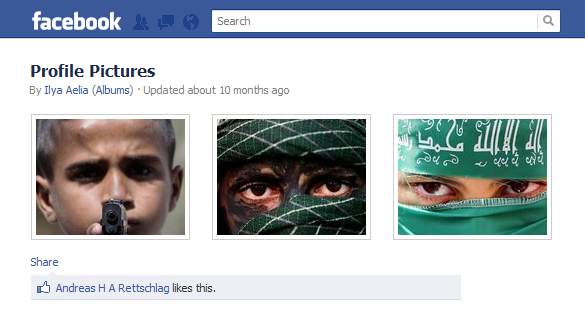
The young man pointing a gun at the viewer on a Facebook page (h/t Internet Hagganah) is the avatar of a net-salafi in Germany whose sequence of avatars looks like this:

Quintan Wiktorowicz defines a salafi thus:

The term “salafi” is used to denote those who follow the example of the companions (salaf) of the Prophet Mohammed. Salafis believe that because the companions learned about Islam directly from the Prophet, they commanded a pure understanding of the faith.

As he notes in another article:

The Salafi movement (often referred to as the Wahhabis)1 represents a diverse community. All Salafis share a puritanical approach to the religion intended to eschew religious innovation by strictly replicating the model of the Prophet Muhammad. Yet the community is broad enough to include such diverse figures as Osama bin Laden and the Mufti of Saudi Arabia. Individuals and groups within the community reflect varied positions on such important topics as jihad, apostasy, and the priorities of activism. In many cases, scholars claiming the Salafi mantel formulate antipodal juristic positions, leading one to question whether they can even be considered part of the same religious tradition.

The avatar-salafi depicted above sums up his own existence and “aim in life” by pointing a gun at you.

3.

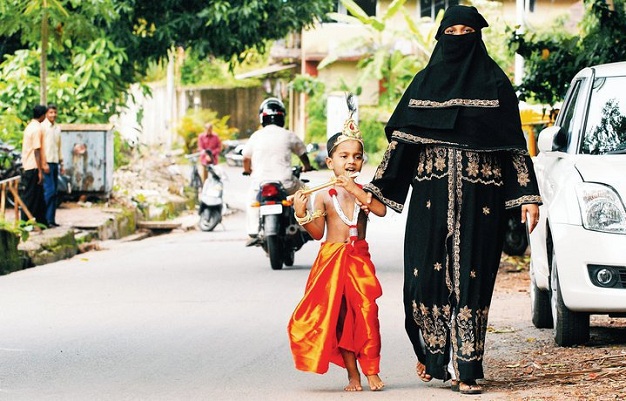
Not so the lady leading a child by the hand in the lower of the two images, from a photo taken in India.

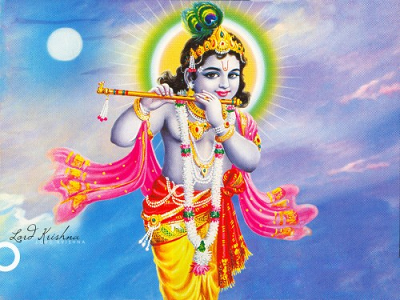
She offers us, in fact, a vividly contrasting picture of Islam to that of the salafi. She, a woman who is clearly observant of the demure dress code given in Qur’an 33.59 and wearing a niqab, is leading by the hand a joyful child arrayed in the finery of Krishna — beloved flute-playing avatar of Vishnu (avatar in its original sense) among her Hindu neighbors.

You might consider the pair of them together as monotheism hand-in-hand with polytheism. But then again, you might see them as peace and delight together, walking hand-in-hand.

You might see them as expressive of the Quranic proclamation (49.13 ):

O people, We have created you from a male and a female and made you into races and tribes so that you may know each other. Surely the most honored of you in the sight of God is the one who is the most righteous of you.

4.

To bring this back to contemporary politics, we may have our views about Islamist politics, and in the context of the changing scene across the Arab world it is worth pondering this recent quote from Rachid Ghannouchi, founder of the Ennahda Party in Tunisia, indicating another significant aspect of the contemporary evolution of Islamist thought:

Freedom is a fundamental principle in Islam, religion can not be forced on believers … Religion is not meant to give us guidance in all areas of industrial management, agricultural innovation, and governance, those subjects require human reason. Religion, however, gives us a code of values and principles.

Islam is not merely diverse, it is self-renewing.

5.

In light of all this, we need a far richer awareness of the mosaic that is Islam that our tendency towards black and white, war or peace, either / or thinking easily allows.

Consider these Quranic verses (35.27-28):

See you not that Allah sends down rain from the sky? With it We then bring out produce of various colors. And in the mountains are tracts white and red, of various shades of color, and black intense in hue. And so amongst men and crawling creatures and cattle, are they of various colors.

Again, the delight in diversity!

Now take another, closer look at those two folks from India:

Beautiful.

Darfur question… and wider Sufi ripples

Saturday, February 25th, 2012

[ by Charles Cameron — request for info, Darfur, Janjaweed, Sufis, Senegal and more ]

.

.

Dr John Esposito has a post up at HuffPo disputing Ayan Hirsi Ali‘s recent Newsweek piece, and one very small matter of phrasing raised a small cluster of questions for me …

*

My Questions:

Dr Esposito quotes Hirsi Ali as saying “What has often been described as a civil war is in practice the Sudanese government’s sustained persecution of religious minorities” and comments, “to say that Darfur is an example of the Muslim-Christian genocide is flat out wrong”.

My questions are not about Ali’s “Global War on Christians” or “Muslim-Christian genocide” but about the range of Muslim theological interests at play in the Darfur conflict.

Julie Flint, in Sudan, Darfur destroyed: ethnic cleansing by government and militia forces in Western Sudan, writes that “Almost all Darfurians belong to the Tijaniya sect of Sufi Islam that extends from Senegal to Sudan.”

And Robert Spencer writes that “Salafists target Muslims they regard as insufficiently Islamic also in Darfur, where Arab Muslims attack non-Arab Muslims whose Islam is closer to the cultural version that prevailed in Somalia than to Wahhabi austerity.”

So:

Is Spencer right about that? And is it therefore arguable that in additional to nomadic vs sedentary and Arab vs black African issues, there’s a sectarian (intra-Muslim) component to the conflict?

Further, is Darfur (inter alia) a front we should be monitoring in terms of a global Salafi vs Sufi struggle?

Who and what should I be following / reading?

*

All of which brings me to the wider issue of violence against Sufis (and for that matter, violent as well as peaceable Sufi responses) in (eg) Libya (Daveed GR today), the Punjab (Raza Rumi) and of course Senegal (see image of mosque in Touba above)…

All pointers welcome.


Switch to our mobile site