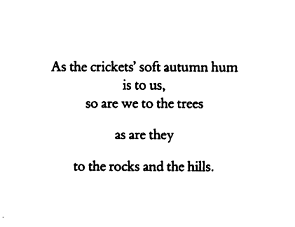
One bead for a rosary
Friday, June 22nd, 2012[ by Charles Cameron — one bead from NASA for the glass bead game as rosary ]
.

photo credit: Norman Kuring, NASA’s Goddard Space Flight Center
.
Consider her sacred, treat her with care.
[ by Charles Cameron — one bead from NASA for the glass bead game as rosary ]
.
photo credit: Norman Kuring, NASA’s Goddard Space Flight Center
.
Consider her sacred, treat her with care.
[ by Charles Cameron — Pat Robertson, the Taliban, Bamiyan, Buddha statues, a Zen tale, Petraeus and Pastor Jones ]
.

credits: (a) wikipedia under cc license, (b) dharmashop
.
Here, by way of context, is a story posted on the Treeleaf Zendo site, and widely discussed in the Catholic blogosphere:
On a cold winter night, a big snow storm hit the city and the temple where Dan Xia served as a Monk got snowed in. Cut off from outside traffic, the coal delivery man could not get to the Zen Monastery. Soon it ran out of heating fuel after a few days and everybody was shivering in the cold. The monks could not even cook their meals.
Dan Xia began to remove the wooden Buddha Statues from the display and put them into the fireplace.
“What are you doing?” the monks were shocked to see that the holy Buddha Statues were being burnt inside the fire place. “You are burning our holy religious artifacts! You are insulting the Buddha!”
“Are these statues alive and do they have any Buddha nature?” asked Master Dan Xia.
“Of course not,” replied the monks. “They are made of wood. They cannot have Buddha Nature.”
“OK. Then they are just pieces of firewood and therefore can be used as heating fuel,” said Master Dan Xia. “Can you pass me another piece of firewood please? I need some warmth.”
The next day, the snow storm had gone and Dan Xia went into town and brought back some replacement Buddha Statues. After putting them on the displays, he began to kneel down and burn incense sticks to them.
“Are you worshiping firewood?” ask the monks who are confused for what he was doing.
“No. I am treating these statues as holy artifacts and am honouring the Buddha.” replied Dan Xia.
*
In light of that, compare and contrast this recent video of Pat Robertson:
with this video (I don’t think you need to see all of it, just a taste perhaps?) titled The Beheading of the Buddha, posted on YouTube and “presented” by Al-Muhaajiroun:
and both of those with this third video, of Pastor Jones, discussing both his own burning of the Qur’an and GEN Petraeus‘ powerful and intelligent response…
*
I think we should discuss these matters in an open and respectful way, and hope that this post will provide an appropriately respectful and open-minded framing for such a discussion.
As to my own view – I see a consideration that whatever opens us up to compassion and clarity is an icon and a grace, and another consideration that whatever closes us off from clarity and compassion is an idol or a poison…
***
For those of a scholarly bent, here’s a downloadable fatwa on the Taliban’s destruction of the great Buddhas of Bamiyan — from which the screen-grab below is taken:

[ by Charles Cameron — Yom HaShoah, quality vs quantity, sacramental value of life, continuing from Q&Q I, long, intense ]
.
Today is Yom HaShoah, Holocaust Remembrance Day.
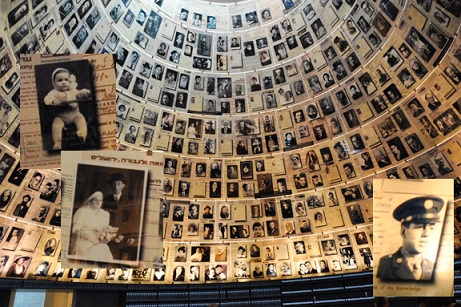
photo credit: Joni B Hannigan
The mind is struck dumb.
Six million individuals is too vast a gathering to contemplate. Even to think of ten people we know well if they are in the room with us requires us to move from face to face, person to person, picking up where we left off with each one, perhaps with this couple or these four colleagues from a remembered journey or project.
Six million.
Six million people is more than a crowd, it’s a blur — it is, approximately, the entire population of Arizona, of Rio or Lahore, of entire nations, El Salvador, Libya or Sierra Leone.
Today we remember those who died in the Shoah, as individuals and together.
*
I believe the Shoah to be one of those topics where we humans need to use the cognitive equivalent of a zoom lens – the capacity to hold magnitude in mind while exploring at the level of the individual, and to feel for the individual while not losing sight of the magnitude of the larger picture.
Consider the rabbinic opinion given in the Babylonian Talmud, Sanhedrin 37a:
For this reason was man created alone, to teach thee that whosoever destroys a single soul of Israel, scripture imputes [guilt] to him as though he had destroyed a complete world; and whosoever preserves a single soul of Israel, scripture ascribes [merit] to him as though he had preserved a complete world.
How do you magnify that “complete world” by six million?
*
Another such topic involving the individual and the group is torture.
Here the issue is, at best, not one of innate cruelty or hatred or disregard for values, but a considered weighing of alternatives — the brutal interrogation of a Khalid Sheikh Mohammed, say, against the chance to avoid a second 9/11. Torture, too, is a matter of the relationship of the many to the one, and I suspect people’s opinion of torture pretty much rests on each person’s understanding of when and indeed whether the need of the group ever trumps that of the individual.
Again, I think we need a cognitive zoom capability, if we are to begin to grasp the subtlety of the issue — and to be able to countenance those who see it differently from ourselves.
*
I suggest that the core question is that of the relationship of quality to quantity — which I have argued before, is essentially the same as the deep question in consciousness, that of the relationship between (subjective) mind and (objective) brain.
Can a sheer quantity of people saved from some hateful end ever really compare to the quality — radiant suchness of the Tathagata (Diamond Sutra), image and likeness of God (Genesis) — of a single willfully tortured human?
For some people this is a no-brainer. Of course: you weigh the likely impacts, and on occasions when torturing one is liable to reveal information that saves thousands of others, do it. Reuel Marc Gerecht, lately of the CIA, posed the issue this way:
… if you had been confronted on 7 September 2001 with a captured Khalid Shaykh Muhammad or Abu Zubaydah and you knew that a major, mass-casualty terrorist strike was about to go down in the United States, and you had plenipotentiary authority for the nation’s security …
For some, it is a no-brainer. Of course not: if you treat others that way, even in the heat of battle, you’ve lost already — you’ve become what you hate. John Kiriakou, lately of the CIA, wrote:
even if torture works, it cannot be tolerated – not in one case or a thousand or a million. If their efficacy becomes the measure of abhorrent acts, all sorts of unspeakable crimes somehow become acceptable. … There are things we should not do, even in the name of national security.
*

.
In the Egyptian scene above — taken from the Papyrus of Ani in the British Museum — judgment is rendered on a single human soul when it is weighed against the feather of Maat:
The goddess Maat, shown as a feather in the scale pan, is the deification of the concept of maat: truth, justice and cosmic order.
Is the heart light enough to balance justice herself?
The jackal-headed Anubis is weighing the heart of the supplicant as the ugly beast Ammit, known as “The Devourer,” “Bringer of the Second Death” — a hybrid monster, part lion, part hippopotamus, part crocodile — crouches by the scales drooling, waiting to gulp down the failed soul. The ibis-headed Thoth is poised to record the verdict on his slate. Various deities are ranged around the scene, serving as Judges or in other roles important to the ritual or the ideology that had developed over the span of many centuries. Overlooking this scene is the Ba — the winged representation of the personality of the deceased — perched and ready but not yet able to take flight as a risen being.
Even though Osiris is pictured at the far end of the Judgment scene, indicating the conclusion of the proceedings, his presence nonetheless dominates the scene, as a confirmation of the ultimate purpose of all this.
*
Mary Qualit and Martha Quant…
A number of significant thinkers have weighed in on the scales which measure human lives… basically asking if a quality can be quantified, added, multiplied.
The philosopher Wittgenstein, in a selection of his posthumous writings, says:
The whole earth cannot be in greater distress than one soul.
The writer CS Lewis concurs:
We must never make the problem of pain worse than it is by vague talk about the “unimaginable sum of human misery.” … There is no such thing as a sum of suffering, for no one suffers it. When we have reached the maximum that a single person can suffer, we have, no doubt, reached something very horrible, but we have reached all the suffering there ever can be in the universe. The addition of a million fellow-sufferers adds no more pain.
And Arne Naess, the “father” of Deep Ecology, in his Philosophy of Wolf Policies says:
We should be careful when talking about greater suffering. Referring to a consciously experienced suffering, including simple pain, we have to do with a quality admitting degrees of intensity, but in an important sense unquantifiable and nonadditive.
Strictly speaking, experienced suffering is not additive.
In my view — or perhaps I should say, with my mind — it is hard even to fully grasp what these three distinguished and diverse folk are saying. And yet I feel as if they are bringing me a truth, bringing it right to the edge of my awareness.
*
Tarek Mehanna wrote in his sentencing statement, given in court last week:
I learned about the American-led sanctions that prevented food, medicine, and medical equipment from entering Iraq, and how – according to the United Nations – over half a million children perished as a result. I remember a clip from a ’60 Minutes’ interview of Madeline Albright where she expressed her view that these dead children were “worth it.”
I can understand that, the reluctance to accept that particular policies are “worth” the loss of children. Where is Maat, to weigh such matters for us?
*
Here are four quotations having to do with the value of sparrows, one way or another:
Are not two sparrows sold for a farthing? and one of them shall not fall on the ground without your Father. But the very hairs of your head are all numbered. Fear ye not therefore, ye are of more value than many sparrows. — Matthew 10.29-31.
Whoever uselessly kills a sparrow, on the Day of Judgment, it will come and shout in front of the throne and say, “Oh my Lord, ask this person why he uselessly killed me.” — Hadith of the Prophet, quoted in Kazemi, Environmental Rights and the Teachings of Mahdism
There is a special providence in the fall of a sparrow. — Shakespeare, Hamlet, V.2
If a sparrow dies in Central Park, I feel responsible. — Mayor Fiorello La Guardia
*
There’s a streak of paradox running through the heart of Christianity, in which two values are simultaneously present: one temporal and moral, the other atemporal / eternal and transcendent. Thus Christ can say “Before Abraham was, I am” — situating himself in both eternal and temporal realms simultaneously. Thus also, he can say of himself and his betrayal by Judas, “The Son of man goeth as it is written of him: but woe unto that man by whom the Son of man is betrayed! it had been good for that man if he had not been born.”
And thus also, in a masterful paradox, St John’s Gospel recounts how the High Priest Caiaphas argued for the death of Christ:
Then gathered the chief priests and the Pharisees a council, and said, What do we? for this man doeth many miracles. If we let him thus alone, all men will believe on him: and the Romans shall come and take away both our place and nation. And one of them, named Caiaphas, being the high priest that same year, said unto them, Ye know nothing at all, Nor consider that it is expedient for us, that one man should die for the people, and that the whole nation perish not. And this spake he not of himself: but being high priest that year, he prophesied that Jesus should die for that nation; And not for that nation only, but that also he should gather together in one the children of God that were scattered abroad. Then from that day forth they took counsel together for to put him to death.
On the one hand, Caiaphas is arguing that one troublesome young rabbi’s life is expendable if it will avoid a Roman crackdown not unlike the one that did in fact occur some forty years later, with the destruction of the Temple in 70 CE. This is, in Christian terms, a vile argument, and one respondible for the death by execution of the Christ.
On the other, though — and the brilliance of the paradox lies in the way that John weaves the two perspectives together — God thinks it preferable that he himself, incarnate, should die as a once-for-all sacrifice to save his many creatures who — and here I can’t help but hear the strains of Handel’s Messiah — like sheep have gone astray…
Putting it mildly.
So, whether you’re Christian or not — and I wouldn’t claim to be, though I’m clearly influenced — the notions of sacrifice and self-sacrifice belong in here somehow.
*
I quoted the Talmudic Tractate Sanhedrin at the top of this post. The Qur’an recalls this passage in Sura 5.32:
Therefore We prescribed for the Children of Israel that whoso slays a soul not to retaliate for a soul slain, nor for corruption done in the land, shall be as if he had slain mankind altogether; and whoso gives life to a soul, shall be as if he had given life to mankind altogether.
It is my suggestion that the difference between Quantity and Quality is as profound (in Bateson’s terms, makes as great a difference as) as the difference between mind and brain, subjective and objective or inner and outer worlds — which itself revovles around the “deep problem” in consciousness.
If I’m right about this — and “right” may not be the best term in any case — then the quality / quantity issue is one facet of the great mystery at the heart of things that religion approaches and derives from, but can never fully define or express.
Morality is our attempt to work in the world with some of the insight gleaned from that mystery, and it may well be that dualistic, propositional thinking is inherently unsuited to the task.
I’d like to return at this point to a quote I’ve used here before, and find very insightful. It’s from Lin Jensen, An Ear to the Ground: Uncovering the living source of Zen ethics, and it tells us:
Judgments on right and wrong are a nearly irresistible enticement to pick sides. And that’s exactly why the old Zen masters warned against becoming a person of right and wrong. It isn’t that the masters were indifferent to questions of ethics, but for them ethical conduct went beyond simply taking the prescribed right side. For these masters, the source of ethical conduct is found in the way things are, circumstance itself: unfiltered immediate reality reveals what is needed.
*

In closing, I would like to return to the issue of torture, and to offer you another quote, this one from one of the most powerful works of theology known to me, William T Cavanaugh‘s Torture and Eucharist: Theology, Politics and the Body of Christ:
by making the seeking of important answers seem like the motive for the torture, the torturer seems able to justify his brutality. No one would think of defending the sheer physical act of torture, the merciless inflicting of pain on a helpless victim. However, once we consider the verbal aspect, the question and answer which seem of such great urgency, the moral contours of torture seem less clear, and utilitarian justifications of torture become thinkable, provided the motive for the questions is of sufficient importance.
Cavanaugh is writing about those who were “disappeared” in Pinochet‘s Chile, and his broader argument is that torture is the antithesis of the sacramental nature of human identity — and here we return full circle to the “image and likeness” of the divine in the mortal, the human.
The deeper we can penetrate into the central mystery, it seems to me, the better we will be enabled to love, to understand, and to forgive.
[ by Charles Cameron — Nancy Fouts, sculpture, juxtaposition, essence of creativity, pocket universes, Arthur Koestler, Mark Turner ]
.

Nancy Fouts is an American artist based in London. I ran across her work a while ago thanks to Michael Weaver on Google+, and was immediately struck by the intensity of her images, each one of which seemed like a landmark from a larger geography, more precisely focused and dense with meaning than our own world usually appears to be.
.
The first image I saw was of a snail on the straight edge of a razor blade (above, left) — an image out of the script of Apocalypse Now to be sure, but presented by Fouts in sharp detail and unadorned by any other context, visually, direct from eye to mind and heart.
This may be the image many people first see of her work — very, very striking, exquisite, terrifying if you allow it to be so, and yet as clear and simple, almost, as a single drop of water on a leaf.
.
But it was this next image that conquered me:

The juxtaposition is impeccable: sewing machine, record on turntable – and the overlap between the two, the link, the vesica piscis between them, is the needle.
The music of Bach, Handel, and Vivaldi — particularly on harpsichord — has been disparagingly called “sewing-machine music”. If that phrase gave rise to this marvelous image, perhaps the slight can be forgiven.
The sewing-machine? It’s a Singer. And in what must surely be an ironic, gender-influenced choice coming to us from an artist so assured and exacting — the music that the needle draws from the groove of the record is, as you can tell from the record label, the music of His Master’s Voice.
.
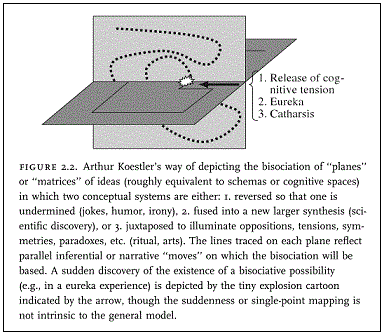
I have pointed before to this diagram from Mark Turner‘s The artful mind: cognitive science and the riddle of human creativity, based on those in Arthur Koestler‘s The Act of Creation (eg those on pp 35 and 37):
It shows the essence of the creative act — the “release of cognitive tension” that occurs when some form of analogy, similitude, overlap allows the mind to join conceptual clusters from two fields in a “creative leap”.
Nancy Fouts’ work doesn’t merely make use of such twinned field overlaps, it makes twinned fields with overlap the defining quality of her works.
She is aiming right at the heart of the creative process. And it shows.
.
In that earlier post of mine, I talked about Ada, Countess of Lovelace, and noted that her analogy between Charles Babbage‘s Analytical Engine and Jacquard‘s mechanical loom, famously expressed by her thus:
The Analytical Engine … weaves algebraic patterns, just as the Jacquard-loom weaves flowers and leaves.
was precisely the creative leap that led to the us of punched card systems in computation from Babbage to Watson…
I could give other examples. The Taniyama-Shimura conjecture which formed the basis of Andrew Wiles‘ proof of Fermat‘s Last Theorem, bridges two previously distinct branches of mathematics precisely by showing that for every elliptic curve, there is a related modular form…
And no, I don’t understand the mathematics. But I understand the concept of twinned fields, and the power of their overlap.
.
Back, then, to Nancy Fouts:

One thing that interests me about her work is that she has a few simple “essences” that she returns to time and again: in this case, bees, forms that resemble honeycombs, and by implication, honey.
In my own work, making similar connections between what we might paradoxically call “kindred ideas in unrelated fields” — I might set Nancy’s honeybees across from the verse from the Upanishads [Brihadaranyaka, fifth Brahmana, 14] which says:
This Self is the honey of all beings, and all beings are the honey of this Self.
Another of Nancy’s tropes connects nature and music…

.
And thimbles, those miniature emblems of armor and protection, are another recurring theme:

Let’s take a look at that last image, of the thimble transpierced by a needle.
I believe it has a history — again, accessible via an associative leap. Here are three images of the “wounded healer” motif, two of them specifically images of the Inuit shaman who has harpooned himself — a motif which the anthropologist and zen roshi Joan Halifax writes “captures the essence of the shaman’s submission to a higher order of knowing”:

Armor, the defenses we have in place to protect our selves, and vulnerability, the ability to to allow our selves to be wounded, so that the “self” which is “the honey of all beings” may shine through us. The paradox of Selflessness and Self.
.
Among wounded healers, we might count the crucified Christ, his side pierced by the spear of a Roman soldier — and here I might suggest that Fouts contrasts (image below, left) the self-sacrifice at the heart of Christianity with the pugilistic approaches of some proponents of his message:

And the image of Christ (right) balancing on a high wire?
Again I’m reminded of the language of shamanism. The anthropologist Barbara Myerhoff studied the religious beliefs and practices of the Huichol or Wixaritari of the Mexican Sierra Madre Occidental, with Ramon Medina Silva, a mara’akame or shaman of the tribe.
In her book, Peyote Hunt: The Sacred Journey of the Huichol Indians, she describes a feat of balance that Ramon performed, which appeared to serve a “sacramental” function for his people – providing them with what Cranmer‘s Book of Common Prayer calls “an outward and visible sign of an inward and spiritual grace”:
One afternoon Ramon led us to a steep barranca, cut by a rapid waterfall cascading perhaps a thousand feet over jagged, slippery rocks. At the edge of the fall Ramon removed his sandals and told us that this was a special place for shamans. We watched in astonishment as he proceeded to leap across the waterfall, from rock to rock, pausing frequently, his body bent forward, his arms spread out, his head thrown back, entirely birdlike, poised motionlessly on one foot. He disappeared, reemerged, leaped about, and finally achieved the other side. We outsiders were terrified and puzzled but none of the Huichols seemed at all worried. The wife of one of the older Huichol men indicated that her husband had started to become a mara’akame but had failed because he lacked balance.
It’s easy to read the description — but by no means as easy to keep one’s balance — something that Fouts’ image perhaps suggests more vividly than words easily can.
Richard de Mille describes the mara’akame‘s function in Huichol society as to “cross the great chasm separating the ordinary world from the otherworld beyond,” and suggests that Medina Silva’s feat of acrobatics on the barranca that day is to be understood as offering “a concrete demonstration in this world standing for spiritual balance in that world.”
Myerhoff herself was never entirely sure whether Medina Silva was “rehearsing his equilibrium,” or giving it “public ceremonial expression” that afternoon: it is clear, however, that for the Huichols, such feats of balance possess a resonance and meaning that extends beyond the “merely” physical.
.
I may of course be projecting some of my own ideas onto Nancy Fouts’ work — and indeed, perhaps that’s the point.
She has some pretty fierce observations to make concerning matters religious — Christian, Buddhist and other — and I’ll leave those who are interested to make their own discoveries on her website. I don’t doubt there are places where her sympathies and my own overlap, and others where we differ.
Fouts speaks a direct and visceral language of images — and her juxtapositions, carefully chosen and choreographed as they are, provoke us to feel and think.
Thank you, Nancy.
No need to reach for the gun, fellas — but that’s art.
_________________________________________________________________________________________
credits for images of Harpooned Shaman: Charlie Ugyuk (left); David Ruben (right).
[ by Charles Cameron – extended analytic game on Israeli-Palestinian conflict — for those who wish to catch up, our game thus far consists of an intro to the game and game board, followed by moves 1-5, 6-9, then moves 10-11 which together constitute a meditation, moves 12, 13-15, 16-17, and most recently before this, move 18 with cadenza ]
Move content:
Discussing strategy, the very canny LTG (USMC, Ret’d.) Paul Van Riper had this to say:
What we tend to do is look toward the enemy. We’re only looking one way: from us to them. But the good commanders take two other views. They mentally move forward and look back to themselves. They look from the enemy back to the friendly, and they try to imagine how the enemy might attack them. The third is to get a bird’s-eye view, a top-down view, where you take the whole scene in. The amateur looks one way; the professional looks at least three different ways.
A bird’s-eye view, a hawk’s eye view, a top-down view, an overview, a view from 30,000 feet, a God’s eye view, a view from above, a zoom…

If move 18 and its cadenza gave us a view of the depth of vision or insight that is necessary for a full and rich understanding of the world we live in — its qualitative or spiritual scope, if you like — this next move, with its picnic and drone-sight, addresses its breadth in space and time — materially and quantitatively speaking.
The classic expression of the sheer material scope of the universe was put together by Charles and Ray Eames in their justly celebrated film, Powers of Ten, from which the lower of these two images is drawn:
Here are some other relevant scans of the scope of things, in terms of time and space:
The Scale of the Universe 2
A Brief History of The Universe
The Known Universe
A Time-Lapse Map of Every Nuclear Explosion Since 1945
These are impressive videos to be sure, but as an aside I’ll invite you to ask yourselves how well they compare with this zoom in words, a poem by the zennist, ecologist, essayist and poet Gary Snyder, from his book, Axe Handles: Poems:
Such breadth of vision, such craft.
*
If this “material scope of things” too has a cadenza, it would be that all of this is shot through with some primary oppositions, dappled as the poet Gerard Manley Hopkins would have it, with swift, slow; sweet, sour; adazzle, dim — as indicated in the drone-sight and picnic double image at the head of this move.
This dappling, this constant flux of opposites, takes many forms — day and night lead to the more abstract light and dark, which can then be interpreted morally as good and evil, to which we respond with repulsion and attraction as the case may be, building our worldviews from love or fear…
At different scales the opposites that matter most to us may have different names and shadings, but here I’d just like to draw attention to the dappling of our world with:
competition and cooperation
Darwin‘s natural selection and Kropotkin‘s mutual aid
duel and duet (ah! — a favorite phrasing of mine)
war and peace
Provocatively, we find this dappling in scriptures, too, wherein the ripples of such verses as “The LORD is a man of war: the LORD is his name” (Exodus 15.3) dropped like a stone into the pond of the human mind, meet with the ripples of other verses such as “God is love; and he that dwelleth in love dwelleth in God, and God in him” (I John 4.16).
There are times when we take such oppositions literally, perhaps too literally, and times when we begin to see oppositions as abstract and theoretical end-points to what is in fact a yin-yang process continually unfolding…
Which brings me by a commodius vicus of recirculation to this image of the great opposition between war and peace, its dappling, its unfolding:

Links claimed:
To the Lamb, move 18: this move presents the material scope of the universe in counterpoint to its visionary scope as laid out in move 18 with its cadenza.
To Revelation, move 17 — the word revelation means unveiling, as we have seen, and our sciences and technologies, with their spectra of telescopes, microscopes, cameras and zooms, are unveiling and revealing to us much about the physicality of the world we live in — much that was accounted for in other times and places through intuition, vision and poetry.
This scientific and technical revelation of material existence, for many of us moderns, has largely eclipsed the mode of visionary revelation of move 17 — yet it cannot eradicate it. Implicit in this move, then, is the sense that we carry with us both subjective and objective, inner and outer, qualitative and quantitative understandings — though the data that “sight” and “insight” provide us with may be different in kind, and resolving them may be something of a koan to us, the deep problem in consciousness as philosophers of science have named it — and that we can discount neither one if we are to have and maintain a rich sense of our situation.
Comment:
If the two previous moves have shown us the scope of the universe we co-inhabit, perhaps we should now make our own zoom in, much as James Joyce did when he had the schoolboy Stephen inscribe his name and address in his geography book as Stephen Dedalus, Class of Elements, Clongowes Wood College, Sallins, County Kildare, Ireland, Europe, The World, Universe – an address that Stephen then read both forwards and backwards, finding himself in one direction, and finding in the other that he had no means of knowing what might lie beyond the universe…
Imagine then, skipping rapidly from (unimaginable) cosmos via such things as the intriguingly named End of Greatness to galaxy or nebula…
…solar system and planet — whence we can slow down and zero gently in on the Middle (or as my friend Ralph Birnbaum would call it, the Muddle) East, Israel / Palestine, Jerusalem / Al Quds / the Temple Mount / Noble Sanctuary – and to such matters of contemplative vision and tribal passion as the first, second and projected third Temples, the al-Aqsa mosque.
Our increasing focus will bring us, then, to that the rock which Jews believe marks the place where Abraham bound his son Isaac (the Akedah), and which Muslims believe to be the place of ascent of the Prophet to the celestial realms (the Mi’raj) on his Night Journey (Qur’an, Al-Isra).
Here again myth and history collide, and both visionary and material considerations merge in the heart of the what my friend the Israeli journalist Gershom Gorenberg has justly called “the most contested piece of real estate on earth”.

Zenpundit is a blog dedicated to exploring the intersections of foreign policy, history, military theory, national security,strategic thinking, futurism, cognition and a number of other esoteric pursuits.
Customized Web Site & Blog Design