zenpundit.com » ideas

Archive for the ‘ideas’ Category

Kesler on R2P

Saturday, September 10th, 2011

Bruce Kesler, a long time friend of this blog, links here as he digs into R2P, the “Responsibility to Protect” doctrine and like me, finds the logical implications hold much to worry about in terms of being anti-democratic as well as destabilizing :

Transnational Elites Uber Alles

 It is the liberal internationalists’ concept of how US foreign policy ought to be. R2P reflects limitations of the US abilities to militarily intervene elsewhere as perceived by our liberal elites but raises our humanitarian impulses selectively by them to justify certain interventions, again, as they perceive which to be worthwhile. Further, R2P raises hazy international law or consensus of international liberal elites to supremacy over national law or consensus.

One of R2P’s main propounders, Anne Marie Slaughter, even advocates each US agency and members of our judiciary to act independently of Executive or Congressional oversight or law to conform to the consensus of foreign liberal elites. Slaughter is not just someone blathering. Slaughter was Dean of Princeton’s influential Woodrow Wilson School of Public and International Affairs from 2002-2009 then from 2009-2011 she served as Director of Policy Planning for the United States Department of State, now back at Princeton. Slaughter’s thinking is telling in the pieties mouthed by Secretary of State Hillary Clinton and President Obama as they ignore US laws, ignore Syria’s worse repression and threat as they intervene in Libya, and extol a hostile majority in the UN to undeserved credence. Slaughter isn’t alone. Obama administration insiders Samantha Powers and Susan Rice are R2P foxes in the henhouse.

Methinks, given what passes for strategic thinking these days, that they pushed against an open henhouse door. Kesler continues:

For a taste of Anne Marie Slaughter

At first glance, disaggregating the state and granting at least a measure of sovereignty to its component parts might appear to weaken the state. In fact, it will bolster the power of the state as the primary actor in the international system…Giving each government institution a measure of legitimate authority under international law, with accompanying duties, marks government officials as distinctive in larger policy networks and allows the state to extend its reach.

Actually, it extends the uncontrolled reach of liberal elites within our government to act regardless of our laws or popular will.

Read the rest here.

This is not an argument over whether genocide is bad and should be prevented or the positive good of Western liberal societal values but rather over how power will be exercised in our name, for what reasons and by whom. Any good ends sought under a putative R2P doctrine can be done today if the political will for intervention is present. That will is crystalized when the ends, ways and means are scrutinized in open, free, debate under our constitutional norms, not by a self-appointed vanguard.

Al Farrow: an artist who leaves me uneasy, questioning

Wednesday, September 7th, 2011

[ by Charles Cameron — art, religion, and violence ]

.

Al Farrow, the San Francisco-based artist, finds and shows us that violence which is one pole of religion — what I think of myself as the landmines in the garden, where the garden is pardis, pairidaeza, paradise, the opposite pole of religion — perhaps inseparable from the violence, perhaps separable — the pole of peace, eirene, salaam

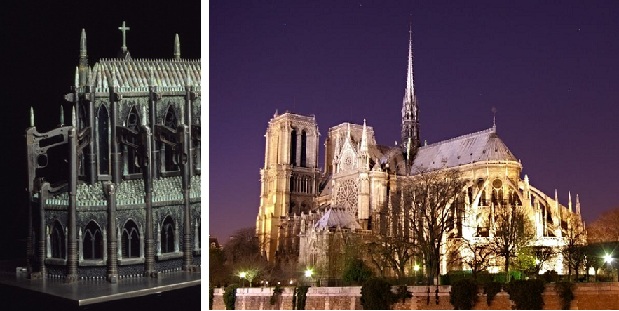
He show us this uncanny juxtaposition by building. meticulously, a cathedral out of guns and bullets:

al-farrow-cathedral-p-sm.jpg

His work leaves me impressed, but ill at ease, and for that I am grateful: he makes me think.

Take a close look at one of those flying buttresses… and compare it with its cousins at Notre Dame:

buttresses-nd-sculpt.jpg

That detail really brings the power of Farrow’s work home to me.

*

William Blake suggested that it is the artist’s function to “cleanse the doors of perception” — to give us fresh eyes, to see the world anew for us.

Al Farrow does this: it is as though in his cathedral, Catholic and Protestant Ireland meet.  Indeed, in an exhibit of his works — he has built mosques and synagogues of guns and bullets too — Christianity faces off against Islam, Judaism confronts its demons.

But there’s something more here, perhaps – the clash of war and peace, of hate and love — and how hatred can at times work with “love” as a protective shield…

Farrow himself says:

I am perpetually surprised by the historical and continuing partnership of war and religion. The atrocities committed in acts of war absolutely violate every tenet of religion, yet rarely do religious institutions speak against the violations committed in the name of God. Historically, Popes have even offered eternal salvation to those who fought on their behalf (The crusades, etc.).

In my constructed reliquaries, I am playfully employing symbols of war, religion and death in a facade of architectural beauty and harmony. I have allowed my interests in art history, archeology and anthropology to influence the work. The sculptures are an ironic play on the medieval cult of the relic, tomb art, and the seductive nature of objects commissioned and historically employed by those seeking position of power.

There’s considerable further irony, therefore, in the way in which Farrow’s already ironic work can be juxtaposed with it’s utterly non-ironic equivalent – Saddam Hussein‘s concept of the Mother of All Battles Mosque:

quo-for-al-farrow.jpg

*

Farrow’s work does not instruct us to be warriors, nor to be pacifists – it draws our attention to the blend of violence and peace of which our human dreams and lives are made. As Farrow says in this video clip from an exhibit of his work in Washington:

I use real bones, real bullets, real guns, because fake bones wouldn’t shake anybody up, nor would a fake gun. The purpose of my work is actually to get people to think about that complex relationship between war and religion – or any violence and religion. And a lot of violence is committed and has been through history in the name of religion, and that’s an ongoing thing, in any part of the world you look.

And yes, I think it’s fair to say Farrow’s juxtapositions of religion and violence clearly lean us towards peace.  War does the same, no?

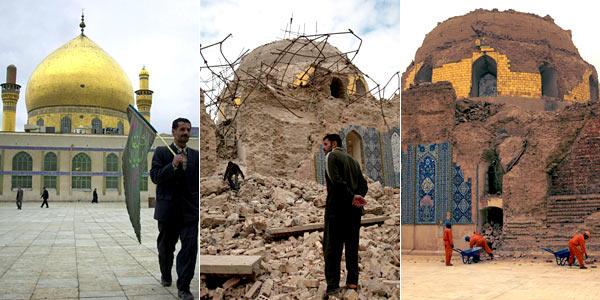
War, after all, destroys places of worship, along with many and varied other places – munitions dumps and churches, mosques and homes:

mosque-5679058138_dfee59923e_z.jpg

But just as religion has its landmines, so too it offers us its gardens – and just as a mosque or church or temple may be a rallying point offering a divine sanction to violence, so too it may be a focus for peace and reconciliation.

samarra-mosque-al-askari-rebuilding-wide-horizontal.jpg

Out of the ashes of destruction: creation, renewal, rebuilding…

For more on Al Farrow’s work, visit the Catharine Clark Gallery page.  And feel uneasy by all means, meditate — the koan I am sitting with this month is “Stop the War” — and ponder…

Elkus on Wikileaks and Sovereignty

Sunday, September 4th, 2011

Adam Elkus has a smart piece up at Rethinking Security that deserves wider readership:

WikiLeaks and Sovereignty

….WikiLeaks represents the idea that states have no inherent authority to hold onto vital national secrets. Because information is fundamentally boundless and unlimited by the “oldthink” of national borders and politics, state control over proprietary information is irrelevant. WikiLeaks and other radical transparency advocates believe that they-an unelected, transnational elite-can pick and choose which states are good and bad and whose secrets deserve exposure. And if information deserves to be free-and the only people who would keep it from being so are those with something to hide-then it is fine for non-state networks to arrogate themselves the right to receive and expose state secrets.

….While WikiLeaks is often positioned as a champion of digital democracy, it is actually wholly anti-democratic. It transfers power and security from national governments and their publics to unelected international activist organizations and bureaucrats. While this may seem like a harsh interpretation, there is no check on the likes of Julian Assange. Governments-even autocratic ones-still must contend on a day-to-day basis with the people. Even China had to face a reckoning after the Wenzhou train crash. WikiLeaks and other radical transparency organizations mean to replace one group of elites-which at least nominally can be called to court-with another who are accountable only to their own consciences.

Read the whole thing here.

Let me add a few comments to Adam’s excellent analysis.

Wikileaks and Julian Assange were not and have never been, lone wolves or information-must-be-free martyrs. They are allied with important institutions and individuals within the Western progressive elite, not least major media heavyweights like The New York Times, The Guardian and Der Spiegel, but also sympathizers within Western governments. Unless you think that Pvt. Bradley Manning was a hacker wunderkind with an intuitive grasp of which files that could be swept up to further a sophisticated political agenda, the man had some inside help from further up the food chain.

Adam is correct to describe these political factions as anti-democratic because they are and while leaking has been going on as long as there have been governments, we now have the emergence of a transnational generational clique that see themselves as entitled to rule and impose policies that comport with their social prejudices, economic self-aggrandizement and ideological fetishes, whether the people support them or not. A vanguard attitude, if not an organizational vanguard.

Wikileaks and other devices operating in shadowy undercurrents are their form of liberum veto against the rest of us in the instances where they are not completely in control, thus migrating political power from responsible state institutions to the social class that currently fills most of the offices and appointments. So far, their actions have been largely cost-free because their peers in government, however irritated they may be at the effects of Wikileaks, are loath to cross the Rubicon and hammer these influential conspirators with whom they went to school, intermarry, do business, live amongst and look out for the careers of each other’s children the way they have hammered Bradley Manning.

The same oligarchical class indulgence is seen in the financial crisis where almost none of the people responsible for massive criminal fraud in the banking and investment  sectors that melted the global economy have faced prosecution, unlike previous financial scandals like the S&L crisis or BCCI where even iconic figures faced grand juries. Instead of indictments, the new class received subsidies, bonuses and sweetheart, secret deals from their alumni chums running central banks and national governments. 

Carl Prinecommenting on a much narrower and wholly American slice of this corrupt camarilla, described this new class very well:

Let me be blunt.  A late Baby Boomer generation of politicians, bankers, reporters and generals has formed into a cancer inside this democracy, and their tumorous leadership won’t be kind to your future.

Unfortunately, this cancer is not limited to our democracy, it is the root of the decline of the West.

R2P is a Doctrine Designed to Strike Down the Hand that Wields It

Saturday, September 3rd, 2011

There has been much ado about Dr. Anne-Marie Slaughter’s ennunciation of “Responsibility to Protect” as a justification for the Obama administration’s unusually executed intervention (or assistance to primarily British and French intervention) in Libya in support of rebels seeking to oust their lunatic dictator, Colonel Moammar Gaddafi. In “R2P” the Obama administration, intentionally or not, has found it’s own Bush Doctrine, and unsurprisingly, the magnitude of such claims – essentially a declaration of jihad against what is left of the Westphalian state system by progressive elite intellectuals – are beginning to draw fire for implications that stretch far beyond Libya.

People in the strategic studies, IR and national security communities have a parlor game of wistfully reminiscing about the moral clarity of Containment and the wisdom of George Kennan. They have been issuing tendentiously self-important “Mr. Z” papers for so long that they failed to notice that if anyone has really written the 21st Century’s answer to Kennan’s X article, it was Anne-Marie Slaughter’s battle cry in the pages of The Atlantic.

George Kennan did not become the “Father of Containment” because he thought strategically about foreign policy in terms of brutal realism. Nor because he was a stern anti-Communist. Or because he had a deep and reflective understanding of Russian history and Leninism, whose nuances were the sources of Soviet conduct. No, Kennan became the Father of Containment because he encapsulated all of those things precisely at the moment when America’s key decision makers, facing the Soviet threat, were willing to embrace a persuasive explanatory narrative, a grand strategy that could harmonize policy with domestic politics.

Slaughter’s idea is not powerful because it is philosophically or legally airtight – it isn’t – but because R2P resonates deeply both with immediate state interests and emotionally with the generational worldview of what Milovan Djilas might have termed a Western “New Class”.

While it is easy to read R2P simply as a useful political cover for Obama administration policy in Libya, as it functioned as such in the short term, that is a mistaken view, and one that I think badly underestimates Anne-Marie Slaughter. Here is Slaughter’s core assertion, where she turns most of modern diplomatic history and international law as it is understood and practiced bilaterally and multilaterally by sovereign states in the real world (vice academics and IGO/NGO bureaucrats) on it’s head:

If we really do look at the world in terms of governments and societies and the relationship between them, and do recognize that both governments and their citizens have rights as subjects of international law and have agency as actors in international politics, then what exactly is the international community “intervening” in?

…For the first time, international law and the great powers of international politics have recognized both the rights of citizens and a specific relationship between the government and its citizens: a relationship of protection. The nature of sovereignty itself is thus changed: legitimate governments are defined not only by their control of a territory and a population but also by how they exercise that control. If they fail in that obligation, the international community has the responsibility to protect those citizens.

Slaughter is a revolutionary who aspires to a world that would functionally resemble the Holy Roman Empire, writ large, with a diffusion of power away from legal process of  state institutions to the networking informalities of the larger social class from whom a majority of state and IGO officials are drawn, as a global community. In terms of policy advocacy, this is a brilliantly adept move to marry state and class interests with stark moral justifications, regardless of how the argument might be nibbled to death in an arcane academic debate.

As with Kennan’s X Article, which faced a sustained critique from Walter Lippmann who realized that Containment implied irrevocable changes in the American system, R2P has attracted criticism. Some examples:

Joshua Foust –Why sovereignty matters

Much as advocates of the “Responsibility to Protect,” or R2P, like to say that sovereignty is irrelevant to the relationship of a society to its government (which Slaughter explicitly argues), it is that very sovereignty which also creates the moral and legal justification to intervene. For example, the societies of the United States and NATO did not vote to intervene in Libya – their governments did.

Foreign Affairs – The Folly of Protection

….RtoP, responding to the sense that these domestic harms warranted international response, solidified the Security Council’s claims to wider discretion. Yet it also restricted its ability to sanction intervention to the four situations listed in the RtoP document — genocide, war crimes, ethnic cleansing, and crimes against humanity — and thus precluded, for example, intervention in cases of civil disorder and coups. Although the resolution authorizing force against Libya will certainly further entrench the principle of RtoP, it will not completely resolve the tension between RtoP — in itself only a General Assembly recommendation — and the UN Charter itself, which, according to the letter of the law, limits action to “international” threats.

Dan Trombly –The upending of sovereignty and Responsibility to Protect Ya Neck

Beauchamp, along with Slaughter, have revealed R2P for what it actually is: a doctrine based on regime change and the destruction of the foundations of international order wherever practically possible. After all, are intervening powers really fulfilling their responsibility if they fail to effect regime change after intervening? This is exactly why I believe R2P is far more insidious than many of its advocates would have us believe or intend in practice. It is essentially mandating a responsibility, wherever possible, to seek the sanction, coercion, or overthrow of regimes which fail to meet a liberal conception of acceptable state behavior. Even if R2P is never applied against a major power, it is hard to see why such behavior would not be met with just as much suspicion as humanitarian intervention and previous Western regime change operations were. Indeed, a full treatment will reveal there is immense pressure for R2P to initiate the more fundamental, and more universal, impulse to revert to the potential ruthlessness inherent in international anarchy.

Understandably, such critiques of R2P are primarily concerned with sovereignty as it relates to interstate relations and the historical predisposition for great powers to meddle in the affairs of weaker countries, usually with far less forthrightness than the Athenians displayed at Melos. It must be said, that small countries often  are their own worst enemies in terms of frequently providing pretexts for foreign intervention due to epic incompetence in self-governance and a maniacal delight in atavistic bloodshed. Slaughter is not offering up a staw man in relation to democide and genocide being critical problems with which the international community is poorly equipped and politically unwilling to counter.

But R2P is a two edged sword – the sovereignty of all states diminished universally, in legal principle, to the authority of international rule-making about the domestic use of force is likewise diminished in it’s ability to legislate it’s own internal affairs, laws being  nothing but sovereign  promises of state enforcement. Once the camel’s nose is legitimated by being formally accepted as having a place in the tent, the rest of the camel is merely a question of degree.

And time.

As Containment required an NSC-68 to put policy flesh on the bones of doctrine, R2P will require the imposition of policy mechanisms that will change the political community of the United States, moving it away from democratic accountability to the electorate toward “legal”, administrative, accountability under international law; a process of harmonizing US policies to an amorphous, transnational, elite consensus, manifested in supranational and international bodies. Or decided privately and quietly, ratifying decisions later as a mere formality in a rubber-stamping process that is opaque to everyone outside of the ruling group.

Who is to say that there is not, somewhere in the intellectual ether, an R2P for the the environment, to protect the life of the unborn, to mandate strict control of small arms, or safeguard the political rights of minorities by strictly regulating speech? Or whatever might be invented to suit the needs of the moment?

When we arrest a bank robber, we do not feel a need to put law enforcement and the judiciary on a different systemic basis in order to try them. Finding legal pretexts for intervention to stop genocide does not require a substantial revision of international law, merely political will. R2P could become an excellent tool for elites to institute their policy preferences without securing democratic consent and that aspect, to oligarchical elites is a feature, not a bug.

R2P will come back to haunt us sooner than we think.

ADDENDUM:

Doug Mataconis at Outside the Beltway links here in a round-up and commentary about R2P posts popping up in the wake of the Slaughter piece:

The “Responsibility To Protect” Doctrine After Libya

….It’s understandable that the advocates of R2P don’t necessarily want to have Libya held up as an example of their doctrine in action. Leaving aside the obvious contrasts with the situation in Syria and other places in the world, it is by no means clear that post-Gaddafi Libya will be that much better than what preceded it. The rebels themselves are hardly united around anything other than wanting to get rid of Gaddafi and, now that they’ve done that, the possibility of the nation sliding into civil and tribal warfare is readily apparent. Moreover, the links between the rebels and elements of al Qaeda that originated in both Afghanistan and post-Saddam Iraq are well-known. If bringing down Gaddafi means the creation of a safe haven for al Qaeda inspired terrorism on the doorstep of Europe, then we will all surely come to regret the events of the past five months. Finally, with the rebels themselves now engaging in atrocities, one wonders what has happened to the United Nations mission to protect civilians, which didn’t distinguish between attacks by Gaddafi forces or attacks by rebels.

….Finally, there’s the danger that the doctrine poses to American domestic institutions. If Libya is any guide, then R2P interventions, of whatever kind, would likely be decided by international bodies of “experts” rather than the democratically elected representatives of the American people. American sailors and soldiers will be sent off into danger without the American people being consulted. That’s not what the Constitution contemplates, and if we allow it to happen it will be yet another nail in the coffin of liberty.

Read the rest here.

Two Links on Political Economy

Friday, August 19th, 2011

That are complementary:

Fabius MaximusOur fears are unwarranted. America is in fact well-governed.

….America is in better shape than Europe and Japan.  We have good demographics, sound fundamentals, relatively easily solved problems, and no powerful enemies.  Why the constant sense of crisis?  QE2, hyperinflation, climate armageddon, Obama the socialist, AIDS, alar on apples, jihadists, debt, swine flu – a constant drumroll of doom, explained by Peter Moore in “The Crisis Crisis” (Playboy, March 1987).   Answer:  elites govern a weak people by exploiting their fears.  For example, look at the “government is broke” panic.

  • The Federal government’s net debt is only 2/3 of GDP, well below the 100% of GDP “red line” (that Italy reached many years ago).
  • The short-term deficit is mostly the result of the recession.  The medium-term deficit results from the Bush tax cuts.
  • Social security’s funding gap is small vs. GDP and easily fixed.
  • The massive funding gap is mostly Medicare, easily fixed by adopting features from the mixed public-private systems in Europe.

Panic pushes Americans to allow cuts to popular social services plus increased and highly regressive taxes.  No matter who wins, after the 2012 election our representatives will implement the necessary policy changes:  raising taxes, cutting expenditures, rebuilding our infrastructure, and beginning the long process of reforming health care.  It will be another morning in America.  There is no crippling polarization, just distracting noise masking a consensus between both parties about the key points of economic and foreign policy.

We do not see this long-standing pattern (see the previous post for details) because our collective OODA loop is broken (see section 6 here).  That makes us easier to lead.  Relying on wealth-based elites to run the country has a cost.  They take a large share of the pie; we take a small slice….

Global Guerrillas –JOURNAL: Global Financial Cancer

….A couple of years ago, I wrote that the underlying structure of the global financial system was a “bow-tie.”  Here’s what I said (it’s worth going back and reading the entire article and this paper on bow-ties from John Doyle at Caltech):

If we look at this new global system from a distance, its architecture is something called a bow-tie. This is a universal control system architecture that underlies complex systems from the Internet to cell metabolism.

Bowtie

What is a Bow Tie?

The bow-tie is a very powerful approach to organizing a complex system (it’s a system design that is used by controls engineers.)  Visually, it starts with complex inputs (the left side of the bow-tie), boils them down into simple build blocks (the knot), which then allows the construction of complex outputs (the right side of the bow-tie….

….Unfortunately, as I mentioned in the earlier article, bow-ties are vulnerable to organisms that attach themselves to the knot at their center (like the way cancer uses the body’s metabolism system).  These organisms relentlessly use the bow-tie’s knot to for selfish ends (rapid growth).  The end result is typically death for the system.  My suggestion was that the instability we were seeing in the financial system was an indication that it had been co-opted by a malicious, self-serving organism.

Of course, at the time there wasn’t much data to support this systemic analysis.  That has been rectified with a new paper, The Network of Global Corporate Control by Vitali et. al. from ETH in Zurich.  This paper finds, through extensive network analysis, that a small group of tightly intertwined financial institutions control the bow of the global financial system.  It is in effect, the world’s first super-organism….

They are both right. Probably not perfectly, the American economy, even more the world’s, is too complex a subject, but right enough.

FM is right that the emerging class of people I have been calling “the Oligarchy” the past couple of years do not intend to deliberately implode the system that is working outrageously to their benefit. They are currently in the stage of trying to come up with an arsenal of tax-farming schemes that will pass political muster (i.e. – not provoke uncontrollable, “Arab Spring” street demonstrations or a successful populist electoral revolt  that would eject their sycophants from government en masse in a single election) and are quietly, methodically and strategically neutering the capacity of the populace to resist their rule over the long term. It is there that we see seemingly unrelated measures as the coordinated political attack on public education and university education, restrictions on the ability of citizens to get courts to review arbitrary actions of Federal agencies, imposition of laws to permit total surveillance of US citizens and acquisition of their personal information and so on.

The elite, who are not completely cohesive or formally organized, are supremely confident in their ability to manage the technocratic economy they are putting into place, or if bumps in the road appear, to squeeze sufficient new leverage from the populace through inflation, devaluation and other forms of expropriation. Unfortunately, I am not confident that these folks are nearly as competent as they imagine themselves to be. Nor am I sure that the global system that they have built, a high-performance, deeply complex, ultra-leveraged, financial sector dominant political economy isn’t as fragile and dangerously unstable as people like John Robb and Nassim Nicholas Taleb have maintained it is. The system might not just crash, it could crash to extreme depths with unprecedented speed with unforseen consequences (financial systems also ensure the reliable and continuous logistical flow of *food* and *power* to population centers).


Switch to our mobile site