zenpundit.com » complexity

Archive for the ‘complexity’ Category

Tree series, II: Phototropic Simplexities

Monday, June 25th, 2012

[ by Charles Cameron — this one’s a prose poem: it begins with a statement so tight it needs to be unwound, and unwinds it ]
.

I wrote this urgently starting when it “woke” me at 4am one morning in the late 1990s or 2000, and as soon as it was out, I found myself writing #3 in the series, a game design. Together, the pair of them represent a stage in my games and education thinking intermediate between Myst-like Universities of 1996 and my vision today of games in education, which I hope to address in a further post addressed to Sebastian Thrun & with appreciation to Bryan Alexander and Lewis Shepherd. In this posting, I have added the words “figuratively speaking” for absolute clarity: otherwise, the piece remains as written all those years ago.

***


A copse. Photo credit: Ian Britton via FreePhoto.com under CC license. Note how the wind sweeps the trees into a group shape.

***

Trees: Phototropic Simplexities

Trees are phototropic simplexities, no wonder we like them they cowork so well too: copses, see.

*

Meaning:

Trees we know: I as writer can refer you, reader, safely to them, “trees”, in trust that the word I use will signal to you too — triggering for you, also — pretty much the assortment of branching organic thingies about which I’m hoping to communicate that they are complex entities whose complexity comes from a simplicity of rule — branching — repeated with variations, said variants doing their branching in thirst of light, each trunk rising, limb outpushing, branch diverging, twig evading other twig much as one who seeks in a crowd a clear view of a distant celebrity shifts and cranes and peers — branching, thus, by the finding of light in avoidance of nearby shadow and moving into it, into light as position, that light, that position, growing, and thus in the overall “unified yet various”, we, seekers of the various and unified love them, to see them in greens themselves various in their simplexity is to say “tree” with a quiet warmth; while they themselves also, by the necessity of their branching seeking, if clumped together seek in an avoidance of each other’s seeking, growing, thus space-sharing in ways which as the wind sweeps and conforms them to its own simplex flows, shapes them to a common curve we call aerodynamic, highlit against the sky huddled together as “copse” — this, in the mind’s eyes and in your wanderings, see…

*

Meaning:

Trees we can talk about. Simplexity is a useful term for forms — like trees — which are neither simple only nor complex only, but as varied as complexity suggests with a manner of variation as simple as simplicity implies.

Trees? Their simplexity is conveyed in principle by the word “branching”. Its necessity lies in the need of each “reaching end” of the organism to ascertain from its own position and within the bounds of its possible growing movement, some “available” light — this light-seeking having the name “phototropism”.

Simplexities — and thus by way of example, trees — we like, we call them beautiful.

Clustered together, too, and shaped by the winds’ patterns of flow, these individual simplexities combine on an English hilltop (or where you will) to form yet other beauties.

*

Thus:

Trees are phototropic simplexities, no wonder we like them they cowork so well too: copses, see.

*

Meaning:

I love trees. Want to talk about simplexities, beauty.

I wish to talk about beauty because it is beauty that I love, if I love it, that is beauty: love is kalotropic, a beauty-seeking. I am erotropic, love seeking — you can find in this my own simplexity, my own varieties of seeking, of the growths that are my growth, and clumping me with others under the winds, the pressures that form and conform us, you can find also the mutual shapes that we adopt, beautiful.

Simplexity, then, is a key to beauty, variety, self, character, cohabitation… Tropism, seeking, is the key to simplexity. Love is my tropism. Ours, I propose.

*

Meaning:

Beauty is one simplexity perceived by another: the eye of the beholder, with optic nerve, “brain”, branching neuron paths that other simplexity, “consciousness” the perceiving.

*

Meaning also:

That all is jostle, striving — a strife for life, in which the outcome overall is for each a “place in the sun” but not without skirmishes, shadows. The overall picture, therefore, beautiful — but this overall beauty hard to perceive when the specific shadow falls in the specific sought place of the moment, the “available” is not available, and the strife of the moment is paramount.

Branching being the order behind simplexity, differentiation…

Differentiation for maximal tropism at all levels — life seeking always the light, honey, beauty, is always and everywhere in conflict also with itself, competitive: and competition the necessary act of the avoidance of shadow, and the shadow creating act.

And beauty — the light, thing sought, implacably necessary food and drink, the honey — thus the drive that would make us kill for life.

I could kill for beauty.

I could kill for honey.

Figuratively speaking.

*

Implying:

Paradise and Fall, simultaneous, everywhere.

It is at this juncture, at this branching, that we are “expelled from the garden” — can no longer see the beauty that is and remains overall, that can allow us to say also, “we are never outside the garden” — for the dappling of light on and among the leaves has become to us, too closely jostled, shadow.

And shadow for shadow we jostle, and life is strife.

*

Thus:

The dappling of light on leaves, beautiful, is for each shadowed leaf, shadow, death-dealing, is for each lit leaf, light, life-giving: a chiaroscuro, beautiful, see.

Roots, too, have their mirror branchings.

Introducing myself to ETHOS

Tuesday, June 5th, 2012

[ by Charles Cameron — games and complexity, Joseph Kony, think tanks, need for a new analytic institution ]
.

I just introduced myself to the Ethos Network — their motto: Collaboration, Trust, Moderation — a group of mainly UK-based mil, biz & creativ types a good friend pointed me to, partly responding to an earlier conversation about Kony on their platform, partly laying out my own interests…

And with a suggestion thrown in there that we could really use a new analytic setup of some sort, a point I’ll return to.

Here, then, is my introduction as posted there:

*****************************************************************************

Hello:

A few words of introduction are probably in order, before I dive in…

You might say I live at the intersection of complexity and games, and work at the intersection of religion and violence.

1.

My interest in complexity comes from a sense that the problems facing us contains many diverse and conflicting tensions to be resolved in some sort of continuous, shifting balance, and that we as humans face them with a complexity of our own, the complexity of our individual tensions, preferences, desires, interrests, hopes, fears, assumptions, resistances and so forth.  

So both within each one of us, and in groups, we have a situation where many points of view, many voices should if possible be heard, taken into account, adjusted for.

As social beings, we need to let the voices of other stakeholders, other constituencies, other points of view be heard, so that we can move towards win-win balances — I won’t call them solutions — wherever possible.

As humans, we need to let some of our own quieter, slower, deeper voices emerge — and that’s the purpose of inward listening, meditation, taking a break, the Sabbath, sleeping on it, relaxing, reverie — to bring out some of the voices that add insight, to give the aha! time to develop and space to show itself…

And in both cases, it’s the voices that go unheard, the parts of the web of tension unattended to, which can come back and bite us.

So… two things.  

One:  I am interested in developing ways to map conversations that are many voiced — literally “polyphonic” — such that, as with the music of Bach and Handel (and hey, Dylan and the Band), multiple voices can be heard at once, held in a shifting tension, with conflict arising and moving into resolution as they do when Glenn Gould plays Bach or Eric Clapton jams with Billy Preston…  I have games I’ve designed that do this…

Two: I am interested in what we’re not paying attention to, to our blind spots, to the undertows of our own and other cultures, to the stuff we easily dismiss.

Which brings me to…

2.

I am specifically interested in the contribution of religion, of religious emotion, to contemporary violence.

Religious violence is obviously not the only aspect of violence — but materiel is easier to quantify than morale, and all too often we miss religious signals in others (and in those on our own side) which turn out to have been powerful drivers of conflict.

Joseph Kony is the example of “religious violence” that I’ve seen mentioned here, and given my interest in jihad — I’d been tracking jihadist groups since before the turn of the millennium — he popped up on my screen and claimed some real estate in my attention in May 2005, when I downloaded DFID Media Fellow Maya Deighton’s report in the then-DFID journal, Developments, in which she wrote:

The rebels’ leader is a religious fanatic called Joseph Kony, who hides out for most of the time in southern Sudan.

Kony manages to combine a heady blend of occultism, born-again Christianity, and most recently, a much-proclaimed conversion to Islam, with his campaign of terror and child abduction.

At about the same time, I dowloaded a Chalcedon Foundation file containing Lee Duigon’s piece, “Uganda’s War with ‘the Devil’” — Chalcedon is the late “dominionist” theologian Roussas John Rushdoony’s outfit, and preaches the imposition of the full Old Testament law of Moses, stoning of adulterers included, in the United States (and ultimately the world) — hence my interest.

In any case, it would have been Kony’s “much-proclaimed conversion to Islam” that likely caught my interest in Deighton’s article, and it may well have been Duignon’s piece that first brought Kony to my attention. 

I have tried to keep a wary eye out for news of Kony and the LRA ever since, and for my own purposes, the most informative materials that I have run across in the interim are the notes taken by LTC Richard Skow, published by the New York Times in December 2010.

I have blogged at least twice on Kony, once after Rush Limbaugh, an American media presence on the right, described Kony and the LRA approvingly as “Christians … fighting the Muslims”, and the other time to note (among other things) Kony’s connection with Alice Lakwena.

But Kony’s not the point, and indeed Kony’s wider context, with its multiple drivers in terms of resources, warlords, moral issues, the whole shebang, isn’t the point either.

The point is that I work a seam that’s very little noticed by western analysts, and that runs through the heart of pretty much every insurgency and terrorist movement in recent memory.

The LTTE, for what it’s worth, included.

3.

Al-Qaida’s the prime example of course — but when Omam Hammami’s made his video presentation just last week, how many people noticed that he defined jihad as an act of worship?  And who had an inkling of what that meant?

That was the topic of my most recent blog-post on Zenpundit, but it’s just the most recent instance of a trend that’s both significant and significantly under-appreciated.  It’s in one of our blind spots.

There are times when I’m hugely thankful for the work of people like Nelly Lahoud at the Combating Terrorism Center (CTC) at West Point — her preliminary report on the “history of jihad” written by bin Laden’s personal secretary came out today — or Will McCants at the Center for Naval Analyses.  But there are other times when I’m equally frustrated, knowing how many bright scholarly voices with valuable insights to offer go unheard.

The think tanks are pretty much all heavily politicized: twitter and blogs are the go to places to keep up with cutting edge thinking — and still, just today, a rising star like Aaron Zelin can tweet about another, in this case Gregory Johnsen:

Is it me or has  predicted everything re: AQAP/Yemen/US policy the past 4-5 yrs? Yet no1 in gov is listening to him. Stupid.

— and pretty much everyone who knows about Yemen agrees…  

This, too, while hugely knowledgeable people like JM Berger of Intelwire are in all likelihood too independent-minded and truth-driven to fit into one of those politicized tanks!  A place for bright, oddball, curious analysts to work without the pressures of group think or authority is very much needed.

But I rant!  And to get back to my own area of special interest – who’s paying attention to the Khorasan motif, to the idea that Afghanistan is where the Mahdi’s army will come from, to the significance of black flags (sometimes Mahdist signals, sometimes “just a cigar”), to the end game in Jerusalem — and for that matter to the notion, likewise found in hadith and widely proclaimed on populist Pakistani videos, that there’s a prong of attack — the Ghazwah-e-Hind — that sweeps from Pakistan down into India, until the victorious flag of Pakistan flies over the Red Fort?

4.

Well, I’ve pointed you towards my own areas of interest, and I do want to indicate that they are extremely focused — that in my view they constitute one important and often overlooked strand in a much larger weave, a strand that needs to be braided along with many others into a larger picture that I make no claim to see.

I am frankly ignorant about what doesn’t interest me, and frankly a very quick study in what piques my curiosity.  And I learn — and forget — more with each passing day.

Any place where Oink’s friends gather grabs my attention. I already see a number of friends here, Greg Esau, Richard Hodkinson, Peter Rothman, John  Kellden, Bryan Alexander, Gregory McNamee… 

So.

How can I be of service?

*****************************************************************************

So that’s what I wrote for Ethos — and one of my analytic buddies already sent me a comment:

There is def a vacuum that needs to be filled that intersects relevant research with a level of independence for writers. Something between academia and a think tank.

I think that’s an important issue — but it shouldn’t remain at the issue level, it should be acted on.

Any ideas about that?

Of swastikas, meanders and the mapping of complexity

Wednesday, May 16th, 2012

[ by Charles Cameron — a meander from the symbolism of the Greek neo-Nazi party to the complex flow of the great Mississippi River ]
.


.

As every red (or blue) blooded conspiracist knows, there’s a swastika-shaped building on the US Naval Amphibious Base Coronado near San Diego, CA.

That might of course mean the US Navy is under the spell of Hinduism or Buddhism, each of which makes use of the swastika for reasons that have nothing to do with the Nazis and more perhaps to do with simple geometric shapes and their near-universal use in rituals:

*

I mention this, because symbolism is important, because the Greek right-wing party that did well in the recent elections has a flag that has been compared with the Nazi swastika, and because conspiracy theories, though informative markers of shifts in the collective unconscious in their own right, are also useful tools in the shame and blame game.

The Greek party concerned (Chryssi Avghi or Golden Dawn) points out that the central symbol of its flag (left) is taken from an ancient Greek “meander” (note similarities in the various common designs, middle) and not from the Nazi flag (right) – even though it’s curious that they choose the same black on white on red colors, isn’t it?

In my view the flag is suggestive, not conclusive: it’s their holocaust denial that proves the point.

*

Anyway, it’s likely that none of that would have been interesting enough for me to post it, had my quirky researches not also pointed me to a far more interesting graphic.

Regular readers here will remember that I have an interest in graphical representations of complexity, and posted a piece titled Of railroad tracks and polyphonic thinking a while ago, in which I took the metaphor of trains of thought far too literally, and used railroad imagery to suggest a few ideas about complexity…

My researches into the Greek “meander” patterns were intriguing — but it was stumbling across this image from a post at the Ontario-based Onsite Review that decided me (and I think that’s the right usage, we are decided, we don’t decide) that I really did need to make this post.

Consider: it’s the mighty Mississippi, seen as it meanders across time:

The Onsite Review’s attribution is to Harold N. Fisk, Ancient Courses. Mississippi River Meander Belt, 1944. Their comment for this image reads:

The greek key pattern is sometimes called the meander, after the Maeander River, now called the Büyük Menderes River that flows from central Turkey to the Aegean. It winds through the Maeandrian plain in the manner of most prairie rivers, cutting into soft banks and creating oxbows.

We know a certain amount scientifically about river meanders, just as we know quite a bit about perturbations in the flow of liquids — but not enough, never quite enough to know where the river of time will take us next.

The map above illustrates the flows of a fairly simple complexity: take a good look at it. The thought-flows of a human are liable to be far more complex.

Announcement: “Legacies of the Manhattan Project” May 12-13

Tuesday, May 8th, 2012

From blogfriend Cheryl Rofer as well as Molly Cernicek and Susan Voss at Nuclear Diner, – an event for those interested in nuclear weapons, science, Cold War diplomatic history, national security, strategic theory and American strategists:

Nuclear Diner Teams With Santa Fe Institute To Bring You Legacies of the Manhattan Project 

Next weekend, May 12-13, at the Santa Fe Institute, a hand-picked group of physicists, historians, social scientists, systems theorists, and writers will examine the long-term legacies of the Manhattan Project in a timely discussion of an important event in world history that still influences science and society today. Harold Agnew, who was part of the historic effort to develop the first atomic bomb, will participate in the discussion.

SFI is collaborating with the Nuclear Diner to bring the discussion to you live on Twitter. You can participate before, during, and after by searching for the hashtag #bomblegacy or following @nucleardiner. Before the event, you can also leave questions at Nuclear Diner and the Facebook event page. If you “like” the Facebook page, you will get updates throughout the week and continuing information after the workshop.

The group will discuss new information, review original records, and mine the memories of project participants to present a case study in conflict from an important period in scientific history.

More about the Santa Fe Institute working group, including biographies of the participants and discussion topics, here.

Many of SFI’s founders were senior fellows at Los Alamos National Laboratory. As the Institute has emerged as a leader in complexity science, particularly in working toward a theory of conflict in human and animal societies, the Manhattan Project has become an important case study for understanding conflict. The project’s history also illustrates the occasional tension between pure theoretical research and applied science.

Photo: Harold Agnew holding the core of the Nagasaki bomb.

An excellent opportunity for students, grad students, historians and practitioners in various fields to participate here via twitter.

Simultaneity II: the pictorial eye

Wednesday, April 11th, 2012

[ by Charles Cameron — when sequence becomes simultaneous, the pictorial eye, rethinking thinking, continuing from Simul I ]
.

What better day to begin writing this second post on simultaneity than the day on which Google celebrated the birthday of Eadweard Muybridge with a Google Doodle — not that I’ll get the post finished within those same 24 hours!

The film — sequence of frames? stills? which would you call it? — that Muybridge took of a horse, used in that Google Doodle [view it in motion, here], is celebrated as showing beyond a doubt that when galloping, all four of a horse’s hooves may be in the air at the same time.

But is it — Muybridge’s work product — sequential, ie a film, or simultaneous, ie the presentation of many moments at one time?

That question gets to the heart of an issue that all narrative faces, as we shall see. First, the pictorial side of things.

*

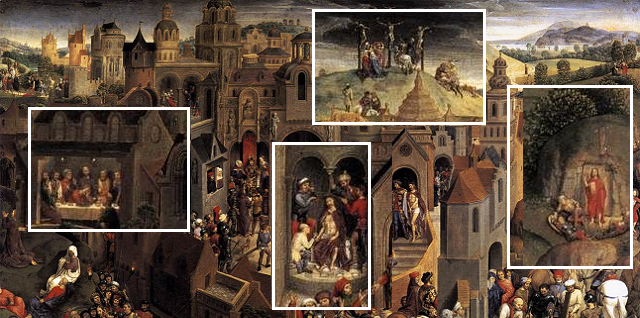
Hans Memling‘s Passion of Christ (above) tells the gospel narrative, from Christ’s entry into Jerusalem and the Last Supper through his crucifixion, entombment and resurrection to his appearances in Emmaus and by the sea of Galilee in one canvas, much as Bach’s Matthew Passion [link is to Harnoncourt video] tells major portions of the same narrative in three hours of unfolding musical drama.

*

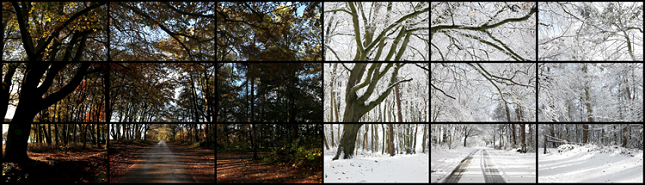
David Hockney has recently been working on forms of what I can only call “asynchronous synchrony” — as exemplified here:


Stills from Woldgate 7 November 2010 11:30 AM (left) and Woldgate 26 November 2010 11 AM (right). Credit: ©David Hockney

This image comes from a fascinating article describing Hockney’s current work by Martin Gayford, titled The Mind’s Eye, which you can find in MIT’s Technology Review, Sept/Oct 2011:

We are watching 18 screens showing high-definition images captured by nine cameras. Each camera was set at a different angle, and many were set at different exposures. In some cases, the images were filmed a few seconds apart, so the viewer is looking, simultaneously, at two different points in time. The result is a moving collage, a sight that has never quite been seen before. But what the cameras are pointing at is so ordinary that most of us would drive past it with scarcely a glance.

As with the Muybridge video above, “the viewer is looking, simultaneously, at different points in time”. Here Hockney does this with video cameras — but he achieves something of the same effect of time-displacement with still photos, too, as you can see in his brilliant portrait of the sculptor Henry Moore, hosted on the British Council’s Venice Biennale site.

Here is Gayford’s concluding paragraph, tying Hockney’s work into the larger context of our need for multiple frames of reference:

“Don’t we need people who can see things from different points of view?” Hockney asks. “Lots of artists, and all kinds of artists. They look at life from another angle.” Certainly, that is precisely what David Hockney is doing, and has always done. And yes, we do need it.

*

Memling again — and here I have enlarged and “framed” four of the 23 scenes from the passion of Christ which he has incorporated in the one painting: the Last Supper, the Crowning with Thorns, the Crucifixion, the Resurrection — Thursday evening through Sunday, and from life to death and back again.

*

It was Holy Week for Christians just last week, so perhaps you will forgive my having been preoccupied with images of the passion during the season set aside for such meditations — but what I want to point out to you is timeless, and indeed brings the transcendent into the everyday. Let’s take a look at a Hitchcock film next, then, and see how a contemporary videographer Jeff Desom has remixed the already Hockney-like Rear Window [link to IMDb] to create his own time-lapse telling of the tale [link to Vimeo], from which I took this screen-grab:

*

Time-lapse — simultaneity? The philosopher Alfred North Whitehead once wrote:

The communion of saints is a great and inspiring assemblage, but it has only one possible hall of meeting, and that is the present; and the mere lapse of time through which any particular group of saints must travel to reach that meeting-place, makes very little difference.

And so it is with this other Memling painting — and many others like it, by artists old and new:

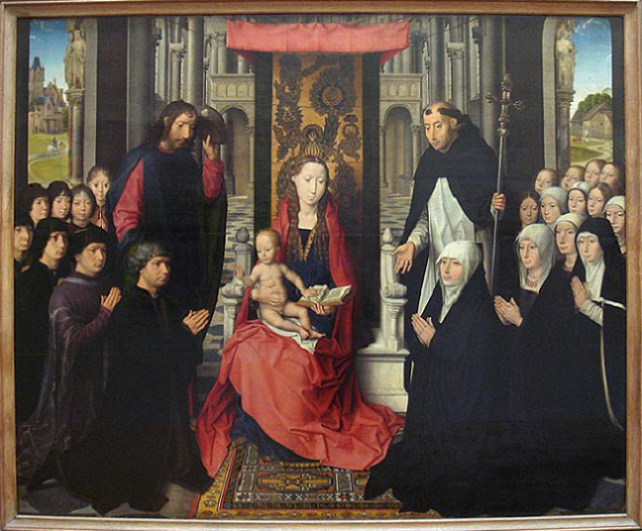
Here we see the Virgin Mary and Christ child with Saints Dominic and James — there’s an eleven centuries gap right there, St Dominic lived from 1170 – 1221, more than a millennium after Christ — and Memling has St Dominic presenting his patron, the spice trader Jacques Floreins with his family to Christ, circa 1490. With everyone dressed in late 15th-century fashions…

Whitehead — co-author with Bertie Russell of Principia Mathematica — see how amazing this is? — could have been thinking of Memling: “the mere lapse of time through which any particular group of saints must travel to reach that meeting-place, makes very little difference”.

*

Coming up next: how this affects our understanding of story.

____________________________________________________________________________

For an understanding of the setup David Hockney uses for his multiple-video takes, see here and specifically this and this. For the setup used by Jeff Desom in his Rear Window remix, see here and specifically this.


Switch to our mobile site