Through a glass bead game, darkly
Thursday, February 18th, 2016[ by Charles Cameron — Hesse and Hitchcock, two good to pass up ]
.
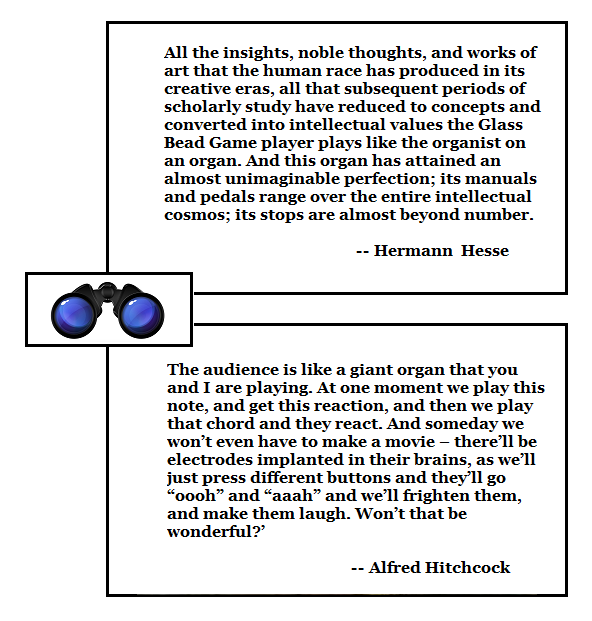
Hitch was discussing his movie North by Northwest.
[ by Charles Cameron — Hesse and Hitchcock, two good to pass up ]
.
Hitch was discussing his movie North by Northwest.
[ by Charles Cameron — background reading for the post which follows ]
.
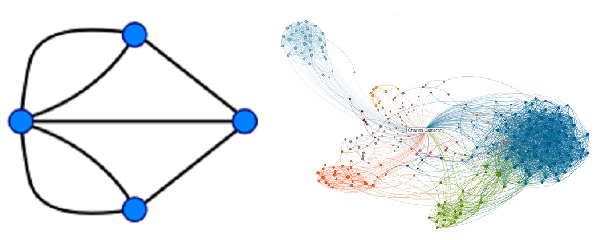
This is a quick look at node and edge graphs and some of the boards used in HipBone, DoubleQuote, and Sembl Games — a refresher for those who already know, and a quick intro for those who may not…
Above, you’ll see two graphs — one very simple and one far more complex. What they have in common is points (known as nodes) and lines connecting them (known as edges). Graphs of this kind are instances of the basic pattern on which much of contemporary understanding of the world rests, as it mostly rested on linear thinking in previous centuries. They are everywhere.
**
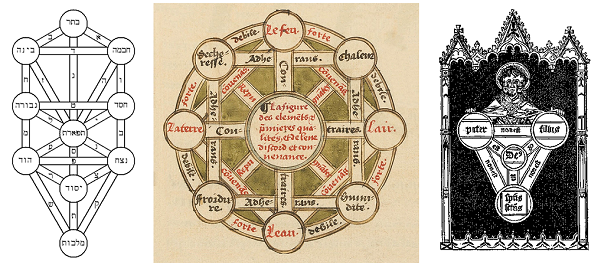
In the next image, however, we see some medieval and renaissance instances of graphs in which concepts and their relations have been assigned to the nodes and their edges — these are also commonly found today, but the early versions here have a beauty all their own..
Left to right: the Sephirotic Tree of classical Jewish Kabbalah; Oronce Fine‘s diagram of the four elements; and a medieval respresentation of the Christian Trinity. It was the Reformation & Counter-Reformation that really put a stop to this kind of graphical thinking, as Ioan Couliano teaches us.
**
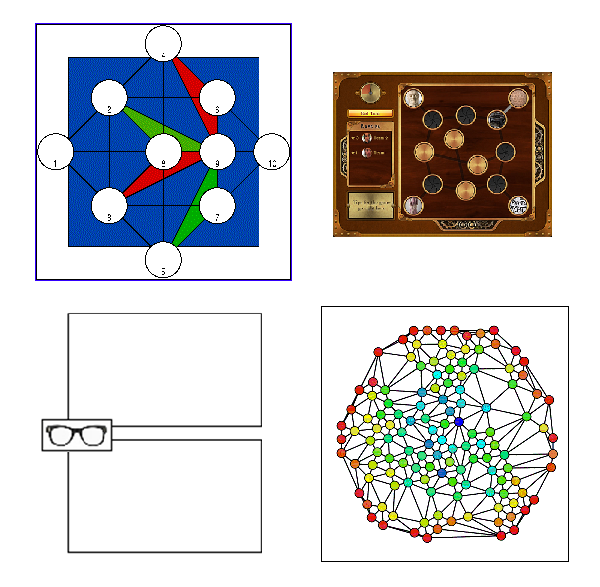
Finally, my HipBone Games and the Museum Game that Cath Styles designed for the National Museum of Australia use graphs as their boards, and the players assign concepts to the various nodes, establishing conceptual links between them:
Upper left, th4 standard WaterBird board for HipBone play; upper right, one of Cath’s boards for the Museum Game; lower left, the DoubleQuotes board, and lower right, a beautiful graph on which I hoped gto play a symphonic Bead Game.
**
That’s the essential background you need to proceed to the next post, Graph-types 2: towards a universal graphical mapping language, where I lay out my hopeful, hopeless scheme for a Grand Unified Map. Onwards.
[ by Charles Cameron — via Christopher Alexander, Arthur Koestler, James Clerk Maxwell, Hermann Hesse, and Wells Cathedral ]
.
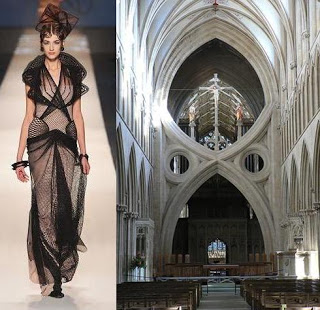
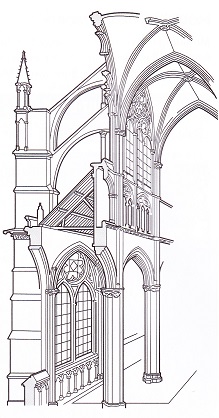
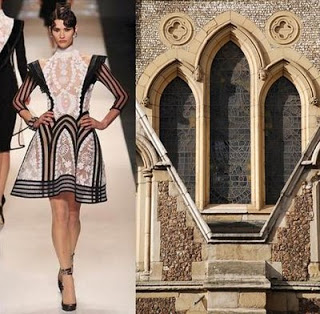
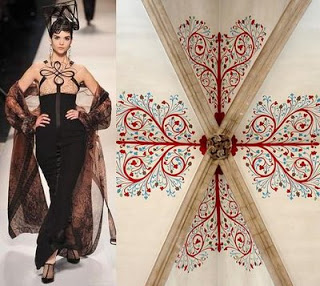
My topic today is a comment that John Robb just posted on his FaceBook page. As so often, I’ll proceed by indirection. Here’s a wild DoubleQuote illustrating a blogger’s perceived similarity between the “scissors arch” at Wells Cathedral and one of the models in Jean Paul Gaultier‘s 2009 Spring collection:
**
Some philosophical thinking:
Human knowledge, at an elemental level, can be described as a “transformation” of data.
Complex ideas are built using layers of “transformations” with each layer feeding into the next (think pyramid)
We teach these transformations at home and at school to our children.
We communicate by sharing transformations.
Questions We Need to Answer in the Age of Cognitive Machines:
How many transformations would it take to model all human knowledge?
How deep (how many layers of transformation is human knowledge) is human knowledge? Both on average or at its deepest point?
How broad is human knowledge (non-dependent transformations)?
How fast is the number of transformations increasing and how fast is it propagating across the human network?
**
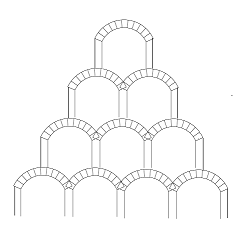
My interest is in John’s pyramid, considered as a pyramid of arches.
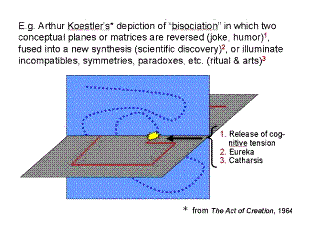
My starting point (with Hermann Hesse‘s Glass Bead Game ever in background) is Arthur Koestler‘s observation in The Act of Creation that the creative spark occurs at the intersection of two planes of thought —
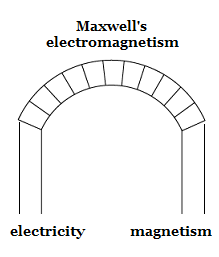
— or to put that another way, that the creative leap is an associative leap between two concepts, disciplines or aspects of knowledge — thus, an arch:
Likewise:
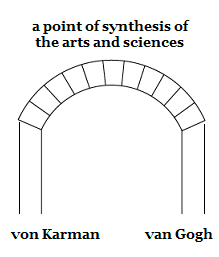
— which in my own DoubleQuotes notation gives us:
— thus, many arches build to a pyramid:
**
Of course, with arches one has to be very circumspect, buecause in rich contexts, they’re not simple creatures:
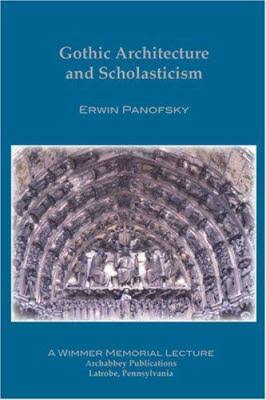
Among the greatest such arches I know are Taniyama‘s 1955 “surmise” as Barry Mazur puts it, that “every elliptic equation is associated with a modular form” — arching way above my pay grade — an insight that was to bear rich fruit forty years later, in Andrew Wiles‘ proof of Fermat’s Last Theorem; and Erwin Panofsky‘s great book similarly linking the structures of medieval cathedrals and scholastic thought:
**
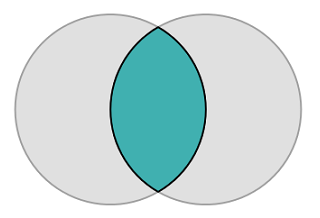
White we’re on the topic of gothic iconography, another form of arch we might consider is the vesica piscis:
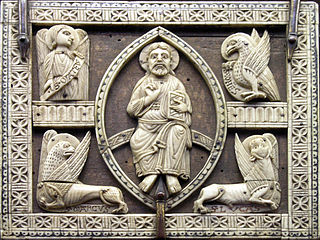
— frequently found in medieval art and architecture:
**
I’m not suggesting, John, that your inquiry and mine are identical — far from it — but that they have a sufficiently rich overlap that an appreciation of one is likely to spark insight in terms of the other.
And with Hesse’s Game, with which I recall from our earlieest conversations you are familiar..
I mentioned Hesse and Christopher Alexander in my bracketed note at the top of this post. It’s my impression that both were striving for a similar encyclopedic architecture to the pyramid John proposes. Hesse on the Glass Bead Game:
All the insights, noble thoughts, and works of art that the human race has produced in its creative eras, all that subsequent periods of scholarly study have reduced to concepts and converted into intellectual values the Glass Bead Game player plays like the organist on an organ. And this organ has attained an almost unimaginable perfection; its manuals and pedals range over the entire intellectual cosmos; its stops are almost beyond number. Theoretically this instrument is capable of reproducing in the Game the entire intellectual content of the universe.
And Hesse is clear that individual moves within the games take the form of parallelisms, resemblances, analogical leaps — writing, for instance:
Beginners learned how to establish parallels, by means of the Game’s symbols, between a piece of classical music and the formula for some law of nature.
Speaking of the playing of his great Game, Hesse said:
I see wise men and poets and scholars and artists harmoniously building the hundred-gated cathedral of the mind.
And Alexander? His book A Pattern Language is pretty clearly his own variant on a Glass Bead Game, following on from what he terms his Bead Game Conjecture (1968 – p. 75 at link):
That it is possible to invent a unifying concept of structure within which all the various concepts of structure now current in different fields of art and science, can be seen from a single point of view. This conjecture is not new. In one form or another people have been wondering about it, as long as they have been wondering about structure itself; but in our world, confused and fragmented by specialisation, the conjecture takes on special significance. If our grasp of the world is to remain coherent, we need a bead game; and it is therefore vital for us to ask ourselves whether or not a bead game can be invented.
**
Gentle readers:
For your consideration, delight, temptation, confusion or disagreement, here are three more of Gaultier’s arches, as perceived by Kayan’s Design World:
[ by Charles Cameron — it seems — to me at least — that associative memory is at the root of creativity, and that the process, preconscious pattern-recognition, is basically aesthetic in nature ]
.
As stormy winter weather approaches please take care around our coasts. #alwaysoncall #rnliroughweather @RNLI pic.twitter.com/Wk5W0Is2oJ
— RNLI Poole Lifeboats (@PooleLifeboats) November 17, 2015
**
There’s the present moment — in this case, today’s tweet from the RNLI above.
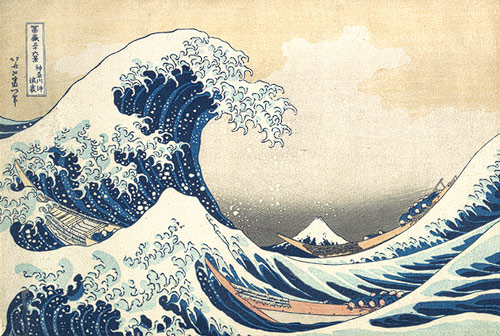
And there’s the memory it elicits — in this case, Hokusai‘s Great Wave at Kanagawa, with its three little boats, tiny Mt Fuji, and towering, breaking wave, from A Series of Thirty-Six Views of Mount Fuji:
**
That’s the same process, from perception to memory, that I was thinking of when I wrote DoubleQuoting the French Revolution, and quoted Robert Frost:
The artist must value himself as he snatches a thing from some previous order in time and space into a new order with not so much as a ligature clinging to it of the old place where it was organic.
**
Come to which, and moving by the same process from what’s in front of me to what I remember, here’s a DQ of Hokusai (~1760-1849) — before me now as I write this — and an image deriving from the work of Benoit Mandelbrot (1924-2010) on fractals” — which looking at the Hokusai quickly reminds me of:
**
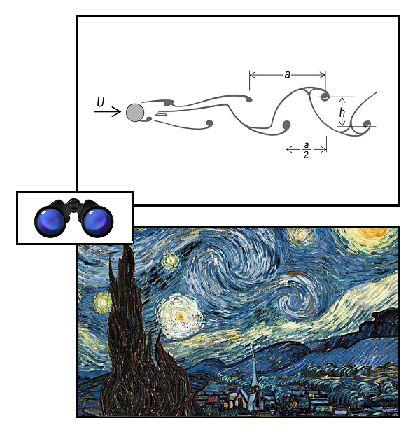
And as I look at that DoubleQuote, here at the time of writing this post, it reminds me strongly of my earlier DoubleQuote of Van Gogh and Von Kármán:
In each of these two cases, art precedes science.
**
In each case, too, the associative process is the same, with some item perceived in the present calling up a past memory that is related to it — in a manner that can generally be articulated and annotated.
Such is the mechanism of a typical “move” in a DoubleQuote or HipBone game.
[ by Charles Cameron — some examples of deep dreams, mechanical and spiritual ]
.
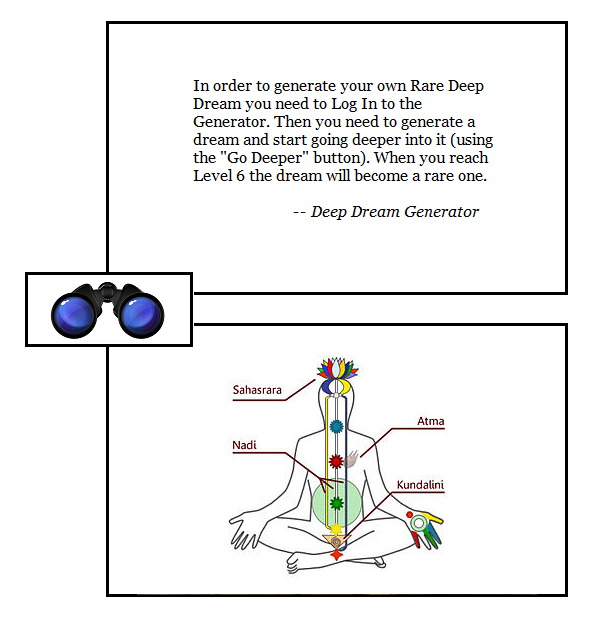
In the upper panel, a claim made for the Deep Dream Generator:
In the lower panel, an image of the chakras or lotuses in the subtle body, through which the kundalini serpent rises from deep sleep to full spiritual awakening.
The “sixth level” in the chakra system would be the Ajna chakra:
The Ajna chakra is positioned in the brain, directly behind the eyebrow center. Its activation site is at the eyebrow region, in the position of the ‘third eye.’
**
Deep Dreams:
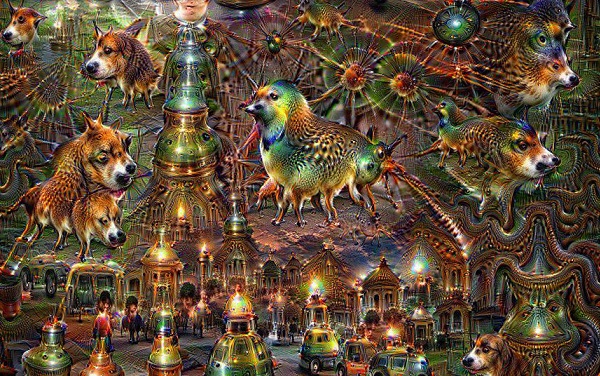
Here’s what Google’s Deep Dream Generator comes up with:
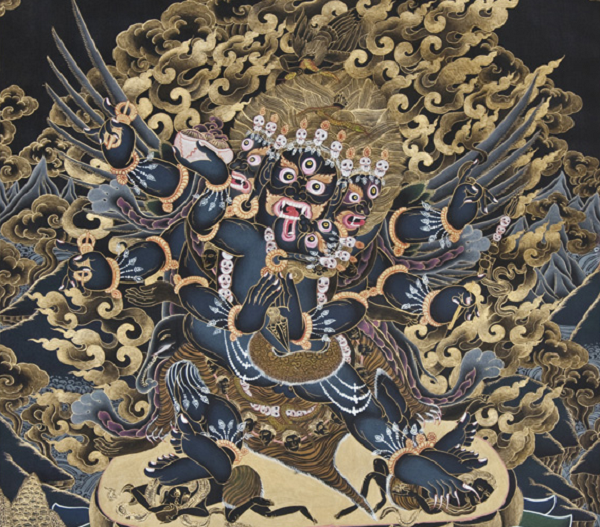
Here’s an early statue of Arya Lokeshvara from the Potala Palace, dating to the 7th century and described as the Potala’s most sacred statue:
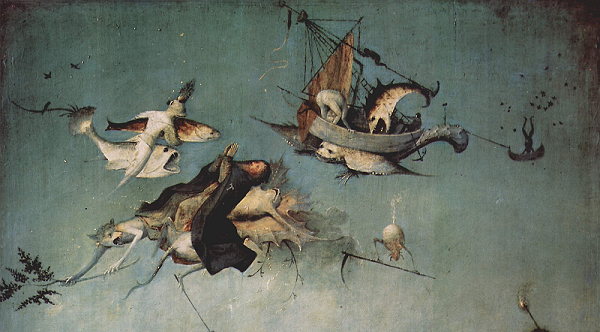
This is a detail from Hieronymus Bosch, The Temptation of St Anthony:
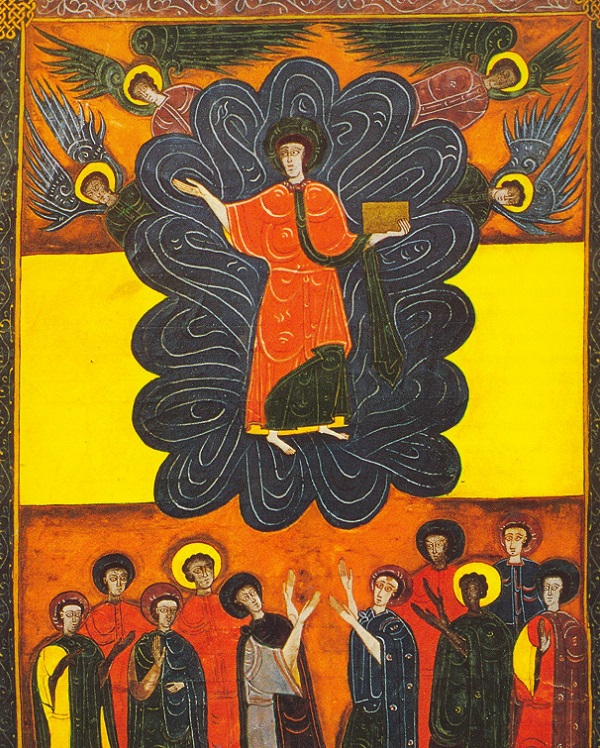
From one of the marvellous array of manuscripts of the Beatus commentary on Revelation:
Here’s a deep dream in words, from Hermann Hesse..
Another, from Shakespeare:
A secular deep dream..
and a deep dream — as surreal as all the rest, yet capturing “no more than” simple reality — in a photo posted today by Bill Benzon:
**
Roll over, Beethoven:

Zenpundit is a blog dedicated to exploring the intersections of foreign policy, history, military theory, national security,strategic thinking, futurism, cognition and a number of other esoteric pursuits.
Customized Web Site & Blog Design