zenpundit.com » 2010

Archive for 2010

Book Review: Magic and Mayhem by Derek Leebaert

Monday, November 22nd, 2010

Magic and Mayhem: The Delusions of American Foreign Policy From Korea to Afghanistan by Derek Leebaert

As I mentioned previously, I enjoyed Derek Leebaert’s earlier Cold War history, The Fifty Year Wound, so I was pleased to be sent a courtesy review copy of his latest work, Magic and Mayhem:The Delusions of American Foreign Policy from Korea to Afghanistan. Leebaert, a professor of government who teaches foreign policy at Georgetown university, does not disapoint; Magic and Mayhem is a lively and highly provocative excoriation of of the dysfunctional political culture of making foreign and national security policy in America.  While I found many fine points of disagreement with Leebaert in Magic and Mayhem, his broad themes constitute a healthy challenge to a dolorous status quo in Washington.

In Leebaert’s view, American foreign policy suffers from being crafted under two related evils: a culture of “magical thinking” and a cadre of professional alarmists, the “Emergency Men” who constitute a kind of self-appointed, adrenalin-addicted, national security ecclesia who exploit the magical thinking of the public and labor under its delusions themselves. It is this dual embrace of ends without a priori examination of means or ways and a lust for action that leads our foreign policy elite to embrace all manner of costumed charlatans with polished English language skills who are allegedly willing and able to be America’s “partner” in dangerous neignorhoods. From South Korean autocrats to African kleptocrats to figures of a more recent vintage. Leebaert writes:

Afghan president Hamid Karzai, with his Western-style technocrats and talk of democracy, was immensely appealing to Washington after the Taliban was ousted.  For more than seven years, reports the Times Dexter Filkins, Karzai was a “White House favorite – a celebrity in a flowing cape and dark grey fez” a dramatic outfit that he had designed himself but that had no origin in Afghani dress…..

….”We thought we had found a miracle man” moaned one diplomat. On closer inspection, the sorcerer proved unconvincing as the opium trade and corruption flourished.

I have always wondered where the hell that cape came from.

Leebaert takes aim at a wide variety of targets. I definitely do not agree with his assessments of everything and everyone who has caught his ire, but it is a list that is breathtaking in expanse; a parade of names and terms that includes, but is not limited to:

George Kennan
Douglas MacArthur
Paul Nitze
Detente
Robert McNamara
McGeorge Bundy
Peter Rodman
Brinkmanship
Donald Rumsfeld
COIN
Richard Holbrooke
Henry Kissinger
The CIA
NSC-68
John McCain
Arms Control
John F. Kennedy

Richard Nixon
Curtis LeMay
Defense intellectuals
Lyndon Johnson
Maxwell Taylor
Dick Cheney
Cyrus Vance
George W. Bush
Neocons
Oliver North
Revolution in military affairs
Richard Perle
Crisis management
MAD theory
Strategic/Security Studies
Walt Rostow
Wiliam Westmoreland
Robert Kennedy
Bernard Lewis
Thomas P.M. Barnett
Lawrence Summers
George Tenet
Robert Kaplan
Samuel Huntington
John Abizaid
Stan McChrystal
Barack Obama
David Ignatius
Thomas Friedman
David Brooks
US Public Diplomacy
Jimmy Carter
Michael O’Hanlon

That, by the way, was not comprehensive.

It would be a much shorter list to cite those statesmen of whom Leebaert approved – men like Henry Stimson, Dean Acheson, Matthew Ridgway, Omar Bradley, George Marshall, Dwight Eisenhower, George Schultz and Ronald Reagan. The book is not flawless. There are minor factual errors. Not every person or doctrine in Magic and Mayhem is considered in depth.  At times, Leebaert comes across as glib or superficial in his criticism, but predominantly, as with the cases of Kissinger or Rumsfeld, his bitter jeremiads are skewering their targets.

Leebaert argues for a considered retreat from policy alarmism and the cult of emergency, and for a reduction of ambitious American policy grandiosity that would flow from recognizing and respecting the agency of other nation’s leaders and peoples. Implicitly, a call not so much for isolationism, as for restraint and a sense of proportion, coupled with a dimunition of status and power for national security “celebrities” and the cottage industry of think tank consultancy for which they stand.

Magic and Mayhem is a book that was written to demystify shibboleths and smash idols.
What the Dickens? Symbolic details in Inspire issue 3

Sunday, November 21st, 2010

by Charles Cameron
.
It’s easily missed. It’s part of the “small print” that most small-format paperbacks carry on the copyright page:

The sale of this book without its cover is unauthorized. If you purchased this book without a cover, you should be aware that it was reported to the publisher as “unsold and destroyed.” Neither the author nor the publisher has received payment for the sale of this “stripped book.”

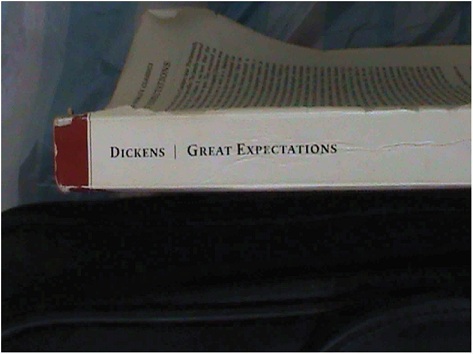
Here’s the picture that AQAP took of the copy of Dickens’ novel Great Expectations they inserted into one of their bombs recently – which they then published in issue 3 of their English language magazine Inspire:

Dickens

And here’s the explanation that accompanies that photo, in a piece titled “The Objectives if Operation Hemorrhage” by their “Head of the Foreign Operations Team”:

This current battle fought by the West is not an isolated battle but is a continuation of a long history of aggression by the West against the Muslim world. In order to revive and bring back this history we listed the names of Reynald Krak and Diego Diaz as the recipients of the packages. We got the former name from Reynald de Chatillon, the lord of Krak des Chevaliers who was one of the worst and most treacherous of the Crusade’s leaders. He fell into captivity and Salahuddeen personally beheaded him. The name we used for the second package was derived from that of Don Diego Deza, the Inquisitor General of the Spanish Inquisition after the fall of Granada who along with the Spanish monarchy supervised the extermination and expulsion of the Muslim presence on the Iberian Peninsula employing the most horrific methods of torture and done in the name of God and the Church. Today we are facing a coalition of Crusaders and Zionists and we in al Qaeda of the Arabian Peninsula will never forget Palestine. How can we forget it when our motto is: “Here we start and in al-Aqsa we meet”? So we listed the address of the “Congregation Or Chadash”, a Gay and Lesbian synagogue on our one of our packages. The second package was sent to “Congregation B’nai Zion”. Both synagogues are in Chicago, Obama’s city.
.
We were very optimistic about the outcome of this operation. That is why we dropped into one of the boxes a novel titled, Great Expectations.

They may not have read the book or seen the movie, as Ibn Siqilli comments at the link above, but they do have long memories and/or a taste for history, and they are indeed sending signals with small details like the fictitious names of their addressees.

*

This is in line with one of the basic premises of Islamic thought: that the world we inhabit is a world of ayat or symbols (the singular is ayah, and the word is also used to refer to the verses of the Qur’an, each of which is viewed as a symbolic utterance). Here, for instance, is a passage from Fazlun Khalid’s paper, Islam and the Environment, from the website of Jordan’s Royal Aal al-Bayt Institute for Islamic Thought:

The Qur’an refers to creation or the natural world as the signs (ayat) of Allah, the Creator, and this is also the name given to the verses contained in the Qur’an. Ayat means signs, symbols or proofs of the divine. As the Qur’an is proof of Allah so likewise is His creation. The Qur’an also speaks of signs within the self and as Nasr explains, “… when Muslim sages referred to the cosmic or ontological Qur’an … they saw upon the face of every creature letters and words from the cosmic Qur’an … they remained fully aware of the fact that the Qur’an refers to phenomena of nature and events within the soul of man as ayat … for them forms of nature were literally ayat Allah”. As the Qur’an says, “there are certainly signs (ayat) in the earth for people with certainty; and in yourselves. Do you not then see?” (Adh-Dhariat, 51:20, 21).

*

BTW, I don’t think Penguin (or, for that matter, Charles Dickens) got paid for that book… whatever their expectations may have been.

Metaphors as Catalyst and Scaffold

Friday, November 19th, 2010

Via John Hagel, a particularly interesting NYT article on the neroscience of metaphors. I have always considered metaphors and analogies to be a “spark” or a “catalyst” to insight but they appear to be potentially structural organizers or “signal switches” of information processing:

This Is Your Brain on Metaphors

….Symbols, metaphors, analogies, parables, synecdoche, figures of speech: we understand them. We understand that a captain wants more than just hands when he orders all of them on deck. We understand that Kafka’s “Metamorphosis” isn’t really about a cockroach. If we are of a certain theological ilk, we see bread and wine intertwined with body and blood. We grasp that the right piece of cloth can represent a nation and its values, and that setting fire to such a flag is a highly charged act. We can learn that a certain combination of sounds put together by Tchaikovsky represents Napoleon getting his butt kicked just outside Moscow. And that the name “Napoleon,” in this case, represents thousands and thousands of soldiers dying cold and hungry, far from home.

And we even understand that June isn’t literally busting out all over. It would seem that doing this would be hard enough to cause a brainstorm. So where did this facility with symbolism come from? It strikes me that the human brain has evolved a necessary shortcut for doing so, and with some major implications.

….This potential to manipulate behavior by exploiting the brain’s literal-metaphorical confusions about hygiene and health is also shown in a study by Mark Landau and Daniel Sullivan of the University of Kansas and Jeff Greenberg of the University of Arizona. Subjects either did or didn’t read an article about the health risks of airborne bacteria. All then read a history article that used imagery of a nation as a living organism with statements like, “Following the Civil War, the United States underwent a growth spurt.” Those who read about scary bacteria before thinking about the U.S. as an organism were then more likely to express negative views about immigration.

Another example of how the brain links the literal and the metaphorical comes from a study by Lawrence Williams of the University of Colorado and John Bargh of Yale. Volunteers would meet one of the experimenters, believing that they would be starting the experiment shortly. In reality, the experiment began when the experimenter, seemingly struggling with an armful of folders, asks the volunteer to briefly hold their coffee. As the key experimental manipulation, the coffee was either hot or iced. Subjects then read a description of some individual, and those who had held the warmer cup tended to rate the individual as having a warmer personality, with no change in ratings of other attributes.

From this simple associative effect are the conditions from which a “eureka” moment of insight can crystallize, as it did for Archimedes in his bath:

Effect—-> Association —-> Orientation ——> Insight ——> Extrapolation/Generalization

ADDENDUM:

Curtis has commented and expanded the discussion, though his comments seem to go into my akismet spam folder. Should be fixed now:

WOODA = C(OODA) + A(OODA) / 4GW & 5GW

There is the potential not only for insight but also for deception, whether the deceivers are others in our milieu or we ourselves (and our brains) may be deceivers….

True. Metaphors and analogies can crystallize insughts but they can also become powerfully attractive distorions of reality – sort of “anti-models” or  “false models”.

….As a model of what might be called metaphorization, these similarities make sense.  The OODA in all its forms, including the WOODA which includes World, represents a dynamic process of cycling (although perhaps not always uniform and unidirectional cycling) of information.  The focal point of the A-OODA, Observe above, is the abstract locus of observation:  New information received from without comes into contact (abstractly speaking!) with previously built understandings, or Mental Constructs, and relatively newer insights, or Conditional Constructs.  These diverse abstract observations have, to some extent, already prepared the mind for interpretation of new information and, these observations taken as whole create an opportunity for triangulation (of a sort.)  Using Mark Safranski’s terminology, after the information is Associated, it is Oriented through analysis and synthesis, Insights may form the basis of new hypotheses which may either be conditional (re-looped into further observation w/ outside information and previous understandings) or may be accepted as finalized understandings about what one has observed (Extrapolation/Generalization).

Hmmmm…. I have read that “insight” as a neurocognitive event tends to occur in two brain regions, the lateral inferior prefrontal cortex and the anterior cingulate cortex. The associative work of insight correlates with the former region but the “combinatory play” cited by Einstein and referenced , if I recall, by Charles and leading to new hypothesis correlates with the latter.  I am not a neuroscientist, so I am now wondering if insight is a distributed, parallel processing, brain function or if we are really talking about two separate cognitive effects – an “Insight 1” and “Insight 2”?

Anyone who cares to weigh in here, feel free…..

Games of War and Peace V: Space Invaders

Thursday, November 18th, 2010

By Charles Cameron 

It has been a while since I posted an entry in my “Games of War and Peace” series, but I just came across a quote in Stephen Ulph’s Towards a Curriculum for the Teaching of Jihadist Ideology that brought back memories…

spaceinvaders

The epigraph to Ulph’s Introduction quotes from Rosie Cowan and Richard Norton-Taylor’s piece, Britain now No 1 al-Qaida target – anti-terror chiefs from the (UK) Guardian of 19 October 2006, and I’ve added a couple of earlier paragraphs for context:

Even though the police and M15 have disrupted terror plots and groups influenced by al-Qaida, they describe the networks as very resilient.They say there is a frightening number of young men willing to step up and replace those who have been arrested or gone to ground.

“It’s like the old game of Space Invaders,” said one senior counter-terrorism source. “When you clear one screen of potential attackers, another simply appears to take its place.”

I don’t think there’s a deep strategic insight there, the way there may be with Mao and the game of Go, although the question of what drives the continuing recruitment of those young men is an important one.

But I’d like to ask — what other game-related insights do you find of value in understanding contemporary jihadism?

Sinophilia

Thursday, November 18th, 2010


Historyguy99, who has a lot of “in-country” experience, offers up a nice blog round-up and commentary on China.


Switch to our mobile site