zenpundit.com » 2010

Archive for 2010

RESTREPO on Television this Monday

Monday, November 29th, 2010

An important announcement from my colleague, Lexington Green:

Lexington Green – (1) RESTREPO Monday, 11/29/10 at 9PM ET/PT; (2) Maj.Gen. Scales on Small Unit Dominance

This is the television premier of this extraordinarily film. I wrote about seeing this film here.

Restrepo chronicles the deployment of a platoon of U.S. soldiers in Afghanistan’s Korengal Valley. The movie focuses on a remote 15-man outpost, Restrepo, named after a platoon medic who was killed in action. It was considered one of the most dangerous postings in the U.S. military. This is an entirely experiential film: The cameras never leave the valley; there are no interviews with generals or diplomats. The only goal is to make viewers feel as if they have just been through a 94-minute deployment. This is war, full stop. The conclusions are up to you.

I highly recommend this film to all of our readers.

An information page for Restrepo is here, including video.

RESTREPO, an award winning documentary, was based on (or more precisely, closely related to) the book WAR by Sebastian Junger, which told the story of the war against the Taliban in the Korengal Valley, waged by the soldiers of the 2nd Platoon of Battle Company.

I previously reviewed WAR here and the movie RESTREPO here.

More Books!

Friday, November 26th, 2010

Just picked up a few new reads…..


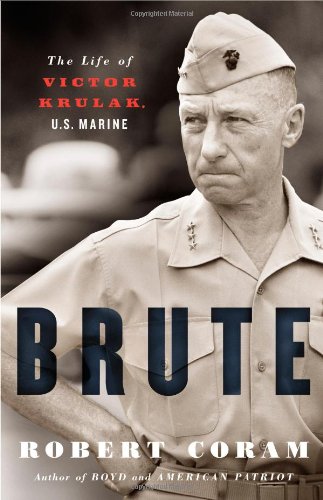
Brute: The Life of Victor Krulak, U.S. Marine by Robert Coram

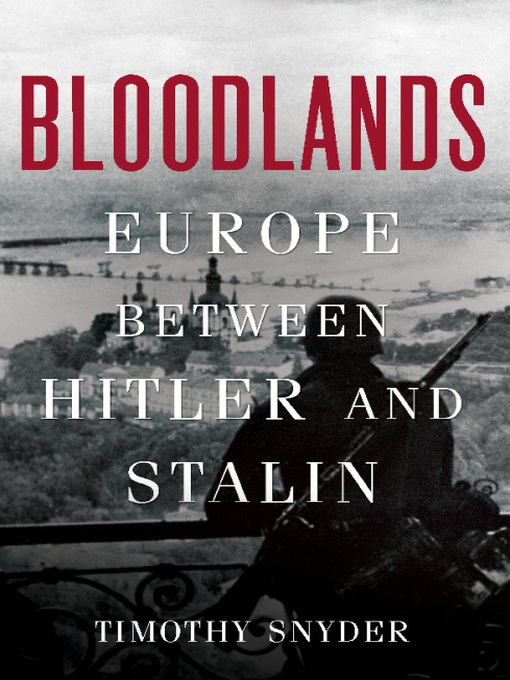
Bloodlands: Europe Between Hitler and Stalin by Timothy Snyder

Robert Coram, whom I had the pleasure of meeting at Boyd ’07, has a new biography of the legendary military visionary and Marine Lt. General Victor “Brute” Krulak, reviewed here by Max Boot and here by Tony Perry (Hat tip to Dr. Chet Richards). Having thumbed a few pages, Krulak appears a complicated man – gifted, dauntless and extremely driven but also possessed of a mean streak, edging at times toward petty cruelty.

Bloodlands I intend to read in a “Hitler-Stalin/Nazi-Soviet Comparison” series along with Richard Overy’s The Dictators: Hitler’s Germany, Stalin’s Russia, Robert Gellately’s Lenin, Stalin, and Hitler: The Age of Social Catastrophe , Richard J. Evans’ The Third Reich at War and Alan Bullock’s classic dual biography Hitler and Stalin: Parallel Lives.  I’d also recommend, for those with the stomach for historiographic commentary, Robert Conquest’s Reflections on a Ravaged Century and John Lukac’s The Hitler of History

CURRENTLY READING:

Human Face of War by Jim Storr

After reading approxmately a third of The Human Face of War by  Dr. Jim Storr, a retired Lt. Colonel, King’s Regiment and an instructor at the UK Defence Academy, I will say that if you are going to read only one book on modern military thought this year, it should be The Human Face of War. It’s that good.

Aside from a reflexive hostility toward John Boyd’s OODA Loop ( though not, strangely enough, toward the substantive epistemology advocated by Boyd that the diagram represented), Storr’s tome is an epistle of intellectual clarity on military theory that deserves to be widely read.

ADDENDUM:

NDU Press recommends, and I concur, this review of The Human Face of War by Col. Colonel Clinton J. Ancker III. Ancker, like Storr, is an expert on military doctrine, so it is a well-informed review by a professional peer.

More on Galula

Wednesday, November 24th, 2010

At SWJ Blog:

Octavian ManeaPros and cons on Galula model

In response to the interest raised on the relevance of the Galula model for understanding and dealing with today’s insurgencies, I conducted a brief inquiry with key experts on the topic – Peter Mansoor, Steven Metz, David Betz, and Alex Marshall.

Dr. Peter Mansoor

The Galula model applies in those cases where the population of a country is more concerned about the effectiveness and legitimacy of its government than in its sectarian or ethnic make-up. “Classic” counterinsurgency efforts to improve the legitimacy of a government are then operative. In those cases where sectarian or ethnic identity trumps other factors (e.g., Sri Lanka or Chechnya), then protecting the people will avail the counterinsurgent little in the way of gaining their trust and confidence. In these cases, other strategic or operational approaches need to be considered….

Dr. Steven Metz

To me, the Cold War/Maoist model of insurgency applied in situations where new segments of a society were becoming politically aware or mobilized and thus made demands on the state which it could not fulfill. These demands were both tangible–infrastructure, security, education–and intangible (a sense of identity). That’s why I think it has very little applicability to current insurgencies. Granted current insurgencies attempt to emulate the Maoist strategy because it worked in the past, but I think this will lead to failure.

Dr. David Betz

The work of the French officer David Galula was clearly very influential on the thinking of the authors of FM 3-24 Counterinsurgency. There is certainly a lot to like. For one thing, his book Counterinsurgency Warfare is less than 150 pages long which makes it an easy read-four cups of tea and a Sunday afternoon will get you through it. For another, it’s written in a very aphoristic style which is highly memorable. So if you’re trying to get across to a large number of people a number of ‘best practices’ or paradoxes of COIN then Galula is a very good assigned reading. The truth is though that most COIN best practice would fit on a bumper sticker. In fact the new UK Field Manual on COIN comes with a laminated credit card sized aide memoire on one side of which are printed the principles of COIN and on the other ISAF’s game plan for stabilizing Afghanistan. I’m not criticizing-I think it’s a handy thing; my point is rather that Galula and his interpreters sometimes sound a bit like Kipling’s ‘Just So’ stories. In practice, it’s complicated, as one sees in Galula too if you read his longer, messier, more ambiguous and more rewarding book Pacification in Algeria. Anyway, to get to the point I have three main reservations about Galula…..

Dr. Alex Marshall

My issue with the Maoist Paradigm is really two-fold.

My first reservation, as a historian, is that we lack a definitive English-language study of Maoist insurgency itself beyond some fairly stereotyped notions of a three-stage or five-stage revolutionary process (from political agitation to guerrilla conflict to regular warfare). Galula and Thompson were great generalizers, but one can scarcely call their work proper historical studies-their general view was that Maoist-style insurgencies involved a degree of mass brainwashing for example. We possess some interesting case studies of how Maoist mobilization worked in practice on the ground, in individual villages or Shanghai for example, but there is so much more that could be done. Thus Western writing during the Cold War in general generated a shorthand stereotype, when in reality insurgency practice was often more diverse. The reason was simple I suggest-most successful insurgents aren’t particularly pithy writers (Guevara and Mao were exceptions), most unsuccessful ones are very quickly dead.

My second concern is more overarching however. The majority of discourse on COIN doesn’t take into account the strategic context, remaining locked into the operational level instead…..

Read the whole thing here.

A very productive piece by Manea and the gents above. Galula’s historiographic importance in COIN should be undisputed and his contribution to theory acknowledged and respected. Application of Galula’s framework (or, really, anybody’s) for understanding COIN, in analyzing insurgencies should be used cautiously or lightly until there is enough of an emprical understanding of the structure and motivations of the insurgents and the political deficiencies of the state, to see to what extent the model fits, before the operational assumptions of a military bureaucracy and theater command harden into place.

Lacking the reliable contingency of a superpower patron on an ideological crusade in the 21st century to impose a stamp of identity and tactics on it’s proxies, insurgencies are likely to be as diverse as La Familia is from FARC, the Taliban or the Real IRA.

Tom Barnett’s Communique to the Barbarians

Wednesday, November 24th, 2010

” A communication: magnificently our great Emperor soothes and pacifies China and the foreign countries, regarding all with the same kindness. If there is profit, then he shares it with the peoples of the world; if there is harm, then he removes it on behalf of the world. This is because he takes the mind of heaven and earth as his mind.”                                      – Lin Zixu

I am no Sinologist, so I am interested in how professional China-watchers interpret this signal. Here’s my two cents:

Dr. Thomas P.M. Barnett teamed up with two highly-regarded (inside Chinese elite circles) pundits John Milligan-Whyte and Dai Min to offer a “grand strategic rebalancing” of the Sino-American relationship for the 21st century, which ran in The People’s Daily, the official newspaper of the Central Committee of the Communist Party of China. Agree or disagree with the particulars, an impressive and timely move on Tom’s part.

An excerpt – but you should really read the whole thing:

….When agreed upon by the presidents of both nations through an “executive agreement” not subject to U.S. Senate ratification, it will promote U.S. economic recovery, increase U.S. exports to China, create 12 million US jobs, balance China-US trade as well as reduce U.S. government deficits and debt. Furthermore, it will stabilize the U.S. dollar, global currency and bond markets. It will also enable reform of international institutions, cooperative climate change remediation, international trade, global security breakthroughs as well as facilitate the economic progress of developed and developing economies, the stabilization and rebuilding of failed states and security of sea transport. The essence of the grand strategy is that the United States and China will balance their bilateral trade and never go to war with each other, and the US will refrain from seeking regime change and interference in China’s internal affairs with regard to Taiwan, Tibet, Xinjiang, the Internet, human rights etc. and China will continue its political, legal, economic and human rights reforms.The Taiwan situation will be demilitarized by an informal U.S. presidential moratorium on arms transfers to Taiwan, China’s reduction of strike forces arrayed against it, a reduction of U.S. strike forces arrayed against China and ongoing joint peacekeeping exercises by U.S., Chinese and Taiwan militaries.The strategic uncertainty surrounding nuclear program in Democratic People’s Republic of Korea (DPRK) will be de-escalated by the U.S. eschewing DPRK regime change goals and China ensuring that DPRK adopt policies along the lines of Deng Xiaoping’s economic reforms and terminate its nuclear weapons program. China, U.S., South Korean and other military forces will together ensure maritime safety in the Yellow Sea….

Read more: Thomas P.M. Barnett’s Globlogization – Thomas P.M. Barnett’s Globlogization – New China-U.S. grand strategy proposal, as published in People’s Daily Online

Publication in The People’s Daily does not imply that this blue sky missive is Chinese policy, but it would never have appeared without the sanction of some important figures in China’s government and Communist Party. I am not up to speed on elite Chinese politics, but historically, the Central Committee of the CCP was a much more integrated body of elite decision makers in the sense of mixing PLA generals, state bureaucrats and Party bigwigs than was the Soviet Cenntral Committee, which served in the post-Stalin era to cement CPSU dominance over the military and KGB. 

Set aside the merits of this “rebalancing” for later, as some points have not a hope in hell of seeing the light of day,and focus on what it means that the article has appeared at all.

First, I read this as a Mongolfier kind of trial balloon, a plausibly deniable rough draft of a Shanghai Communique 2.0 where Chinese rulers lay out their internal consensus “red line” vital interests and what they will put on the table in return, without any risk of “losing face”.

Secondly, while most of the critical noise will be over the security-military relationship, Taiwan and the total omission of Japan (!), I find the economics the most interesting section. Never before in history have two great powers with so little in common, who were not allies, so deeply entangled themselves in each others economies, basically to the point of no return. This piece tells me China’s leaders realize that a path of confrontation with America or pursuing beggar-thy-neighbor trade policy indefinitely, will mean the destruction of a generation of painfully accumulated surplus wealth, held largely in dollars and treasury securities. China’s elite would rather “double-down” on their bet on America instead of attempting to painfully wrench themselves free and cut their losses by cashing in devalued chips.

That concern is the apex of realism – a good variable to see at a time when nationalistic hubris and hypersensitivity have increasingly been on display in China’s foreign relations with great powers and weak neighbors alike. That kind of realism, other countries can do business with.

What are your thoughts?

ADDENDUM:

Tom has added his briefing slides

Recommended Reading

Tuesday, November 23rd, 2010

Top Billing! Robert MackeyWhen Cowards Speak

Dr. Mackey is a professor of military history and is a retired US. Army Lieutenant Colonel, and he unloads here on a couple of lunatic wingnuts:

….The Medal of Honor is, other than its value in precious metals, not actually worth that much, at least from a physical view. It is a piece of starry ribbon, a piece of gold, some words. No, its real worth is that it is recognition of bravery and courage under fire, from the fellow citizens of a grateful nation. The history of the Medal is filled with men who did things that few others can imagine, from young black men seizing a Confederate flag from an enemy’s hands in the Civil War, to leading soldiers up San Juan Hill (and to the White House), across No-Man’s Land in the Great War, to World War II submarine captains, bomber pilots and a little known Texan who was rejected by every service except the Army and would become the most decorated soldier in U.S. history, to young Marines in the frozen retreat in the winter of 1950 in Korea, to medics saving their dying comrades in the jungles and paddies of Vietnam, through Somalia, to today. The history of the Medal is the history of our Republic, and its winners are the best of our nation–courageous, honorable, common men, who, almost as a man, would repeat what Audie Murphy said, “I never like being called the ‘most decorated’ soldier. There were so many guys who should have gotten medals and never did – guys who were killed.”

Then you have men–and I use that word in this case to only describe the male of the human species–who have never served a day in uniform, much less a moment in combat. Who have never sacrificed for their fellow countrymen, who have never given a moment’s thought to anything but their own self-centered and selfish pursuits, men to whom the idea of running forward when others run away is anathema.

Eide Neurolearning BlogOur Metaphorical Minds

The Drs. Eide kindly respond to the discussion of metaphorical thinking that Charles and I and our commenters have had recently:

….In other research, scientists found that metaphoric ‘priming’ could change social and political attitudes. Little creepy, huh? Subliminal effects. If one looks at Marcel Just’s work involving literal and metaphorical meanings though, it’s not surprising that cross-talk occurs. What is so surprising is how common it is and how significant the effect. It’s an interesting thought that we are journeying through life constantly triggering metaphorical and literal meanings of which we are dimly aware.

John Arquilla U.S. not prepared for Mumbai-like terror attacks

Dr. Arquilla points out that the national security-homeland security establishment remain tribally wedded to the hierarchical model of counterterror response that amounts to an iron rice bowl for bureaucracies and deeply hostile to local or private citizen response to an attack.

Our military’s Northern Command, responsible for dealing swiftly with major terrorist attacks on American cities, remains largely wedded to the notion of responding by being able to move a brigade-size force – about 3,000 troops – where it’s needed in a day or so. This is too much, too late when it comes to trying to counter small teams attacking a city at several points simultaneously.

Instead of this big, bulky approach, planners should aim at being able to deploy many small teams within minutes. This means giving a lot of attention, training and resources to local law enforcement and other first responders. It means doing simple things like providing more small-arms practice for all police. They don’t have to become SWAT-like master snipers to take down terrorists – incremental improvements in a patrolman’s already strong weapons-handling skills will pay huge dividends.

Global Guerrrillas- OPEN SOURCE JIHAD

John says “I told you so” 🙂

That’s it.


Switch to our mobile site