zenpundit.com » 2012

Archive for 2012

Games of telephone and counter-telephone?

Wednesday, October 3rd, 2012

[ by Charles Cameron — embassy or consulate — a minor detail for an editor, perhaps, but all the difference in the world for Ambassador J Christopher Stevens ]
.

Here’s a screen grab of a piece posted on the Atlantic site today:


.

The article itself is worth your time, and I’ll get back to the screen grab later. Here’s the text para that interests me:

In the famous “Bin Ladin Determined to Strike in US” Presidential Daily Brief of August 6, 2001, one of the major analytic points was that “Al-Qa’ida members — including some who are US citizens — have resided in or traveled to the US for years, and the group apparently maintains a support structure that could aid attacks” (emphasis added). Notice that this analysis uses two hedges in a single sentence. Given the lack of certainty on the issue, such linguistic dodging made sense — as it does in report after report where individuals are discussing information below the level of actionable intelligence.

Leah Farrall has been tweeting about the way this characteristically cautious phrasing used by analysts gets lost as “the higher up the food chain an analytical report goes the greater the tendency for bosses in [the] food chain to add their two cents worth” — so that by the time it reaches the politicians, “there is absolutely WMD.”

The shift from “apparently” to “absolutely” is an interesting one.

**

The 2007 National Intelligence Estimate featured a section on the nomenclature of such distinctions, which I trust and imagine was directed more at its readers than towards the analysts who produced it:

What We Mean When We Say: An Explanation of Estimative Language

When we use words such as “we judge” or “we assess”—terms we use synonymously — as well as “we estimate,” “likely” or “indicate,” we are trying to convey an analytical assessment or judgment. These assessments, which are based on incomplete or at times fragmentary information are not a fact, proof, or knowledge. Some analytical judgments are based directly on collected information; others rest on previous judgments, which serve as building blocks. In either type of judgment, we do not have “evidence” that shows something to be a fact or that definitively links two items or issues.

Intelligence judgments pertaining to likelihood are intended to reflect the Community’s sense of the probability of a development or event. Assigning precise numerical ratings to such judgments would imply more rigor than we intend. The chart below provides a rough idea of the relationship of terms to each other.

We do not intend the term “unlikely” to imply an event will not happen. We use “probably” and “likely” to indicate there is a greater than even chance. We use words such as “we cannot dismiss,” “we cannot rule out,” and “we cannot discount” to reflect an unlikely—or even remote—event whose consequences are such it warrants mentioning. Words such as “may be” and “suggest” are used to reflect situations in which we are unable to assess the likelihood generally because relevant information is nonexistent, sketchy, or fragmented.

In addition to using words within a judgment to convey degrees of likelihood, we also ascribe “high,” “moderate,” or “low” confidence levels based on the scope and quality of information supporting our judgments.

• “High confidence” generally indicates our judgments are based on high-quality information and/or the nature of the issue makes it possible to render a solid judgment.
• “Moderate confidence” generally means the information is interpreted in various ways, we have alternative views, or the information is credible and plausible but not corroborated sufficiently to warrant a higher level of confidence.
• “Low confidence” generally means the information is scant, questionable, or very fragmented and it is difficult to make solid analytic inferences, or we have significant concerns or problems with the sources.

**

You could think of these as counter-telephone measures — attempts to avoid the distortions and corruptions that tend to arise when a message is passed from one person to another, And that’s important a fortiori when an ascending food-chain of transmitters may wish (or be persuaded) to formulate a message that will assure them the favorable attention of their superiors — but also because the higher the report goes, the closer it gets to decision-time..

As the Atlantic article says, this kind of “linguistic dodging” (aka attention to nuance) makes sense “in report after report where individuals are discussing information below the level of actionable intelligence.”

Inevitably there’s a shift in tempo between contemplation and action.

**

Anyway, messages tend to get distorted as they’re passed along.

Consider, for instance, the caption to the photograph that graces the Atlantic piece at the top of this post:

The U.S Embassy in Benghazi burns following an attack in September. (Reuters)

There’s only one problem there. The US didn’t have an Embassy in Benghazi — they had a Consulate — and that’s not a distinction that lacks a consequence. Whatever else may be the case, Ambassador Stevens would certainly have been better guarded had he been back in Tripoli in his embassy.

Whoever wrote that caption wasn’t as deeply immersed in the situation as the former CIA analyst who write the article. And when you’re not deeply immersed, it is perilously easy to get minor but important details wrong.

Let not thy left hand know what thy right hand doeth

Tuesday, October 2nd, 2012

[ by Charles Cameron — this post is about comparisons — what you make of them, and what they make of you, death calculus, and Handel ]
.


.

Scraped from my morning read, these two quotes — a tweeted headline from Breitbart and a gobbit of the Jerusalem Post — neatly illustrate a paradox I’ve been wrestling with, the way more profound souls wrestle with angels [link is to Rilke].

It’s the paradox of comparison.

**

On the one hand, I can barely imagine what it would be like to build — with, say, enough funds for a latter-day Manhattan Project — a Department whose job it was to monitor all activities and ensure even-handedness in the allocation of resources.

So that not ever would a Presidential aide on vacation receive a security detail until each and every ambassador had an equivalent force of marines around them at any given moment, in embassy or out.

I mean, what about consuls, or CIA heads of station — are they ambassadorial enough? Members of the cabinet on vacation? Members of the National Security Council? How far do we need to go with our even-handedness? Is Benghazi different from London? Londonistan?

How would one possibly assure oneself that no “hand” of government, left, right, center, upper, lower, or oblique to all of the above, ever arranged things in a way that compared foolishly with the way some other “hand” of government had arranged something more or less similar?

**

Let’s go to what my friend Bryan Alexander calls the death calculus. Since we’re interested in terrorism here, I’ll pull quotes from a couple of pieces that you can read in full if this topic interests you. Two paras from TomDispatch:

In 2008, 14,180 Americans were murdered, according to the FBI. In that year, there were 34,017 fatal vehicle crashes in the U.S. and, so the U.S. Fire Administration tells us, 3,320 deaths by fire. More than 11,000 Americans died of the swine flu between April and mid-December 2009, according to the Centers for Disease Control and Prevention; on average, a staggering 443,600 Americans die yearly of illnesses related to tobacco use, reports the American Cancer Society;5,000 Americans die annually from food-borne diseases; an estimated 1,760children died from abuse or neglect in 2007; and the next year, 560 Americans died of weather-related conditions, according to the National Weather Service, including 126 from tornadoes, 67 from rip tides, 58 from flash floods, 27 from lightning, 27 from avalanches, and 1 from a dust devil.

and:

The now-infamous Northwest Airlines Flight 253, carrying Umar Farouk Abdulmutallab and his bomb-laden underwear toward Detroit on Christmas Day 2009, had 290 passengers and crew, all of whom survived. Had the inept Abdulmutallab actually succeeded, the death toll would not have equaled the 324 traffic fatalities in Nevada in 2008; while the destruction of four Flight 253s from terrorism would not have equaled New York State’s 2008 traffic death toll of1,231, 341 of whom, or 51 more than those on Flight 253, were classified as “alcohol-impaired fatalities.”

Two paras from a Salon piece [copied here sans links and emphases]:

“The number of people worldwide who are killed by Muslim-type terrorists, Al Qaeda wannabes, is maybe a few hundred outside of war zones. It’s basically the same number of people who die drowning in the bathtub each year,” said John Mueller, an Ohio State University professor who has written extensively about the balance between threat and expenditures in fighting terrorism.

Last year, McClatchy characterized this threat in similar terms: “undoubtedly more American citizens died overseas from traffic accidents or intestinal illnesses than from terrorism.” The March, 2011, Harper’s Index expressed the point this way: “Number of American civilians who died worldwide in terrorist attacks last year: 8 — Minimum number who died after being struck by lightning: 29.” That’s the threat in the name of which a vast domestic Security State is constructed, wars and other attacks are and continue to be launched, and trillions of dollars are transferred to the private security and defense contracting industry at exactly the time that Americans — even as they face massive wealth inequality — are told that they must sacrifice basic economic security because of budgetary constraints.

**

My points?

On the one hand, that the world is far too complex to avoid disparities that can draw mockery down on the heads of those one might wish to mock.

And on the other, that comparisons also have an invaluable role to play in giving us a sense of the relative peaks and valleys of the terrain we live in — and may be literally or metaphorically mountaintop removal / valley fill coal mining in preparation for our children’s children…

**

Here’s a “DoubleQuote” for you:

Or for the musically inclined:

Now there’s a fascinating comparison (between the mining and the music) that doesn’t tell you much. Or does it?

**

Onwards to the issue of that sacred plateau in Jerusalem, featured as my second “reading for the day” at the top of this post.

It appears that you can be arrested for carrying a concealed knife on the Noble Sanctuary — or tallit or tefillin on Temple Mount — same place, different perspective.

That’s the sort of comparison that makes me catch my breath with wonder.

As the Famous Thinkers School might ask, giving you a pencil and a blank sheet of paper: can you draw this conclusion?

**

The full text of Matthew 6.3 reads in the KJV:

But when thou doest alms, let not thy left hand know what thy right hand doeth:

Marangolo P and associates uses a significant variant of that verse in the title of a learned paper: Let not thy left hand know what thy right hand knoweth. The case of a patient with an infarct involving the callosal pathways.

Brain malfunctions (and brain surgeries) can provide windows of considerable interest on our human condition, as the writings of Oliver Sacks so eloquently demonstrate.

An Insurgency Coming to a Place Near You?

Tuesday, October 2nd, 2012

Mayor Rahm Emanuel has taken criticism for Chicago’s skyrocketing homicide rate which stands this year at a shocking 19.4 per 100,000 residents. This is roughly triple the murder rate in New York City, is worse than in perennially crime-ridden Oakland and is within shouting distance of  war-torn Afghanistan and Mexico, which are fighting vicious insurgencies. Even for Chicago, the current level of street violence is unusually brazen.

Chicago has always taken an ambivalent attitude toward it’s enormous, 100,000 strong, network of rival street gangs. Traditionally, part of the social fabric of Chicago’s ethnically divided wards, Chicago’s street gangs were far better organized and more ruthlessly disciplined than street gangs elsewhere, which allowed them a limited entree into participation in local politics. The Chicago Outfit from Al Capone’s day on controlled the votes in the old 1st Ward, ran several near suburbs like Cicero and recruited especially brutal sociopaths from the Forty-Two gang; the legendary Mayor Richard J. Daley in his youth had been a thug for the Hamburg Athletic Club, the Democratic Party’s election-time enforcers in the 11th Ward. In more recent decades, the Black P. Stone Nation/El Rukns were Federal grantees and a number of powerful street gangs today use the Black United Voters of Chicago as a front group and cut-out to make deals with local politicians and swing aldermanic races.

However disturbing the status quo may have been in Chicago, it is potentially changing for the worse. Much worse.

DEA BOSS: MEXICAN DRUG CARTELS ARE SO DEEPLY EMBEDDED IN CHICAGO, WE HAVE TO OPERATE LIKE WE‘RE ’ON THE BORDER’ 

The city may be nearly 2,000 miles from Mexico, but the country’s drug cartels are so deeply embedded in Chicago that local and federal law enforcement are forced to operate as if they are “on the border,” according to Jack Riley, special agent in charge for the Chicago Field Division of the Drug Enforcement Administration (DEA).

Because of Chicago’s location in the heart of the United States, its large Mexican population and its abundance of street gang activity, drug cartels have designated the city as one of its main hubs of operation in America, Riley told TheBlaze in an exclusive interview. Inevitably, the increasing presence of cartels has also contributed to the Windy City’s skyrocketing violent crime rates, the DEA boss revealed.

“My opinion is, right now, a number of the Mexican cartels are probably the most organized, well-funded, vicious criminal organizations that we’ve ever seen,” said Riley.

Right now, at least three major Mexican cartels are fighting for control of billions of dollars worth of marijuana, cocaine and heroin in Chicago. That includes the ruthless Zetas and the powerful Sinaloa cartel, run by Joaquin “El Chapo” Guzman, arguably the most wanted man in North America, and perhaps the entire world….

….“If I pitted the Italian organized crime groups against for instance, ‘Chapo’ Guzman and the Sinaloa Cartel, it wouldn’t be a fight,” he told TheBlaze. “In my opinion, Chapo Guzman is the new Al Capone or Scarface to Chicago. His ability to corrupt, his ability to enforce his sanctions and to really do with an endless supply of revenue is in my opinion far greater than older Italian organized crime.”

….The drug trafficking organizations are based in Mexico but, he explained, they have operatives in various cities across the nation. In Chicago, local gangs are used by cartels as a means to get their products onto the streets without putting their operations at risk, all the while raking in massive profits from drug sales. Cartels move every drug you can think of, including cocaine, marijuana, heroin and methamphetamines.

Overall, police records indicate Chicago’s murder rate is up 31 percent from 2011. Further, Mayor Rahm Emanuel in August requested federal assistance to combat violence and drugs. The Chicago Sun-Times reported on Aug. 31 that at least 82 people were injured or killed in shootings within a one week period, 10 in one night alone. Additionally, as of Aug. 23, there had been 351 shooting deaths so far in 2012….

Read the rest here.

The vast profit margin in illegal drug sales and the formidable manpower of Chicago street gangs have led the Mexican cartels to make a strategic choice to stay in the background, as hegemonic partners with local gangbanger street crews and not make the kind of flamboyantly ghoulish “narcocultas” attacks or DIY militarization typical of the Mexican criminal insurgency.  Sharing profits and letting locals run the major risks with law enforcement is a cartel strategy to avoid antagonizing the Federal government into treating their drug operations as ” international terrorism” with the draconian response that would imply, here, inside Mexico and further abroad. The same reason the cartels do not try to kill large numbers of American tourists or assassinate prominent Americans in Mexico, which they could easily do.

However, the cartels could shift from transnational organized crime activities to exporting narco-insurgency to America under a number of scenarios:

  •  Cartel vs. Cartel – a cartel losing to rivals in Mexico breaks the informal rule against high profile attacks inside the US by striking it’s enemies here, inviting a cycle of severe retaliation and drawing in local allies – Mexican Mafia, MS-13 etc.
  • Federal Squeeze – law enforcement gets really serious about systemically destroying a particular cartel, rooting out it’s illicit money stashed in the US banking system and legal investments and jailing everyone in sight under RICO and extraditing everyone else from Mexico. The narcos will employ “silver or lead” tactics to intimidate and co-opt local officials and whole communities and then escalate into symbolic terrorism.
  • US Intervention – American assistance to the government of Mexico against the cartels tips the balance in Mexico’s civil war to what the cartels see as an existential threat ( i.e. drone targeted killings) and the narcos respond with furious attacks against American soft targets intending to create high body count events.

There is nothing magical about the US-Mexican border that prevents the ghastly violence in Mexico from occurring here – it is a rational calculation by cartel leaders that such behavior is not worth the risk of a stand-up fight with the US military and intelligence agencies – the cartels are only just holding their own against the lesser capabilities of the government of Mexico However, if cornered and desperate, the cartels are capable of rapidly escalating the violence in specific American communities to 2006 -2007 Iraq insurgency levels – in places like Chicago. It could happen faster than anyone believes possible.

The political effect of this will be a riptide – and none of it to the good.

The cloak, mantle and authority of the Prophet

Sunday, September 30th, 2012

[ by Charles Cameron — the symbolic importance of Mullah Omar with the cloak of the Prophet, comparative, frankly long, and IMO worth it ]
.
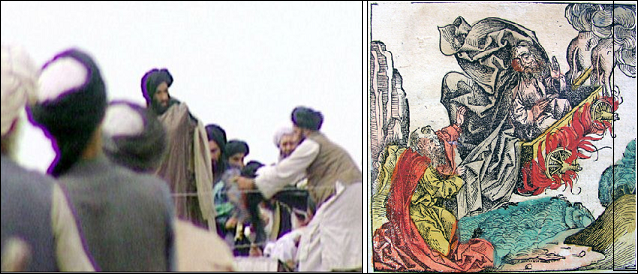
Mullah Omar in Kandahar; Elijah & Elisha from the Nuremberg Chronicle

.
I would like to give you a sense of the significance of an apparently insignificant detail, which I was reminded of today while skimming Charles Kurzman‘s The Missing Martyrs: Why There Are So Few Muslim Terrorists, page 74:

To gain legitimacy as he was taking over Afghanistan,Taliban leader Mulla Muhammad Umar literally wrapped himself in the cloak of the Prophet Muhammad, a cherished relic stored for two centuries at a shrine in Qandahar. He ordered the custodians to unlock the sanctuary, then stood on the roof of a nearby mosque and placed his hands in the cloth as a crowd of supporters chanted “Commander of the Faithful,” a title associated with the first caliphs to succeed the Prophet Muhammad.

To better grasp the significance of the situation, I will first quote from the Jewish and Buddhist scriptures to illuminate the symbolic power that can be vested — interesting word — in a cloak or robe.

**

John Daido Loori is a zen master in whose teishos or teachings I often find insight and delight. Here’s his description of the original transmission of “bowl and robe” in Buddhism, from the Buddha to his disciple Mahakashyapa:

After Buddha died, Ananda became the attendant of Mahakashyapa. One day he asked, “That time on Mount Gudhakutra, when the World-Honored One gave you the bowl and robe, and transmitted the Dharma to you, what else did he give you?” Mahakashyapa called out, “Ananda.” Ananda responded, “Yes, Master?” Mahakashyapa said, “Take down the flagpole.” At that point, Ananda finally had a realization. He realized what Mahakashyapa had realized. So it has been, down through successive generations, mind-to-mind for 2,500 years.

The Buddha’s teaching later passes from India into China, where the transmission continues. Here’s how Hui Neng, in the Platform Sutra, describes his own enlightenment and reception of the teachings:

At midnight the Fifth Patriarch called me into the hall and expounded the Diamond Sutra to me. Hearing it but once, I was immediately awakened, and that night I received the Dharma. None of the others knew anything about it. Then he transmitted to me the Dharma of Sudden Enlightenment and the robe, saying: ‘I make you the Sixth Patriarch. The robe is the proof and is to be handed down from generation to generation. My Dharma must be transmitted from mind to mind. You must make people awaken to themselves.’

**

There’s a remarkable story told in 2 Kings 2.8-15 that concerns the transmission of prophetic gifts by similar means, when the prophet Elijah is carried up into heaven:

And Elijah took his mantle, and wrapped it together, and smote the waters, and they were divided hither and thither, so that they two went over on dry ground. And it came to pass, when they were gone over, that Elijah said unto Elisha, Ask what I shall do for thee, before I be taken away from thee. And Elisha said, I pray thee, let a double portion of thy spirit be upon me. And he said, Thou hast asked a hard thing: nevertheless, if thou see me when I am taken from thee, it shall be so unto thee; but if not, it shall not be so.

And it came to pass, as they still went on, and talked, that, behold, there appeared a chariot of fire, and horses of fire, and parted them both asunder; and Elijah went up by a whirlwind into heaven. And Elisha saw it, and he cried, My father, my father, the chariot of Israel, and the horsemen thereof. And he saw him no more: and he took hold of his own clothes, and rent them in two pieces.

He took up also the mantle of Elijah that fell from him, and went back, and stood by the bank of Jordan; And he took the mantle of Elijah that fell from him, and smote the waters, and said, Where is the Lord God of Elijah? and when he also had smitten the waters, they parted hither and thither: and Elisha went over. And when the sons of the prophets which were to view at Jericho saw him, they said, The spirit of Elijah doth rest on Elisha. And they came to meet him, and bowed themselves to the ground before him.

The beauty, the power in this telling comes from the cloak’s ability to part the waters, as on an earlier occasion Moses‘ staff had done, not merely in the hands on Elijah, but also, once the transmission has been made, in the hands of Elisha. It is that double motif of the parting of the waters that demonstrates the efficacy of the prophetic transmission.

Coming fresh from the Buddha, Mahakashyapa, Hui Neng, Elijah and Elisha, we should be ready to appreciate that the mantle, cloak or robe of a sacred person is imbued with that person’s power — Matthew 14.36 describes crowds bringing the sick to Jesus:

that they might only touch the hem of his garment: and as many as touched were made perfectly whole.

**

In light of these examples, let us consider the reports of the day when Mullah Omar was proclaimed Amir of the Faithful:

There was a tremendous stir in Kandahar: we followed the crowds to a mosque in the city center. The Taliban had been holding an assembly of mullahs from all over Afghanistan. Now the results were about to be made public. Holy war was announced against the government of President Rabbani in Kabul. The head of the Taliban, Mullah Omar, was declared to be the Amir or leader of all Muslims everywhere. Because this was regarded as a key moment for the Afghan nation, Mullah Omar displayed the holy cloak of the Prophet Muhammad to the crowd. It’s kept in Kandahar and shown only in times of crisis. The last time was sixty years ago. Neither the cloak nor the ceremony has ever been filmed before, not has Mullah Omar. People in the crowd threw up their turbans to touch the cloak and be blessed by it. It was like being at some great religious ceremony in the Middle Ages.

That’s from the soundtrack of a video I sadly can’t post here, but which you can see for yourself on a BBC site under the title Mullah Omar reveals the Prophet’s cloak.

Adam Curtis, who posted the clip, describes it thus:

In the early 90s the students returned to Afghanistan and set up the Taliban – to cleanse the country of a revolution that had gone wrong, compromised by the futile idea of modernising Islam. And in April 1996 Mullah Omar went to the Shrine of the Holy Cloak. He took out the cloak for the first time in 60 years and waved it from the roof – just as Amanullah had in 1929 – and announced a jihad against the Islamist factions in Kabul.

The BBC producer Tom Giles and John Simpson were in Kandahar that day – and they captured this extraordinary moment on video.

When King Amanullah had held the cloak above his head in 1929 it symbolised the end of his dreams of creating a modern world in Afghanistan. Now – in 1996 – Omar was saying the same thing – forget the future, listen to the ghosts of your past – and follow their rules.

Let’s note in passing that Omar holds the cloak up — neither in the video clip nor in the two accounts is it suggested that he wore it — and that it had previously been held up by Amanullah Shah in 1929.

**

For the symbolic impact as reported in the West, let’s turn to Tim Weiner‘s piece, Seizing the Prophet’s Mantle: Muhammad Omar, in the NYT of December 7, 2001:

And as the country was falling to the Taliban five and a half years ago, Mullah Omar literally cloaked himself in the trappings of the Prophet Muhammad.

On April 4, 1996, as the Taliban neared total control, he was moved by zeal to unseal a shrine in Kandahar that held a cloak believed to have belonged to the prophet, the founder of Islam. The cloak had not been touched since some time in the 1930’s. He lifted it in the air as he stood on a rooftop, displaying it to a crowd of followers. The event was caught on videotape, one of the very few times that he was ever photographed. He placed the cloak, which only the Prophet was said to have worn, upon his own shoulders.

And at that moment, he declared himself the commander of the faithful, the leader of all Islam. No one had claimed that title since the Fourth Caliph, more than 1,000 years ago.

That’s impressive stuff, and “Seizing the Prophet’s Mantle” and “Omar literally cloaked himself in the trappings of the Prophet” do a decent job of capturing the marriage of literal and symbolic that’s at work here.

But “he placed the cloak … upon his own shoulders”? I’m not so sure.

**

It was a tremulous moment, evidently, even for Omar, as Norimitsu Onishi reported in the NYT a couple of weeks later on December 19, 2001, in A Tale of the Mullah and Muhammad’s Amazing Cloak:

The first time Mullah Muhammad Omar was allowed to enter the Shrine of the Cloak of the Prophet Muhammad here in Kandahar, and cast his gaze on the sacred ancient robe, he trembled. So disoriented was Mullah Omar that as he prepared to pray, he mistook the way toward Mecca.

“He turned to face toward the south,” recalled Qari Shawali, 48, the keeper of the prophet’s cloak. “So I made him change his position to turn toward Mecca.”

I suspect that here we have an indication that Omar was surprised by the event, that he was in fact acclaimed by the assembly of mullahs rather than claiming the robe and title for himself.

However, as the saying goes: Allah is the best of knowers.

**

Mujib Mashal‘s piece, The myth of Mullah Omar on al-Jazeera, 6 June 2012, gives us a few clues as to informed Afghan responses to the event, throwing in the detail that bin Laden was there at the time -– but also informing us that Omar “donned the cloak” and claiming this was the first time in 250 years that this had happened:

To formally announce his leadership in 1996, Mullah Omar, then 36 years old, brought forth the purported cloak of the Prophet Mohammed, one of Afghanistan’s most cherished Islamic relics. For the first time since the reign of Ahmad Shah Abdali more than 250 years before, Omar donned the cloak in the presence of about 1,500 religious leaders, including the late Osama bin Laden.

“Wearing the cloak was a masterstroke,” Sharifi said, adding that it linked the ex-guerrilla fighter to both Abdali and the Prophet. But Wahid Muzhda, an Afghan analyst and one-time high-ranking official in the Taliban foreign ministry, disputes that narrative. “From what I know, from sources close to Omar, and from a chat with the keeper of the shrine [where the cloak is kept], Omar did not wear the cloak.” “With great respect, he held the cloak in front of the religious leaders gathered for allegiance.”

This gesture, more than any other, was the impetus that allowed Mullah Omar, without any deep political or tribal base, to become the iron-fisted ruler of about 90 per cent of Afghanistan until the US invasion in 2001.

**

I know, you’re fatigued and I’m excited: bear with me, let’s hear the story of Ahmad Shah as told by Steve Inskeep on NPR in The Cloak of the Prophet some time in 2002:

According to the version of the legend that I heard, Ahmad Shah traveled to Bokhara — once one of the major centers of Islamic scholarship and culture, now a modern city in the former Soviet state of Uzbekistan . There he saw the sacred Cloak of the Prophet Mohammed, and decided to bring it home. He wanted Kandahar to have the artifact, so he asked to “borrow” the cloak from its keepers.

The keepers knew he might steal it, and told him he must not take the cloak from Bokhara. So Ahmad Shah pointed to a stone in the ground and made a promise. He said, “I will never take the cloak far away from this stone.”

Relieved, the keepers let him take the cloak. Ahmed Shah kept his word, in a sense. He had the stone taken up out of the ground, and had it carried back to Kandahar, along with the cloak, which he never returned. Today, the stone stands on a pedestal near the shrine.

The Cloak of the Prophet is normally hidden from public view. It is taken out only for special occasions. The last such occasion came in 1996, as the Taliban seized control of the country.

The Taliban leader, Mullah Omar, made what was considered a brilliant propaganda move. He took Mohammed’s shroud out of storage and wore it in a public rally, as a way to identify himself with the Prophet, and give himself legitimacy.

That’s an interesting tale in its own right, and reminds me of another Abrahamic treasure, the Stone of Scone, throned above which Scottish and British Kings and Queens are crowned. For your viewing delight: Stone of Destiny.

**

Fast forward to July 1928, a more recent moment when Afghanistan was in crisis.
Adam Curtis reports in The Weird World of Waziristan, 5 April 2010:

Amanullah fled to Kandahar. He knew that his attempt at modernization had failed and to save himself he tried to prove that in reality he was a traditional Islamic monarch. He did it in a final dramatic gesture.

Amanullah went to the Shrine of the Holy Cloak in the centre of Kandahar. He opened up the brass bound chest where the cloak which was reputed to have been the Prophet’s had lain for over a 100 years. Amanullah lifted it above his head and demanded of the mullahs in front of him whether Allah would allow a heretic or an apostate to perform such a sacred act.

**

And so to our most serious analytic effort on the topic, and a couple of indicators of the point I’m so often trying to make, here and in other posts on ZP. Here are Thomas H. Johnson and M. Chris Mason, writing in Terrorism, Insurgency, and Afghanistan as published by the Naval Postgraduate School, where both of them work in the Program for Culture & Conflict Studies:

Omar joined this rogues gallery of politicized insurgent Mullahs by means of a politico-religious stunt that is of enormous importance to the Taliban movement but that is considered insignificant by most Western analysts, if they are aware of it at all. In doing so, he became the epitome of the charismatic leader as described by Max Weber, who he defined as having:

… a certain quality of an individual personality, by virtue of which he is set apart from ordinary men and treated as endowed with supernatural, superhuman, or at least specifically exceptional powers or qualities. These are such as are not accessible to the ordinary person, but are regarded as of divine origin or as exemplary, and on the basis of them the individual concerned is treated as a leader.

The event in question was Omar’s removal in 1994 of a sacred garment -— believed by many Afghans to be the original cloak worn by the Prophet Mohammed -– from its sanctuary in Kandahar, and actually wearing it while standing atop a mosque in the city. Whereas Omar had been a nonentity before this piece of religious theatre, the audacious stunt catapulted him to a level of mystical power (at least among the 90 percent of Pahstuns who are illiterate) in a manner that is almost impossible for Westerners to understand, and it resulted in his being proclaimed locally the Amir-ul Momineen, the Leader of the Faithful — not just of the Afghans but of all Muslims.

I would draw your particular attention to this phrase:

a politico-religious stunt that is of enormous importance to the Taliban movement but that is considered insignificant by most Western analysts, if they are aware of it at all.

Why? Why do we continually overlook such indications of the depth of feeling that animates the Taliban? Perhaps another analogy, from closer to home, will help us here.

I’m not sure that I’d call the exposition of the Shroud of Turin a “piece of religious theatre” or an “audacious stunt” — even if Pope Benedict, famously concerned at the secularization of Europe, visited it and remarked both on the Shroud as an icon of the death and burial of Christ, and of our era’s participation in the “death of God” “after the two World Wars, the lagers and the gulags, Hiroshima and Nagasaki”:

Jesus remained in the tomb until dawn of the day after the Sabbath and the Turin Shroud presents to us an image of how his body lay in the tomb during that period which was chronologically brief (about a day and a half), but immense, infinite in its value and in its significance.

You may regard the Son of God and the Prophet of Allah as similar figures or utterly different: but to understand the emotions roused by Mullah Omar’s gesture, these correspondences drawn from other religious traditions may provide a useful place to start.

**

As for myself, I have a poet’s reverence for symbols, but I recognize that it is what they symbolize that is important — and so I’ll close as I began, with the Buddhist robe and bowl and another delighful teisho from Abbot Loori:

Ming was chasing after Hui-neng, determined to retrieve the bowl and robe of Bodhidharma from him. Finally, when he caught up to Hui-neng, the Sixth Ancestor put down the robe and bowl and said, “This robe was given to me on faith. How can it be fought for by force? I leave it for you to take it.” Ming tried to pick up the robe and bowl but couldn’t—they were as heavy as a mountain. He fell to his knees, trembling, and said, “I come for the teachings, not the robe. Please teach me, oh lay brother.” Completely open, completely receptive, completely ready, he was a man teetering on the brink of realization. Immediately, the Sixth Ancestor struck. “Think neither good nor evil,” he said. “At that very moment, what is the true self of monastic Ming?”


Luttwak on the Australian Strategic Pivot

Sunday, September 30th, 2012

Iconoclastic strategist Edward Luttwak has characteristically caustic words on an Australian -American strategic entente to contain an “autistic” rising China:

Australia counters Chinese threat 

AUSTRALIA has been quietly building a regional defence coalition to restrain China’s increasingly ”aggressive” and ”autistic” international behaviour, an influential adviser to the Pentagon says.

Edward Luttwak bluntly contradicts Australian and US denials that they see China as a threat or want to contain its rise. ”Australians view themselves as facing a strategic threat,” he writes in his coming book, The Rise of China v The Logic of Strategy.

The emerging latticework of regional defence arrangements augments ”the overall capacity of the US-Australian alliance to contain China”.

The book praises Australia’s strategic initiative in forging ties with countries such as Malaysia, Indonesia and India that lie beyond America’s natural security orbit, as well as broadening the defence networks of close US allies such as Japan.

”Each of these Australian initiatives derives from a prior and broader decision to take the initiative in building a structure of collective security piece by piece, and not just leave it all to the Americans,” it says.

….The Australian National University’s Hugh White has argued that the US needs to ”share power” with what is going to be ”the most formidable power the US has ever faced”. But for Mr Luttwak, the ”logic of strategy” dictates that neighbours will naturally coalesce against the new rising threat, thus preventing China from realising anything like the relative military power that has been projected.

”The rapid accession to prosperity has been a very common way for countries to lose their sanity,” Mr Luttwak told the Herald. He said China suffered from ancient and new foreign policy weaknesses.

”The Chinese are autistic in dealing with foreigners, they have no sense of the ‘other’,” he said. ”They think they are incredibly brilliant strategists as if they had been conquering other nations, when in fact it’s been the other way around for 1500 years.”

Ouch.

China’s political system is in the midst of a particularly edgy and uncertain generational transition of power, following the succession machinery designed by China’s last “paramount leader”, Deng Xiaoping, to retain harmony among the ruling Communist Party elite.  Deng’s successors are following his script, but their hearts no longer appear to be in it – 15 years after Deng’s death, cracks have appeared in the facade of unity. Not a fatal flaw, but lacking a leader of Deng’s stature who, even in retirement, remained the supreme arbiter of China’s political system, factions of China’s elite have more room to push conflicting agendas.

In foreign policy we see the effects in China’s erratically belligerent, then conciliatory behavior towards it’s East Asian neighbors and the United States. Strategically, it makes little sense for China to repeatedly generate friction over territorial claims to the entire South China Sea with Vietnam, Philippines, Taiwan, Brunei, Malaysia, Indonesia and the United States and push a separate dispute with Japan simultaneously, yet because of intra-elite, domestic politics, Beijing is unable or unwilling to restrain enthusiast Chinese officials from doing so.


Switch to our mobile site