zenpundit.com » 2014 » December

Archive for December, 2014

Creating a web-based format for debate and deliberation: discuss?

Friday, December 12th, 2014

[ by Charles Cameron — Talmud, hypertext, spider webs, Indra’s net, noosphere, rosaries, renga, the bead game, Xanadu, hooks-and-eyes, onward! ]
.

Let me firmly anchor this post and its comments, which will no doubt shift and turn as the wind wishes, in discussion of the possibility of improving on current affordances for online deliberation.

Let’s begin here:

**

There are a variety of precursor streams to this discussion: I have listed a few that appeal to me in the sub-head of this post and believe we will reach each and all of them in some form and forum if this discussion takes off. And I would like to offer the immediate hospitality of this Zenpundit post and comment section to make a beginning.

Greg’s tweet shows us a page of the Talmud, which is interesting to me for two reasons:

  • it presents many voices debating a central topic
  • it does so using an intricate graphical format
  • The script of a play or movie also records multiple voices in discourse, as does an orchestral score — but the format of the Talmudic score is more intricate, allowing the notation of counterpoint that extends across centuries, and provoking in turn centuries of further commentary and debate.

    What can we devise by way of a format, given the constraints of screen space and the affordances of software and interface design, that maximizes the possibility of debate with respect, on the highly charged topics of the day.

    We know from the Talmud that such an arrangement is possible in retrospect (when emotion can be recollected in tranquility): I am asking how we can come closest to it in real time. The topics are typically hotly contested, patience and tolerance may not always be in sufficient supply, and moderation by humans with powers of summary and editing should probably not be ruled out of our consdierations. But how do we create a platform that is truly polyphonic, that sustains the voices of all participants without one shouting down or crowding out another, that indeed may embody a practic of listening..?

    Carl Rogers has shown us that the ability to express one’s interlocutor’s ideas clearly enough that they acknowledge one has understood them is a significant skill in navigating conversational rapids.

    The Talmud should be an inspiration but not a constraint for us. The question is not how to build a Talmud, but how to build a format that can host civil discussion which refines itself as it grows — so that, to use a gardening metaphor, it is neither overgrown nor too harshly manicured, but manages a carefully curated profusion of insights and —

    actual interactions between the emotions and ideas in participating or observing individuals’ minds and hearts

    **

    Because polyphony is not many voices talking past one another, but together — sometimes discordant, but attempting to resolve those discords as they arrive, and with a figured bass of our common humanity underwriting the lot of them.

    And I have said it before: here JS Bach is the master. What he manages with a multitude of musical voices in counterpoint is, in my opinion, what we need in terms of verbal voices in debate.

    I am particularly hoping to hear from some of those who participated in tweeted comments arising from my previous post here titled Some thoughts for Marc Andreessen & Adam Elkus, including also Greg Loyd, Callum Flack, Belinda Barnet, Ken (chumulu) — Jon Lebkowsky if he’s around — and friends, and friends of friends.

    What say you?
    John Brennan & Jay Forrester, George Kennan & Isaac Luria

    Friday, December 12th, 2014

    [ by Charles Cameron — a little something on torture and our knowledge of causality, also man the microcosm in diplo-politics ]
    .

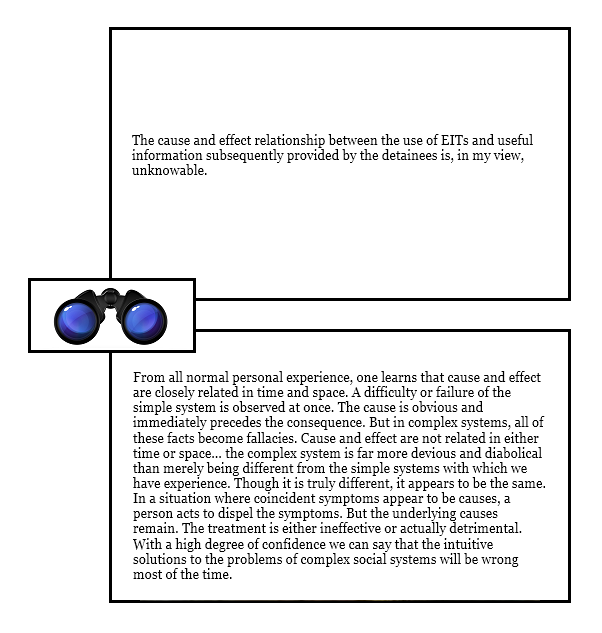
    With John Brennan talking about the “unknowable” causality between what I choose to call torture and what I am content to call the elicitation of actionable intelligence (upper panel, below) — not that I claim any originality to either of those phrasings — I was forced to remind myself of Jay Forrester‘s comments on causality (lower panel) — comments which amount to a warning against simplistic thinking and easy explanations:

    SPEC unknowables

    The human psyche is indeed “complex”, and perhaps more inscrutable than the term “complexity” itself suggests.

    **

    But that was not all: Director Brennan also entered into my own preferred realms of anthropology, psychology and theology, and spoke to the divided nature of our humanity:

    But we are not a perfect institution. We’re made up of individuals. And as human beings, we are imperfect beings.

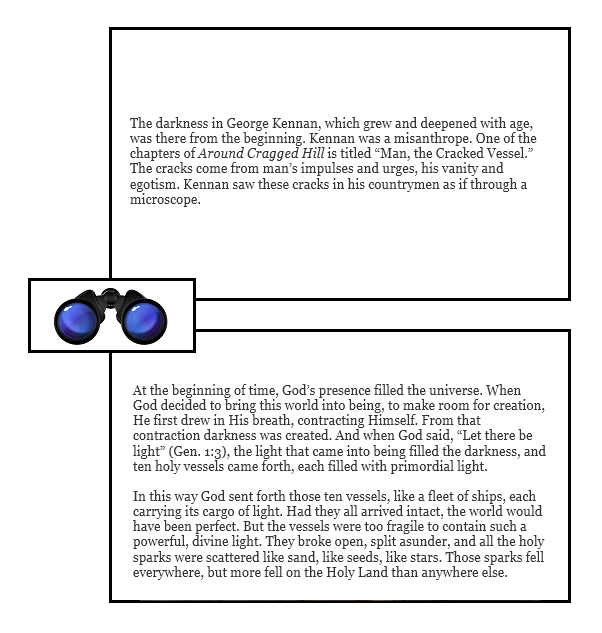
    That in turn overlapped with another DoubleQuote I was formulating at the time, this one juxtaposing a comment about George Kennan with the Ari, Rabbi Isaac Luria‘s concepts of the Shattering of the Vessels and the Repair of the World.

    Kennan’s chapter heading (as quoted by Joseph Epstein in the upper panel, below) refers to the microcosm:

    SPEC cracked vessels

    It seems only appropriate to me to note that the Ari provides us with its macrocosmic equivalent — and also, under the name Tikkun Olam (repair of the world), a sense of what is now required of us.

    Some thoughts for Marc Andreessen & Adam Elkus

    Thursday, December 11th, 2014

    [ by Charles Cameron — proposing a simple tweak for Twitter as a “difference that might make a difference” ]
    .

    Marc Andreessen gave us the first web browser, NCSA Mosaic. Without it, we’d be in an alternate universe. Much gratitude.

    **

    A few days back, Andreessen tweeted:

    Behold, two ideas, each one commonly voiced and easily taken or granted, which move in opposite directions.

    Andreessen has a nose for these things. Sometimes he uses two tweets to point up this kind of paradox, sometimes just the one. But he’s intrigued, presumably, by the fact that two such contradictory attitudes can both persist in the same cloud of discussion without drawing much attention to their discord — and that when they are isolated and juxtaposed in this way, the discord jumps out at us, and with any luck we begin to question assumptions and actually think our way to a more nuanced understanding of the topic in question.

    He’s using form to sharpen insight.

    **

    More than that, conceptual juxtaposition is the form he’s using, and that’s a form I’ve been exploring myself here on Zenpundit and elsewhere under the name DoubleQuotes for a while.

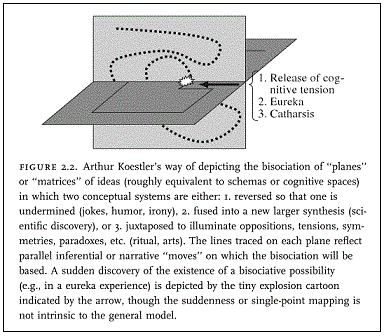
    I use conceptual juxtaposition myself for a variety of purposes, not least because it’s the seed form of creative activity — the intersection between different ideas is the “seam” where Koestler finds the origins of humor, tragedy and discovery:

    koestler-model

    **

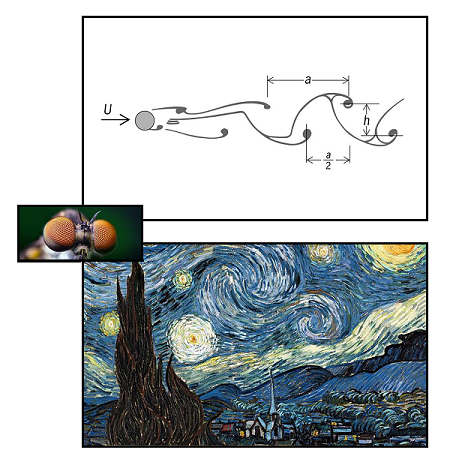
    My own DoubleQuotes format is a means of capturing those intersections, whether they be verbal, visual, aural or even numerical, as shown in these two examples:

    SPEC Baghdad 450

    and:

    SPEC Karman Gogh 450

    **

    A while back, Adam Elkus took note of what Andreessen was up to with his juxtapositions, and thought they merited comment in their own right:

    Adam also noted the similarity between our respective thought processes, and followed up by tweeting, “In fact, one wonders if @pmarca and @hipbonegamer could team up for a double quote post.” I invited @pmarca to play a round or two of DoubleQuotes with me, there was a hiatus of a couple of weeks..

    ..and then Adam retweeted an inquiry along similar lines:

    and responded:

    to which I replied, “Let me think on it.”

    **

    I have been thinking..

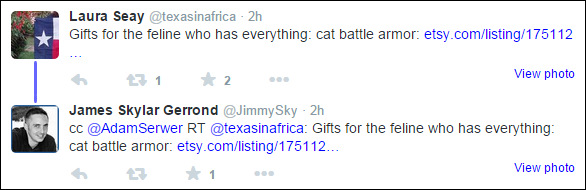
    Twitter already features a line connecting two tweets when one is a direct response to the other:

    DoubleTweet

    That’s a minimalist version of what I’d like to see — but I’d like to be able to lock two tweets, or retweets, together at the time of posting. I don’t know if this is app territory or something Twitter might want to create itself, but I ran across the two tweets that follow…

    within a few minutes of one another on my feed, but with fifteen or so intervening tweets…

    and I wanted to RT them together as a pair — not one followed by the other, with who knows how many tweets from other people in between them as they appear in my tweeps’ feeds.

    In those two n\tweets together, eccentric mechanical beauty meets eccentric natural beauty, I like both, but more than that, I like the contrast, and the underlying similarity — in this case, a similarity that is found in the eye of this beholder, and which I hope might catch the eye of like-minded others.

    **

    So: what I’d like to see is an affordance for posting two tweets or RTs as a connected whole.

    This might be for the purpose of an Andreessen paradox, or a HipBone DoubleQuote, for raising a question or pointing up an irony, for illustrating parallelisms or oppositions in the editing of a film … the possibilities are endless.

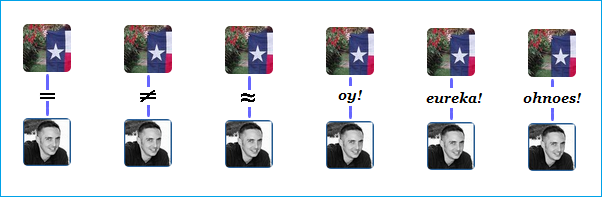
    That single minimalist line tying the two tweets together would be a starting point, but very simple graphics could be devised for signaling identity (the line features a small equals sign at its mid-point), inequality (“does not equal”), parallelism (double line), directionality or causality (an arrow), paradox (two arrows in opposite directions), question (a question mark), or recursion (an arrow chasing its tail), etc..

    Lines with ah! oy! hu! and eureka! at their midpoints would also be neat:

    double tweet links

    **

    Whether with or without these graphical niceties, the capacity to DoubleTweet would put us in play mode, insight mode, aha! mode.

    We could use more exercise in that mode of being and thinking, no?

    An English game

    Wednesday, December 10th, 2014

    [ by Charles Cameron — image and Sotheby’s cataloguing via Michael Robinson ]
    .

    Carl Jung told his friend Sir Laurens van der Post:

    One of the most striking testimonies to the quality of the English spirit is the English love of sport and games in a classical sense and their genius for inventing games.

    **

    Exempli gratia:

    Pooh Stcks

    **

    Catalog entry:

    Shepard, E.H.
    “FOR A LONG TIME THEY LOOKED AT THE RIVER BENEATH THEM…”

    Illustration for Chapter six of ‘The House at Pooh Corner,’ the episode “in which Pooh invents a new game and Eeyore joins in.” The game is ‘Poohsticks.’ Sold this morning: £314,500 (US$492,727)

    Shepard, Ernest H. (10 December 1879 – 24 March 1976)
    188 by 148mm, original ink drawing,
    signed “EHShepard” lower left.

    **

    For those who don’t know the game, here’s the relevant excerpt from The House at Pooh Corner:

    Pooh had just come to the bridge; and not looking where he was going, he tripped over something, and the fir-cone jerked out of his paw into the river. ‘Bother,’ said Pooh, as it floated slowly under the bridge, and he went back to get another fir-cone which had a rhyme to it. But then he thought that he would just look at the river instead, because it was a peaceful sort of day, so he lay down and looked at it, and it slipped slowly away beneath him, and suddenly, there was his fir-cone slipping away too.

    ‘That’s funny,’ said Pooh. ‘I dropped it on the other side,’ said Pooh, ‘and it came out on this side! I wonder if it would do it again?’ And he went back for some more fir-cones. It did. It kept on doing it. Then he dropped two in at once, and leant over the bridge to see which of them would come out first; and one of them did; but as they were both the same size, he didn’t know if it was the one which he wanted to win, or the other one. So the next time he dropped one big one and one little one, and the big one came out first, which was what he had said it would do, and the little one came out last, which was what he had said it would do, so he had won twice … and when he went home for tea, he had won thirty-six and lost twenty-eight, which meant that he was – that he had – well, you take twenty-eight from thirty-six, and that’s what he was. Instead of the other way round.

    And that was the beginning of the game called Poohsticks, which Pooh invented, and which he and his friends used to play on the edge of the Forest. But they played with sticks instead of fir-cones, because they were easier to mark.’

    No compulsion in religion

    Wednesday, December 10th, 2014

    [ by Charles Cameron — is Daesh the exception that proves the rule? ]
    .

    Qur’an 2. 256:

    Let there be no compulsion in religion: Truth stands out clear from Error


    Switch to our mobile site