zenpundit.com » 2015 » October

Archive for October, 2015

Military Reform through Education

Tuesday, October 20th, 2015

[by Mark Safranski, a.k.a. “zen“]
Photo of Don Vandergriff instructing with a map

Don Vandergriff facilitating Adaptive Soldier/Leader exercises at Fort Benning

Fred Leland at LESC Blog recently had a guest post up by Dan Grazier from the Project on Government Oversight regarding the important work Don Vandergriff is doing to reform professional military education and training:

Military Reform Through Education: From The Straus Military Reform Project, Something We In Policing Can Learn From

….I had the privilege of experiencing this process with a group of 30 soldiers and Department of Defense (DoD) civilians learning about adaptive leadership and mission command. All were teachers from various courses at Fort Benning sent by their senior leaders seeking to infuse new ideas into their organizations. They spent a week learning how to incorporate adaptability into their courses during a seminar taught by CDI military advisor Don Vandergriff and his colleagues with Yorktown Systems Group.

The Adaptive Soldier/Leader Training & Education (ASLTE) seminar aims to move the Army away from outdated assembly-line training methods that teach soldiers to mindlessly execute checklists. Instead, the seminar shows soldiers how to incorporate creative and interactive methods that challenge both students and teachers. This results in empowered soldiers at all levels able to adapt to any situation. [….]

….Don Vandergriff, a retired Army major, has been on the front lines of personnel reform for many years. While he is most noted for his work at the service level, these seminars seek to transform the Army from the bottom up.

Approximately 20 soldiers and 10 civilian educators spent the week learning various teaching methods through experiential learning, which flips the traditional method military students are used to. Most training today follows the “crawl, walk, run” theory all service members are familiar with. Students are generally expected to complete reading assignments, sit through a PowerPoint lecture, and then finally conduct field training to reinforce what they have learned.

The seminar exposed students to new methods by putting the practical exercises first. For example, the seminar uses several Tactical Decision Games (TDGs) to encourage students to rapidly develop a plan for a military problem presented by the facilitators. TDGs can be created for nearly any kind of a situation, but this course mostly used actual battlefield problems like how to capture a bridge or defeat an enemy force entrenched on a hilltop. While working through these problems, the students are exposed to such concepts as Mission Command and the Observe, Orient, Decide, and Act decision cycle, commonly called the OODA Loop or Boyd Cycle.
It is only after the practical exercises that they receive reading assignments about those concepts. Because they’ve encountered them during the exercises, the concepts become more tangible. The OODA Loop, for instance, explains an individual’s or an organization’s decision-making process. It is a difficult concept to truly understand, but it becomes easier when one first sees how it works and then reads about it. The idea is to give them a moment of discovery, that “Ah ha!” moment. Success using such methods is to have a student say, “So, that’s what you call that,” while reading.

Don is making use of several powerful learning methodologies in his Adaptive Leadership philosophy – and I saying “learning” and not “teaching” because Don has properly put the emphasis on the student actively thinking and doing rather than on passively listening to a lecture or discussion. Lecture has a place in education, to explain or to set the student up for new learning experiences, but it should be used sparingly and in short bursts of time when the instructor has carefully set up a “teachable moment”. By having the students doing active problem solving first, they come to Vandergriff armed with their own questions, eager to have feedback.

The use of games are also a very powerful learning tool, perhaps one of the most effective because the situational learning. tends to be transferrable rather than be compartmentalized and isolated information. The right kind of decision games are serious practice for life. This was noted by RAND social scientists way back during the early days of the Cold War:

“The gamers argued that insights arose from immersion in play. In 1956 Joseph Goldstein noted that the war game demonstrated ‘ the organic nature of complex relationships’ that daily transactions obscured.War-gaming gripped its participants, whipping up the convulsions of diplomacy ‘ more forcefully…than could be experienced through lectures or books’.”

” A team from the Social Science Division [ at RAND ] posed a number of questions which they hoped the unfoldig month of gaming would resolve. Chief among them was whether gaming could be used as a forecasting technique ‘ for sharpening our estimates of the probable consequences of policies pursued by various governments’. Would gaming spark “political inventiveness“, and more importantly, how did it compare to conventional policy analysis? Did gaming uncover problems that might otherwise be neglected? And invoking the emerging touchstone of intuition, did the experience impart to policy analysts and researchers “ a heightened sensitivity to problems of political strategy and policy consequences?”

  Sharon Ghamari- Tabrizi, The Worlds of Herman Kahn

Back to the article:

….Vandergriff’s teaching method incorporates recent research into adult learning, designed “to engage students in direct experiences which are tied to real world problems and situations in which the instructor facilitates rather than directs student progress.” This creates a situation where the students learn from one another. Unlike most other military classes, the ASLTE teachers use very few PowerPoint presentations. They also end up speaking far less than the students themselves.

Vandergriff ran the class through the first TDG and led the discussion afterward. From that point forward, students took turns leading the class through After Action Reviews. Students gained confidence in leading such an exercise while the rest of the class bounced ideas off each other. The interactive nature of this kept the entire class engaged and gave all of them ownership of their own learning.

The concept of ownership was a consistent theme throughout the seminar. According to Vandergriff, a good teacher “works to make his students better than himself and encourages them to take ownership of their development, to make them life-long learners.”

Here Don is making use of the social pressure and reinforcement of a Peer to Peer (P2P) dynamic to maintain maximum student engagement while having them practice critical intellectual reflection, something that is a vital constituent of a professional culture of learning. A true professional embraces an honest discussion of ideas and both accepts and gives critical feedback on performance in hopes of learning and improving.

Read more regarding Don Vandergriff’s adaptive leadership methods here and here.

Two flags identified, Russians protest Putin’s involvement in Syria

Monday, October 19th, 2015

[ by Charles Cameron — curious to see Solidarnost and Gadsden flags together ]
.

I’m always interested in the graphics and symbolism of various groups, so when I saw this image headed Scores of Russians protest against Putin’s involvement in Syria on the Turkish Daily Sabah news site a couple of days ago —

thumbs_b_c_c83e821e5be87078a17a66c541085fbd

my eye was caught by the Gadsden Flag, which I’m familiar with from the Tea Party and indeed ChicagoBoyz

gadsden

I began checking with my friends to see whether anyone recognized the orange and blue flag, which a couple of friends read as saying Solidarnos.., which in turn led me to this:

ODD_Solidarnost

with Solidarnost being “a Russian liberal democratic political movement founded on 13 December 2008 by a number of well-known members of the liberal democratic opposition, including Garry Kasparov, Boris Nemtsov and others..”

**

I am curious — does it make sense for these two flags to fly together? And can anyone source the blue flag with the white “V” insignia? I have the sense I’ve seen it around..

Hat tips: Tom, Mark and Gabor.

Mass shooting: an abstraction and an icon

Sunday, October 18th, 2015

[ by Charles Cameron — the Aurora cinema shooting — a forensic view, and one through Mantegna’s eyes ]
.

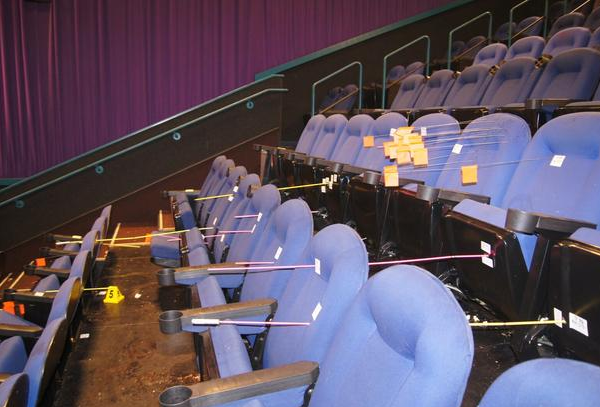
Two ways to be chilled once again by the 2012 slaughter in the Century 16 movie theater in Aurora, Colorado.

The forensic view comes courtesy of the Colorado DA‘s office:

aurora century 16 movie theater

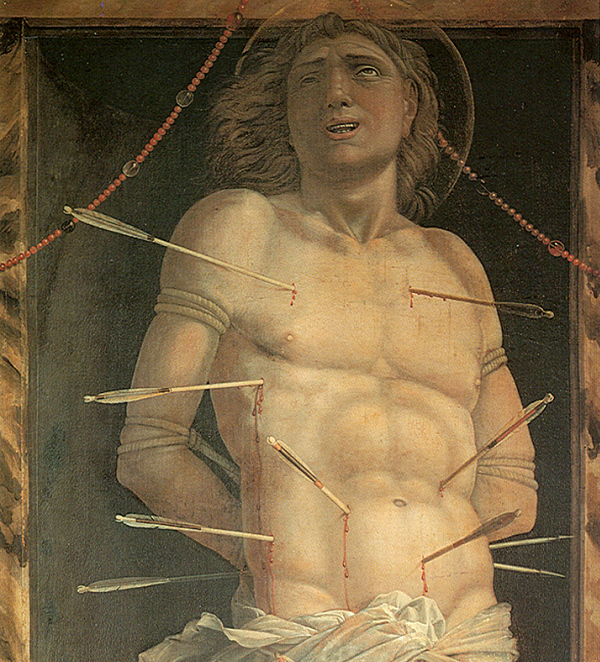
Mantegna‘s image of St Sebastianone of three he painted — affords us a reminder of human suffering.

St_Sebastian_3_Mantegna

The film that was showing at the Aurora Century 16 that midnight was The Dark Knight Rises.

Sunday surprise: kundalini’s rising and the jukebox blows a fuse

Sunday, October 18th, 2015

[ by Charles Cameron — some examples of deep dreams, mechanical and spiritual ]
.

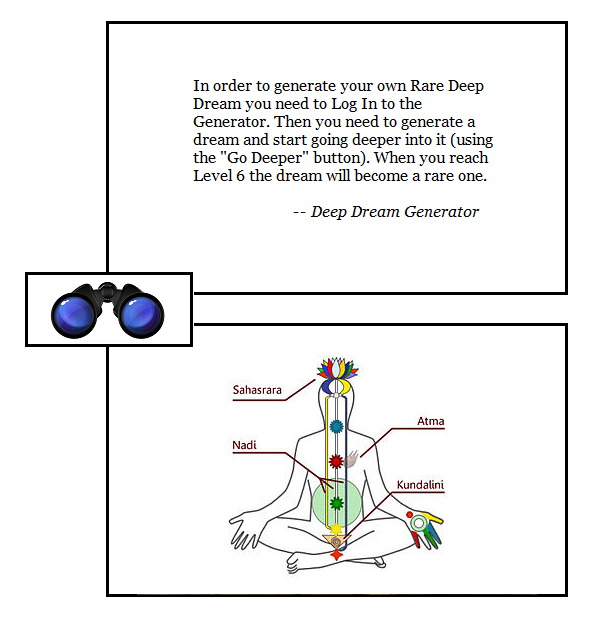
In the upper panel, a claim made for the Deep Dream Generator:

SPEC kundalini deep dream

In the lower panel, an image of the chakras or lotuses in the subtle body, through which the kundalini serpent rises from deep sleep to full spiritual awakening.

The “sixth level” in the chakra system would be the Ajna chakra:

The Ajna chakra is positioned in the brain, directly behind the eyebrow center. Its activation site is at the eyebrow region, in the position of the ‘third eye.’

**

Deep Dreams:

Here’s what Google’s Deep Dream Generator comes up with:

Deep Dream

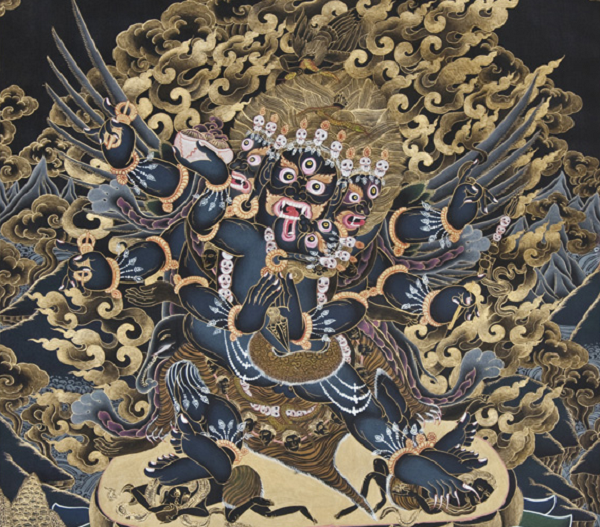
Here’s an early statue of Arya Lokeshvara from the Potala Palace, dating to the 7th century and described as the Potala’s most sacred statue:

Bhairava thangka 600

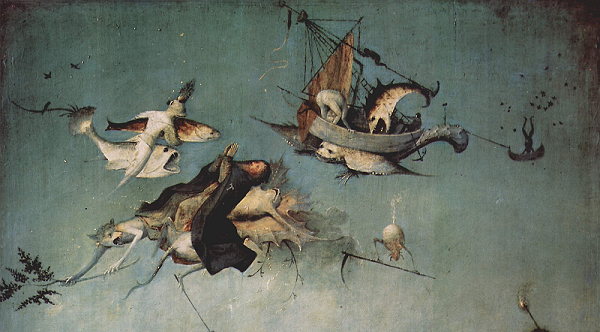
This is a detail from Hieronymus Bosch, The Temptation of St Anthony:

detail, the-temptation-of-st-anthony-1516-1 bosch 600

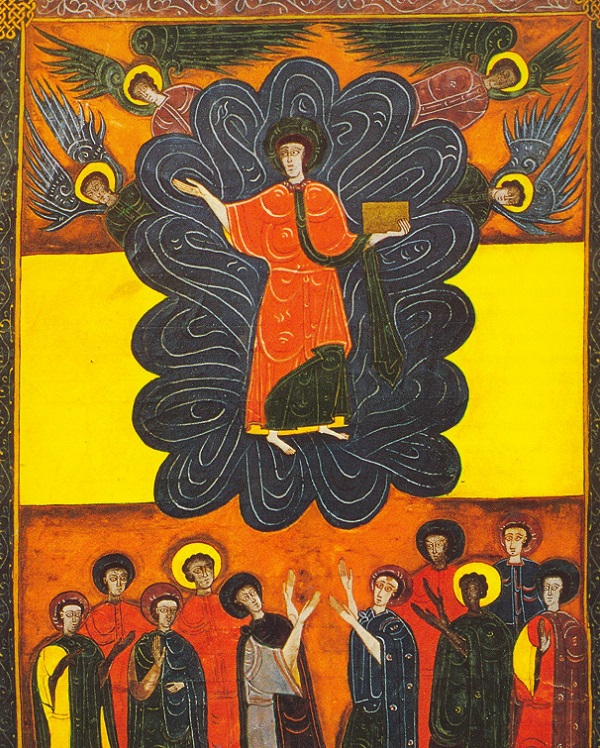
From one of the marvellous array of manuscripts of the Beatus commentary on Revelation:

Beatus 600

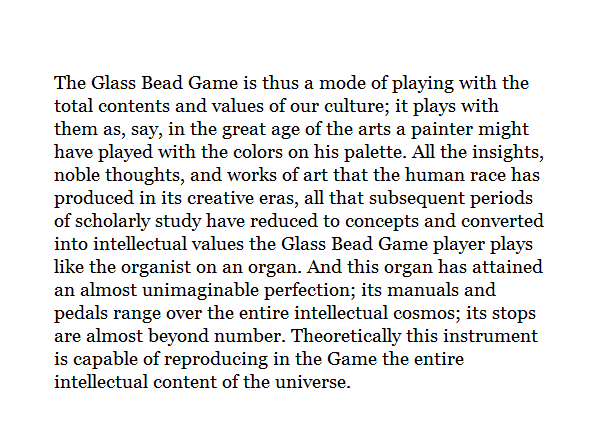
Here’s a deep dream in words, from Hermann Hesse..

GBG as organ 600

Another, from Shakespeare:

shakespeare 600

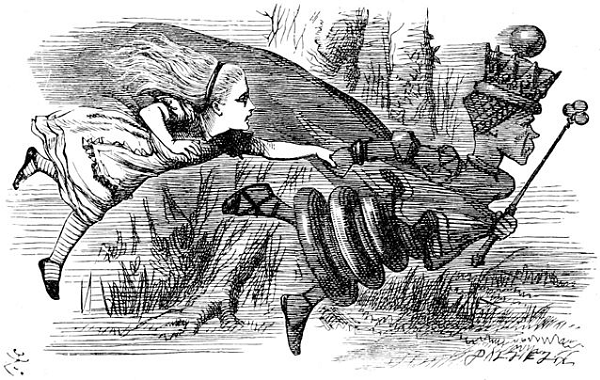
A secular deep dream..

Alice red queen 600

and a deep dream — as surreal as all the rest, yet capturing “no more than” simple reality — in a photo posted today by Bill Benzon:

Benzon coke 600

**

Roll over, Beethoven:

How is history made — songs, dreams, and sermons included?

Saturday, October 17th, 2015

[ by Charles Cameron — the moral arc of history from Billie Holliday via MLK to Obama — and beyond, who knows? ]
.

Our topic here is foresight — prediction, prophecy, prognosis, projection.

**

The Legatum Institute today tweeted a Pew Research projection of Muslim and Christian growth 2010-2050.

Pew Christian Muslim to 2050

It is now 2015, so for practical purposes, we’re thinking here about prophecies and predictions that offer what their authors hope will come close to 35-year foresight.

Short form: I don’t get it.

Obama, like him or not, Christ or Antichrist, Peace-Nobelist or Pol, is now US President and has — whatever his strengths, failings, or both — some influence on how the earth turns, which way the moral arc of the universe bends, and or what history will be seen and written once the future is present.

Short form: How does history happen?

I’ll raise that question by posting three videos along one such arc of history — and I’ll avoid the usual genre of “news” and work with song, dream and sermon.

**

Describing the impact of Billie Holliday’s song, Strange Fruit, David Margolick wrote in his “biography of a song“:

An “historic document,” the famed songwriter E.Y. “Yip” Harburg called “Strange Fruit.” The late jazz writer Leonard Feather once called “Strange Fruit” “the first significant protest in words and music, the first unmuted cry against racism.” To Bobby Short, the song was “very, very pivotal,” a way of moving the tragedy of lynching out of the black press and into the white consciousness. “When you think of the South and Jim Crow, you naturally think of the song, not of `We Shall Overcome,’” said Studs Terkel. Ahmet Ertegun, the legendary record producer, called “Strange Fruit,” which Holiday first sang sixteen years before Rosa Parks refused to yield her seat on a Montgomery, Alabama bus, “a declaration of war … the beginning of the civil rights movement.”

As Shelley reported, “Poets are the unacknowledged legislators of the world.”

**

Preaching borders on prophecy when it addresses dreams, as in Martin Luther King’s great 1963 oration, spoken decades after Abel Meeropol published Strange Fruit as a poem in 1937 and Billie Holliday recorded it in 1939:

It’s surely notable that a singer had a part in that speech, too. As Wikipedia reports, citing DD Hansen‘s The Dream: Martin Luther King, Jr., and the Speech that Inspired a Nation:

The focus on “I have a dream” comes through the speech’s delivery. Toward the end of its delivery, noted African American gospel singer Mahalia Jackson shouted to King from the crowd, “Tell them about the dream, Martin.” King stopped delivering his prepared speech, and started “preaching”, punctuating his points with “I have a dream.”

**

The President of the United States is an acknowledged legislator, constrained by checks and balances that preachers and poets do not face, yet his voice too has been raised from rhetoric to song:

Here are the Here are the “three rhetorical aspects” of Obama’s speech that James Fallows singled out for special praise:

  • The choice of grace as the unifying theme, which by the standards of political speeches qualifies as a stroke of genius.
  • The shifting registers in which Obama spoke—by which I mean “black” versus “white” modes of speech — and the accompanying deliberate shifts in shadings of the word we.
  • The start-to-end framing of his remarks as religious, and explicitly Christian, and often African American Christian, which allowed him to present political points in an unexpected way.
  • Amazing Grace now takes the place of Strange Fruit, and a President that of a poet and a singer — much has changed, yet much remains.

    **

    My own Prior Art on prognostication:

    Recently, in Simply so much.. 02 here on Zenpundit, I pondered the nature of foresight in terms of a Marine Corps forecast:

    I’m thinking of Lise Meitner as I view the Marine Corps’ ambitiously titled Security Environment Forecast 2030-2045. Who would have thought in 1919 that Hahn, Meitner and Strassmann in 1935 would begin a program that resulted in 1939 in her 1939 paper Disintegration of Uranium by Neutrons: A New Type of Nuclear Reaction — which in turn led to Moe Berg‘s attending a lecture by Heisenberg, the Trinity test at Alamagordo, and Hiroshima and Nagasaki?

    And yet the period from 1919 (Treaty of Versailles) to 1939 (fission theorized) is only 20 years, and from 1919 to 1945 (nuclear warfare) is 26 years — equivalents, respectively, to the periods from 2015 (today) to 2035 (a third of the way into the USMC’s period of prediction) and 2041 (still within the UMSC timeline).

    That’s my attempt at a sober assessment of how difficult it is to “see ahead”.

    **

    My Art of Future Warfare story, War in Heaven, is set — as the contest rules required — in 2090.

    By twenty-ninety, in my fanciful hypothesis, we may well have learned how to choose which timeline we want to live along in a “manyworld” of constantly branching possibilities – “words are many, worlds are many more, if possible” I wrote, and supplied portals to worlds secular, magical, religious and fictitious:

    Forty some years from now, in the wake of John Hardy Elk’s vision and its definitive corroboration “in the external” by physicists at the CERN Diffraction Lab, Shamanism is overturning “the Enlightenment” as the preferred intellectual basis for inquiry. With its gestalt understanding of the interconnectedness not only of space and time but of chance and will, context and perspective, self and other, the Shamanic method of burrowing into deep external space “in the internal” has proven more powerful, faster, and – yes — way more creative than what are now known as the old “heavy lifting” methods of transport.

    With schools of Tibetan, Navaho, Benedictine and other forms of contemplative instruction now rapidly surpassing CalTech as the educational venues of choice, and Oxford morphing back towards its earlier life in which theology was Queen of the Sciences, a great many talented explorers have now visited realms considered impossibly “far away” even a decade earlier, the “digital” has fallen away at a time when communication between the like-minded is achieved telepathically, and “radiance bombs” vie with “dark bombs” in the end-of-century duels scattered across many galaxies in which “white” and “black” magics compete — under the law, some would say theory, of the Conservation of Moral Balance.

    Who knows? Who can really say?

    **

    And then there was the ChicagoBoyz Afghanistan 2050 RoundTable. Introducing the RoundTable, Lexington Green noted:

    40 years is the period from Fort Sumter to the Death of Victoria, from the Death of Victoria to Pearl Harbor, from Pearl Harbor to the inauguration of Ronald Reagan. It is a big chunk of history. It is enough time to gain perspective.

    The event, then, was pitched five years past the Marines’ forecast, though still forty years short of my War in Heaven. And once again, though more explicitly this time, I relied on the branching worlds idea.. Here, though, I attempted –- not unlike a circus performer astride two horses -– to bring together the physical and moral universes:

    Historians — on the world-line this is written from, and consequently in those cognate worldlines in which you are reading me — tend to date the by now (2050) clear shift in priorities (if not in actualization) currently emerging along these world-lines to the 2020 joint publication in Nature and Physical Review G of Dogen’s confirmation of the Everett-Klee Transformation Hypothesis, which stated (in its minimal formulation) that free choice is the mechanism by which a human individual switches tracks in a given “present moment” from a “past” world-line to a particular “future” world-line, branching “in that moment” from the first.

    We don’t, I posited, move across parallel “shadow” worlds by diving into portrait size Tarot cards, walking a kundalini-enhancing maze, or substituting the sky, landscape and other furniture of one world-line into that of another, though the great Roger Zelazny in his Amber series posits these as methods for planet-hopping.

    My suggestion: we chose which routes we take when faced with the constant bifurcations of the manyworlds by the moral choices we make.

    **

    And in all this I attempt, however playfully, to glimpse how the past and present might prefigure our possible and impossible futures — and how one or more of those futures may pass through the sieve of the onward-pressing present to become history


    Switch to our mobile site