zenpundit.com » 2016

Archive for 2016

WaPo just can’t bear their faces?

Sunday, October 9th, 2016

[ by Charles Cameron — the words “substitute teachers” come to mind ]
.

There’s nothing like quoting the recent past to illustrate the near future, eh?

presidential-vice-presidents-wapo-savedhttps://twitter.com/postpolitics/status/785172785417125889

I guess these guys seem more presidential?

**

Edited to add: Okay, revised version, 20 minutes later:

https://twitter.com/washingtonpost/status/785177688839520257

On the felicities of graph-based game-board design: nine

Sunday, October 9th, 2016

[ by Charles Cameron — if the territory is graphical, so’s the map ]
.

Terrain, with its named places and transportation links between them, is graphical, as illustrated in this map:

It makes me wonder how often graph theory (of the sort that gives us the Königsberg Bridge Problem, see the first post in this series) is applied to troop movements — as it often is to public transportation (see the upcoming tenth post).

**

My next example of the use of a node-and-edge graphical design both puzzles and intrigues me:

It puzzles me, because I can’t quitec grasp what Raza Rumi — a very bright fellow — is up to in choosing this particular illustration. And it intrigues me, because once on a vision quest I glimpsed an outstretched eagle’s or hawk’s wing, with a similar graphical overlay of its structural essence. It’s a sight I’ve never forgotten, an exquisite linking of the real and abstract worlds, and one that I’m sadly ill-equipped to reproduce visually myself. Words don’t do it justice.

**

My third example, as you can see, is taken from a learned paper describing the use of graphs to illustrate musical compositions according to a strictly defined protocol:

What interests me here — aside from the fact that any of these digrams could be used as a board in a sufficiently complex HipBone or Sembl game — is that I ran across this particular paper within 24 hours of reading m’friend Bill Benzon‘s account of his friend Michael Bérubé and his son Jamie, introduced in this tweet:

Bill’s post Jamie’s Investigations, Part 1: Emergence to which his tweet refers us — is illustrated thus:

benzon-jamie-berube-01

Michael Bérubé, we read, has recently published a book about Jamie, who has Down’s, Life as Jamie Knows It: An Exceptional Child Grows Up, and it contains a series of Jamie’s drawings, of which this is one example.

Bill, who is himself the author of Beethoven’s Anvil: Music in Mind and Culture, notes “Jamie loves music, and his dad is a rock-and-roll drummer, so’s his older brother Nick, I believe.” And here’s the clincher — he then asks:

In what way are these drawings like drum beats?

So that’s two examples of novel visual representations of musical pattern in just two days, earlier this week.

**

Enough for now — onwards to On the felicities of graph-based game-board design: ten — a long, fascinating post IMO, long enough that I’m glad this is a Sunday.

Earlier in this series:

  • On the felicities of graph-based game-board design: preliminaries
  • On the felicities of graph-based game-board design: two dazzlers
  • On the felicities of graph-based game-board design: three
  • On the felicities of graph-based game-board design: four
  • On the felicities of graph-based game-board design: five
  • On the felicities of graph-based game-board design: six
  • On the felicities of graph-based game-board design: seven
  • On the felicities of graph-based game-board design: eight
  • Cartels & ISIS, Mexico & France

    Friday, October 7th, 2016

    [ by Charles Cameron — terror and anti-clericalism — a double parallel? ]
    .

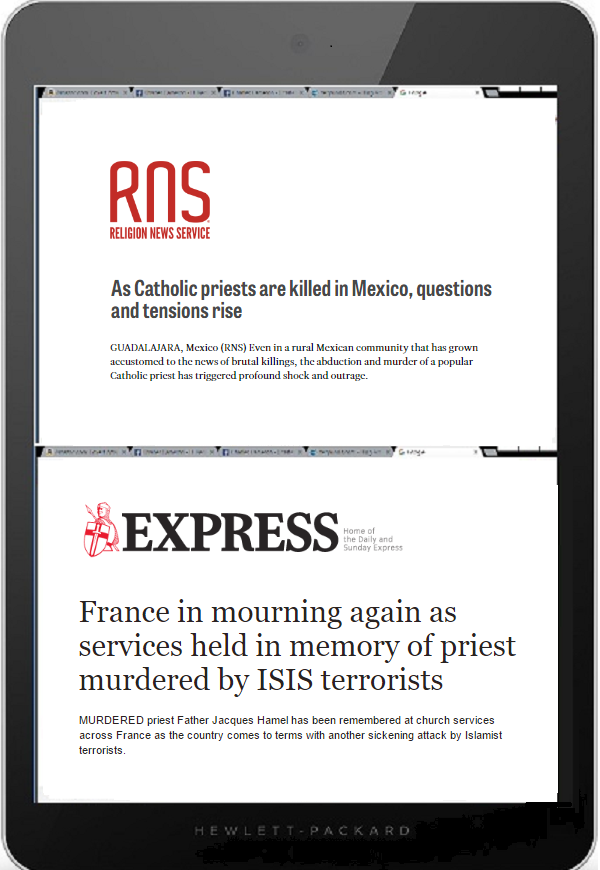
    Imagine how Catholic Mexico feels at the murder of Fr. Jose Lopez Guillen, a priest, if even secular France is shocked by the killing of another priest, Fr Jacques Hamel.

    tablet-dq-600-mexico-france-priests-killed

    **

    From the RNS report:

    Lopez was kidnapped on Sept. 19, the same day authorities discovered the bodies of two slain priests in the eastern state of Veracruz; that makes at least 15 priests slain over the past four years. [ .. ]

    Mexico is the country with the second-largest Catholic population in the world, with nearly 100 million people, or more than 80 percent of the population, identifying as Catholic. But the country has a long history of anti-clericalism and in the past century the government officially and often violently suppressed the church. [ .. ]

    Motives have not been established for the latest killings, but the Catholic Multimedia Center notes that violence against the clergy occurs disproportionately in states with high levels of organized crime, such as Veracruz and Michoacan.

    The organization records 31 killings of priests in Mexico since 2006, the year then-President Felipe Calderon deployed troops to Michoacan in an effort to stamp out the drug cartels.

    A decade on, the war across Mexico has claimed more than 150,000 lives, while Michoacan remains a hotbed of crime and civil unrest.

    Note that France, like Mexico, has a history of anti-clericalism — dating back in the French case to the time of the French Revolution — see my LapidoMedia post, When laïcité destroys egalité and fraternité

    October 8: ignore this till afterwards — or afterlife

    Friday, October 7th, 2016

    [ Charles Cameron — glance, okay, because it’s strange, and about tomorrow — no need to play the videos ]
    .

    Nostradamus:

    Brother Nathanael:


    Sheikh Imran Hosein:

    Illuminati:


    And:

    **

    Just dipping my toe in the strange waters of Matthew 24:36:

    But of that day and hour knoweth no man, no, not the angels of heaven, but my Father only.

    and Qur’an 33:63:

    People ask you concerning the Hour. Say, “Knowledge of it is only with Allah. And what may make you perceive? Perhaps the Hour is near.”

    So:

  • Socrates, The unexamined life is not worth the living…
  • Christ, That they might have life, and that they might have it more abundantly..
  • Anais Nin, The personal life deeply lived always expands into truths beyond itself..
  • Bob Dylan: It’s life and life only..
  • Three self-references already, and its only 8am

    Tuesday, October 4th, 2016

    [ by Charles Cameron — with an eye for form, paradox, self-reference ]
    .

    I’ve found three self-references already today, and its only 8am.

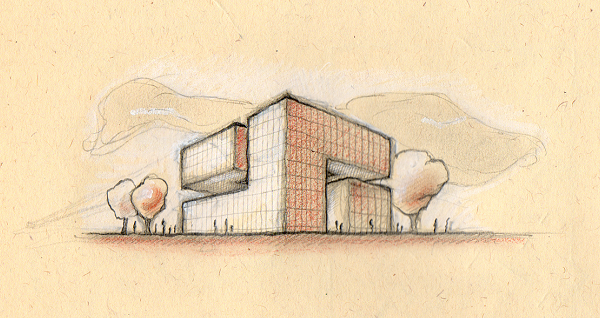
    Unless of course you count architect Matteo Pericoli‘s building design to illustrate the structure of Friedrich Dürrenmatt’s mystery novel The Judge and His Hangman:
    perspective

    — in which case, I’ve found four. Pericoli comments:

    As in the novel — with its surprise ending that flips everything upside down, transforming the structure we had taken for granted into a profound moral and existential dilemma — in the building, what seemed to obscure now illuminates, what once concealed now is hidden, what seemed to give support is now nothing but a weight to bear and understand.

    Now tell me, is that self-referential and ouroboric, or merely boustrophedonic or enantiodromic?

    For Greek fun, wait till the end of this post*.

    **

    On firmer self-referential ground, my first self-referential account has to do with a Nobel Prize, just awarded. Gina Kolata and Seawell Chan in the New York Times explain:

    Yoshinori Ohsumi, a Japanese cell biologist, was awarded the Nobel Prize in Physiology or Medicine on Monday for his discoveries on how cells recycle their content, a process known as autophagy, a Greek term for “self-eating.” It is a crucial process.

    Self-eating: even the ouroboros can’t say it plainer than that.

    **

    The second comes from an article on artist Jennifer Trask titled Death and Decay Lurks Within These Stunning Works of Art in the Smithsonian magazine. The description of Jennifer and her work begins:

    Those who encounter a piece by Jennifer Trask are likely first struck by its elegance: a baroque gold-coated necklace or an intricate floral broach. But a closer look reveals much more happening below the gilt surface: antlers woven into the necklace; snake vertebrae used as the “petals” of the broach’s flower, giraffe femurs…

    Death, here, as in earlier artistic tradition, is a reminder of the fickleness of life. The article gives us the self-referential paradox as it explains:

    Trask draws on the tradition of vanitas — moralistic paintings that were popular in 16th- and 17th-century Netherlands. She says her interest is now focused on the “symbolism and the ironic nature” of the paintings, and “how the vanitas itself ultimately became another of the luxurious objects they were meant to warn against.”

    **

    And the third might even count as two recursions — one analogous to the other.

    You may have read the New Yorker‘s profile, Sam Altman’s Manifest Destiny: Is the head of Y Combinator fixing the world, or trying to take over Silicon Valley?, and you may just be cooler than I, and either way you may already know that the Y Combinator is the startup starter-upper par excellence.

    Here’s the self-ref, from their FAQ:

    Why did you choose the name “Y Combinator?”

    The Y combinator is one of the coolest ideas in computer science. It’s also a metaphor for what we do. It’s a program that runs programs; we’re a company that helps start companies.

    A hat-tip here to Steven H. Cullinane, whose Log 24 blog today pointed me to this particular quote.

    **

    *It’s all Greek to me:

  • ouroboros, a snake or dragon devouring its tail, standing for infinity or wholeness
  • boustrophedon, written from right to left then left to right, as in ploughing with oxen
  • enantiodromia, tendency of things to change into their opposites, as a natural principle
  • **

    Well, it’s past 9am now, but I haven’t been scouting around for further examples since I began this post.

    Switch to our mobile site

