zenpundit.com » insight

Archive for the ‘insight’ Category

Will Dr Fadl retract his Retractions?

Monday, February 14th, 2011

[ by Charles Cameron ]

Sayyid Imam al-Sharif, popularly known as Dr Fadl, wrote two of the key works of jihadist ideology, The Essential Guide for Preparation and the thousand-page Compendium of the Pursuit of Divine Knowledge, in the late 1980s — thereby providing his friend from student days, Ayman al-Zawahiri, with powerful scholarly backing for the doctrines of militant jihad and takfirism. Lawrence Wright refers to Fadl as an “Al-Qaeda mastermind” in a detailed 2008 New Yorker analysis.

Dr Fadl was imprisoned without trial in the Yemen shortly after 9/11, but it was after he had been transferred to an Egyptian prison in 2004 that he wrote Rationalizing Jihad, the first volume of his “retractions” — a work so powerful in its attack on his own earlier jihadist doctrine that al-Zawahiri felt obliged to respond with a two-hundred page letter of rebuttal. A second volume from Dr. Fadl followed more recently.

Here’s the point: as far as we (the “open source reading” public) know, Dr Fadl remains in Tora Istikbal prison in Egypt, and thus far it has been possible for Al-Qaida and others to argue that his “retractions” were the result of coercion.

*

In recent days, however, Egypt has been in considerable flux.

There were reports before the fall of Mubarak of prisoners being liberated or escaping from prison — either as part of the revolution, or alternatively to supply Mubarak with groups of paid thugs who could attack the demonstrators. More recently, the freeing of political prisoners has been one of the demands the demonstrators have made of the military, and it is here that Robert Fisk’s report in The Independent today fits in:

As for the freeing of political prisoners, the military has remained suspiciously silent. Is this because there are prisoners who know too much about the army’s involvement in the previous regime? Or because escaped and newly liberated prisoners are returning to Cairo and Alexandria from desert camps with terrible stories of torture and executions by – so they say – military personnel. An Egyptian army officer known to ‘The Independent’ insisted yesterday that the desert prisons were run by military intelligence units who worked for the interior ministry – not for the ministry of defence.

*

Every major act on the world stage has consequences that ripple out in unexpected directions.

If Dr Fadl regains his liberty, the question arises whether he will claim his critiques of jihadist dictrine were obtained by force, and effectively retract his retractions – or whether he will stand by them, as I somehow expect he might — still declaring, this time as a free man, that “There is nothing that invokes the anger of God and His wrath like the unwarranted spilling of blood and wrecking of property,” and “There is nothing in the Sharia about killing Jews and the Nazarenes, referred to by some as the Crusaders. They are the neighbors of the Muslims … and being kind to one’s neighbors is a religious duty.”

*

I haven’t seen any discussion of this question in the western press, and it was only a tweeted nudge from Leah Farrall on January 31 that set me thinking about Dr Fadl, and the questions that his possible release from prison might raise.

Is he free? Will he be freed? If he is, what will he say?

Whichever tack he takes, his statements will have impact.

And as Leah points out, there are parallels between Dr Fadl’s critique of al-Qaeda and that of Abu Walid al-Masri — which just gives me further reason to be interested in what we might hear next from either one.

Egypt: Jan 25 and the internet

Sunday, February 6th, 2011

[ by Charles Cameron — cross-posted from Brainstormers on the Web ]

There are so many possible lessons to take here:

That a single image speaks louder than dozens of words. That we are more easily persuaded by images than by words. That FB and Twitter are clearly important to Egyptian youth. That dozens of words can convey nuances that a single image misses. That FB and Twitter were at best among the vehicles, rather than the drivers, of the events of January 25th.

That we’d do well to bear the Aristotelian distinction between material, formal, efficient and final causes in mind when talking about what “caused” or “becaused” those events – and elsewhere.

That the simple juxtaposition of two closely similar ideas can illuminate both, and perhaps create a spectral “third thing” which possesses the full detail of both with greater depth than either one in a single understanding, by a sort of stereo process not too different from stereoscopic vision or stereophonic sound.

That we live in exciting times…

DQ Egypt: impact on Israel

Wednesday, February 2nd, 2011

[ by Charles Cameron [hoping Zen’s ISP will be back up shortly] — cross-posted from ChicagoBoyz ]

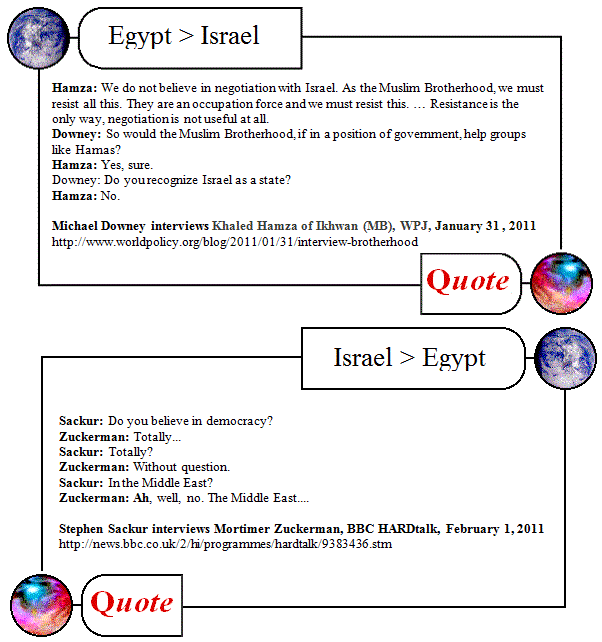
Someone posted an excerpt from an interview with Khaled Hamza, the webmaster of the Muslim Brotherhood, as a comment on an earlier post of mine on ChicagoBoyz, where I also blog, and I was interested enough to track the original interview down, and have presented the key points of the excerpt here in Quote #1.

I am pairing it, in Quote #2, with an excerpt from an interview the BBC recently conducted with Mortimer Zuckerman – because I find the two quotes taken together suggest something of the complexity of the breaking situation in the Middle East.

*

I’d like to float a trial balloon / try a though experiment, if I might. And since I’m more “tail” than “left” or “right wing”, I’ll be posting this in more than one place, and hope to get comments from all sides…

On the face of it, Zuckeman is applying what’s arguably a racist double-standard. He advocates democracy, “totally” and “without question” – but not for the Egyptians, or at least not today or tomorrow.

On the face of it, the Egyptian public seems distinctly unenthused by Mubarak’s regime and will, in a democratic election, presumably vote in a fair number of Muslim Brotherhood representatives – though it’s by no means clear that they would be in the majority, and their present ideology in any case is closer to the processes of electoral politics than those of violent jihad.

So there is reason for Israel to be concerned, and reason for those who support democracy to see some hope for democracy, in the ongoing events in Egypt.

Let me put it this way: Quote #1 illustrates why Zuckerman might make the remarks quoted in Quote #2, while Quote #2 illuminates why Hamza might make the remarks quoted in Quote #1.

*

And here’s the thought experiment — I’d like to come at this from a Maslovian angle.

Maslow’s Hierarchy of Needs

I’d like to suggest that “democracy” is an ideal, or to get away from that word with its somewhat ambiguous political connotations, an activity of the “the better angels of our nature” – and thus, from a Maslovian perspective, an aspect of a group or nation’s “self-actualization” level of interest, whereas “stability” would fall under “safety” or even “physiological”.

If that’s right, Zuckerman is at least arguably articulating a “stability first, eventual democracy would be ideal” position.

Does that “Maslovian” formulation throw any additional light on the situation?

*

The problem with the position I just described is nicely articulated by Mohammad Fadel at the very end of a Foreign Policy post, Can Black Swans lead to a sustainable Arab-Israeli peace? — and it’s only his conclusion I’m quoting here:

Tunisia and Egypt have demonstrated categorically that any peace which relies on the stability of police states is doomed from the outset.

If a butterfly flapping its wings in Brazil can in theory cause a tornado in Texas – heaven alone knows what someone blinking in Cairo or Jerusalem or Washington can do.

Myself, I pray for empathy, which seems a reasonable request, I hope for wisdom, which seems a great deal more chancy — and I long for peace.

In the current environment of hatred and mistrust, that seems entirely beyond the capacity of anyone’s present thinking to achieve.

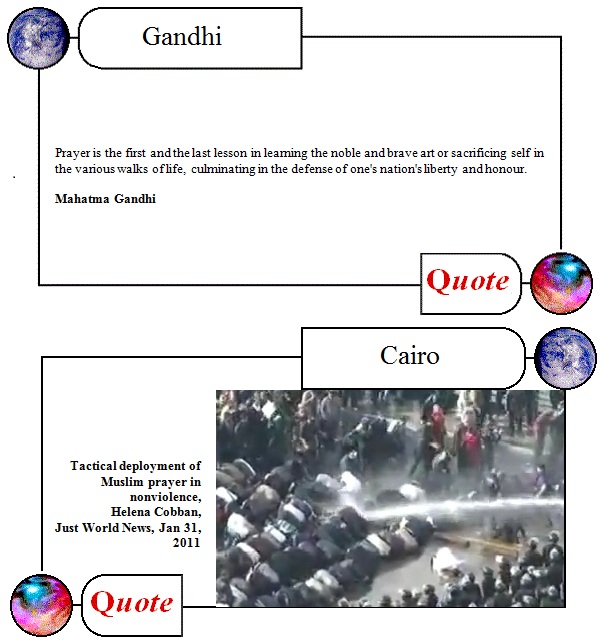
Egypt: prayer vs water cannons

Tuesday, February 1st, 2011

[ by Charles Cameron cross-posted from Brainstormers on the Web ]

For location / background, see Helena Cobban, Tactical deployment of Muslim prayer in nonviolence.

The image is from the middle of this YouTube video — you can see the prayers begin around the 3.25 mark, and the ending is also worth watching, as Cobban notes.

Egypt: tear-gas and hotels

Monday, January 31st, 2011

[ by Charles Cameron, cross-posted from Brainstormers on the Web ]

Here are two data-points to drop into the mind-pool as we think about current events in Egypt, the Middle East in general, and the way the world turns.

DoubleQuotes is my name for the format I’m using here, which I came up with a few years back on Brainstorms. The idea is simply to generate fresh insights by juxtaposing two thoughts – be they images, quotes, or even equations (I don’t have the technical chops for music or film clips yet) — in condensed, haiku-like form.

Think of them as pebbles dropped in a pond, watch the ripples…

[ note to Zenpundit readers: I’ll say more about Brainstorms and Brainstormers on the Web in a week or two, once the “on the Web” blog gets under way ]


Switch to our mobile site